Your body and your classroom tools send you little clues. A chair is for sitting, not tipping. Scissors are for cutting paper, not hair. A button on a screen may be fine to tap, or it may be one you should leave alone. Learning how to choose the safe thing helps you stay well and keep learning.
A safe choice helps protect your body, your feelings, and the things around you. An unsafe choice may hurt you, hurt someone else, or break something. Safe choices help you feel calm and ready. Unsafe choices can cause falls, cuts, spills, or scary surprises.
Safe means something is okay to do because it helps protect you. Unsafe means something is not okay to do because someone could get hurt or something could be damaged.
You do not have to know everything by yourself. If you are not sure, the safe choice is to stop and ask. That is a smart and safe choice.
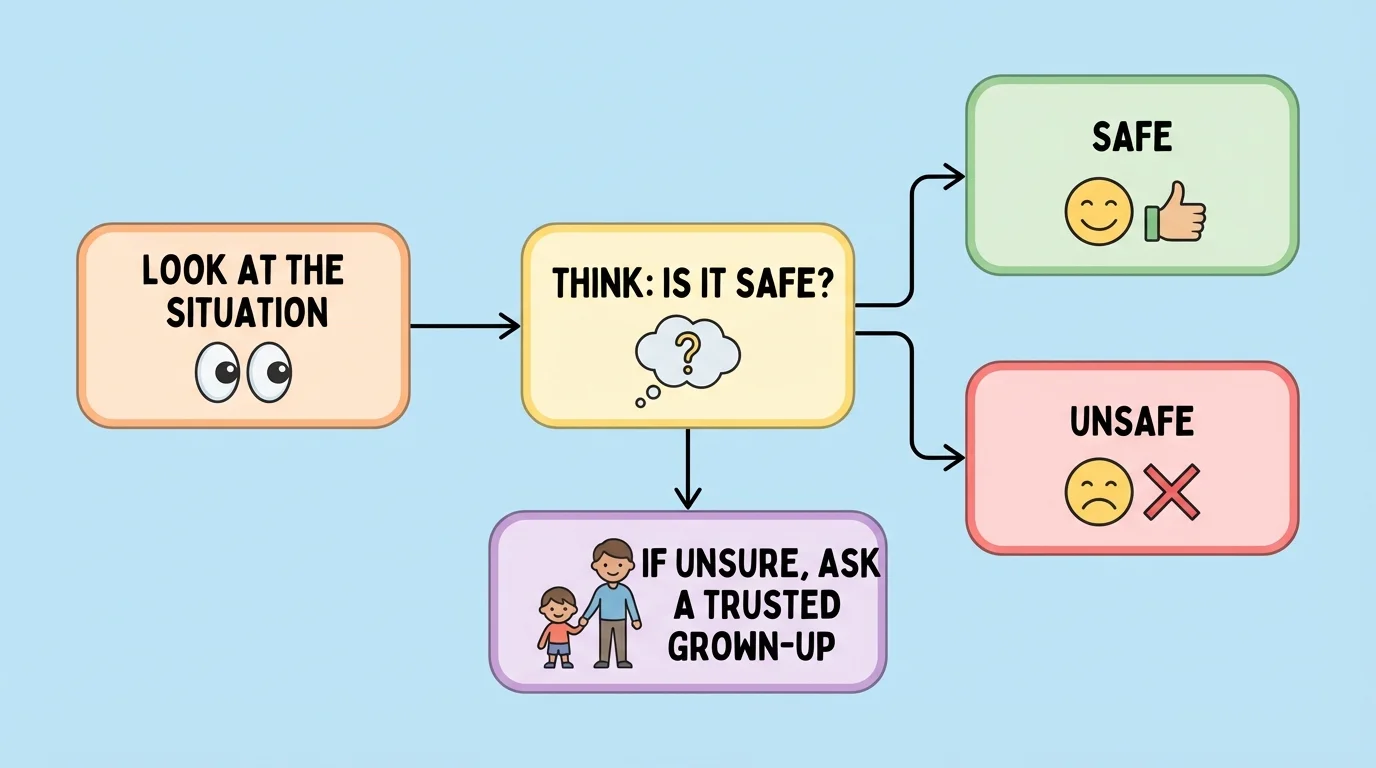
You can use a tiny decision routine every day. As [Figure 1] shows, first you look at what is happening. Next you think, "Will this keep me safe?" If you still do not know, you ask a trusted grown-up.
This helps with many little moments: picking up scissors, standing on a chair, clicking a new button on your tablet, or touching something on the floor. A short pause can stop a big problem.
Try This: Before you touch something new, put your hands in your lap for one moment. Then say, "Look, think, ask."
Careful decision-makers slow down. A safe choice often starts with stopping your body for a second. When you pause, you have time to notice danger and ask for help.
If you grab fast, run fast, or click fast, you may miss clues. Moving slowly and carefully is often safer than moving quickly and wildly.
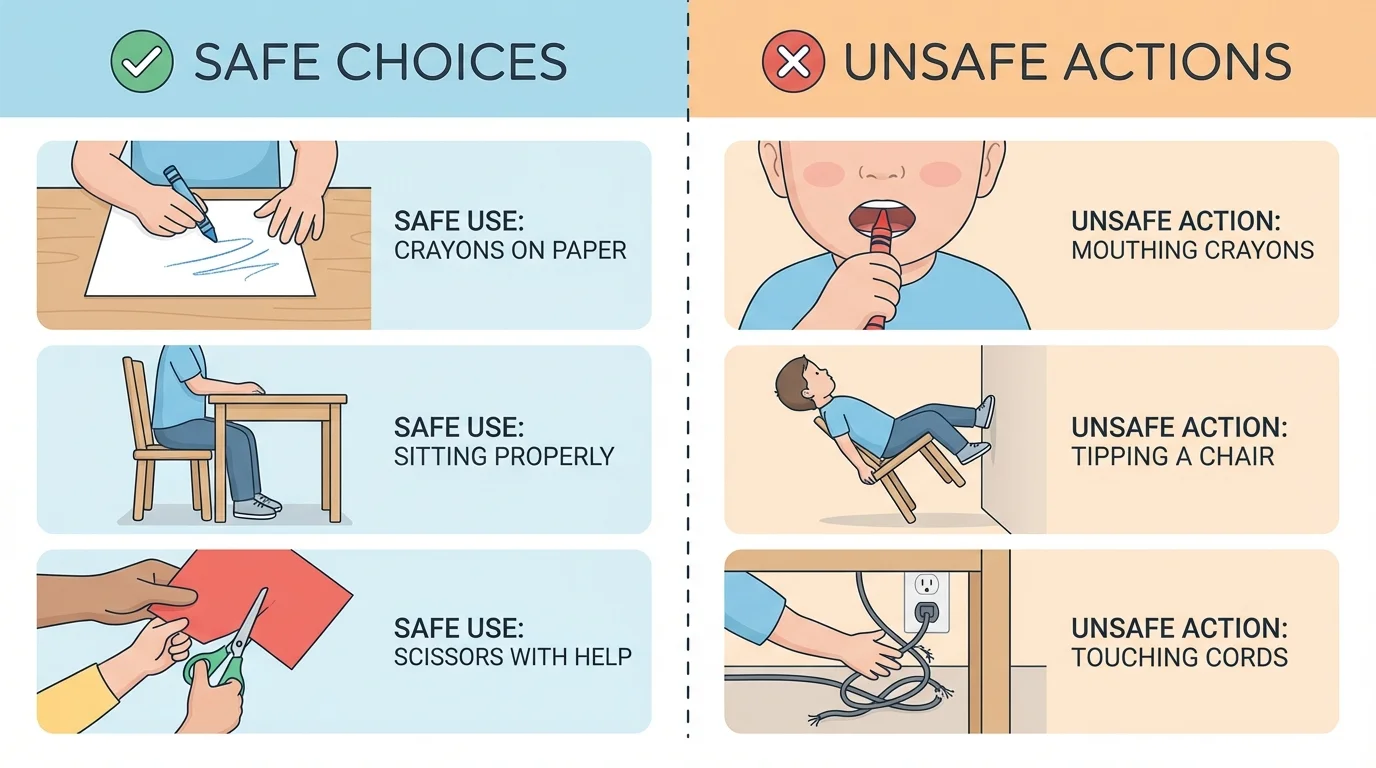
At home, your learning space has many tools. Those tools can be safe or unsafe depending on how you use them, as [Figure 2] illustrates. Crayons are safe on paper. Crayons in your mouth are unsafe. A chair is safe when all its legs stay on the floor. Leaning back too far is unsafe.
Scissors can be safe when a grown-up says it is time to use them and you hold them the right way. Pulling on cords, poking with pencils, or putting tiny items in your nose or mouth is unsafe. Drinks near a tablet or computer can also be unsafe because spills can ruin devices.
When you use school things the safe way, you can keep learning. When you use them the unsafe way, someone may get hurt, or the lesson may have to stop.
| Thing | Safe choice | Unsafe choice |
|---|---|---|
| Crayons | Color on paper | Put in mouth |
| Chair | Sit with feet down | Tip back |
| Scissors | Use with help when allowed | Wave around |
| Tablet | Tap only what a grown-up says | Click random buttons |
| Cord | Leave it alone | Pull or chew it |
Table 1. Examples of safe and unsafe choices with common learning tools at home.
Try This: Look at your learning space with a grown-up. Point to one thing that is safe to use and one thing you should only touch with help.
Your body needs safe choices too. Walking inside is usually safer than running. Sitting on the floor or chair carefully is safer than climbing on furniture. Gentle hands are safer than grabbing or pushing.
A trusted adult may give you a rule. A rule helps keep you safe. For example: "Feet stay on the floor." "Markers stay on the table." "We carry scissors carefully." These rules are there to protect you.
Your brain gets better at safe choices each time you practice them. Small habits, like walking instead of running indoors, help your body remember what to do.
If your body feels wiggly, you can make a safe change. Sit down. Put your hands in your lap. Take a slow breath. Then decide what to do next.
Online learning has safety choices too. Sometimes a screen shows a button, a video, or a message. The safe choice is to use only the apps, buttons, and links a trusted adult says are okay.
A trusted adult is a grown-up who helps keep you safe, like a parent, caregiver, or teacher helping online. If a screen asks for your name, picture, or microphone, ask first unless your grown-up already said yes. Just like with scissors or cords, screens need careful choices too.
Later, when you think about safe tools again, [Figure 2] still fits: the same object can be helpful when used the right way and unsafe when used the wrong way.
Sometimes something feels strange, confusing, or scary. In that moment, you do not have to guess. You can use a simple problem plan. As [Figure 3] shows, the steps are: stop, put your hands down, step back, and tell a trusted grown-up.
You can say, "I am not sure this is safe," or "Can you help me?" Those are strong words. They help adults know what you need right away.
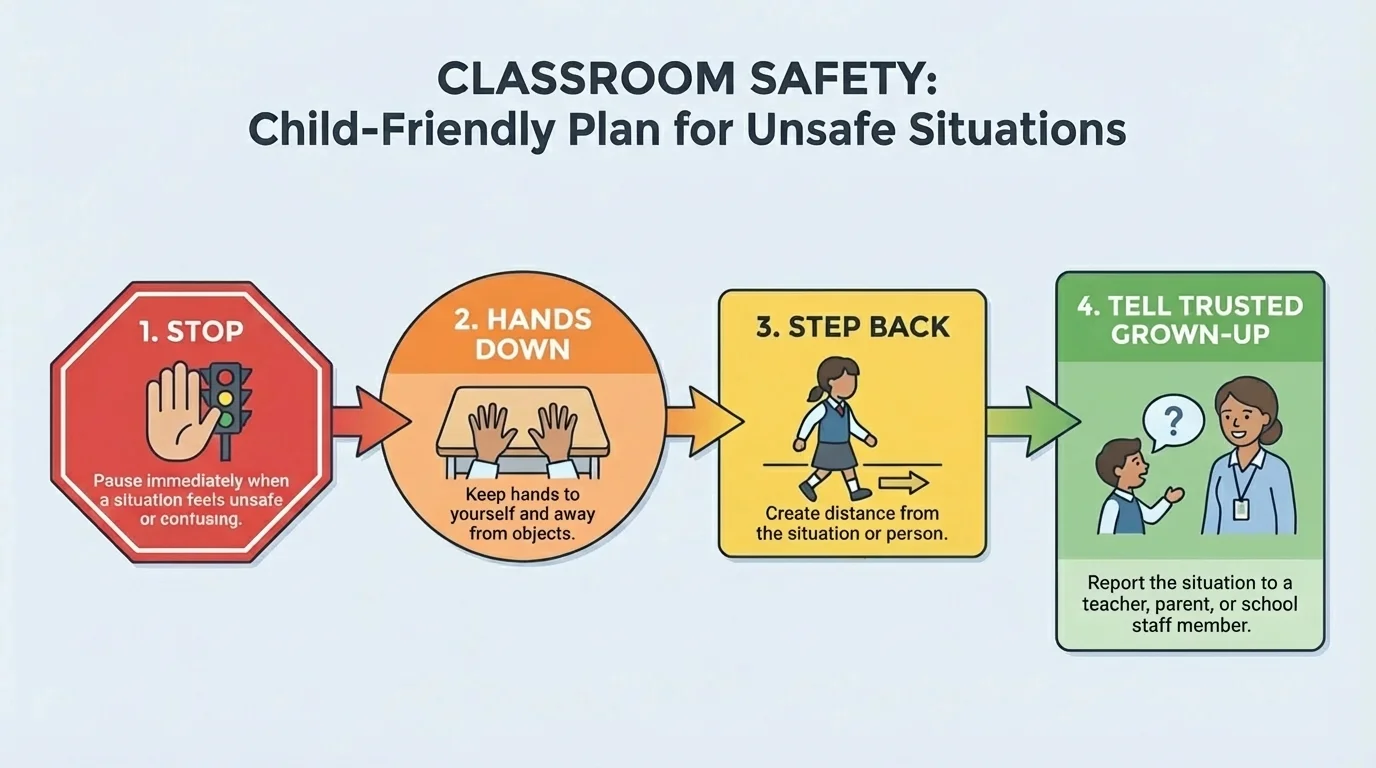
If a cup spills near a computer, stop and tell. If you find medicine, stop and tell. If you see a sharp tool, stop and tell. If a new pop-up appears on the screen, stop and tell. The safest choice is often getting help quickly.
Real-life examples
Step 1: You want to stand on a chair to reach something.
Look and think: chairs are for sitting. Standing may make you fall.
Step 2: Choose the safe action.
Keep your feet on the floor and ask a grown-up for help.
Step 3: Another moment: a new button pops up on the tablet.
Do not tap it. Ask a trusted grown-up first.
When you use the safety plan again later, [Figure 3] reminds you that stopping is the first brave step.
"When I am not sure, I stop and ask."
Safe choices help your day go smoothly. You stay ready to play, learn, and feel proud of yourself.
