What happens when your toy will not fit in the box, your shoe feels tricky to put on, or your crayon rolls under the couch? A problem can feel big for a moment, but often there is more than one idea you can try. You do not have to stop at the first try.
When you use problem solving, you notice what is wrong, think of an idea, and try it. If that idea does not work, you can try another one. This helps you grow strong, calm, and confident.
Problem means something is not working the way you want. Idea means a way you might fix it. Choice means the thing you decide to do. Trying more than one idea means you do not give up after only one try.
Sometimes the first idea works. Sometimes it does not. Both are okay. The important part is to keep thinking and choose another safe way.
If one block tower keeps falling, you might make the bottom wider. If that still does not work, you might use fewer blocks. If that still feels hard, you might ask a grown-up to help you look closely. That is trying more than one idea.
This skill is called flexible thinking. Flexible means your brain can change plans. Instead of saying, "It has to be this way," you say, "I can try a new way."
Your brain gets stronger when you try, check, and try again. Each new try helps you learn what works and what does not.
Trying another idea does not mean you failed. It means you are learning.
You can use a small plan when something is hard, as [Figure 1] shows. Small children do not need lots of steps. A short, easy path helps you know what to do next.
Step 1: Stop. Step 2: Look. Step 3: Think of one idea. Step 4: Try it. Step 5: Check. Step 6: If it did not work, try another idea or ask a grown-up.
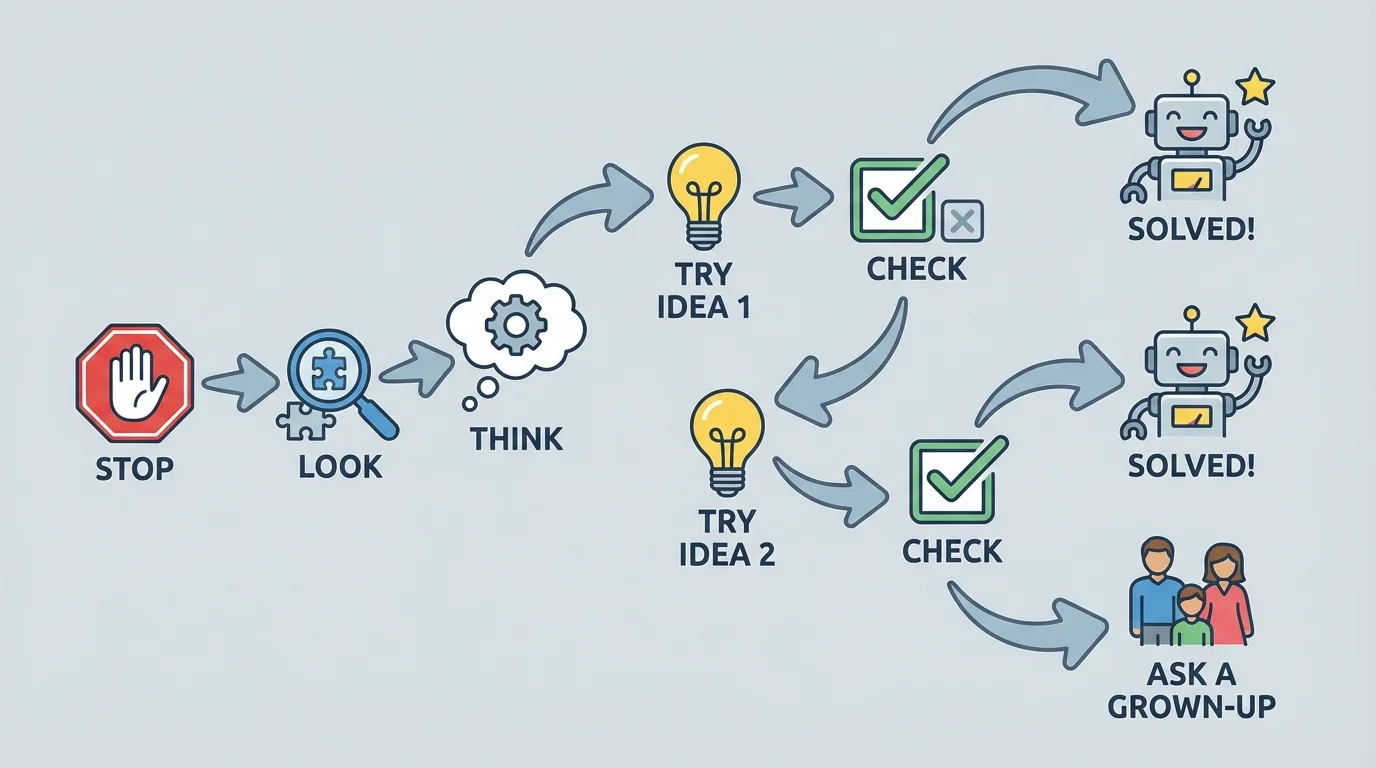
Here is what that sounds like: "My lid will not open. I stop. I look. I try turning it. Hmm, not yet. I try asking for help." That is smart problem solving.
Example: A puzzle piece will not fit
Step 1: Stop and look.
You notice the piece is turned the wrong way.
Step 2: Try one idea.
You turn the piece.
Step 3: Check.
It still does not fit.
Step 4: Try another idea.
You look for a different spot.
You worked on the problem by trying more than one idea.
The checking part matters. After you try something, ask, "Did that help?" If yes, keep going. If no, choose a new safe idea.
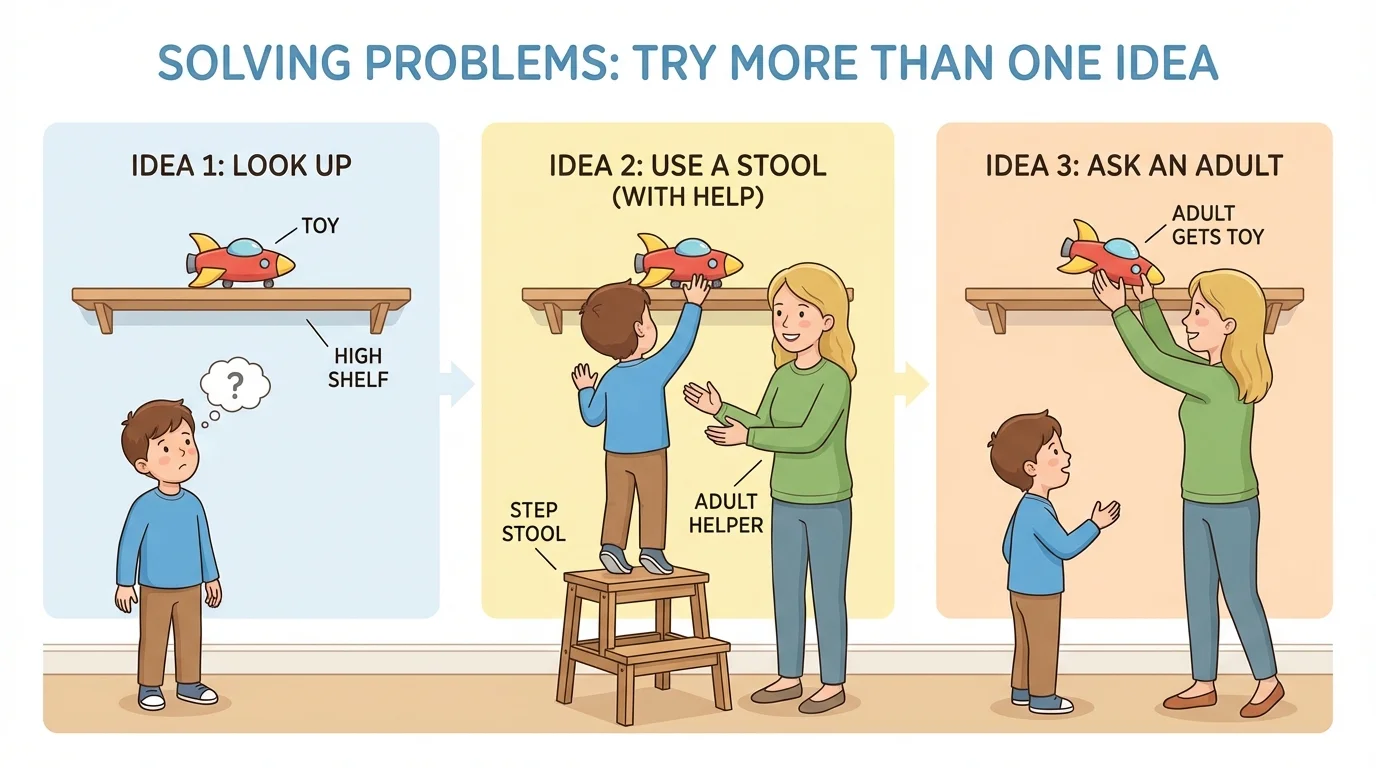
Many little problems happen at home every day, and [Figure 2] illustrates how one problem can have different safe answers. You might not reach something, you might spill water, or you might not know where a toy goes.
If a toy is too high, one idea is to look for it from another spot. Another idea is to ask a grown-up. Another idea might be to use a safe step stool with a grown-up right there. You do not climb on chairs or counters. Safe choices come first.
If juice spills, one idea is to get a towel. Another idea is to ask, "Can you help me clean?" If a sock feels wrong, one idea is to pull it off and try again. Another idea is to sit down first and use two hands.
If you are on a video call and cannot hear, you can try turning up the sound, checking if the device is muted, or telling a grown-up, "I need help." That is a real-life problem you can solve step by step.
One problem, many possible answers
Some problems have one best answer, but many small daily problems have several good answers. You are learning to notice choices, test them, and pick the one that works safely.
When you practice with little problems, you get ready for bigger ones later, like sharing space nicely, following directions, or fixing a small mistake.
Not every problem should be solved alone. Some ideas are not safe. You should stop and get a trusted grown-up if the problem involves sharp things, hot things, plugs, roads, medicine, or anything that makes your body feel unsafe.
A good choice is a safe thing to do. A safe choice might be moving back, keeping your hands to yourself, and saying, "Help, please."
Example: The snack bag is hard to open
Step 1: Try a safe idea.
Pull gently at the top.
Step 2: Try another safe idea.
Put the bag down and hold it with two hands.
Step 3: Make a safe choice if it is still hard.
Ask a grown-up instead of using something sharp.
Smart problem solvers know when to stop and ask for help.
You are still solving the problem when you ask for help. Asking for help is not giving up. It is one of your ideas.
Sometimes a problem makes you feel mad, sad, or stuck. That is normal. When feelings get big, your brain may need a short calm moment first, as [Figure 3] shows.
You can take a deep breath, count to 1, 2, 3, relax your hands, and try again. A calm body helps you think of a new idea.
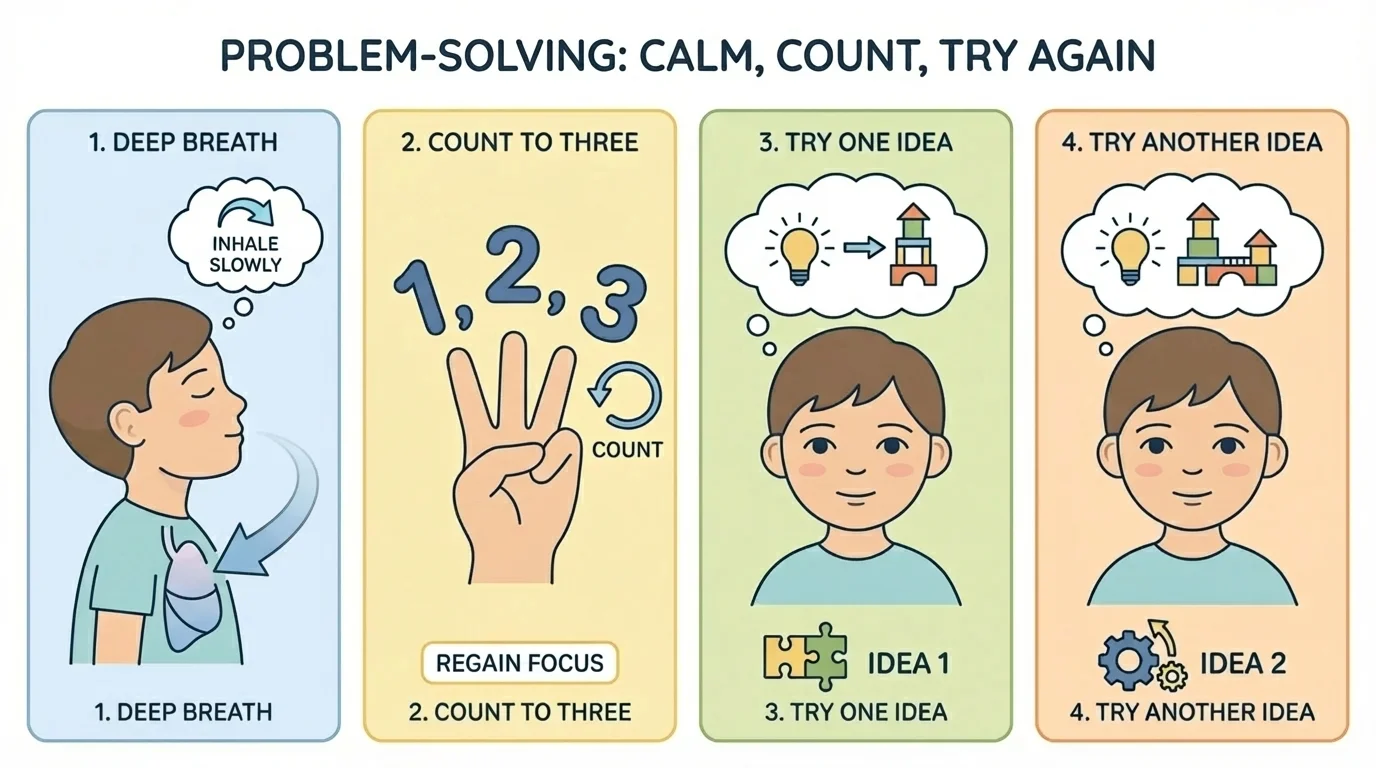
You can say, "I feel frustrated. I can pause." That is frustration getting smaller. Then you are ready to choose what to do next.
"I can try a different way."
Later, when you face another hard moment, remember the calm child in [Figure 3]. First calm down, then try a new idea.
You can use this skill during play, getting dressed, cleaning up, or doing something online with a grown-up. First try one safe idea. Then check. Then try another safe idea if needed.
The problem-solving path in [Figure 1] works for many little moments: shoes, toys, puzzles, snacks, and simple technology troubles. The safe toy example in [Figure 2] also reminds you that some answers are better because they are safe.
You do not need to know everything right away. Learning happens when you look, try, and try again.
Each time you solve a little problem, you build confidence. You learn, "I can think. I can choose. I can try again."
