Money is all around you. You may see it at a store, in a wallet, or in a small jar at home. Some money is shiny and round. Some money is flat and paper-like. Learning about money helps you make simple, smart choices as you grow.
Money can look different, as [Figure 1] shows. Some money is a coin. A coin is small, round, and made of metal. Other money is a bill. A bill is flat and made of paper-like material.
You might hear these names: penny, nickel, dime, and quarter. You might also see a $1 bill and a $5 bill. Coins and bills are not all the same size, color, or shape. That helps you tell them apart.
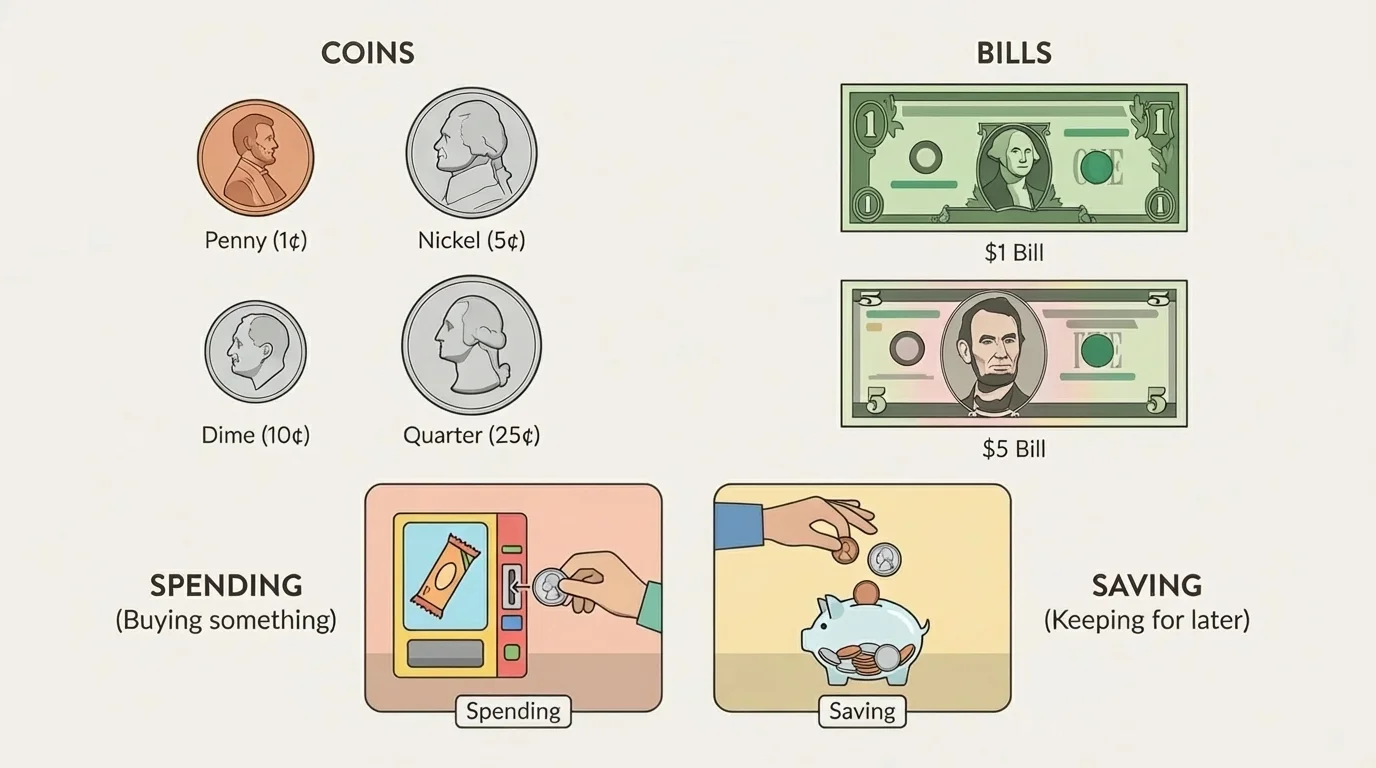
Spend means using money to buy something now.
Save means keeping money for later.
When you look closely, you can notice clues. A quarter is bigger than a dime. A bill is bigger than a coin. A grown-up can help you look at money and say each name out loud.
People use money to get things they need and things they want. You may use money for food, soap, or a toy. When you give money at a store or a market, you get an item back.
A store is a place where people buy things. At home, you may shop online with a grown-up or go to a local store with family. Money helps people make choices about what to get.
Some people keep coins in a small bowl, piggy bank, or jar so they can find them easily when they want to save or use them.
Not every choice is the same. Sometimes a person buys something right away. Sometimes a person waits. Waiting can help you keep your money for something else.
You can have two simple money choices, as [Figure 2] shows. You can spend money now, or you can save money for later. Both choices can be okay, but it helps to think first.
If you spend, you buy something now. If you save, you keep the money safe. Maybe you want a small snack today. That is spending. Maybe you want to put coins in a jar for a toy later. That is saving.
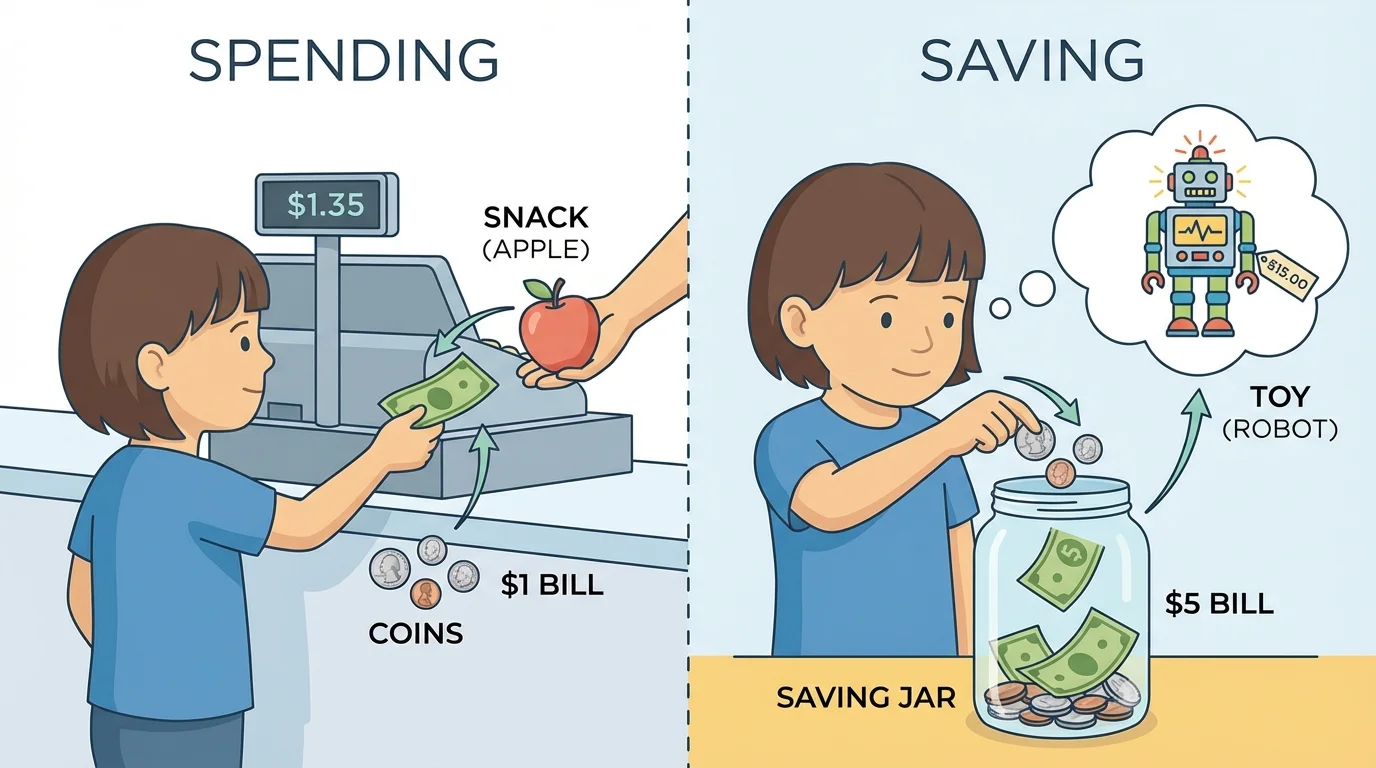
Saving is helpful when you want something that costs more, or when you want to wait and choose carefully. Even if you save only a little at a time, your money can grow. If you put in one coin, then one more coin, you have more than before: \(1 + 1 = 2\).
Simple money choice
You have one coin and you want stickers now, but you also want to save for a ball later.
Step 1: Stop and look at your choices.
You can use the coin now, or keep it.
Step 2: Ask what matters more.
Do you want something small now, or something bigger later?
Step 3: Choose.
If the ball matters more, put the coin in your saving jar.
This is a smart way to think before using money.
Later, when you think again about using money, [Figure 2] still helps you remember the two paths: buy now or keep it safe for later.
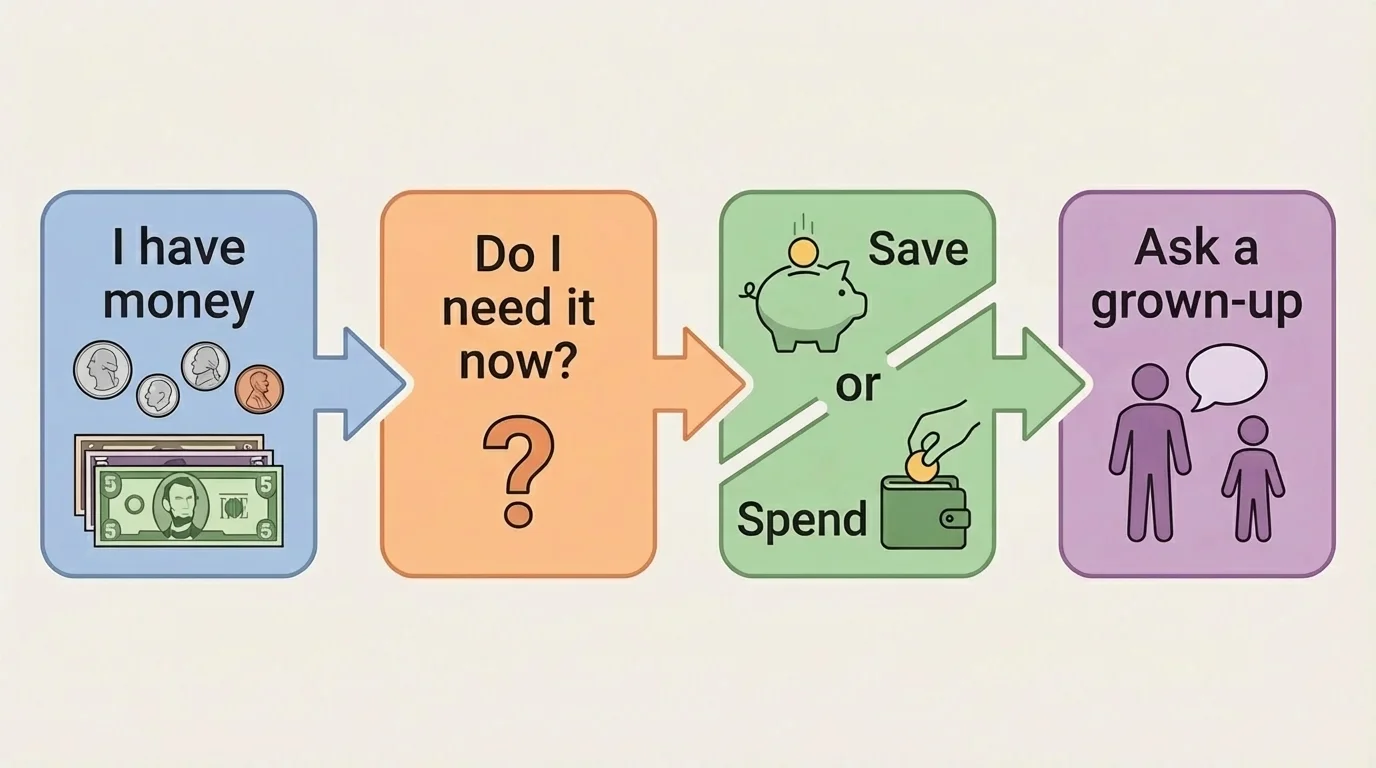
When money is in your hand, you do not have to rush. A simple decision path, shown in [Figure 3], can help you decide. You can use the same small routine each time.
Step 1: Look at the money.
Step 2: Say what you want to do.
Step 3: Ask, "Do I want it now or later?"
Step 4: Ask a grown-up for help if you are unsure.
Step 5: Spend or save.
Needs and wants
A need is something important, like food or warm clothes. A want is something you would like to have, like a toy or treat. Grown-ups often use money for needs first.
If you are choosing between two things, you can ask a grown-up, "Should I save this?" That is a strong money habit. Good money choices help you feel calm and ready later. Rushing can mean the money is gone before you are sure.
You can practice safe, careful money habits at home and in your community. Keep money in a small wallet, jar, or envelope. Hand money to a trusted grown-up if you are not holding it. Be gentle with bills so they do not rip.
When you buy something with a grown-up, use kind words. You can say, "Here you go," or "Thank you." Money choices are not only about objects. They are also about being careful, polite, and patient.
When you look back at the decision path in [Figure 3], you can remember that asking for help is part of being smart, not a sign that you did something wrong.
"Use it now, or keep it for later."
— A simple money rule
You do not need to know every money fact all at once. Start by noticing coins and bills, then practice small choices. Every time you stop, look, and think, you are building a strong life skill.
