Have you ever seen an adult bring home groceries, pay for a toy, or order something online? Money helps people get things they need and things they want. People usually earn money by doing work. That means they do a job to help others.
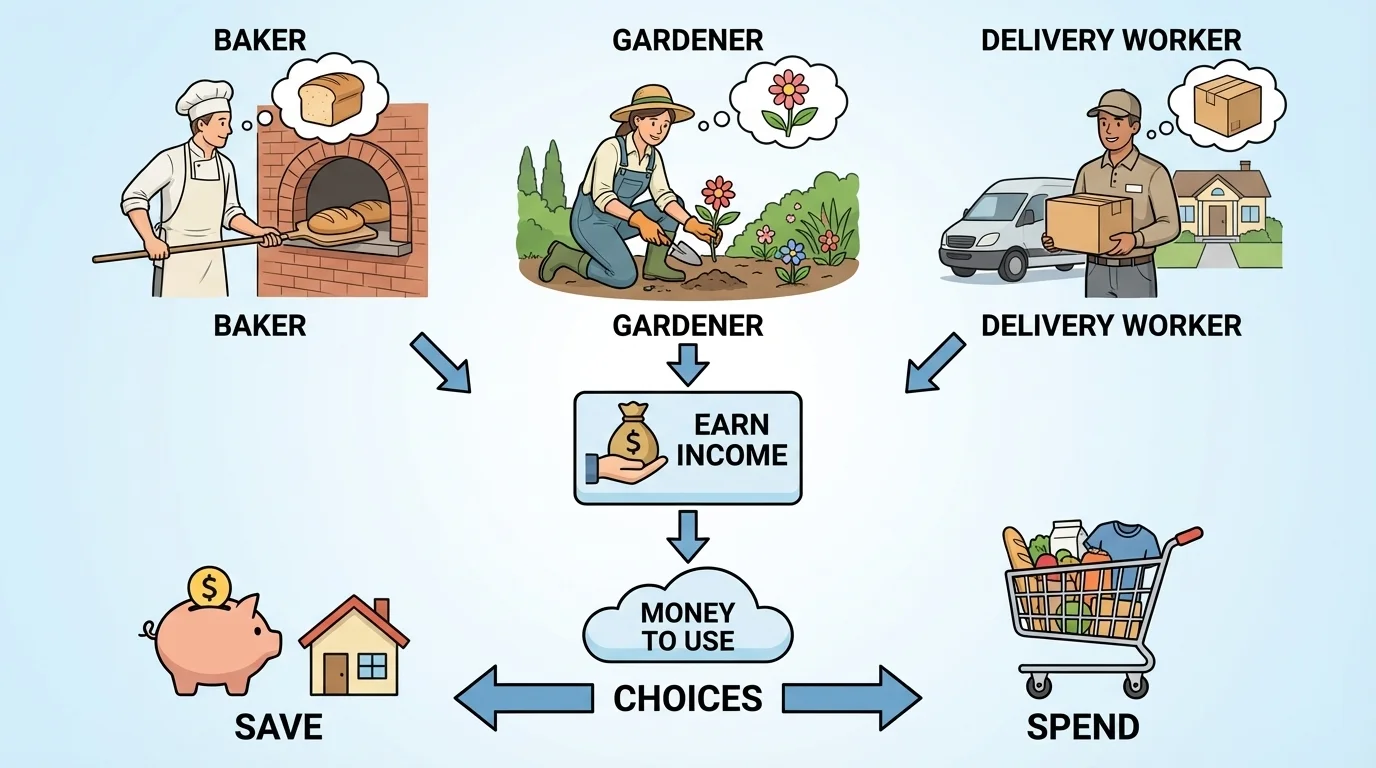
A job is work a person does. Some people cook food, fix cars, care for pets, grow plants, drive buses, make videos, or help sick people feel better. When people work, they can earn money for their time and effort, as [Figure 1] shows with different kinds of jobs.
Your family may earn money in different ways. One adult might work at home on a computer. Another might work in a store, a garden, a hospital, or a restaurant. The big idea is simple: people work, and work helps them earn money.
Earn means to get money because you did work. Money is what people use to pay for things.
Money is important because families use it for food, clothes, a home, and other things they need. If people do not plan carefully, they may not have enough for important things. Good choices with money help a family stay ready for everyday life.
Money can buy needs and wants. A need is something people must have, like food or warm clothes. A want is something nice to have, like a sticker book or a special snack.
You do not need to know big math to start learning money choices. A simple idea is enough: if you have one coin or a few coins, you may not be able to get everything. If a toy costs more than your coins, you may need to wait and save. For example, if you have $1 and the toy costs $3, then you still need more because \(1 + 1 + 1 = 3\).
Many families talk about money every day without using fancy words. Choosing between buying now and waiting until later is already a money skill.
Sometimes using money well means buying something important first. For example, a family might buy fruit and soap before buying a treat. That is a smart choice because needs come first.
When you have money, there are a few simple choices. You can spend it now, save it for later, or share some with someone else. These choices are easy to see in [Figure 2], where money goes into different jars.
Spend means using money to buy something. Save means keeping money for later. Share can mean giving money to help someone, buying a gift, or adding to a family giving jar.
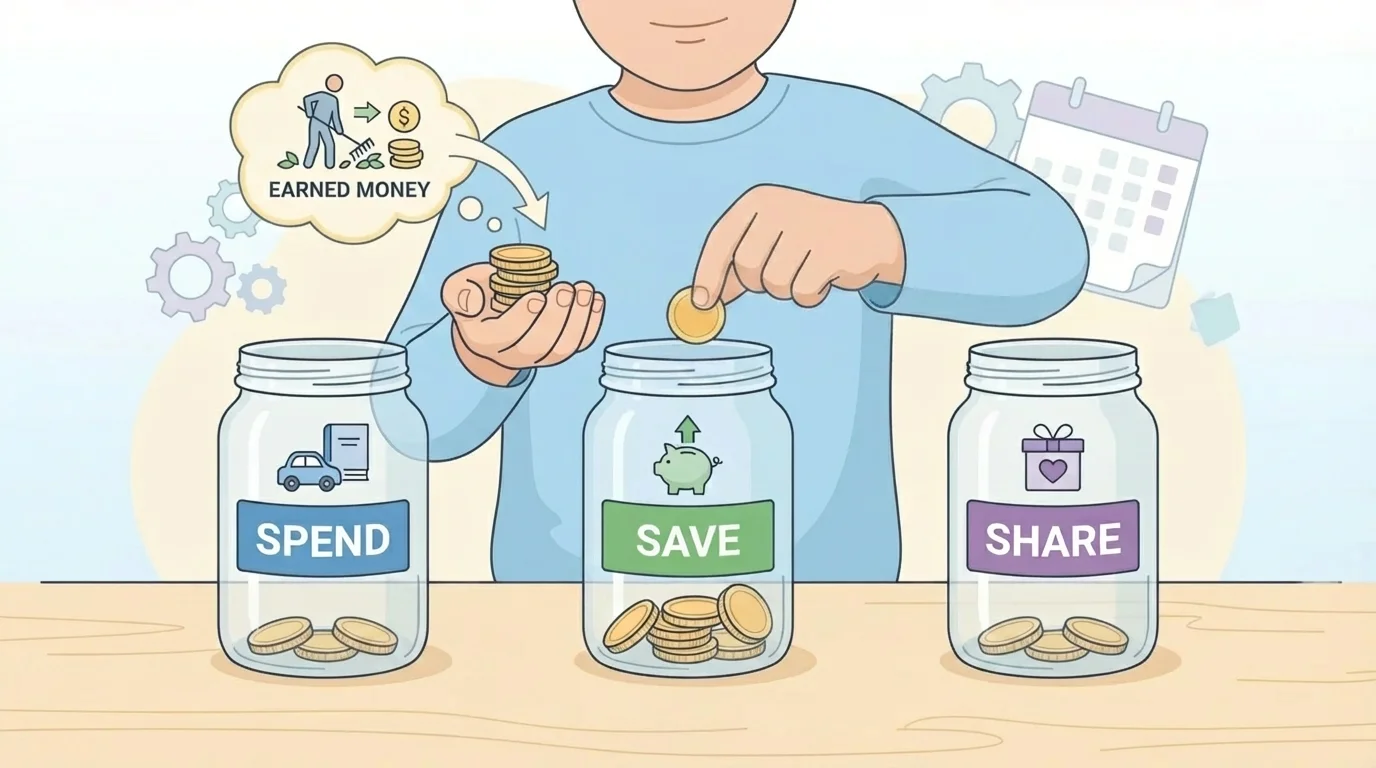
If you spend all your money right away, it is gone. If you save some, you may be able to get something later. If you share some, you can help others and feel kind. A good choice depends on what is needed right now.
Small choices add up
Even tiny money choices matter. Putting one coin in a save jar again and again can help you wait for something special. Choosing not to spend every coin right away helps you practice self-control.
Later, when you think again about the jars in [Figure 2], you can see that one coin can have different jobs. The same coin can be used to buy something now, wait for later, or help someone else. That is what making a choice means.
You can practice money skills with a trusted grown-up at home. Keep it simple and calm.
Step 1: Look at the money together. Maybe it is a few coins in a cup or money in a savings jar.
Step 2: Say the choices out loud: spend, save, or share.
Step 3: Ask, "Do I need this now, or can I wait?"
Step 4: Let the grown-up help you choose.
Step 5: Put the money in the right place.
Real-life example
You have $3 from helping put away laundry at home.
Step 1: You want a snack for $1.
You can spend $1 now.
Step 2: You also want a small toy for $3.
If you spend $1 first, then you have $2 left because \(3 - 1 = 2\).
Step 3: You decide what matters more today.
You might buy the snack now, or save all $3 for the toy later.
Both choices can be okay if a trusted grown-up helps you think about needs and wants first.
Some families use jars, envelopes, or small boxes. Some use an app or a note on a phone. The tool can be different, but the habit is the same: stop, think, and choose.
When money is used online, a grown-up should help. Never tap "buy" on a phone, tablet, or computer without asking. Some games and videos try to get people to spend quickly. Taking time helps you make safer choices.
You can also practice polite money words. You might say, "Can we talk about this before we buy it?" or "I want to save for later." These words show self-control and respect.
Waiting can feel hard, especially when you really want something. Taking a breath, asking for help, and thinking about later are all strong life skills.
People work hard to earn money, as you saw earlier in [Figure 1]. Because work takes time and effort, using money carefully shows respect for that work. Even little children can begin learning this by making small, thoughtful choices with a trusted adult.
