Sometimes your body gives you a clue before your words do. Your tummy may feel tight. Your face may feel hot. You may want to move away or hide. Those feelings matter. If touch, words, or behavior do not feel okay, you can ask for help.
Your boundary is the space and safety around your body and feelings. You are allowed to like some things and not like other things. You are allowed to want space. You are allowed to ask for help.
Sometimes something feels good, like a kind high-five you want. Sometimes something feels not okay, like a hug you do not want, a loud mean voice, or someone acting in a way that scares you. If it feels yucky, scary, confusing, or too much, that is important.
Uncomfortable means something does not feel safe, kind, or okay to you. It might be touch on your body, words someone says, or behavior someone does.
Trusted adult means a grown-up who listens, helps, and works to keep you safe.
You do not have to figure everything out by yourself. A grown-up can help you understand what happened and what to do next.
Uncomfortable feelings can happen from touch, words, or actions, as [Figure 1] shows. Touch might be a tickle that does not stop, a hug you do not want, or someone picking you up when you want to get down. Words might be yelling, teasing, threats, or a person saying something that makes you feel small or scared.
Behavior is what someone does. It might be someone getting too close, blocking your way, showing you something on a phone or tablet that feels wrong, or asking you to keep a secret about something that made you uncomfortable. Uncomfortable can happen at home, during a play activity, with a babysitter, at a park, in a club, or on a video call.
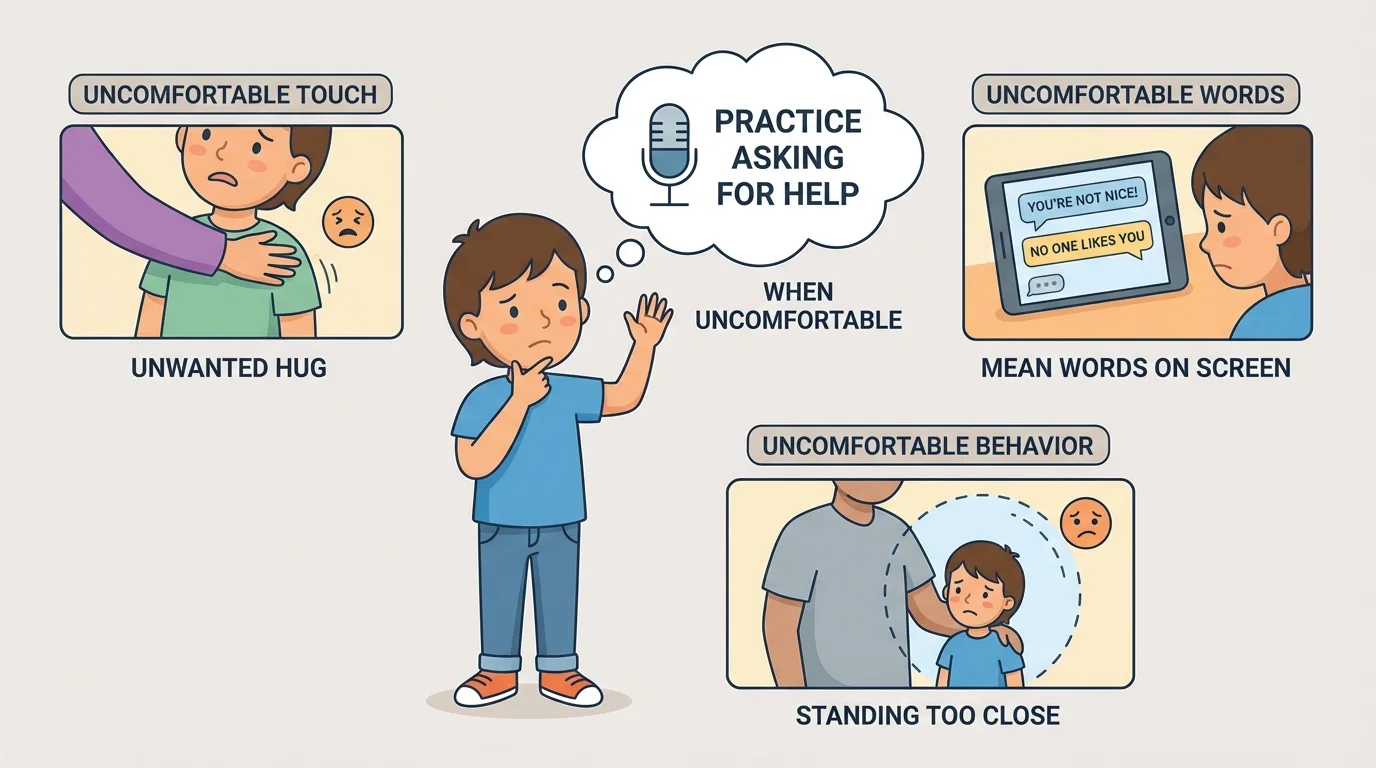
Not every uncomfortable moment is dangerous, but every uncomfortable moment matters. If your body says, "I do not like this," you can get help.
Young children often notice safety with body signals first. A fast heartbeat, a frown, hiding, freezing, or moving away can all be clues that something does not feel right.
Even if the person is someone you know, you can still ask for help. Being familiar does not make uncomfortable behavior okay.
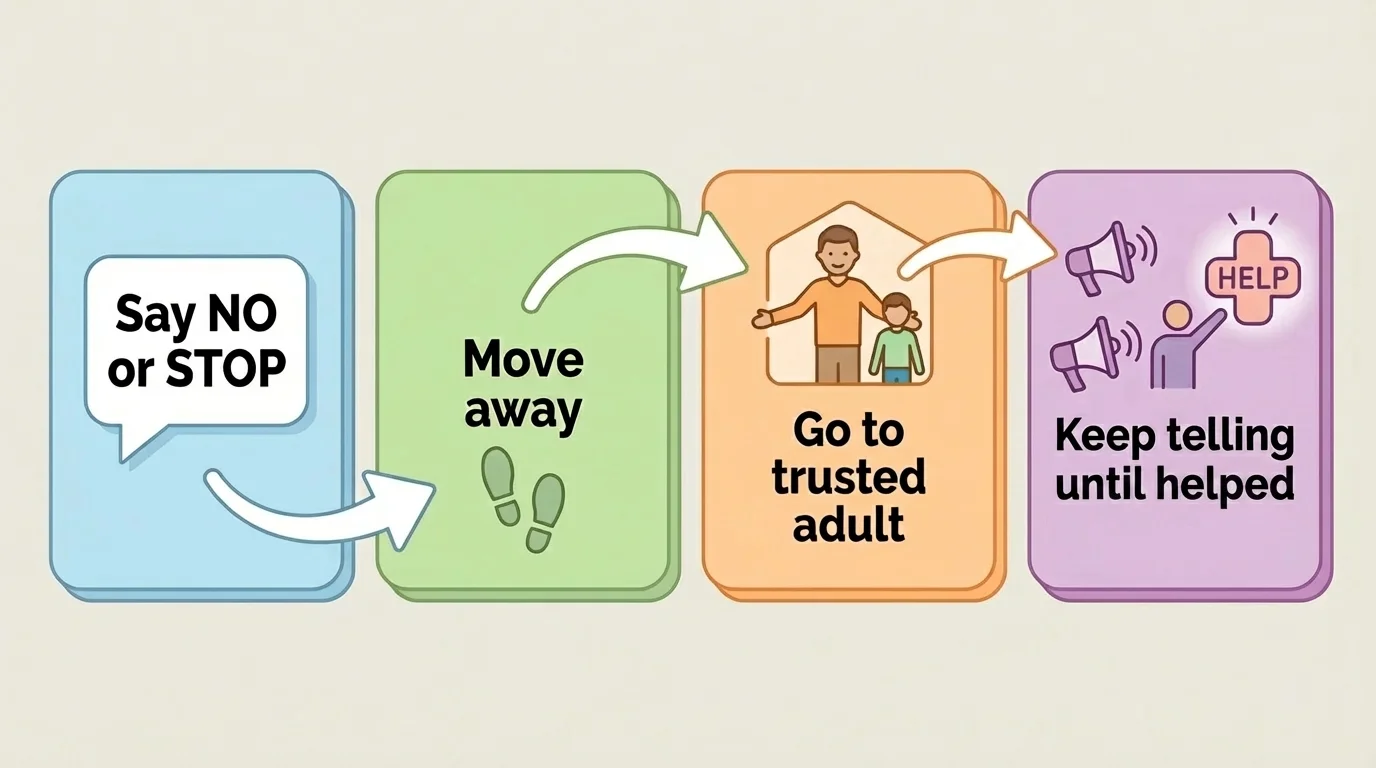
When something feels wrong, there are simple safety steps, and [Figure 2] puts them in order. You can use a big voice or a calm voice. The important part is getting safe and getting help.
Step 1: Say what you need. You can say, "No." "Stop." "I don't like that." "Move back." "I need help."
Step 2: Move away if you can. Go to a safer place near a trusted adult.
Step 3: Tell a trusted adult right away.
Step 4: Keep telling until someone helps you.
You do not need fancy words. Short words are strong words. "Stop." "No." "Help." Those words work.
Words you can use in the moment
Step 1: If someone tries to hug you and you do not want it, say, "No thank you. I want space."
Step 2: Move your body closer to a safe grown-up.
Step 3: Tell the grown-up, "That hug felt uncomfortable. I need help."
As shown again in [Figure 2], moving away and telling are just as important as using your words. If you freeze and cannot talk, you can still go to a trusted adult. The job is to get safe, not to be perfect.
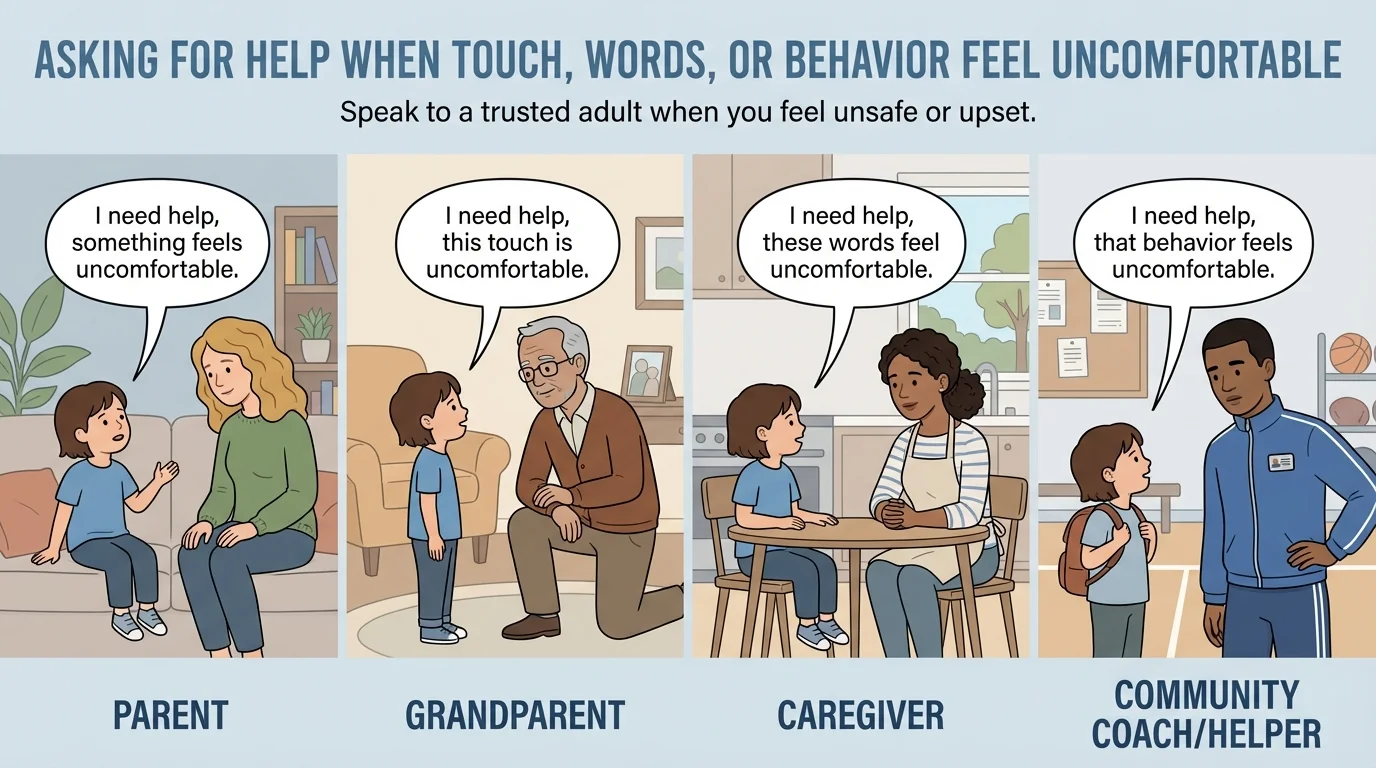
A trusted adult is someone who listens and helps, and [Figure 3] gives examples. This might be your parent, grandparent, caregiver, aunt, uncle, family friend, neighbor you know well, doctor, or a coach or leader from an activity.
You can think of more than one trusted adult. That is helpful because sometimes one adult is busy or does not understand right away. If the first person does not help, tell another adult. Keep telling until someone helps you feel safe.
If an adult says, "It's nothing," but you still feel upset or unsafe, tell another adult. Your feelings still matter.
Keep telling until you get help
Sometimes children worry about being rude, getting in trouble, or hurting someone's feelings. Safety comes first. Telling again is not tattling when you are trying to stay safe. It is a smart safety choice.
Like the helpers shown in [Figure 3], trusted adults should listen, believe you, and help make a plan.
You can learn a few short sentences and keep them ready. When you already know the words, it can be easier to say them.
Try saying these kinds of words in a strong, clear voice: "Stop." "No." "I need space." "I don't like that." "Please help me." "I want my grown-up." "That felt uncomfortable."
It is also okay to ask questions. You can say, "What are you doing?" or "Why are you saying that?" Sometimes asking a question helps you get ready to move away and get help.
"My body belongs to me, and I can ask for help."
You never have to smile or pretend to like something that feels wrong. Being polite is nice, but being safe is more important.
Uncomfortable things can happen on screens too, and [Figure 4] shows the safest next move: get a trusted adult right away. Maybe someone says mean words in a game, asks to see something private on a video call, sends a strange picture, or tells you not to tell your grown-up.
If that happens, stop looking if you can, put the device down, and go get help. Show the screen to your grown-up. Do not worry about fixing it by yourself.
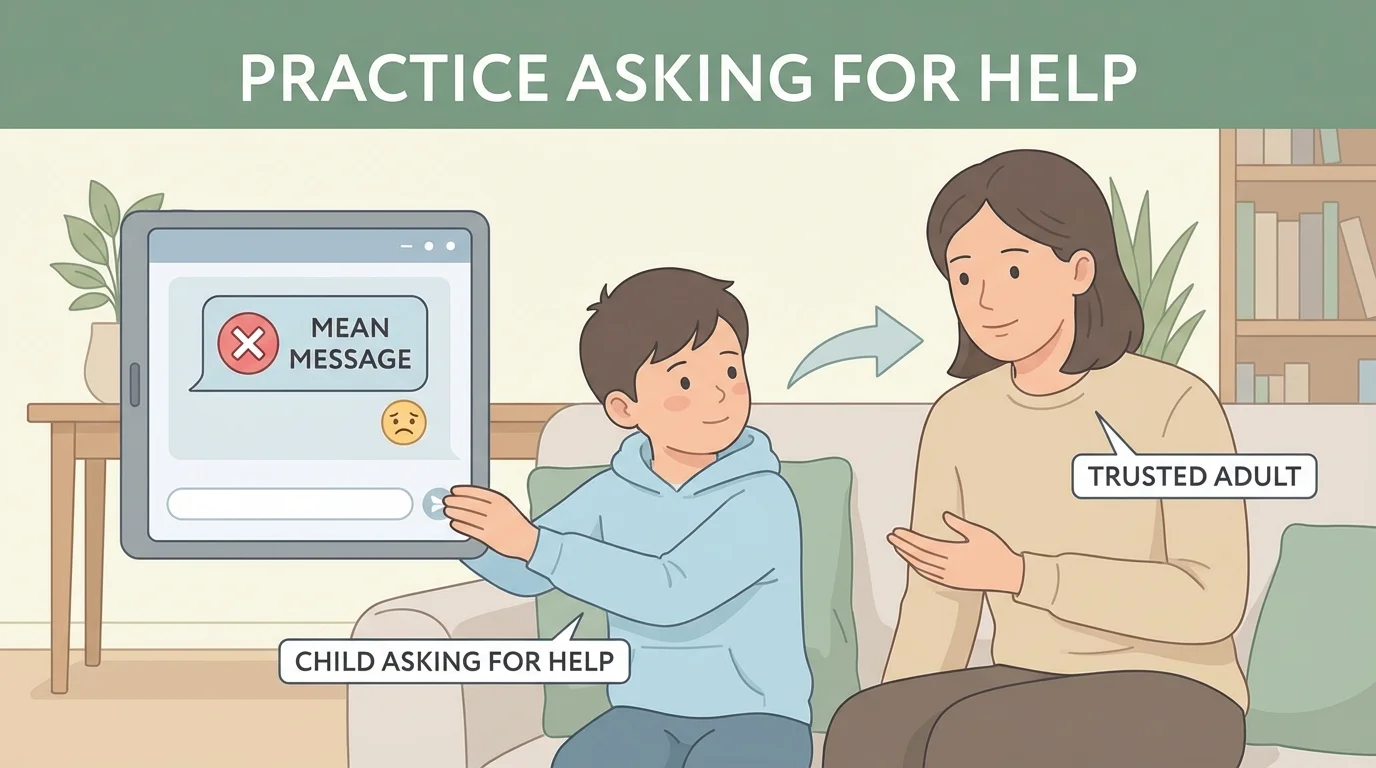
You can say, "This popped up and I don't like it," or "Someone said something weird on my screen." Those are good words to use when asking for help.
Later, when you talk about screen safety again, [Figure 4] reminds you that showing the device to an adult is often the fastest way to get help.
If someone tells you to keep an uncomfortable touch, word, or action a secret, that is a big clue to tell a trusted adult. Safe grown-ups do not ask children to hide things that make them feel scared or confused.
It is not your fault if someone else makes you uncomfortable. You are not being bad by saying no. You are not causing trouble by asking for help. The grown-ups around you are supposed to help keep you safe.
Real-life examples
Example 1: A neighbor wants a hug, but you do not want one. You say, "No thank you. I want space," and stand by your caregiver.
Example 2: Someone on a video chat says words that feel scary. You leave the screen and tell your parent, "I need help. That felt bad."
Example 3: A person keeps tickling after you said stop. You say, "Stop," move away, and tell a trusted adult right away.
When children tell, adults can step in sooner. That helps stop the behavior and helps children feel calmer and safer.
You deserve kind touch, kind words, and respectful behavior. If something feels uncomfortable, ask for help right away.
