What happens when milk spills, a toy is left on the floor, or someone taps a button on a tablet? Small things can become big learning moments. Every day, you can make strong choices by being honest, following rules, and helping fix little problems.
These skills help people trust you. They also help your home feel calm and safe. When you tell the truth, adults know they can believe your words. When you follow rules, people stay safer. When you take responsibility, you show that you can help make things better.
Honesty means saying what is real and true. Rules are directions that help people know what to do. Responsibility means doing your part and helping with what you did.
Tell the truth means saying what really happened.
Follow rules means doing the safe and kind thing people expect.
Take responsibility means helping fix a problem, even if it was an accident.
These are not just big-kid skills. You can use them when you play at home, join a video call, help in the kitchen, or visit a park with your family.
[Figure 1] Sometimes telling the truth feels hard, especially if you worry that someone may feel upset. But truth helps problems get solved. A child tells a caregiver about spilled blocks right away, and that honest choice helps the adult know what happened and how to help.
If you knock over crayons, you can say, "I dropped the crayons." If you tear paper by accident, you can say, "I tore it." If you touch something you were not supposed to touch, you can say, "I touched it. I need help."
Telling the truth does not mean you are bad. It means you are brave. A mistake can be fixed more easily when you use true words.
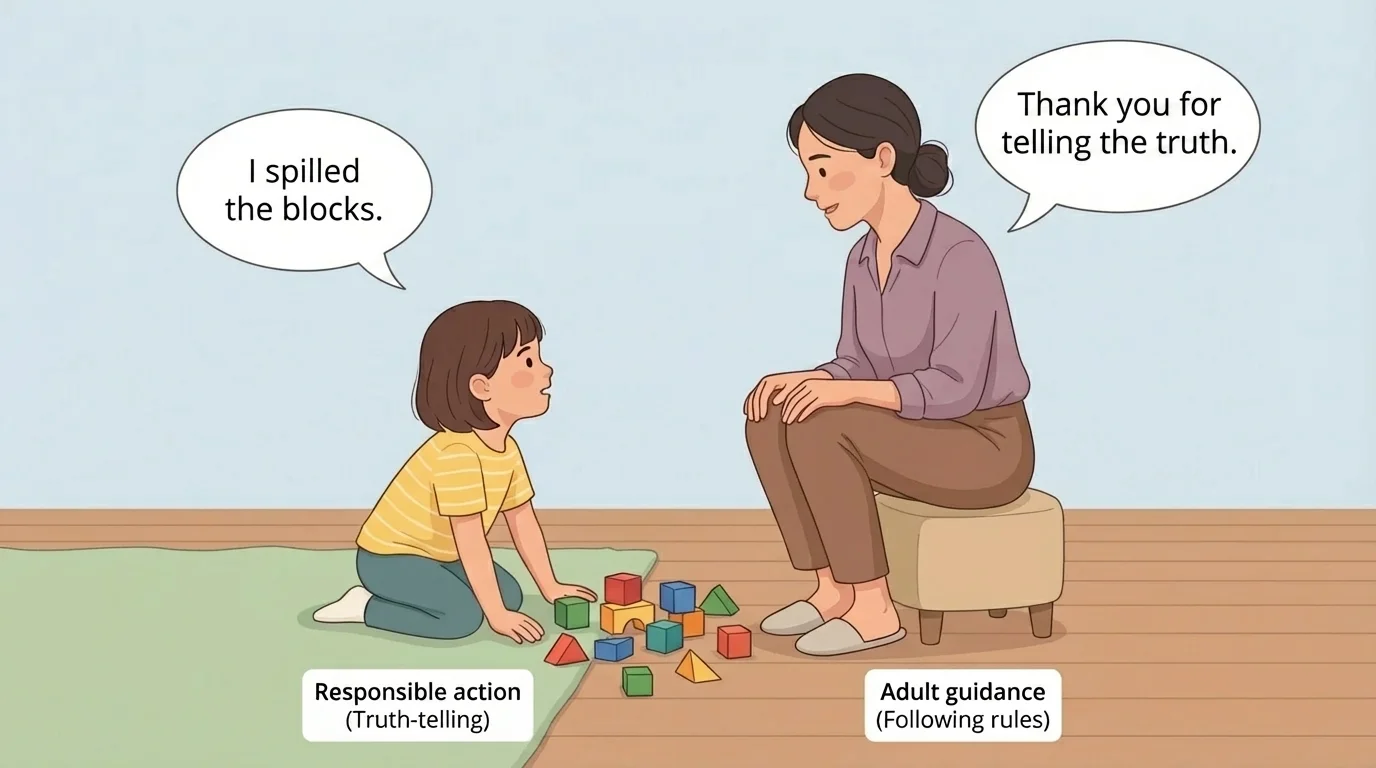
When people do not tell the truth, others may feel confused. An adult may not know how to help. Trust can weaken. But when you tell the truth, trust grows.
Small truth example
You were drawing and a marker made a line on the table.
Step 1: Stop and look.
See what happened.
Step 2: Say the truth.
"I made a mark on the table."
Step 3: Ask to help.
"Can I help clean it?"
That is a strong choice. It is much better than hiding the marker or blaming someone else.
[Figure 2] Rules are important because they protect people. Simple rules like putting toys away, holding an adult's hand near a street, and asking before tapping on a device help keep life safe and smooth.
Some rules are for safety. For example: keep small objects out of your mouth, walk inside the house, and stay near a trusted adult outside. Some rules are for kindness. For example: use gentle hands, wait for a turn, and listen when someone is speaking.
Some rules are for screens and online time. You may use a tablet, watch a video, or wave to family on a video call. A good rule is to ask a grown-up before clicking, typing, or sharing a picture.
Rules are not there just to stop fun. Rules help everyone know what to do. That makes play, meals, trips, and online time easier.
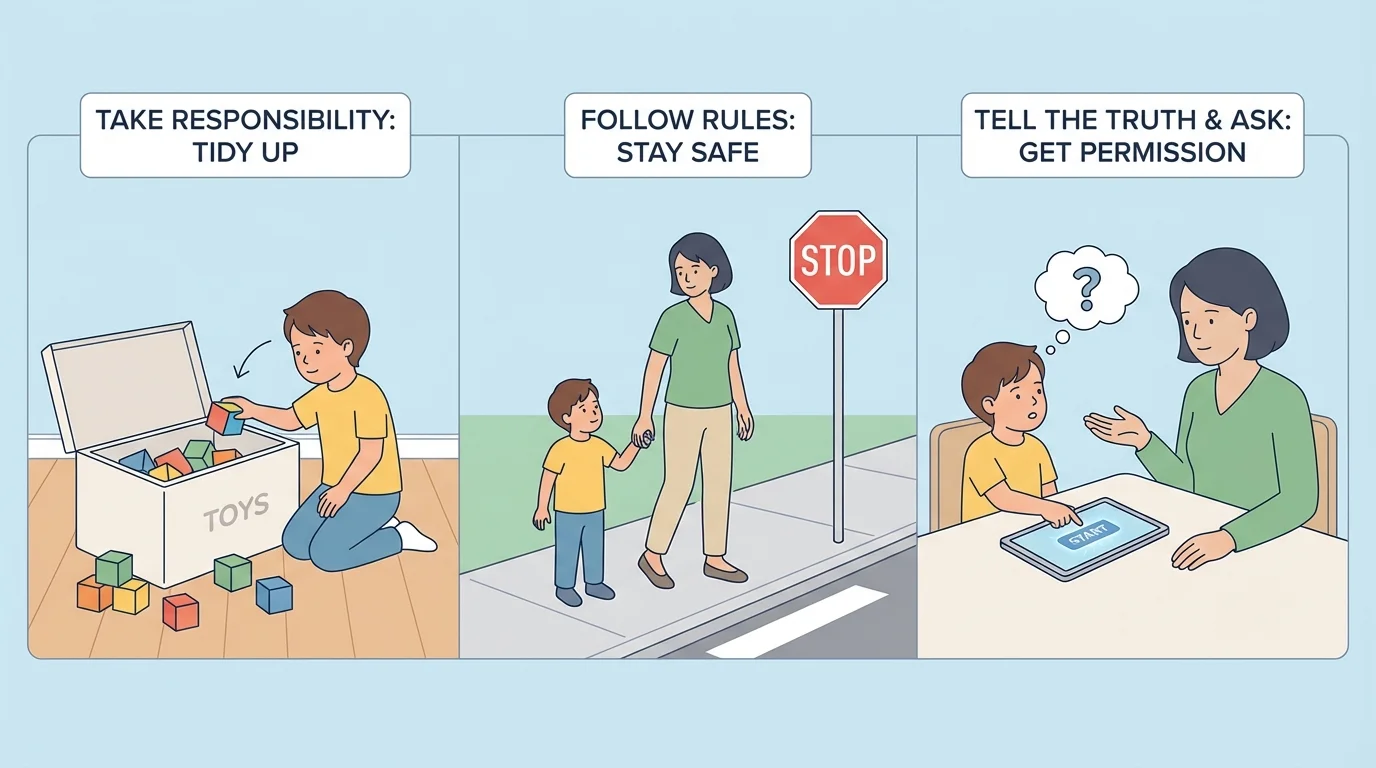
When rules are ignored, someone can get hurt, a mess can grow, or someone's feelings can be hurt. When rules are followed, people feel safer and calmer.
| Rule | Why it helps |
|---|---|
| Put toys back | Stops trips and keeps the room neat |
| Ask before clicking online | Keeps devices and information safe |
| Use gentle hands | Protects bodies and feelings |
| Stay with a trusted adult outside | Keeps you close and safe |
Table 1. Examples of simple rules and why they matter.
[Figure 3] Responsibility means noticing what you did and helping make it better. The child wipes a spill, puts back a toy, and says sorry. Those small actions show care.
You can take responsibility even when something was an accident. If water spills, get a towel with help. If you leave blocks on the floor, pick them up. If you grab a toy, give it back and use kind words.
Saying "sorry" is part of responsibility, but it is not the only part. Helping fix the problem matters too. A true apology sounds like this: "I am sorry. I will help."
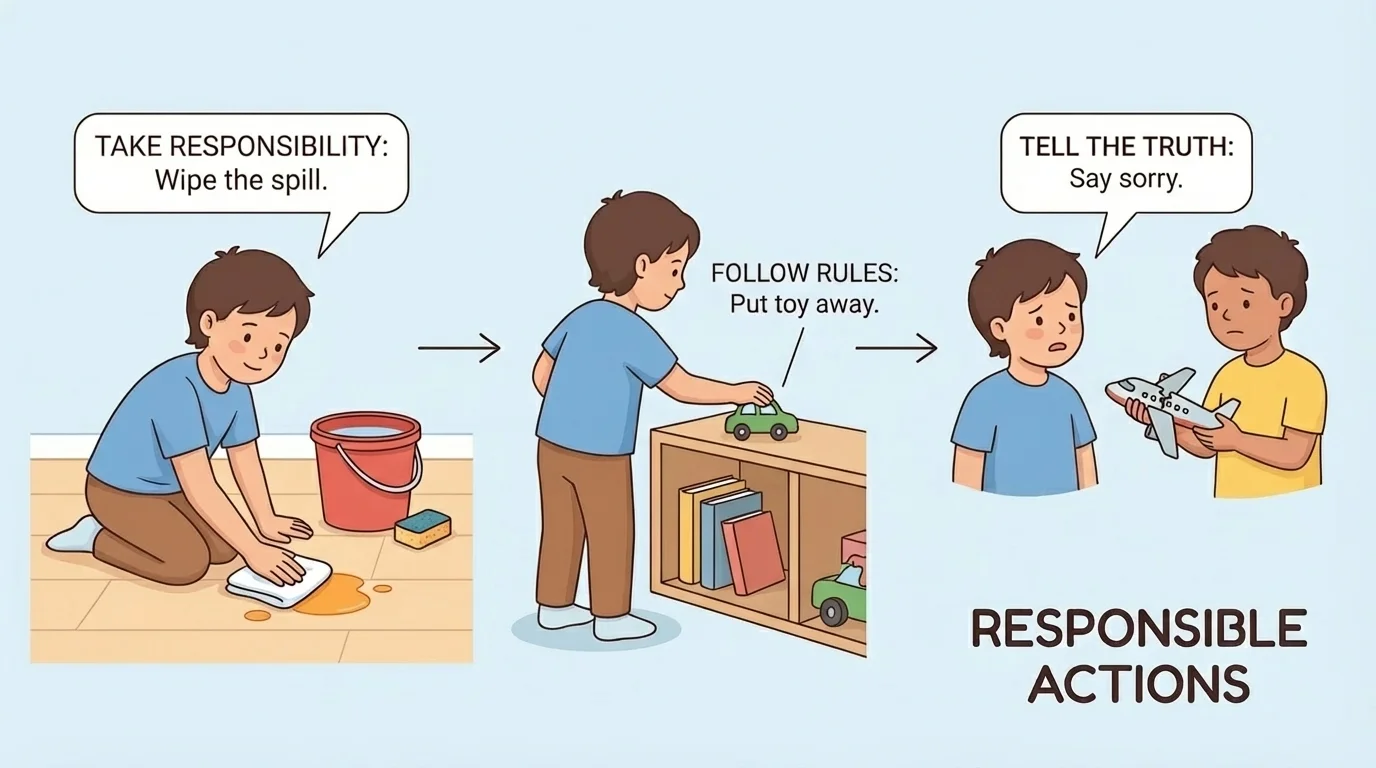
Later, the same idea from [Figure 1] still matters: when you tell the truth first, it becomes easier to take responsibility next. Honest words and helpful actions work together.
Small actions build character
Every time you tell the truth, follow a rule, or help fix a mistake, you practice being trustworthy. Character grows from many little choices, not just one big moment.
A person who takes responsibility may not be perfect, but they are learning to care for people, places, and things.
Sometimes it helps to know the words ahead of time. You can practice short, clear sentences.
To tell the truth: "I did it." "It was an accident." "I need help."
To follow a rule: "I will wait." "I will use gentle hands." "I will ask first."
To take responsibility: "I am sorry." "I can clean it up." "I can put it back."
What to do when a small problem happens
Step 1: Stop your body.
Take a quiet moment.
Step 2: Tell the truth.
Say what happened in simple words.
Step 3: Listen to the adult.
The adult helps you know what to do next.
Step 4: Help fix it.
Clean, return, or try again.
These steps work at home, at the store with your family, during a community activity, or while using technology with adult help.
Sometimes children hide mistakes because they feel scared or embarrassed. That feeling can happen to anyone. You can still make a good choice.
Even adults make mistakes. What matters most is telling the truth and trying to fix the problem.
If you are worried, find a trusted grown-up. You can say, "I need to tell you something." Then use true words. The sooner you speak, the sooner you can get help.
As [Figure 2] reminds us, rules are there to guide you before problems happen, and as [Figure 3] shows, responsibility helps after a problem happens. Both are ways of caring for yourself and others.
"When you make a mistake, tell the truth and try to make it right."
That is a strong way to live. Small honest choices today help you become a kind and dependable person tomorrow.
