Have you ever had one toy that two people wanted at the same time? That can feel tricky. The good news is that you can learn simple ways to be kind, fair, and helpful. When you share, wait for a turn, and care about another person's feelings, play goes better and people feel safe with you.
Fairness means people are treated in a kind and honest way. It does not always mean everyone gets the exact same thing. Sometimes it means everyone gets a turn. Sometimes it means everyone gets what they need. Care means noticing how someone feels and trying to help.
Sharing means letting another person use or have some of what you have. Taking turns means one person goes, then another person goes. Working together means doing something with another person and helping each other.
When you are fair and caring, you help people feel included. That means no one feels left out on purpose. This matters at home, on a video call, at the park, with family, or with friends in your community.
Sometimes sharing is easy. Sometimes it is hard. You may want to keep the toy, the crayons, or the last cookie. [Figure 1] shows that being fairness means thinking, "How can we both have a good time?" Fair sharing can mean giving each person some items or letting one person use something first and the other person next.
You can share toys, books, dress-up clothes, puzzle pieces, play dough, or art supplies. You can also share space and attention. If you are on an online call with family, sharing means letting another person talk and not shouting over them.
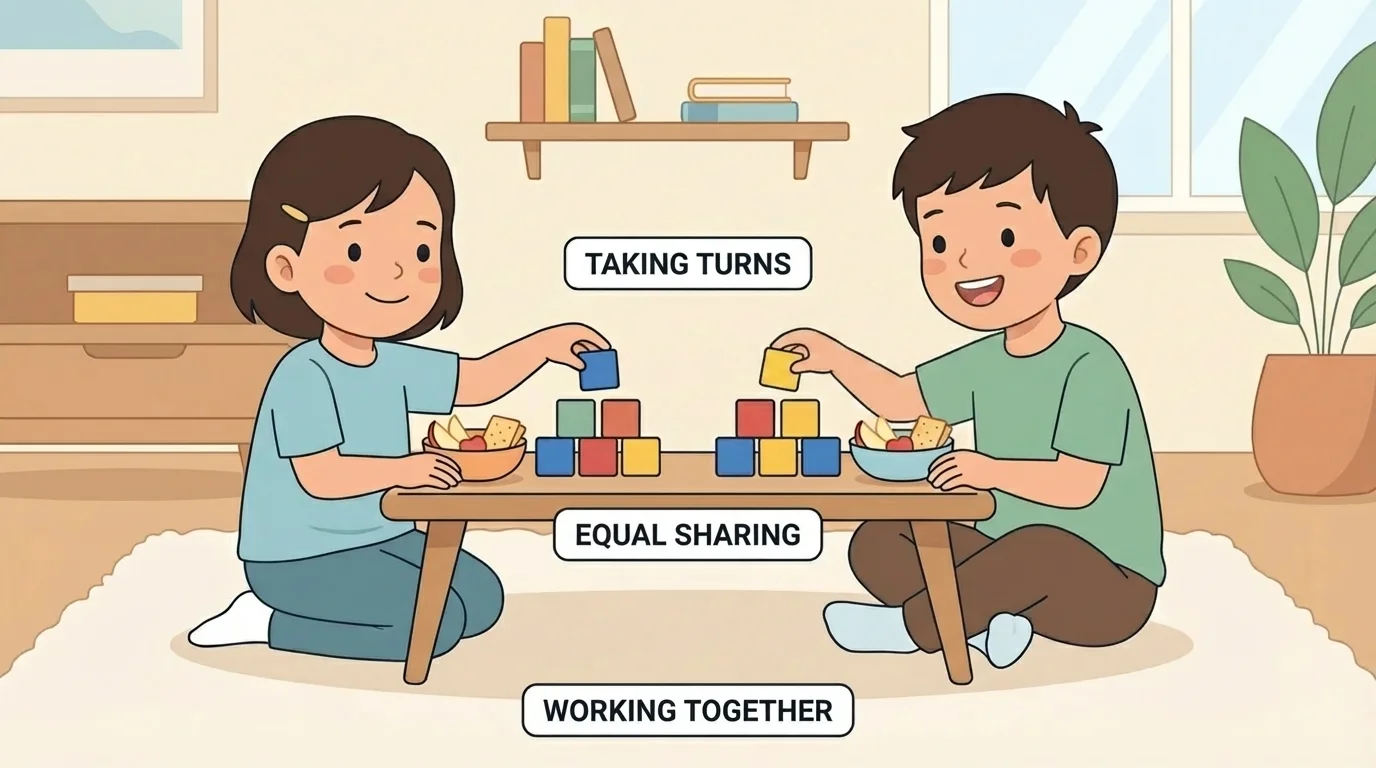
Simple sharing choices
Step 1: Look at what is being shared.
Is it a toy, a snack, a screen, or a job?
Step 2: Pick a fair way.
You can split it, take turns, or use it together.
Step 3: Use kind words.
Say, "You can have some," or "My turn, then your turn."
If there are enough pieces, you can make small groups so each person has some. If there is only one item, you can take turns. If the game lets two people join, you can play together. These are all fair choices.
Sharing does not mean you must give away everything. It is okay to have a special item that an adult says is not for sharing right now. You can still be kind by offering something else.
Taking turns helps people feel calm and respected. Waiting can be hard, especially when you are excited. A turn means you wait, then you get a chance. While you wait, you can watch, clap, count slowly, or hold a different toy.
Kind words make sharing easier
Short, calm words help solve many problems. You can say, "Can I have a turn?" "You can go first." "Let's do it together." "I'm still using this. You can have the next turn." These words are clear, gentle, and helpful.
Using a calm voice matters too. Loud grabbing, yelling, or snatching can hurt feelings and stop the fun. A calm voice helps other people listen to you.
Later, when you solve a problem, remember the fair sharing idea from [Figure 1]. A turn, a split, or doing it together are often the best answers.
Sometimes being fair is not about toys. It is about a job. You might help put away blocks, carry napkins to the table, water a plant, or clean up after art time. Working together means each person does a small part.
To work well with others, try these simple steps. First, listen. Next, pick one job you can do. Then, do your part. Last, check if anyone needs help. When everyone helps a little, the job gets done more easily.
Young children learn kindness best by practicing it again and again in small moments, like handing someone a marker, waiting for a turn, or helping pick up toys.
If you make a mess while helping, that is okay. You can still be responsible by trying again and cleaning up. Fairness is not about being perfect. It is about trying to do the right thing with others.
[Figure 2] shows simple steps to fix the problem when something feels unfair. Sometimes you may feel upset. Maybe someone grabbed a toy, skipped your turn, or would not listen. You do not need to hit, scream, or quit right away.
Stop. Keep your hands safe. Say the problem. Use simple words like, "I was using that," or "I want a turn." Listen. Hear what the other person says. Ask for help. If the problem stays big, ask a trusted adult.
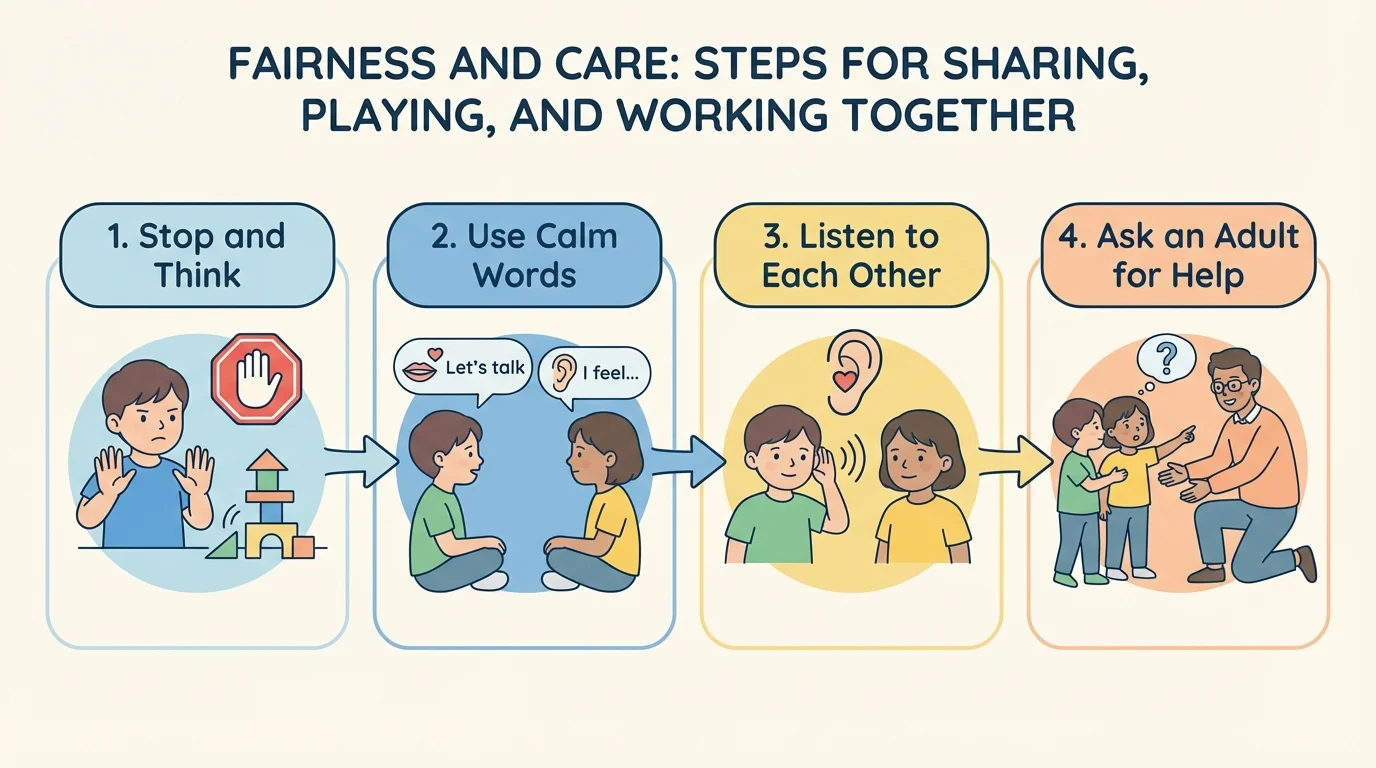
When a toy problem happens
Step 1: Stop your body.
Keep hands to yourself.
Step 2: Use words.
Say, "I am still playing with that."
Step 3: Make a fair plan.
Say, "You can have it after me," or "Let's use it together."
Step 4: Get help if needed.
Ask a grown-up if the problem does not stop.
These steps help because they keep everyone safer and calmer. They also help you learn how to solve problems, not just react to them.
If someone else is sad, you can show care by noticing their face and voice. You might say, "Are you okay?" or "You can have a turn after me." That small kindness can change the whole moment.
You build fairness by practicing little things every day. Put one toy away for someone else to use. Offer part of your snack if an adult says it is okay. Let another person choose the song or game sometimes. Help clean up, even when the mess is not all yours.
"Kind hands, kind words, kind choices."
Try This: Today, pick one moment to share, one moment to wait for a turn, and one moment to help with a small job. These tiny actions help you grow into a trusted, caring person.
When problems happen again, go back to the calm steps from [Figure 2]. Stop, use words, listen, and ask for help if you need it. The more you practice, the easier fairness becomes.
