You can do things now that you could not do when you were a baby. That is amazing. As you grow, your body grows, your words grow, and your skills grow too. You learn how to put on shoes, help clean up, talk kindly, and try new jobs. Growing up means learning a little more each day.
Growing up does not happen all at once. It happens in small steps. One day you need lots of help. Later, you can do more by yourself. You may learn to wash your hands, carry your cup carefully, or help feed a pet with an adult. These are signs that you are growing.
Future learning means the new things you will learn in the future. Today you may learn to put blocks away. Later you may learn to help set the table. After that, you may learn to get your backpack ready for an outing or remember a simple routine at home. Every new skill starts small.
Growing up means getting bigger, learning new skills, and becoming able to do more things. Future learning means the new things you will learn later. A responsibility is a job you are trusted to do.
When you learn new things, you become more confident. Confident means you begin to think, "I can try." That feeling grows when you practice, and small responsibilities like these are shown in [Figure 1].
A responsibility is a small job that matters. It is something people count on you to do. For a young child, responsibilities are simple and safe. You may put toys in a basket, put dirty clothes in a hamper, throw away trash, or carry a napkin to the table.
Responsibilities help your home and your world work better. When you put crayons back, they are easy to find next time. When you place your shoes by the door, no one trips over them. When you help water a plant, the plant gets care. Small jobs are important jobs.
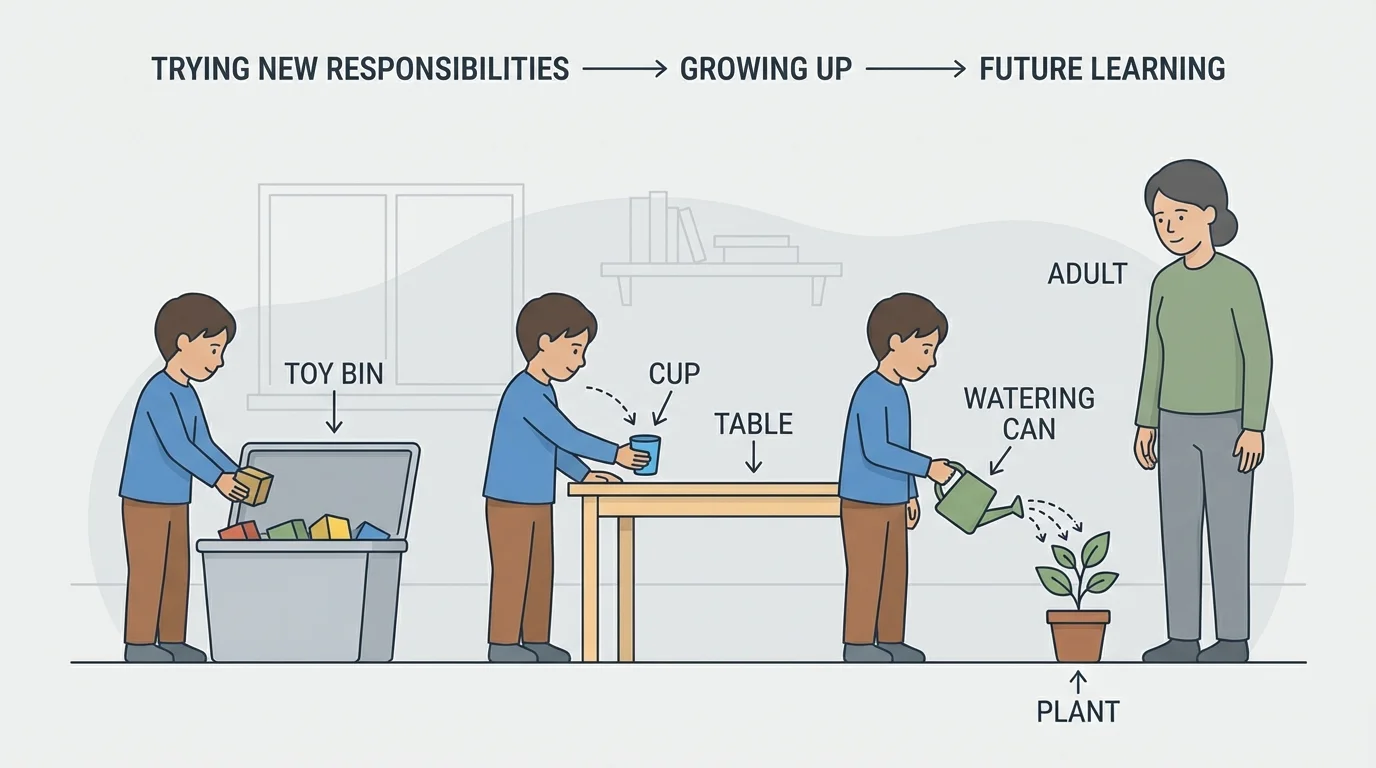
If you handle a responsibility well, things feel calmer and easier. If you forget, the room may get messy, a pet may need help, or someone else must do your job. That is why responsibilities matter. They show care for yourself and for other people.
Very small daily jobs help build strong habits. A child who practices one easy job again and again is learning how to be dependable.
Some responsibilities are part of a routine. A routine is something you do in the same order again and again, like washing your hands, eating a snack, and cleaning up. Routines help your brain remember what comes next.
New tasks can feel big at first, but they become easier when you learn them one step at a time. You do not need to do everything perfectly. You just need to start.
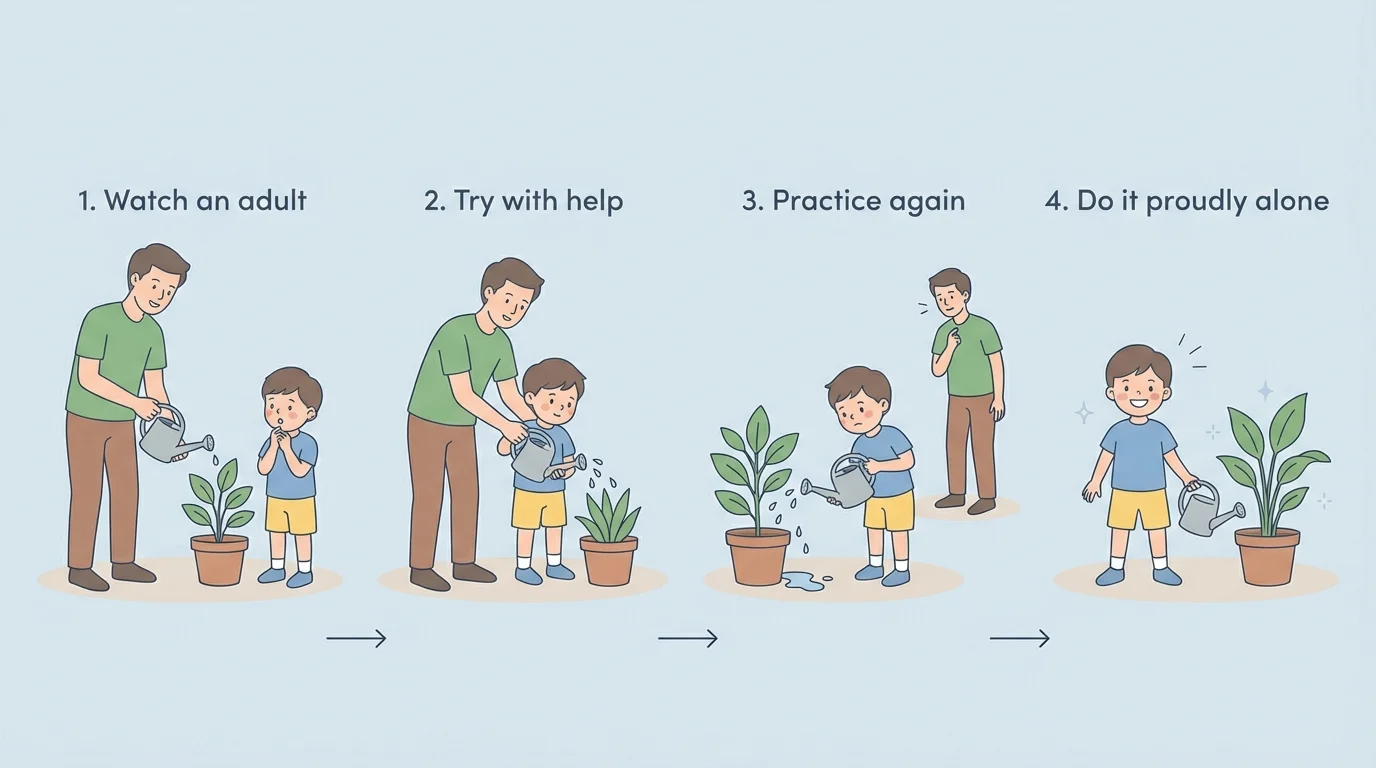
Here is a simple way to try a new responsibility, as shown in [Figure 2]. First, watch. Next, try it with help. Then, practice. Finally, do it more on your own. Maybe you watch an adult fold a washcloth. Then you try folding with help. Later you practice many times. Soon you can do it almost by yourself.
Example: Learning to put toys away
Step 1: Look at the toy area.
You notice blocks on the floor, dolls on a chair, and books on a rug.
Step 2: Put one kind of toy away first.
You place the blocks in the bin.
Step 3: Ask for help if needed.
An adult can point to where the books belong.
Step 4: Finish and check.
You look around to see if the space is neat and safe.
This makes the room easier to use and helps you feel proud.
Practice is powerful. When something is new, your hands and brain are still learning. If you spill a little water while helping, that does not mean you failed. It means you are learning.
You do not grow alone. Your community helps you learn. Your family may teach you how to clean up, greet people kindly, or care for belongings. A librarian may read stories that help you learn words. A coach, music teacher, neighbor, or relative may teach you how to listen, wait, and practice.
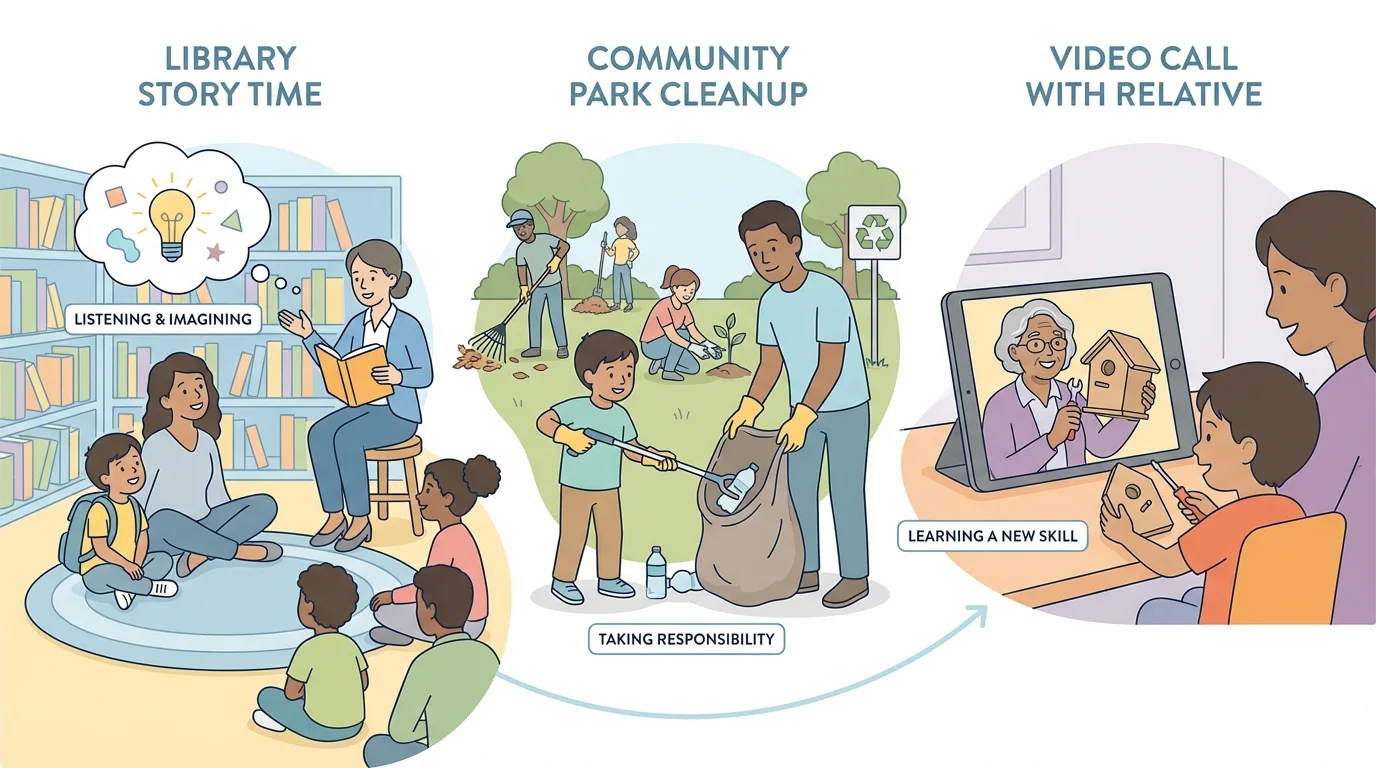
Even when you learn online at home, you still belong to a community, as shown in [Figure 3]. You may talk to a teacher on a video call, join a club, go to story time at the library, or help in your neighborhood with an adult. These places help you develop skills for the future.
Community responsibilities can be small too. You can say hello politely, hold a door with an adult nearby, put trash in a bin, and use gentle hands in shared places. These actions show respect.
How community helps you get ready for the future
When you listen, take turns, follow simple directions, and care for shared spaces, you are practicing life skills you will keep using as you grow. These habits help in classes, activities, jobs, and relationships later on.
As you saw in [Figure 1], even home jobs help more than one person. In the same way, community jobs help everyone around you. Putting a wrapper in the trash keeps a park cleaner for other families.
The future is the time ahead. In the future, you will learn many more things. You may learn to dress yourself fully, pack what you need for an activity, help make a snack, care for school supplies at home, or remember more steps in a routine. Future learning starts with what you practice now.
A goal is something you want to learn or do. Your goal might be, "I will put my cup in the sink after snack," or "I will help feed the fish with a grown-up." Goals for young children should be small, clear, and safe.
When you reach a small goal, you are ready for another one. That is how growing works. One little success helps build the next one.
"I can learn new things step by step."
As shown in [Figure 2], learning usually begins with watching and help. Nobody starts as an expert. Trying is part of learning.
Sometimes a new responsibility feels hard. You may feel frustrated, shy, tired, or worried about making a mistake. Those feelings are normal. The important thing is what you do next.
You can stop, take a breath, and ask for help. Help is not the same as giving up. Help is part of learning. You might say, "Can you show me again?" or "Can we do it together?" That is a strong choice.
You have already learned many hard things before: speaking more words, using a spoon, or putting on shoes. New responsibilities work the same way. They get easier with time and practice.
If a child throws toys instead of putting them away, the room may become unsafe. If a child puts toys away carefully, the space is safer and everyone can find what they need. Good choices have good results.
Here are simple ways to practice growing up at home and in your community. Put one toy away before taking out another. Carry your plate to the counter if an adult says it is safe. Put a book back on a shelf. Help match socks. Wipe a small spill with help. Say "please" and "thank you." Wait for your turn in a game or on a video call.
You can also practice noticing what needs care. Is your blanket on the floor? Is your cup still on the table? Are your shoes in the walkway? Looking around and helping is a big part of becoming responsible.
Try This
Choose one small job to practice every day for a few days.
Step 1: Pick a safe job.
Examples: put toys in a bin, place pajamas on the bed, or carry a napkin to the table.
Step 2: Do the same job each day.
Doing one job many times helps your brain remember it.
Step 3: Notice how it feels.
You may feel proud, helpful, and more ready for new learning.
As shown in [Figure 3], learning happens in many places, not only during lessons on a screen. Home, parks, libraries, clubs, neighbors, and family all help you grow.
