Have you ever waited for your birthday and counted the days until it came? A calendar helps us do that. It is like a time map that helps us see when things happen. We can use a calendar to look at the past, talk about what is happening now, and think about what will happen next.
A calendar helps people organize time. It shows days, weeks, months, and a year in order. When we look at a calendar, we can answer questions like: What day is it today? What day was yesterday? What day comes tomorrow? When is the field trip? When was the holiday?
Calendars also help us place events in chronological order. That means putting events in the order they happen. If school starts in August, a class party happens in December, and summer begins in June, a calendar helps us see which event came first, next, and last.
Calendar means a tool that helps us keep track of time.
Chronological order means putting events in the order they happen, from earlier to later.
[Figure 1] People have used calendars for a very long time. Families, schools, and communities use them to remember important days. Historians also care about dates because dates help them understand when things from the past happened.
A year is a big part of a calendar. One year is made of 12 months. The months always go in the same order: January, February, March, April, May, June, July, August, September, October, November, and December.
Each month is a part of the year. Some months feel different because of weather and seasons. For example, December may feel cold in many places, while July may feel warm. Even though weather can change, the months still stay in the same order every year.
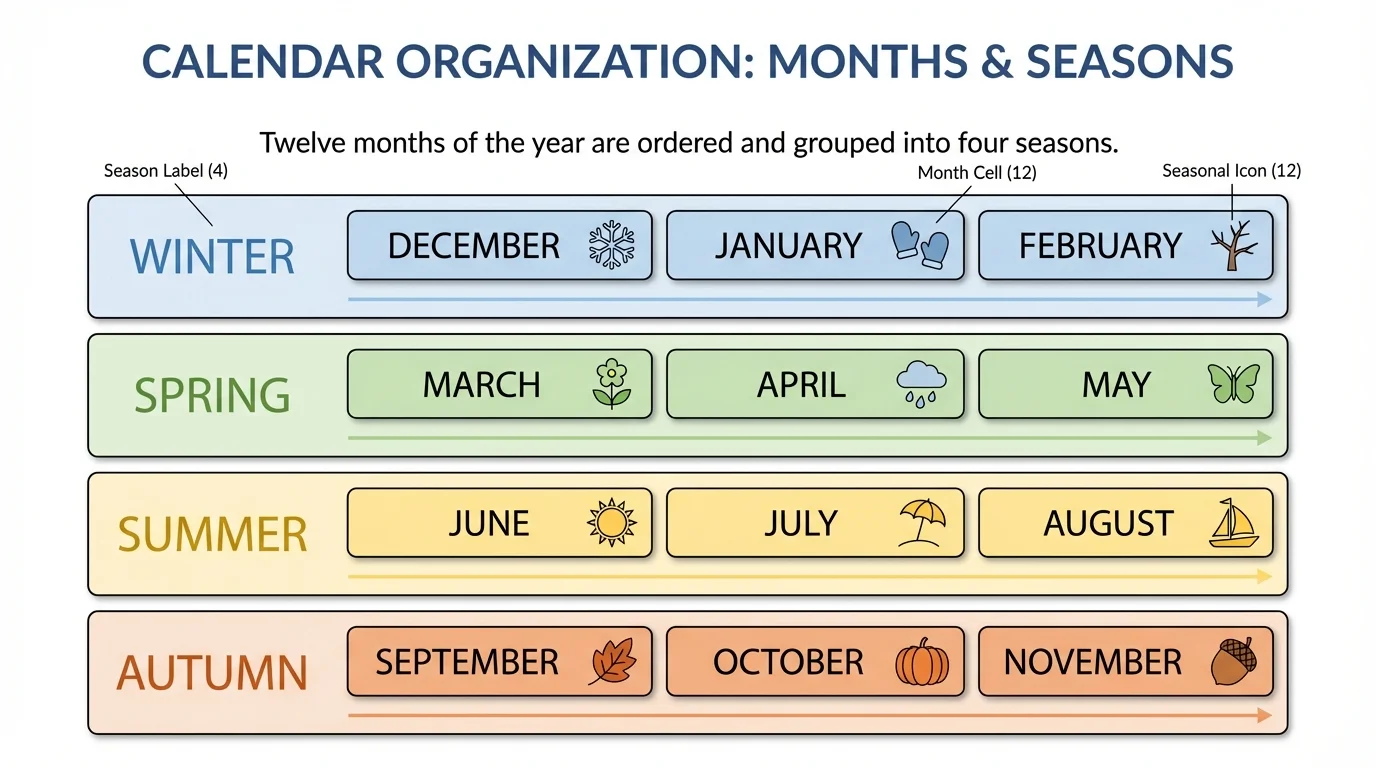
When one year ends in December, a new year begins in January. That is a pattern. A pattern is something that repeats. The order of months repeats every year, which helps us know what comes next.
Many calendars around the world help people track time, but the one used in many schools and homes has 12 months in one year.
[Figure 2] We can ask questions about months to learn about time from the past. If a holiday was in November and a birthday was in December, which one happened first? November came before December, so the holiday happened first.
Months are made of smaller parts called weeks. A week has 7 days in order: Sunday, Monday, Tuesday, Wednesday, Thursday, Friday, and Saturday.
The smallest common parts we read on a calendar are days. A day is one box or space on many calendars. We use days to tell exactly when something happens. If today is Monday, then yesterday was Sunday and tomorrow is Tuesday.
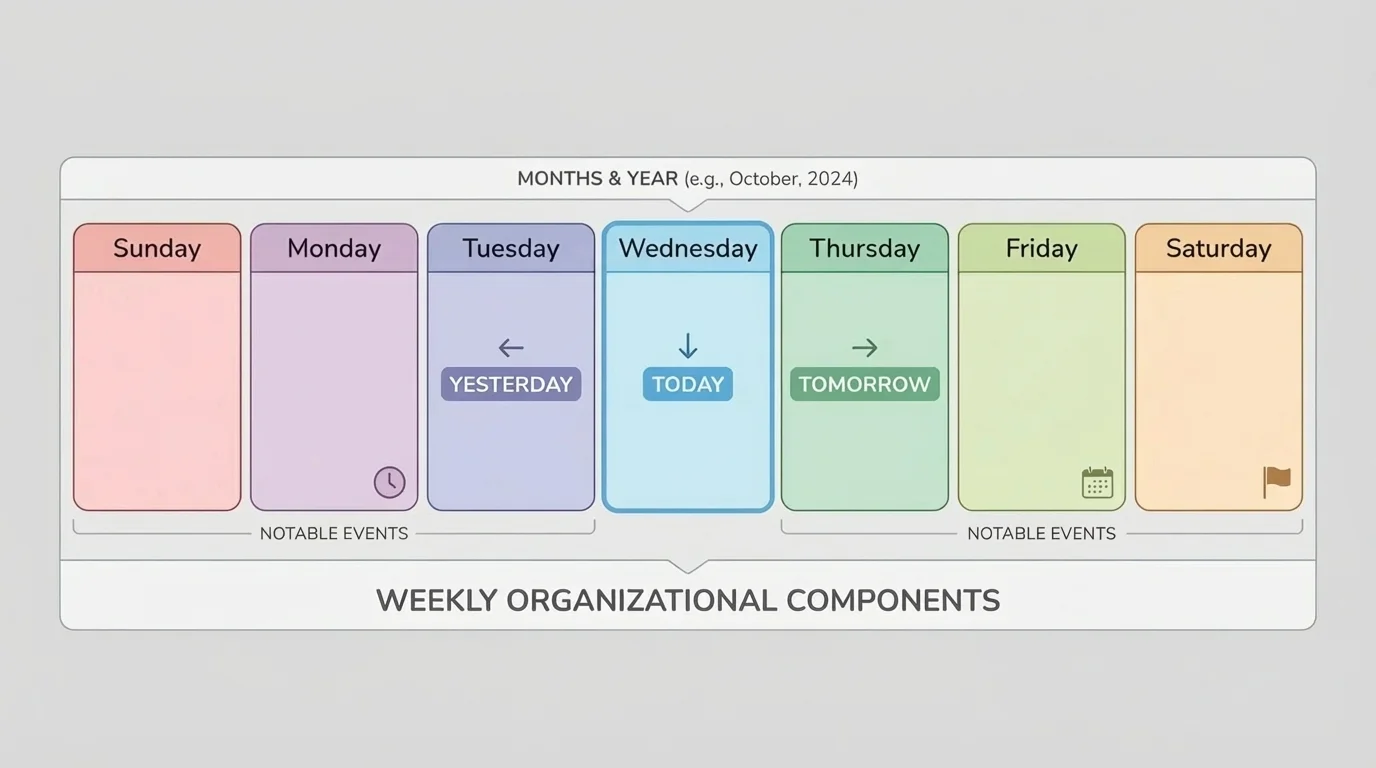
The order of the days repeats again and again. After Saturday comes Sunday. This repeating order is another pattern. Patterns help us predict what day will come next.
You already know words like before, after, yesterday, today, and tomorrow. A calendar helps us see those ideas clearly.
Weeks help us plan school and home life. A teacher may say the library visit is on Thursday. A family may visit grandparents on Saturday. By looking at the week, we can tell how many days are left before an event.
A date tells the exact day of an event on a calendar. A date usually includes the month, the day, and the year. For example, April 15, 2026 is one full date. It tells the month, the number of the day in that month, and the year.
Dates help us be precise. If someone says, "The concert is in May," that gives some information. If someone says, "The concert is on May 9," that gives a much clearer answer.
Dates also help us compare events. If one event happened on March 2 and another happened on March 18, the event on March 2 happened first because 2 comes before 18 in the same month.
Reading dates in order
Look at these three dates: June 3, June 10, and June 21.
Step 1: Check the month.
All three dates are in June, so we stay in the same month.
Step 2: Compare the day numbers.
3 comes before 10, and 10 comes before 21.
Step 3: Put them in order.
The order is June 3, June 10, then June 21.
This is chronological order from earliest to latest.
[Figure 3] When we study history, dates matter because they help us tell the story of what happened first and what happened later. A calendar is one tool that helps us build that story.
Some days are extra important. These are notable events, and they can be marked on a calendar. Notable events can include birthdays, holidays, the first day of school, a music concert, a soccer game, or a family trip.
People often circle or color important dates. This makes them easy to find. If your birthday is on October 12, you might put a star on that date. If the class has a museum visit on February 5, the teacher may mark that day too.
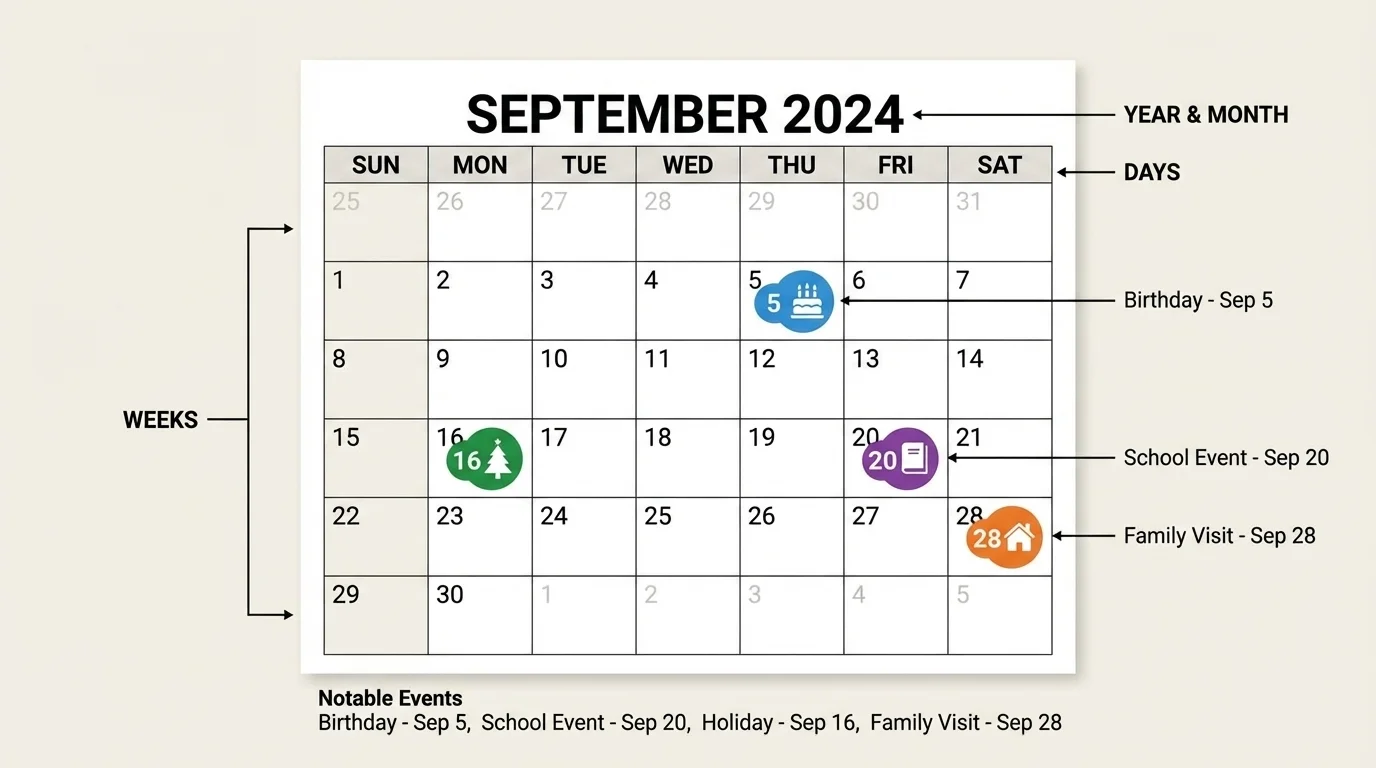
Marking notable events helps us get ready. We can see what is coming soon and remember what already happened. This helps with planning and with talking about the past.
Special days help tell a story of time. When we place birthdays, holidays, and school events on a calendar, we create a simple timeline of our lives. We can look back and say what happened first, what happened next, and what we are waiting for now.
Later, when we talk about a month full of events, [Figure 3] still helps us notice that one page of a calendar can hold many different kinds of important days.
Calendars are full of patterns. The days of the week repeat every 7 days. The months repeat every year. Some events happen on the same date each year, like a birthday. Other events may happen in the same season each year, such as a school beginning in late summer or early fall.
We can ask history questions with a calendar. Which event happened first? Which happened last? Which events happened in the same month? If a family moved in March and a baby was born in July, the move happened first. That is chronological order again.
Looking for patterns also helps us make good guesses. If music class is every Tuesday, then next week music class will be on Tuesday again. If a holiday comes in December each year, we know to look for it near the end of the year.
Putting events in order
Here are three events: a picnic on April 4, a play on April 12, and a race on April 19.
Step 1: Notice that all events are in April.
So we only compare the day numbers.
Step 2: Compare the numbers.
4 is before 12, and 12 is before 19.
Step 3: State the order.
First was the picnic, next was the play, and last was the race.
A calendar helps us answer the question, "What happened first?"
When we understand patterns and order, we become better at talking about past events. That is an important history skill.
At home and at school, calendars help us stay organized. We can check the day, find the month, and talk about upcoming events. If today is Wednesday, and the art show is on Friday, we know the art show is coming soon. The repeating days in [Figure 2] help us think through that order.
A class calendar may show reading day, picture day, or a school break. A family calendar may show doctor visits, soccer practice, and birthdays. These calendars help everyone know what to expect.
We can also use a calendar to remember the past. If a science fair was last month and a holiday is next month, the calendar helps us place both events in time. That is why calendars are important in daily life and in learning about history.
The months in order from [Figure 1] help us know where we are in the year. The days in order help us know where we are in the week. Together, they make time easier to understand.
