Have you ever looked at a baby picture and laughed because you looked so different? That picture is a clue from the past. History is full of clues like that. We use special words to talk about when things happen, what order they happen in, and how things change over time.
Some words help us talk about time. Past means something already happened. If you ate breakfast this morning, breakfast is in the past. Present means what is happening now. Reading these words is happening in the present. Future means something has not happened yet. Recess later today is in the future.
Past means before now. Present means happening now. Future means after now.
These words help us tell clear stories. We can say, "In the past, I was smaller. In the present, I am six years old. In the future, I will be older." Time words help us know when something happens.
History uses these words too. Long ago, people rode horses more often. Today, many people ride in cars or buses. In the future, transportation may change again. When we talk about long ago, now, and later, we are thinking carefully about time.
Other words help us show sequence, or order. We often use first, next, and last. These words are important in history because events happen in an order, as [Figure 1] shows with a simple set of actions. If we mix up the order, the story does not make sense.
Think about brushing your teeth. First, you put toothpaste on the brush. Next, you brush your teeth. Last, you rinse your mouth. That is the correct order. This is also called chronological order, which means putting events in time order from earlier to later.
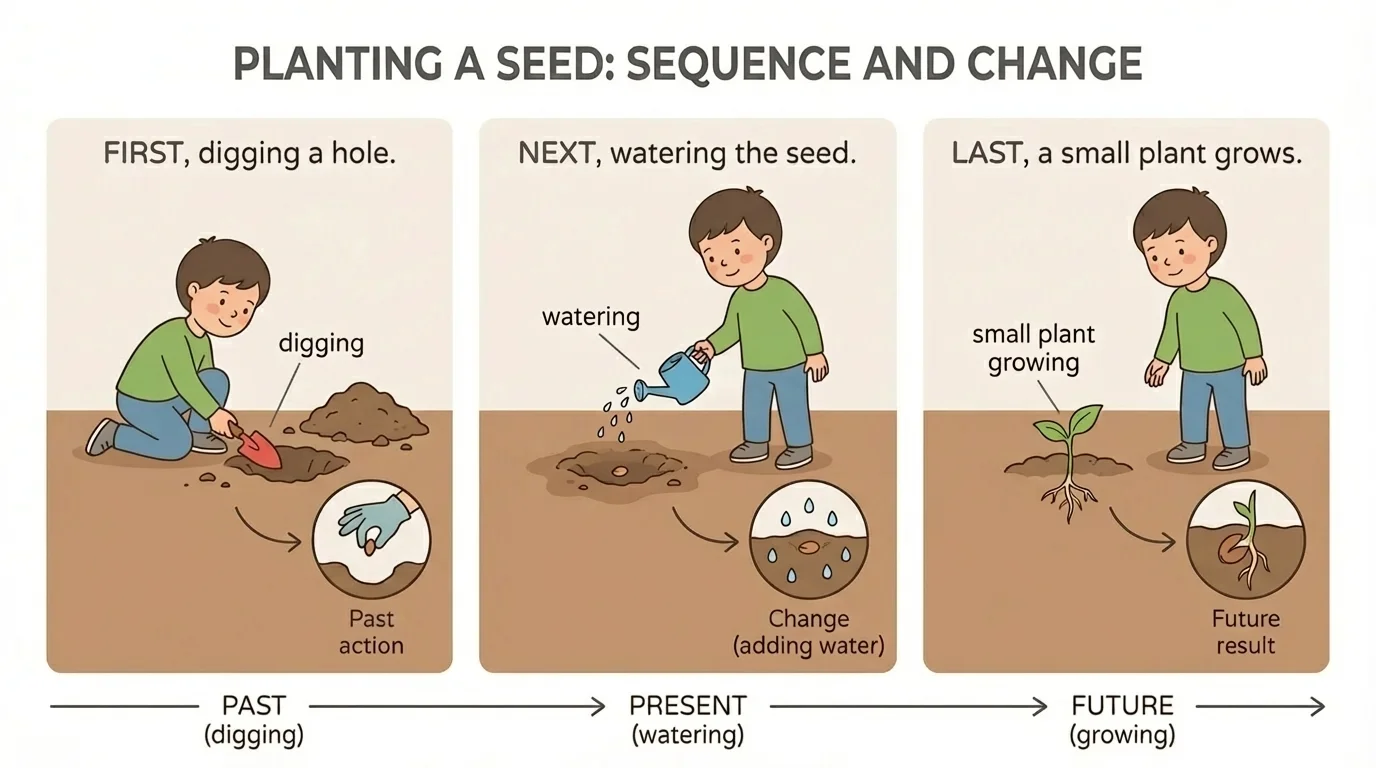
We can use sequence words for stories from the past too. For example: "First, the family woke up when the sun rose. Next, they cooked breakfast over a fire. Last, they began their work for the day." Sequence words help us understand what happened and when it happened.
Putting events in order
Here is a short story about making a sandwich.
Step 1: Start with the earliest event.
First, get two slices of bread.
Step 2: Tell what happens in the middle.
Next, spread peanut butter and jelly on the bread.
Step 3: Finish with the final event.
Last, put the bread together and eat the sandwich.
The words first, next, and last make the order easy to follow.
Historians use order words when they tell what happened in the past. A birthday party, a trip, or a school day all have an order. Just like the plant grows step by step in [Figure 1], events in history happen one after another.
Change means something becomes different over time. A baby changes into a child. A tiny seed changes into a plant. A town can change too. New buildings may be added. Old roads may be replaced. Some things change slowly, and some things change quickly.
Things can change and stay the same
When we study history, we look for differences and sameness. A family in the past and a family today may both eat meals together, but the foods, tools, or homes may be different. Looking for what changed and what stayed the same helps us understand the past.
Change is an important history idea because life is not always the same. Long ago, many people washed clothes by hand. Today, many families use washing machines. That is a change. But people still need clean clothes. That part stayed the same.
You can notice change in yourself too. In the past, you may have needed help tying your shoes. In the present, you might do it by yourself. In the future, you may learn many new skills. Time and change often go together.
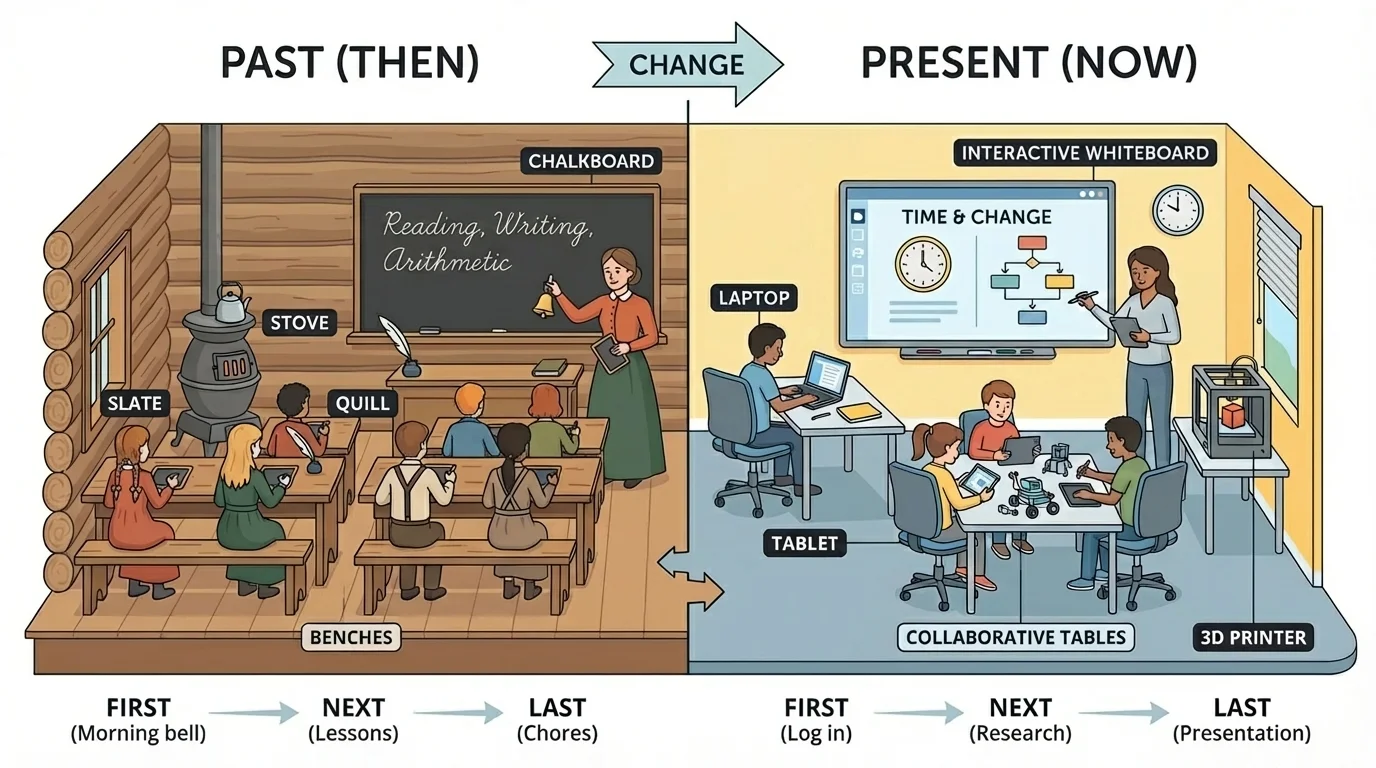
History is about real people and real events from long ago. When we compare the past and the present, we can see how life changes over time, as [Figure 2] illustrates with school life. Looking at events in order helps us understand what came before and what came after.
For example, schools in the past could look very different. Some children learned in one-room schoolhouses. Today, many children learn in larger classrooms with more books, technology, and supplies. Both are schools, but they are not exactly the same.
Families can also study the past in order. A grandparent was once a child. Then that child grew into an adult. Later, that adult became a grandparent. This order helps us understand family history.
Communities change too. A place may have had fewer houses in the past. Later, more people moved there. Roads, parks, and stores may have been added. When we place those changes in order, we learn how a community grew. The school comparison in [Figure 2] reminds us that even familiar places can change over time.
| Time Word | What It Means | Example |
|---|---|---|
| Past | Before now | I learned to walk. |
| Present | Now | I am reading. |
| Future | After now | I will grow taller. |
| First | Beginning event | First, we line up. |
| Next | Middle event | Next, we walk to lunch. |
| Last | Final event | Last, we go back to class. |
| Change | Becoming different | A small puppy grows bigger. |
Table 1. Meanings and examples of important time, order, and change words.
Good historians ask questions. Questions help us notice order and change. We can ask, "What happened first?" "What happened next?" "What happened last?" We can also ask, "What changed?" and "What stayed the same?"
Old photographs, toys, clothes, and letters can teach us about the past. These objects are clues that help people learn how others lived long ago.
If you see an old photo of your family, you might ask: Who is in the picture? Is it from the past or the present? What looks different from today? What is the same? Questions like these help us think like historians.
We can ask questions about our school too. Was the building always the same? Did people add new rooms? Was the playground different before? Every answer helps us understand time, order, and change.
[Figure 3] Sometimes we use many time words in one story. A timeline helps show events in order with parts of a day. A timeline can help us see what happened in the past, what is happening in the present, and what may happen in the future.
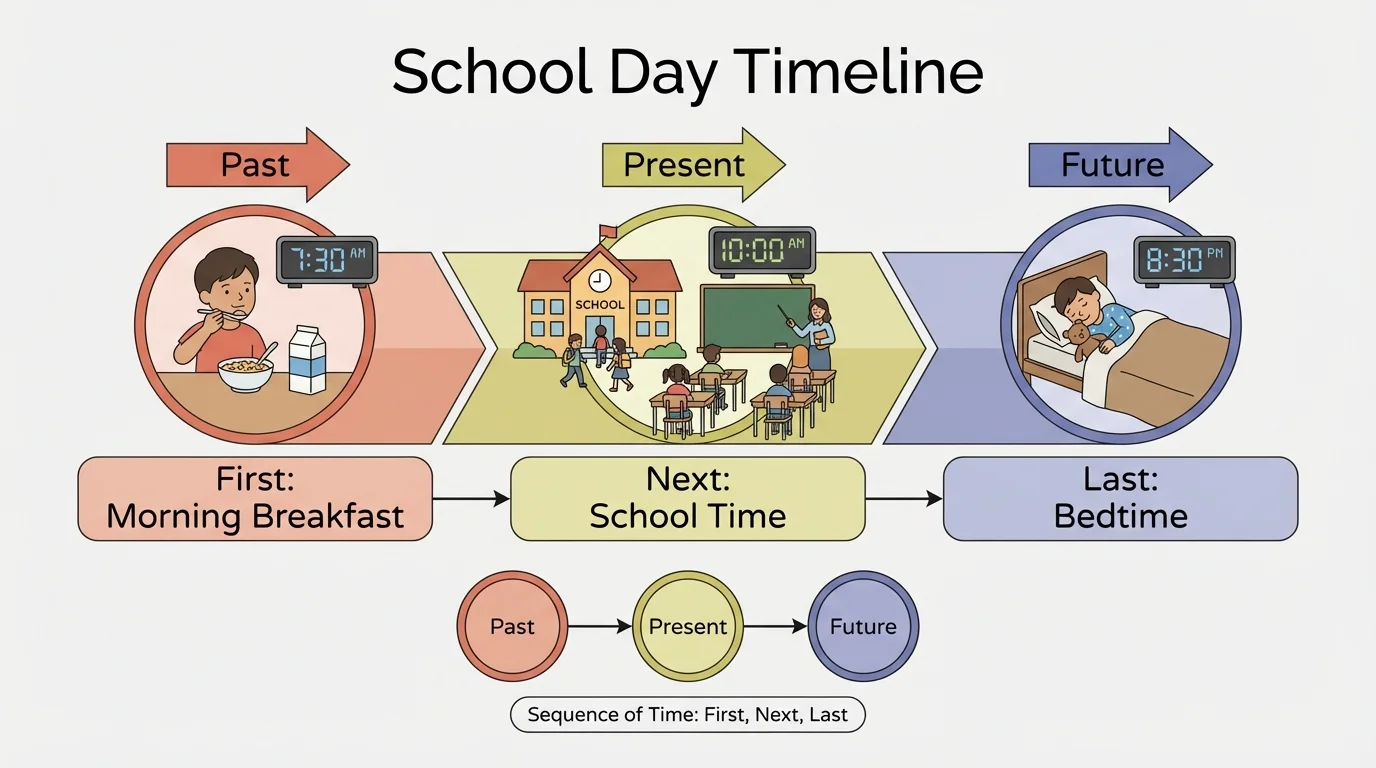
Listen to this example: "First, I woke up. Next, I came to school. Last, I went home." That is a sequence. Now add time words: "In the past, I woke up at home. In the present, I am at school. In the future, I will go home." Now the story tells both order and time.
We can also talk about change in the same story: "In the past, I could not read many words. In the present, I can read more. In the future, I will read even more difficult books." This shows growth and change over time.
When you use words like past, present, future, first, next, last, and change, you make your thinking clear. The simple order shown on the timeline in [Figure 3] helps us remember that every day, every story, and every part of history has a place in time.
