How do you know when your birthday is coming, when school begins, or whether a holiday has already happened? A calendar helps us answer all of those questions. It is like a time map. When we read a calendar, we can look back at things that already happened, look at what is happening now, and look ahead to what will happen next.
A calendar is a tool that helps us keep track of time. It shows days, weeks, months, and years. People use calendars at home, at school, and at work. A family may use one to remember a doctor visit. A class may use one to count school days. A child may use one to count down to a birthday or a trip.
Calendars help us answer questions such as: What day is it now? What day was it yesterday? What day will it be tomorrow? Which event came first? Which event comes later? These questions help us think about time and order.
Past means something already happened. Present means something is happening now. Future means something has not happened yet and will happen later.
When we talk about events, we often use a calendar to place them at the correct time. If the school year started last month, that event is in the past. If today is library day, that event is in the present. If the class picnic is next month, that event is in the future.
[Figure 1] shows the important parts of a calendar. The month tells a larger part of the year, such as January or May. The year tells which year it is. The names across the top usually show the days of the week: Sunday, Monday, Tuesday, Wednesday, Thursday, Friday, and Saturday.
Each box on the calendar usually has a number. That number is the date. The date tells the exact day in the month. A row of seven days makes a week. If today is April 8, then the month is April and the date is 8.
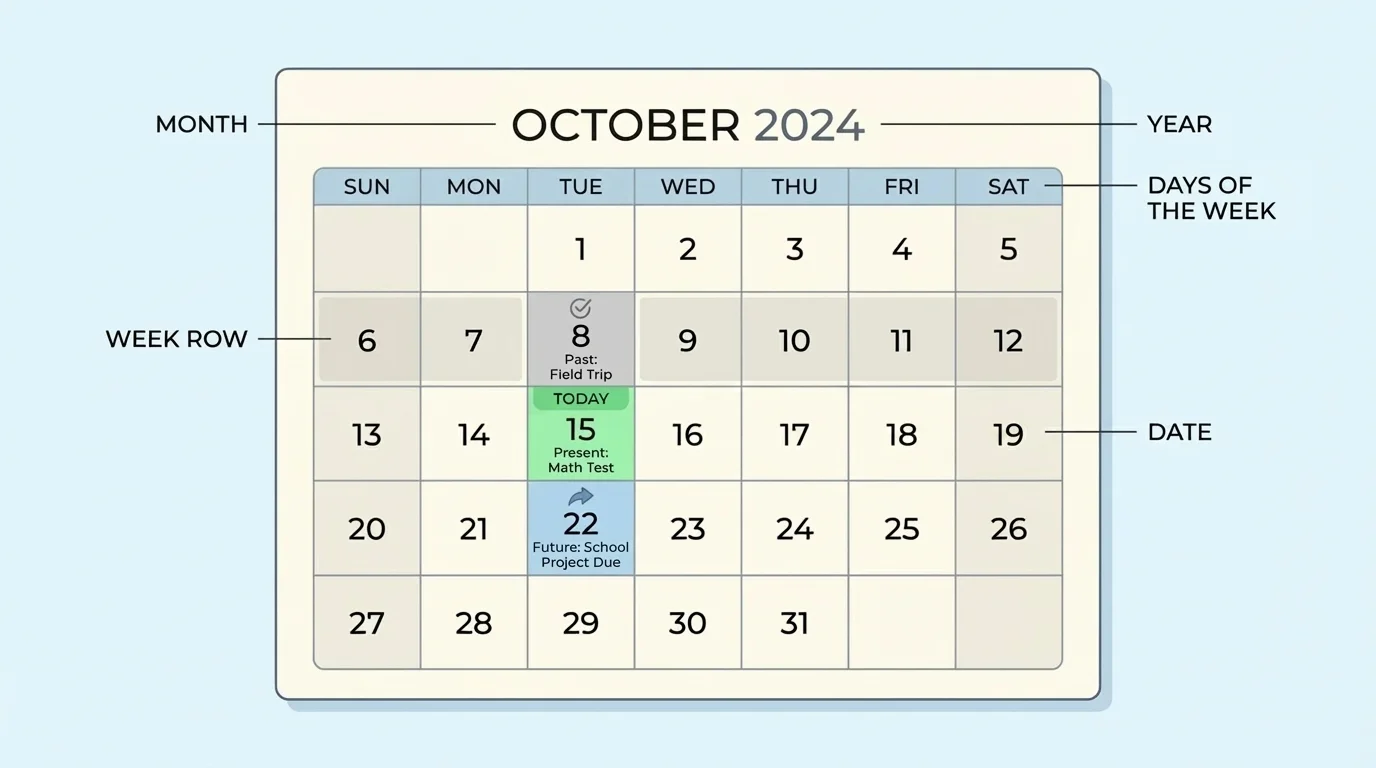
We can read a calendar by looking carefully at these parts. First, find the month. Next, find the day of the week. Then look at the number in the box. This helps us say the full date, such as Monday, April 8.
Calendars also help us notice patterns. After one day comes the next day. After seven days, another week begins. After one month ends, a new month starts. These patterns help us understand how time moves forward.
[Figure 2] helps show how time words describe events. Past events already happened. Present means now. Future events have not happened yet.
We also use the words yesterday, today, and tomorrow. Yesterday is the day before today. Today is the current day. Tomorrow is the day after today. If today is Tuesday, then yesterday was Monday and tomorrow will be Wednesday.
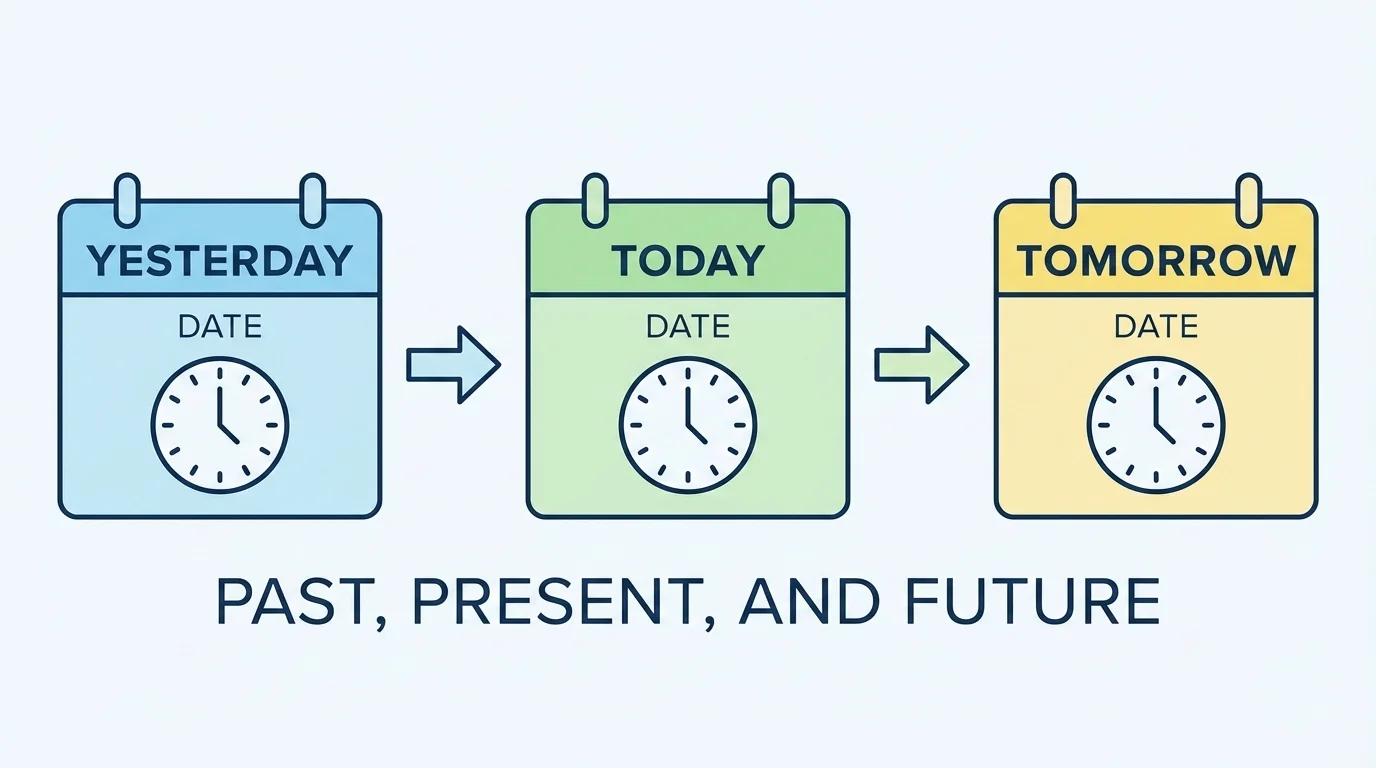
Here are some examples. "We planted seeds last week" is in the past. "We are reading a story today" is in the present. "We will visit the library next week" is in the future. The calendar helps us know where each event belongs.
Finding time words with a calendar
Step 1: Look at today on the calendar.
If today is March 12, that is the present.
Step 2: Look at an earlier date.
March 11 came before March 12, so March 11 is in the past.
Step 3: Look at a later date.
March 13 comes after March 12, so March 13 is in the future.
A calendar helps us compare dates and tell whether they are earlier or later.
When we talk about history, we often ask, "What happened before?" and "What happened after?" Those are calendar ideas too. Even young historians use time order to discuss events clearly.
When we put events in the order they happened, we are using chronological order. That means from earlier to later. We can do this with school events, family events, or events from long ago.
For example, think about a school day. First, students arrive. Next, the class reads. Later, students eat lunch. Last, they go home. This is chronological order because the events are placed in the order they happen.
Why order matters
When events are in the right order, stories and history make sense. If we say a child blew out birthday candles before the cake was brought out, the order sounds wrong. Calendars help us check what came first and what came next.
A family can also use chronological order. A baby is born, then the child learns to walk, and later the child starts school. These are all events from different points in time, and a calendar helps us remember when they happened.
To read a date, match the number in the box with the month and the day of the week. Suppose the class party is on Friday, June 14. June is the month. Friday is the day of the week. 14 is the date.
We can compare dates too. June 10 comes before June 14, so June 10 is earlier. June 20 comes after June 14, so June 20 is later. Earlier dates may be in the past, and later dates may be in the future, depending on what day it is now.
| Calendar Word | What It Means | Example |
|---|---|---|
| Yesterday | The day before today | If today is Monday, yesterday was Sunday. |
| Today | The day now | Today is the current day. |
| Tomorrow | The day after today | If today is Monday, tomorrow is Tuesday. |
| Earlier | Comes before | May 2 is earlier than May 5. |
| Later | Comes after | May 9 is later than May 5. |
Table 1. Calendar words that help describe time and order.
We can use a calendar to answer questions such as, "Did the holiday already happen?" or "Is the field trip coming soon?" If the date is before today, it already happened. If the date is today, it is happening now. If the date is after today, it will happen later.
Some calendars hang on a wall, some sit on a desk, and some are on phones or computers. Even though they may look different, they all help people track time in order.
As we saw in [Figure 1], the same calendar page can help us find both the exact date and where that date sits inside a week and a month. That is why calendars are useful for planning and remembering.
A timeline is another way to show events in order. [Figure 3] shows how events can move from past to present to future. A timeline is like a line of time. Events that happened earlier go first. Events that happened later go next.
Historians study the past by asking questions about when events happened. A calendar can help us talk about our own history too. Last month the class visited the fire station. Today the class is drawing pictures about it. Next month the class will visit the museum. These events are in time order.
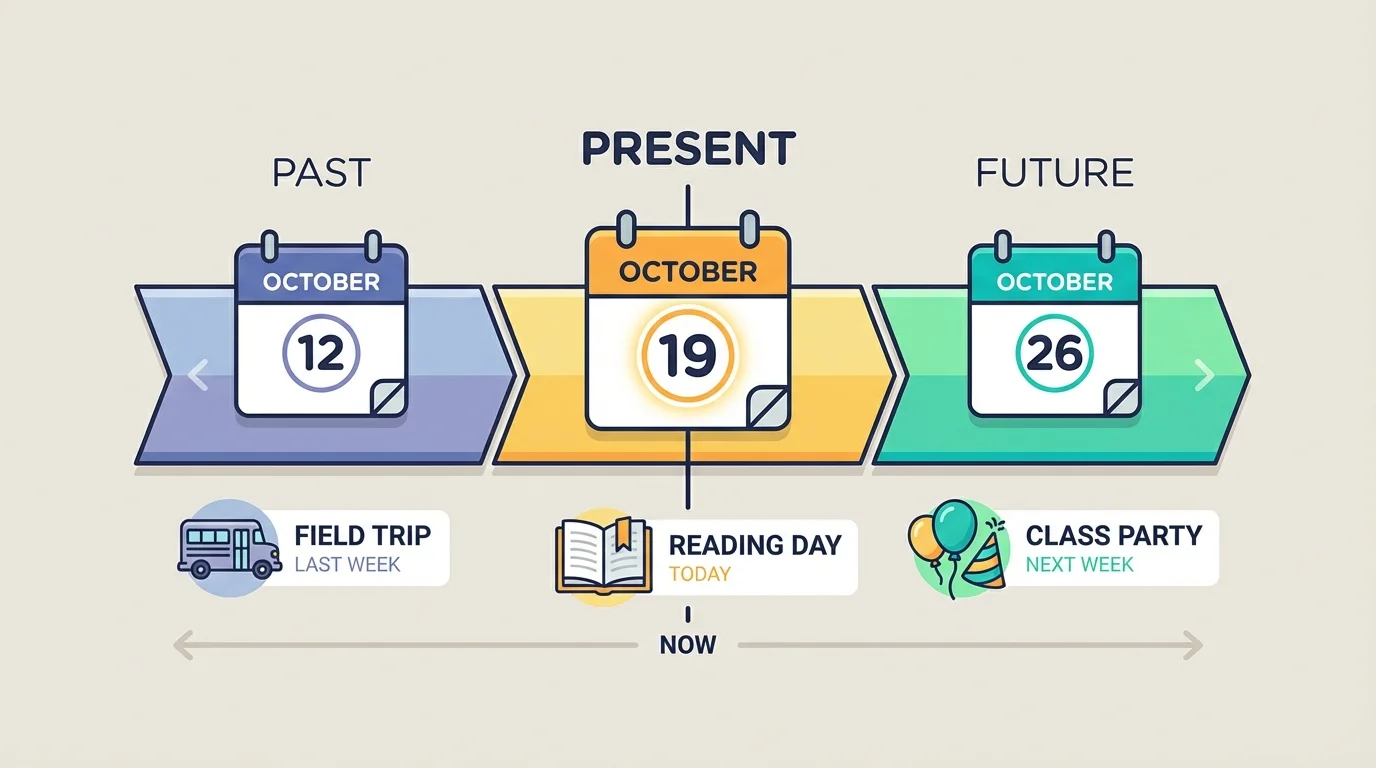
If we mix the order, it becomes harder to understand. Saying "Next month we visit the museum, last month we visited the fire station, today we draw pictures" uses the same events, but not in clear order. Calendars and timelines help us sort events correctly.
History often includes important dates, such as when a person was born, when a school opened, or when a holiday began. Even for big events, people still use the same ideas: before, now, and after.
People use calendars in many real ways. Families mark birthdays, holidays, and trips. Schools mark the first day of school, picture day, and vacation days. Doctors mark appointments. Teams mark game days. All of these events can be placed in the past, present, or future.
Think about a birthday. If your birthday was last week, it is in the past. If your birthday is today, it is in the present. If your birthday is next month, it is in the future. The calendar helps you know which one is true.
Remember that time moves in one direction. We can talk about events from before, now, and after, but we cannot make yesterday come after tomorrow. Calendars help us keep that order straight.
Later, when you learn more history, you will use these same calendar skills to study people and events from long ago. The ideas are the same whether you are talking about your school week or an important event from the past.
As shown in [Figure 3], putting events on a timeline makes it easier to discuss patterns and order. We can ask simple history questions such as, "What happened first?" "What happened next?" and "What will happen later?"
