How can we know what happened before you were born? We cannot hop into a time machine, but we can still learn a lot. Old photos, letters, toys, books, and stories can help us find answers. Historians are people who study the past, and you can be a little historian too when you ask questions and look for clues.
The past is everything that already happened. Yesterday is in the past. Last year is in the past. Long ago, people lived, worked, played, and learned in ways that were the same as ours in some ways and different in other ways. History helps us learn about those people and events.
When we learn history, we ask questions such as: What happened first? What happened next? How do we know? What changed over time? These questions help us understand order and change.
History is the study of people, places, and events from the past.
Chronological order means putting events in the order they happened: first, next, then, and last.
Some history is about our own families. A baby picture, a grandparent's story, or an old birthday card can tell us about earlier times. Some history is about communities, countries, and important people.
A source is something that gives us information. In history, sources help answer questions about the past, as [Figure 1] shows with different kinds of clues. If you want to know what a school was like long ago, you can look at old pictures, school papers, and books about schools from the past.
There are two important kinds of sources. A primary source comes from the time being studied. It is a direct clue from long ago. An old photograph, a letter, a diary, a map, an old toy, or a ticket stub can be a primary source. A secondary source tells about the past using information from primary sources. A history book, a magazine article, or a video made later can be a secondary source.
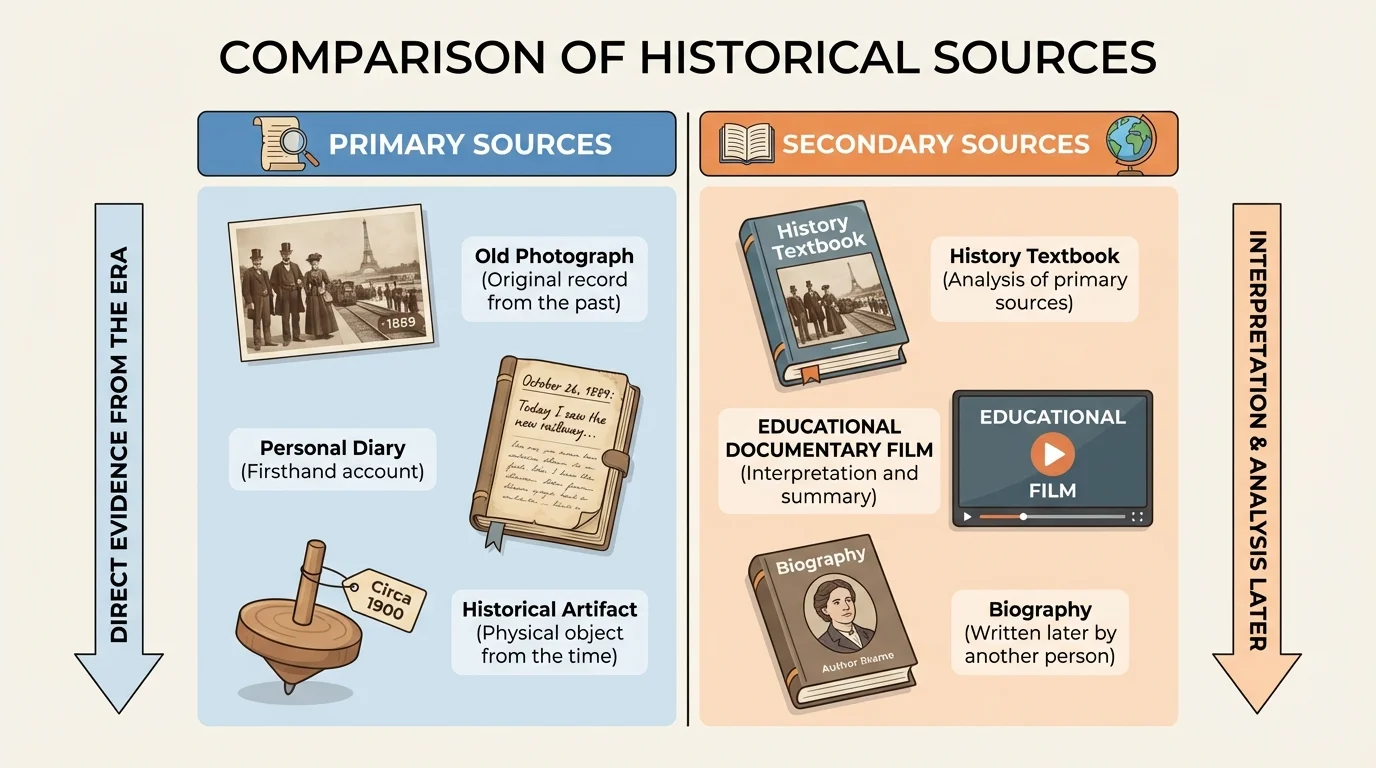
If you ask, "What did children play with long ago?" an old doll or a handmade ball can help answer that question. Those are primary sources. A book that explains toys from long ago is a secondary source. Both can be useful.
Example: Which source helps best?
Step 1: Ask a question.
Question: What did a classroom look like long ago?
Step 2: Look for a primary source.
An old classroom photograph gives a direct look at desks, clothes, and the room.
Step 3: Look for a secondary source.
A book about schools long ago explains what we see in the photograph.
Using both sources helps us answer the question better.
Sometimes one source does not tell us everything. A photo may show children in a room, but it may not tell us what they were learning. A book may explain the lesson, and together the sources give a fuller answer.
History is not only about knowing what happened. It is also about knowing when it happened. [Figure 2] shows how events can be lined up in order, just like parts of your day. Chronological order helps us understand the story of the past.
We use words such as before, after, first, next, and last. If you wake up, eat breakfast, go to school, and then go home, those events happen in a certain order. The past works the same way. Long ago, a town may have been built first, then a school opened, and later a park was added.
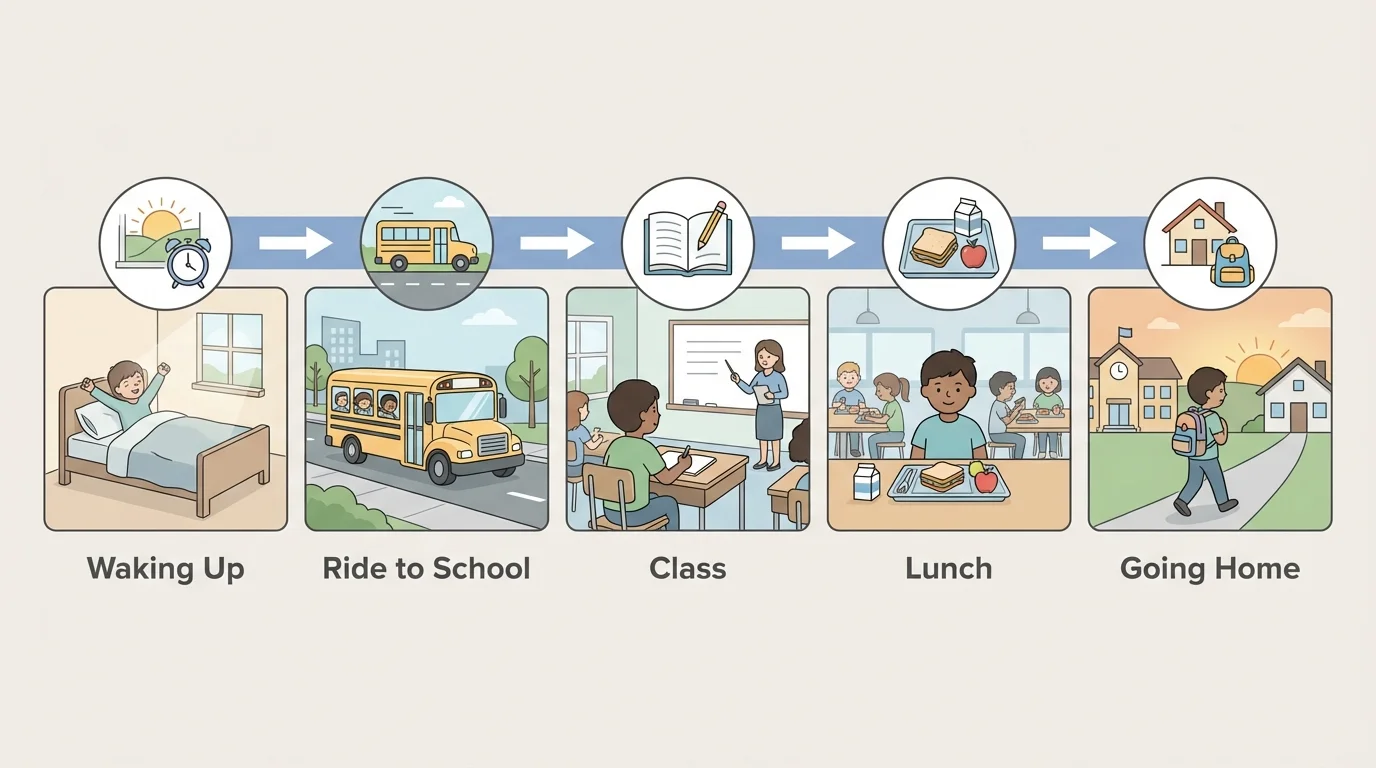
If events are mixed up, the story does not make sense. We need to know what came first. For example, a family had to move into a house before they could celebrate a party there. Order matters.
You already know how to put story events in order. History uses that same skill with real people and real events from the past.
Timelines are tools that help us place events from earlier to later. A timeline can begin with a baby picture, then show starting school, then a more recent picture. That makes the order easy to see.
A pattern is something that repeats or changes in a way we can notice. In history, patterns help us answer bigger questions. [Figure 3] illustrates one pattern: transportation changes over time from slower ways to faster ways. We can look at homes, clothing, games, food, and travel to see what stayed the same and what changed.
For example, children in the past played games, just like children today. That is a pattern of something staying the same. But the toys may have changed. Long ago, many toys were made by hand. Today, many toys are made in factories. That is a pattern of change.
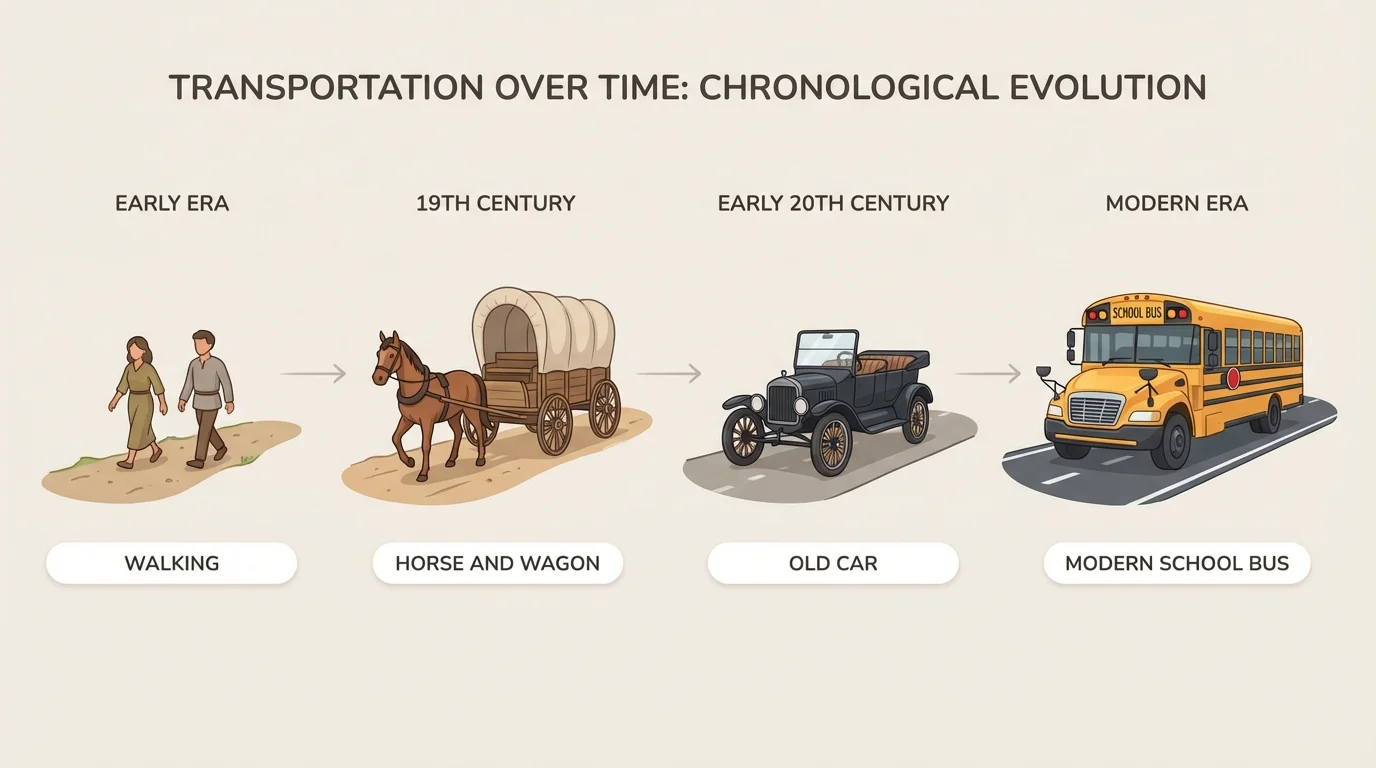
Another pattern is how people travel. Long ago, many people walked or rode horses. Later, more people used cars and buses. When we place these events in order, we can see a pattern of transportation changing over time.
Some families keep old objects for many years. A quilt, a recipe card, or a wedding photo can become a history clue for children and grandchildren later.
Patterns can also be about things that happen again and again. A town may hold a parade every year. A school may celebrate special days each year. Repeated events help us understand community traditions.
Good historians ask clear questions. A question might be, "How was school different long ago?" Another question might be, "What games did children play?" Then they choose sources that can help answer those questions.
If we ask, "What did people wear in winter long ago?" an old photograph can show coats and hats. A diary might tell if the weather was cold. A book about life long ago can explain why people dressed that way. We match the question with the source.
Questions guide the search
When we ask a question first, we know what kind of clue to look for. Pictures help with questions about how something looked. Letters and diaries help with questions about thoughts and feelings. Books and articles help put many clues together.
Sometimes different sources give different details. One person may remember an event one way, and another person may remember it a little differently. That is why using more than one source is helpful. We compare sources to learn more carefully.
History also teaches us about important people and events. Families remember birthdays, moves to new homes, and first days of school. Communities remember holidays, parades, and special leaders.
One important leader many children learn about is Martin Luther King Jr. He worked for fairness and kindness. Photos, speeches, and news reports are sources that help us learn about his life. A book written later about him is a secondary source.
We can also study schools long ago. Old classroom pictures may show rows of desks, chalkboards, and different clothing. As we saw earlier in [Figure 1], a primary source gives a direct clue, while a secondary source helps explain that clue.
"The more you know about the past, the better prepared you are for the future."
— Theodore Roosevelt
When we learn about people and events from long ago, we do not just memorize names. We ask what happened, when it happened, and how we know. That is how history becomes meaningful.
A timeline is a line that shows events in order from earlier to later. It can show a person's life, a family's story, or events in a town. Timelines make chronological order easier to understand.
For example, a family timeline might show: baby is born, child learns to walk, child starts school, family moves to a new house. The order helps us see the story clearly. In the same way, a town timeline might show: town is founded, school is built, library opens, playground is added.
The school-day order in [Figure 2] works like a simple timeline. The transportation changes in [Figure 3] also form a timeline, and that helps us notice a pattern of change over time.
Sources are powerful, but we need to think carefully when we use them. A photograph shows one moment. A diary tells one person's thoughts. A book may collect many facts. Each source helps in its own way.
When we ask, "What happened first?" we look for dates, clues, and order words. When we ask, "What pattern do we see?" we look for things that repeat or things that change over time. These are smart history questions.
By using primary and secondary sources, putting events in order, and looking for patterns, we can answer questions about the past. That is what historians do, and it is something young learners can do too.
