Have you ever noticed that not all places look the same? One place may have tall buildings and busy streets. Another place may have wide fields and quiet roads. People live, learn, work, and celebrate in both places, but they do some things in different ways. When we look closely, we can compare things that are alike and contrast things that are different.
A community is a place where people live, work, play, and help one another. A community can be a town, a city, or a rural area. People in a community share spaces such as homes, schools, parks, roads, and stores.
Compare means to tell how things are alike. Contrast means to tell how things are different. We can compare and contrast communities by looking at what people do and where they live.
Communities are shaped by their surroundings. The land, weather, water, and space around people can change the way a place looks. Some communities have many buildings close together. Some have homes spread far apart. Both are communities, but they fit their environments in different ways.
Let us compare a city community and a rural community. A city community has many people living close together. A rural community has fewer people and more open land. The map in [Figure 1] helps us see these two kinds of places.
In a city community, you might see apartment buildings, buses, sidewalks, and many stores. In a rural community, you might see farms, barns, fields, and long roads. Children in both places have homes and families, but the spaces around them can look very different.
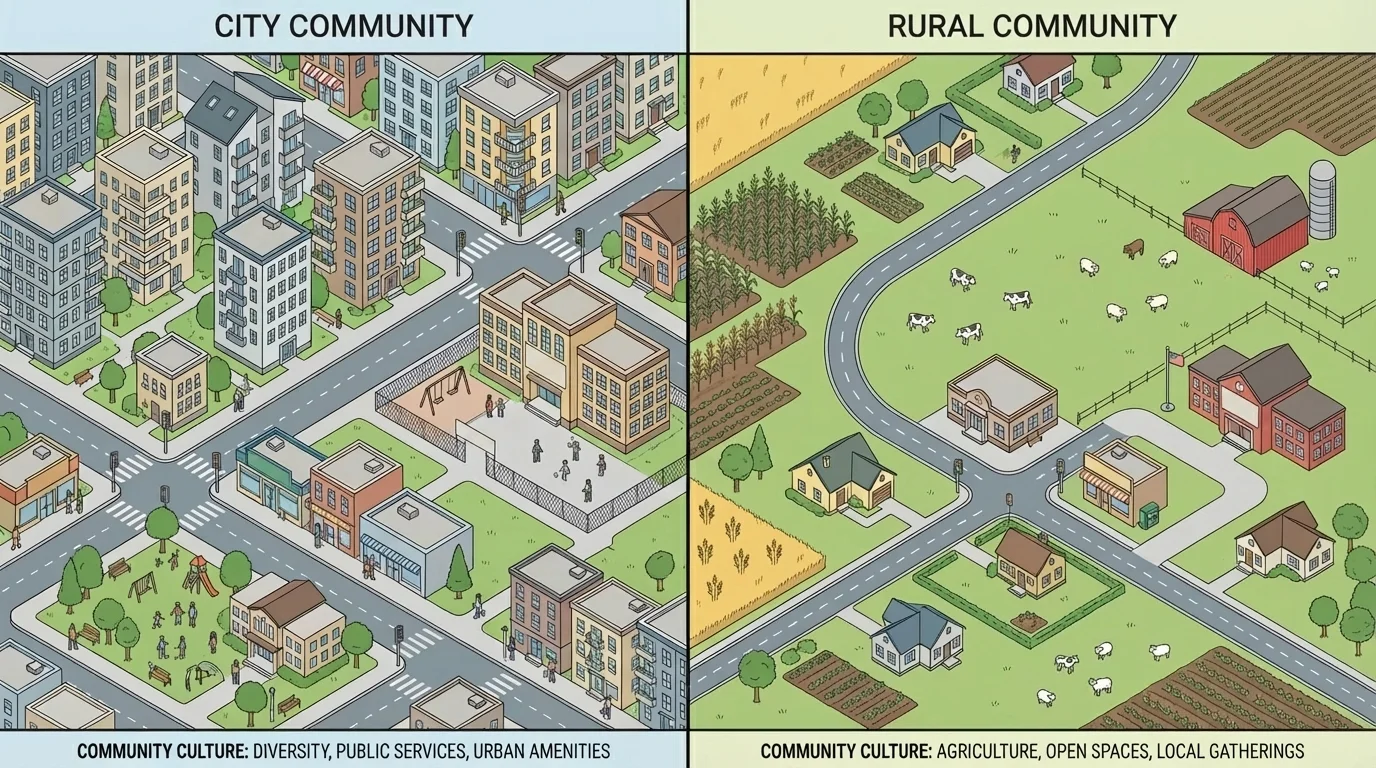
A city may be near a harbor, river, or busy road where many people can travel and work. A rural place may have rich soil for growing crops or open land for animals. This shows that where people live is often connected to the environment around them.
Some schools in very small communities have only a few classes, while schools in big cities can have hundreds of children. Both kinds of schools help students learn.
Even with these differences, people in both communities need food, shelter, safety, and friendship. They also need places to learn and have fun.
Schools can look different depending on where people live, as [Figure 2] shows. In a city community, a school may be large because many children live nearby. In a rural community, a school may be smaller because homes are farther apart.
Some city children walk to school on sidewalks or ride a city bus. Some rural children ride a school bus for a longer distance because their homes are spread out. One child may travel past tall buildings. Another child may travel past trees, fields, or animals.
Schools in both communities have teachers, books, and classrooms. Children in both places read stories, learn numbers, make art, and play with friends. They may sing songs, eat lunch, and go to recess just like students in many other places.
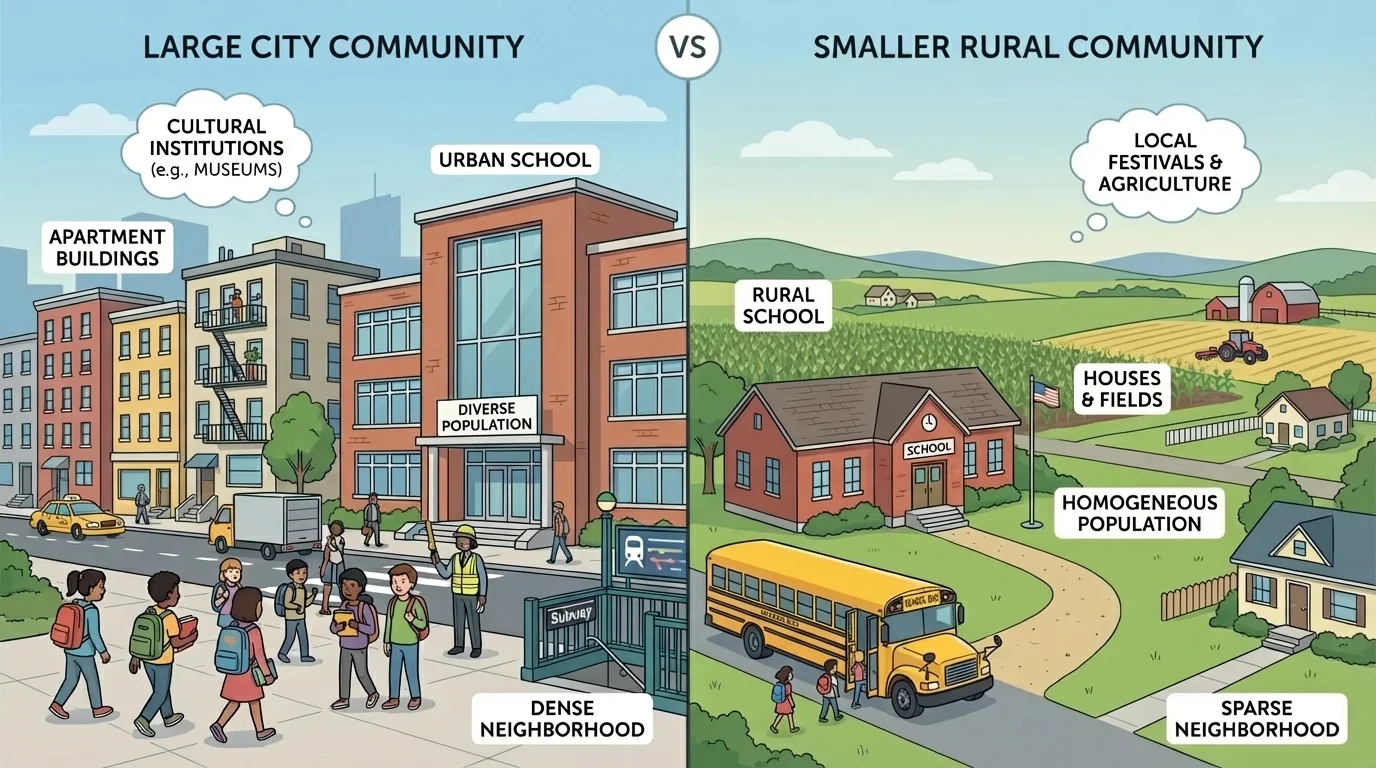
Some school spaces may be different. A city school might have a smaller playground because there is less open land. A rural school might have a bigger field because there is more space. The environment helps explain these differences.
When we think back to [Figure 1], we can understand why travel to school changes from one community to another. Places with many close buildings make walking easier, while places with homes far apart often need buses.
Example: Comparing two schools
Step 1: Look for something the same.
Both schools have teachers and students.
Step 2: Look for something different.
One school is large in a city. One school is smaller in a rural area.
Step 3: Explain why.
The city has more people living close together. The rural area has fewer people living farther apart.
This method helps us compare and contrast communities clearly. We notice what is the same, what is different, and why the difference may happen.
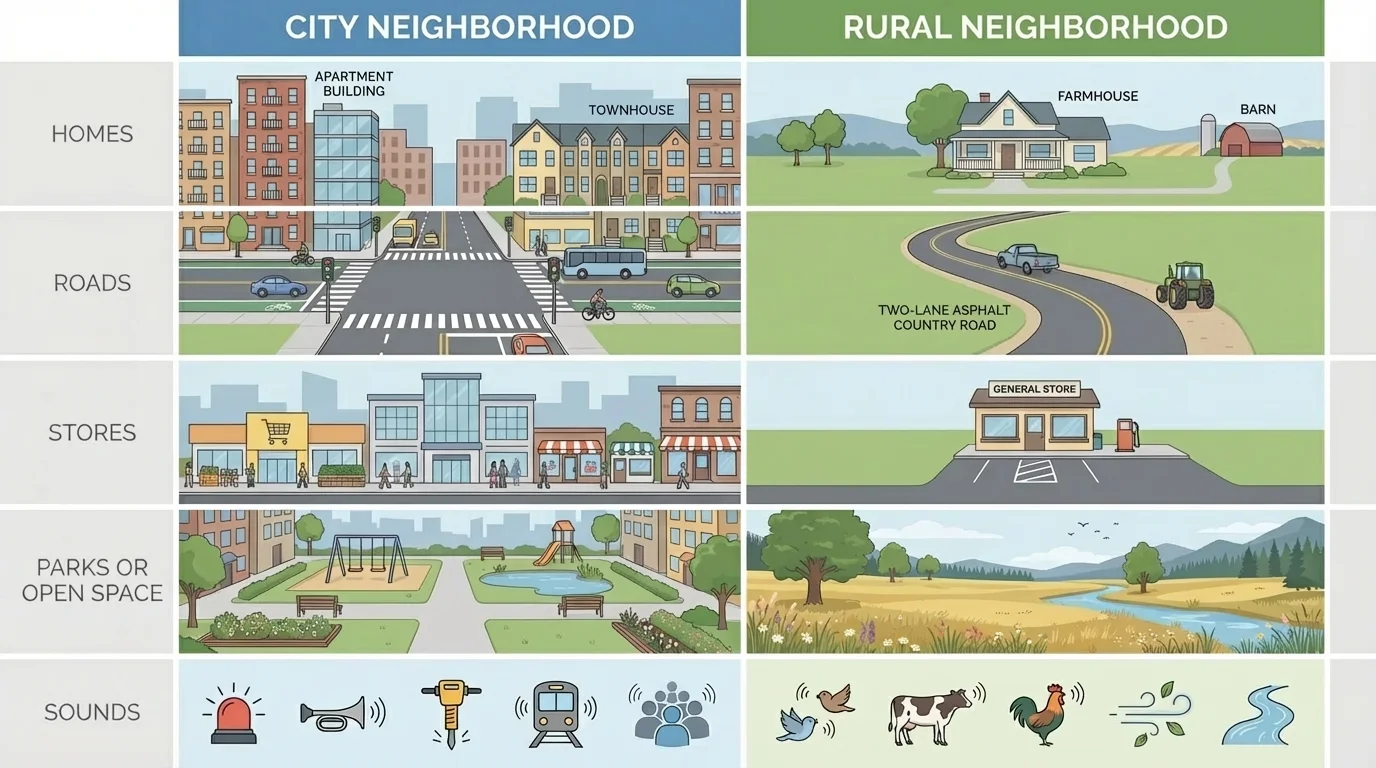
A neighborhood is the part of a community where people live near one another. The comparison in [Figure 3] helps us look closely at homes, roads, stores, and sounds in two neighborhoods.
In a city neighborhood, homes may be close together. There may be apartments, traffic lights, crosswalks, and many people walking. Stores and restaurants may be nearby. You might hear buses, cars, and many voices.
In a rural neighborhood, homes may be far apart. There may be fields, gravel roads, trees, and fewer stores close by. You might hear birds, wind, tractors, or animals. The neighborhood feels different because the land is used in a different way.
| Feature | City Neighborhood | Rural Neighborhood |
|---|---|---|
| Homes | Close together | Farther apart |
| Roads | Busy streets | Quiet roads |
| Stores | Many nearby | Fewer nearby |
| Sounds | Cars and people | Birds and farm sounds |
| Open space | Less open land | More open land |
Table 1. A comparison of neighborhood features in a city community and a rural community.
Neither neighborhood is better for everyone. Some people like being close to many places. Some people like quiet spaces and open land. Communities meet people's needs in different ways.
When we look again at [Figure 2], we also see how neighborhoods connect to schools. If homes are near the school, students may walk. If homes are spread out, students may ride longer.
Culture is the way people live, celebrate, and share traditions. Culture includes food, music, clothing, stories, holidays, languages, and special ways of doing things. Every community has culture.
Culture can be different and shared
People in different communities may eat different foods, enjoy different music, or celebrate different holidays. At the same time, many communities share important values such as family, kindness, and helping neighbors.
In a city community, people may come from many places. That can mean many languages are spoken and many kinds of food are enjoyed. A city block might have a bakery, a noodle shop, and a market all close together.
In a rural community, culture may be shaped by the land and local jobs. A harvest fair, a rodeo, or a farm market may be important events. Families may gather to celebrate seasons, crops, or community traditions.
These cultures are not exactly the same, but both are special. Children in both communities may sing songs, tell family stories, wear clothes for special days, and enjoy community celebrations. Culture helps people feel that they belong.
People can belong to many groups at once. A child can be part of a family, a classroom, a neighborhood, and a community. Each group can have its own traditions.
Sometimes communities change over time. New families move in. New foods and music arrive. New celebrations become part of community life. Culture grows as people share with one another.
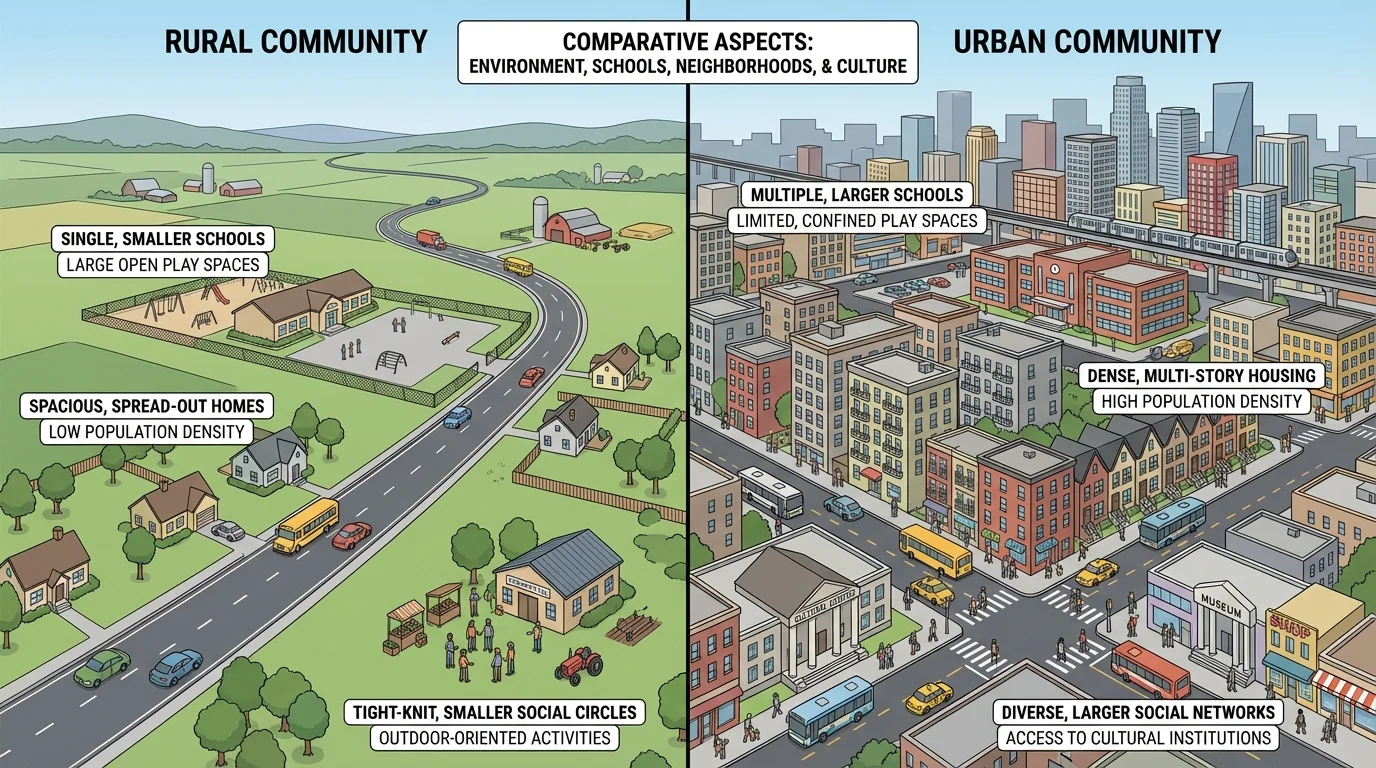
The environment is the land, water, weather, plants, and animals in a place. It helps shape homes, schools, roads, and daily life, as [Figure 4] illustrates. People build communities in ways that fit where they live.
If a place has lots of flat open land, people may build farms and homes with big yards. If a place has less space and many people, buildings may be taller and closer together. If roads are long, buses may travel farther. If stores are close, people may walk more often.
Weather can matter too. In rainy places, people may wear rain boots and build with roofs that help move water away. In snowy places, roads and schools may plan for snow. In hot places, shade and water are very important. The environment affects how people live each day.
Looking back at [Figure 3], we can see that neighborhood features often connect to the environment. Open land leads to different roads, homes, and sounds than crowded land does.
When we compare communities, we ask simple questions. What do the two places have in common? What is different? Why might that be? These questions help us understand people and places better.
A city community and a rural community are both places where people live together. Both have schools, homes, and culture. Both have people who care for children and help neighbors. But they can differ in size, travel, buildings, sounds, and traditions.
Learning about communities helps us respect others. It shows us that people can live in different ways and still share many important needs. Communities are shaped by people, and they are also shaped by the environment around them.
