Have you ever tried to build something big with blocks all by yourself and then noticed it was easier with a friend? Teams can do amazing things when people work together well. In a classroom, on a playground, or during a game, a good team helps everyone learn, share, and succeed.
A team is a group of people who work together to do something. A class can be a team. A reading group can be a team. Even two students cleaning up together can be a team. Teamwork means helping, listening, and trying to reach the same goal.
An effective team is not just a group of people standing near each other. An effective team works in a kind and responsible way. The people in the team try their best. They care about the job, and they care about one another too.
Effective team means a group that works well together to reach a goal. The people in the group listen, help, share, and act responsibly.
Good teams do not need everyone to be exactly the same. In fact, teams are often better when people bring different ideas and different strengths. One student may be good at drawing. Another may be good at reading directions. Another may be good at encouraging others.
Sometimes teammates have different ideas. That is normal. Good teamwork includes respectful disagreement, as [Figure 1] shows. This means saying what you think in a calm and kind way, while also listening to someone else's idea. You can disagree without being rude.
For example, two students are making a poster. One wants to draw the title in blue. The other wants green. Instead of shouting, they can say, "I like blue because it is easy to see," or "I think green matches the picture." Then they can choose together. They might vote, take turns, or even use both colors.
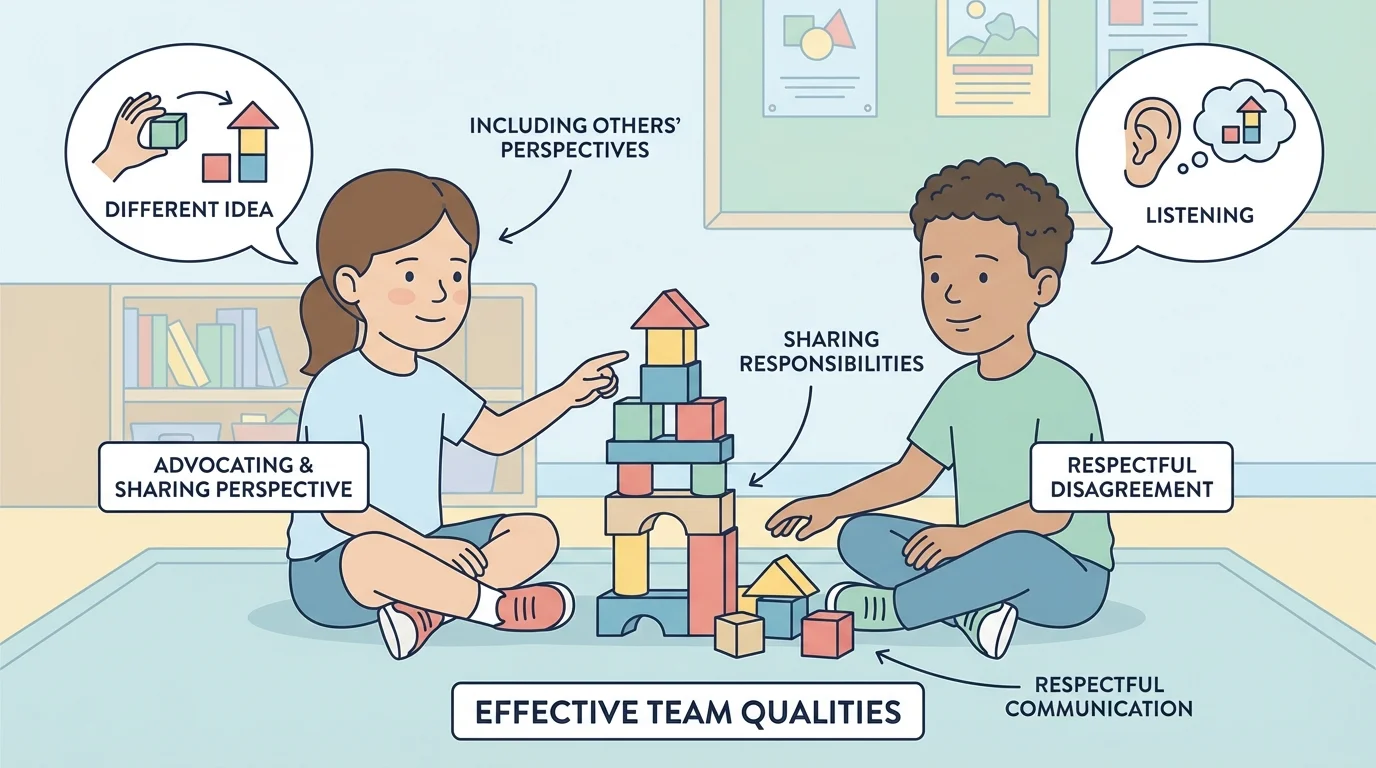
Respectful disagreement helps a team because good ideas can come from many people. If everyone had to agree right away, the team might miss a better plan. Kind words help the team stay safe and friendly while solving a problem.
Words like "I think," "Can we try," "What if," and "I hear your idea" can help. Hurtful words, yelling, or grabbing are not good teamwork. Even when we feel upset, we should try to use calm voices and gentle actions.
Classroom example
A group is choosing a book for partner reading.
Step 1: One child shares an idea kindly.
"I want the animal book because I like facts."
Step 2: Another child shares a different idea kindly.
"I want the story book because it looks fun to read aloud."
Step 3: The group solves the problem together.
They decide to read one book today and the other book tomorrow.
Later, when your class works on a project, remember the block-building idea from [Figure 1]. Different ideas do not have to cause conflict within a team. They can help the team build something even better.
A good teammate knows how to advocate. That means speaking up in a respectful way for yourself or for someone else. If you need a turn with the crayons, you can say, "May I use the red crayon next?" If a classmate is being left out, you can say, "Let's make room for Maya too."
Advocating does not mean bossing people around. It means using words to help make things fair and kind. A strong team allows people to express what they need. A strong team also notices when someone else needs help.
Speaking up helps a team
When children share their needs and help others be heard, the group works better. Problems get solved sooner, feelings are respected, and everyone has a better chance to join in.
If a teammate is quiet, a caring student might ask, "Do you have an idea?" That simple question can help another person feel brave enough to share. Responsible team members do not only think about themselves. They also watch out for others.
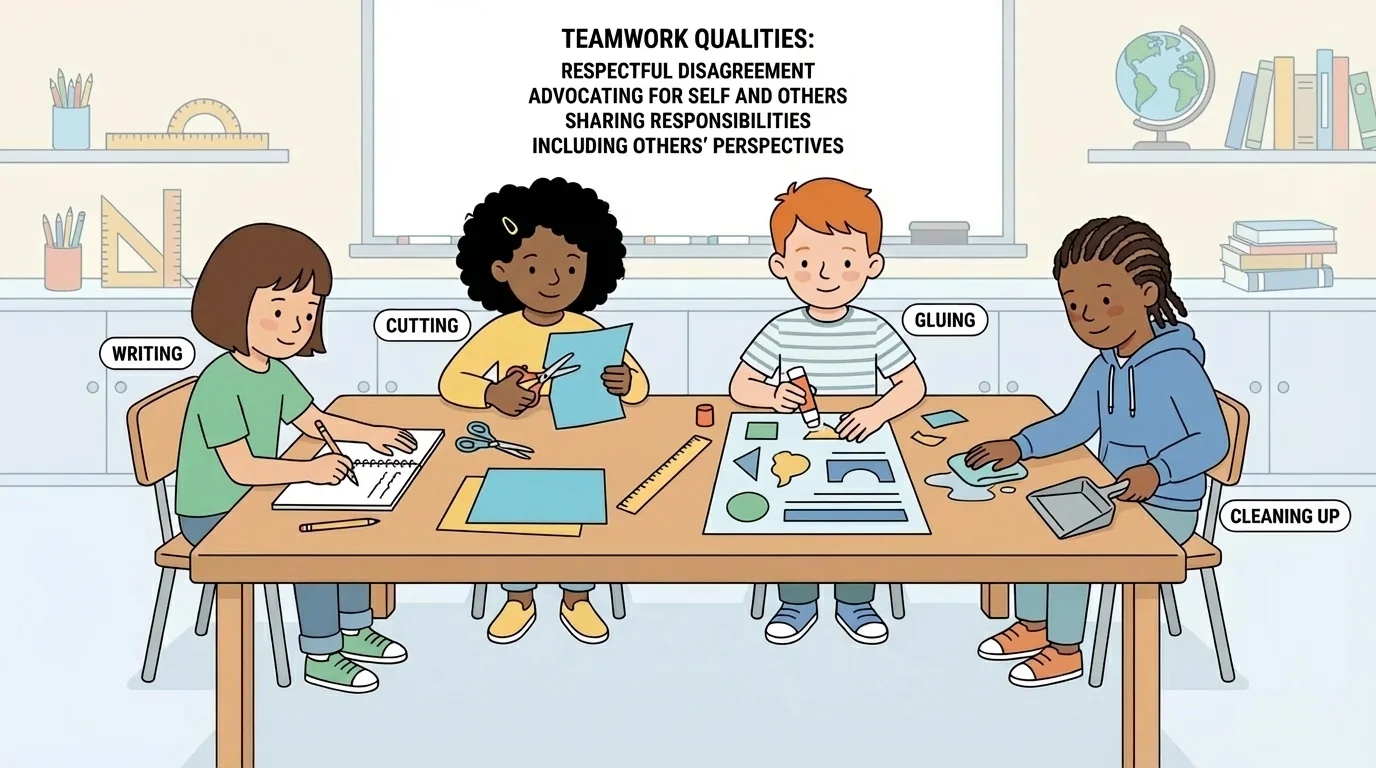
Teams work best when people share jobs, as [Figure 2] illustrates. This is called having responsibility. Responsibility means doing your part and taking care of what you are supposed to do. If one child does all the work and others do nothing, the team is not working fairly.
Imagine four students making a class collage. One student cuts paper. One student glues. One student sorts pictures. One student cleans up scraps. Each job matters. When everyone helps, the work gets done more smoothly.
Sometimes a job feels small, but it is still important. Passing out papers, putting away markers, or holding the book open can help the whole group. In a team, no helpful job is too little.
Sharing responsibilities also means finishing what you start. If you promise to stack the books, then stack the books. Teammates learn they can trust you. Trust helps a group stay strong.
| Team habit | What it looks like |
|---|---|
| Sharing jobs | Each person has something helpful to do |
| Doing your part | You finish your job carefully |
| Helping fairly | No one is left with all the work |
| Being dependable | Others know they can count on you |
Table 1. Ways team members show responsibility during group work.
Think again about the classroom team in [Figure 2]. The group succeeds not because one child does everything, but because everyone contributes. That is one big sign of an effective team.
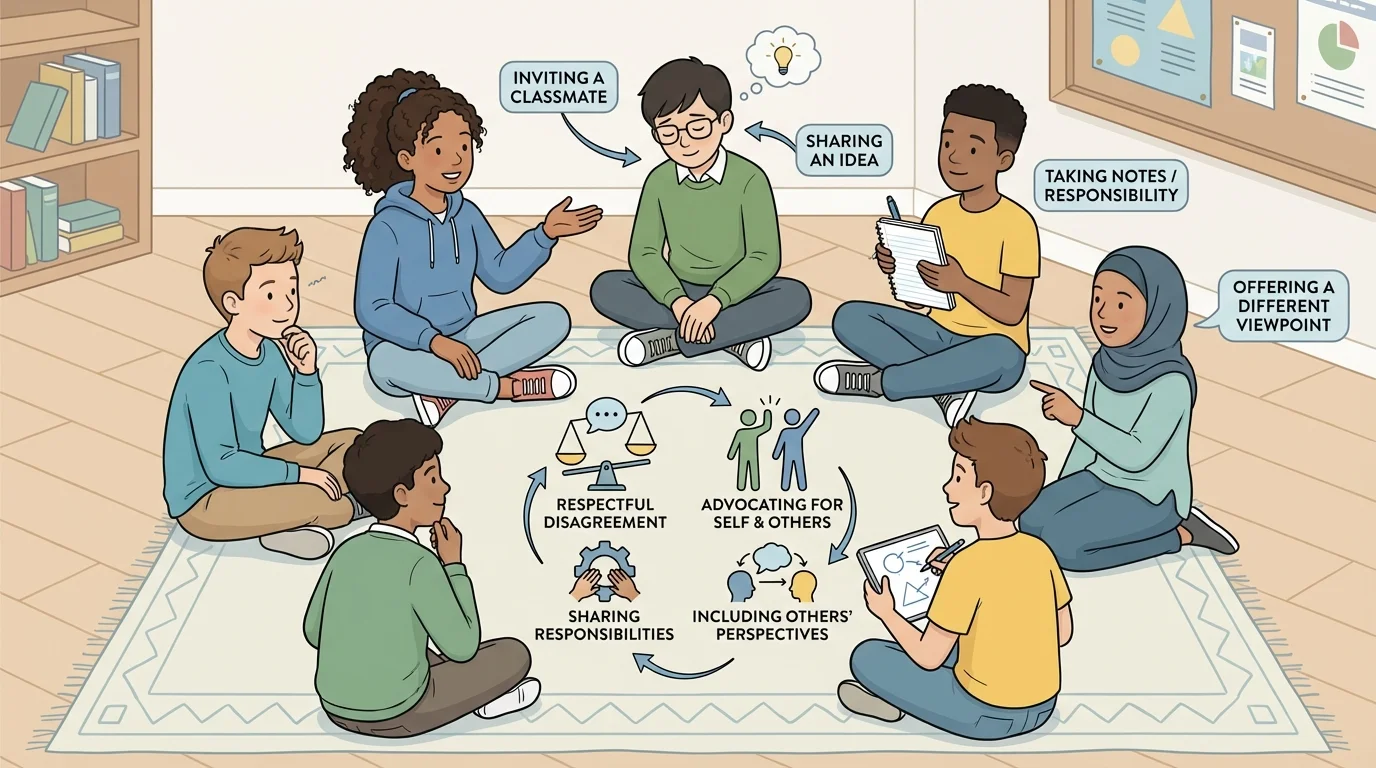
Good teams welcome different perspectives, as [Figure 3] shows. A perspective is the way someone thinks or sees something. One child may notice color. Another may notice shape. Another may think about safety. When the team listens to many perspectives, it can make smarter choices.
Including others means more than letting them sit nearby. It means inviting them in. It means making sure each person has a turn to speak, a chance to help, and a place in the group.
Suppose a group is planning how to care for a class plant. One student says it needs water. Another says it needs sunshine. Another says someone should remember to check the soil. Each idea adds something useful. By listening to all three, the team makes a better plan.
Including others also means noticing who is not joining in. Maybe someone is shy. Maybe someone is new to the class. Maybe someone needs extra time to think. A kind team waits, listens, and makes space for everyone.
Groups often do better when they hear many ideas instead of only one. Different perspectives can help a team spot problems, fix mistakes, and create better plans.
When you see the discussion circle in [Figure 3], you can notice that listening is just as important as speaking. A team grows stronger when every member feels seen and heard.
Effective groups have responsible leaders and responsible team members. A leader helps the group stay focused, kind, and organized. A leader might remind everyone of the goal, help solve problems, or make sure everyone gets a turn.
But leaders are not the only important people in a group. Every team member matters. Good team members listen, follow directions, share ideas, and complete their jobs. A great group needs both: a leader who guides and team members who participate responsibly.
"We can all help the team."
A responsible leader does not boss others around. A responsible leader is fair. The leader listens, encourages, and includes people. In the same way, responsible team members do not wait for others to do everything. They join in and help the group succeed.
You use teamwork often at school. During clean-up time, effective teams put things away quickly because everyone helps. During partner reading, effective teams take turns and listen carefully. During art, effective teams share supplies and respect one another's ideas.
On the playground, teamwork matters too. If children are choosing a game, they can use respectful disagreement. If someone is left out, they can advocate for that person. If equipment needs to be carried, they can share the responsibility. If rules need to be explained, a leader can help fairly.
Remember: Being kind is part of being responsible. In a team, kindness helps people feel safe enough to share, listen, and work together.
Teams are strongest when members are kind, fair, helpful, and willing to listen. They do not have to be perfect. They just need to keep trying to work together in a respectful way.
