Have you ever seen someone help a group solve a problem on the playground or in the neighborhood? A person who listens, speaks up, and helps others can be a leader. Some leaders help not just one class or one street, but whole towns, states, and even the country.
A civic leader is a person who helps people in a community work together. Civic leaders care about fairness, safety, rules, and helping others. They may be mayors, teachers, activists, judges, faith leaders, or neighbors who speak up for what is right.
Good civic leaders listen to people, try to solve problems, and help everyone feel important. They show values our country cares about, such as fairness, freedom, respect, and responsibility.
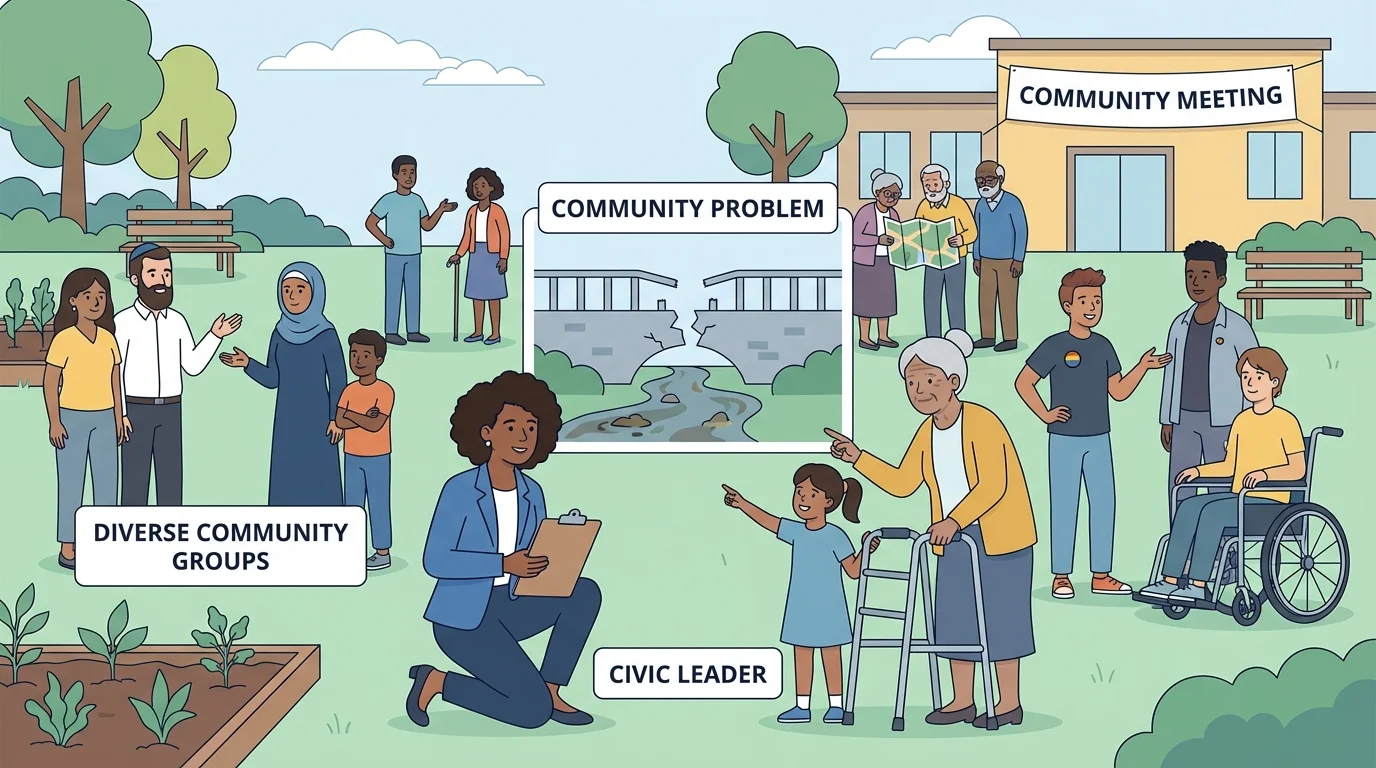
Leader means someone who helps guide others. Citizen means a member of a country or community. Rights are things people should be able to have or do, like being treated fairly and speaking their ideas.
People from many backgrounds have been civic leaders. They may come from different races, cultures, religions, languages, or families. Their differences are important because a community is made of many kinds of people.
In a democracy, people matter. Leaders help make sure voices are heard. Some leaders work so people can vote. Some help children get better schools. Some protect land, water, or places that are special. Others stand up so people are not treated badly because of who they are.
When we learn about leaders, we learn about our country's values. We see that the government and its citizens care about justice, helping others, and making rules that protect people. Civic leaders remind us that one person can make life better for many others.
Why many kinds of leaders are important
When leaders come from different community groups, they can speak about different experiences. This helps communities make wiser and kinder choices. It also helps children see that leadership belongs to everyone.
Some leaders are famous all across the country. Others are especially important to one city, tribe, island, church, synagogue, mosque, or neighborhood. All of them can be notable if they help others and improve civic life.
Our country has notable leaders from many groups. Each leader helped people in a special way. They show courage, care, and service.
Martin Luther King Jr. was an African American civic leader. He worked for civil rights, which means fair treatment under the law. He spoke peacefully and bravely so Black Americans would have equal rights. Today we remember him on a holiday because his work helped our country move closer to fairness.
Dolores Huerta is a Latina civic leader. She helped farm workers, many of whom worked very hard for low pay and unsafe conditions. She organized people so workers could be treated more fairly. Her work shows that leaders can help people whose jobs are difficult.
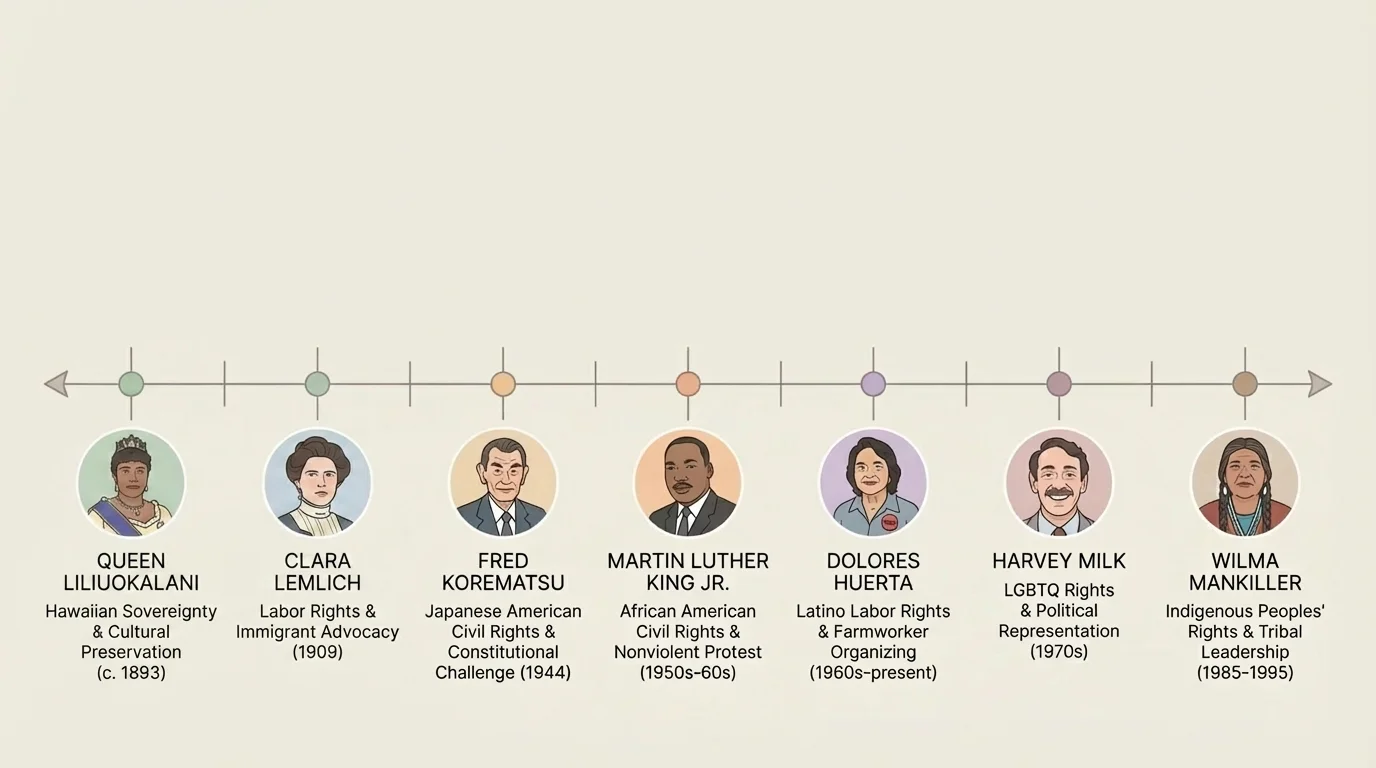
Fred Korematsu was an Asian American civic leader. He stood up when Japanese Americans were treated unfairly during World War II. He reminds us that the government must protect people's rights, even in hard times.
Queen Liliuokalani was a Hawaiian leader and an important figure for Hawaiian and Pacific Islander history. She cared deeply about her people and their land. Learning about her helps us remember that leaders can protect culture, history, and the rights of island communities.
Wilma Mankiller was an Indigenous leader and the first woman elected principal chief of the Cherokee Nation. She worked to improve health, education, and community life. She shows how tribal leaders help their nations grow strong.
Harvey Milk was an LGBTQ civic leader. He spoke up so people would not be treated unfairly because of who they are. His work helped many people feel seen and included in community life.
Clara Lemlich was a Jewish immigrant and labor leader. She helped workers ask for safer workplaces and better treatment. She is one example of a leader from a religious minority whose faith and background were part of her story. Religious minorities include groups such as Jews, Muslims, Sikhs, and others whose beliefs may be different from those of many neighbors.
Some civic leaders were not very old when they began to help others. Leadership does not begin with being famous. It often begins with noticing a problem and caring enough to act.
These leaders came from different groups, but they share something important: they worked for the good of others. They did not all do the same job, and they did not all live in the same place. Still, they each helped make communities fairer and stronger.
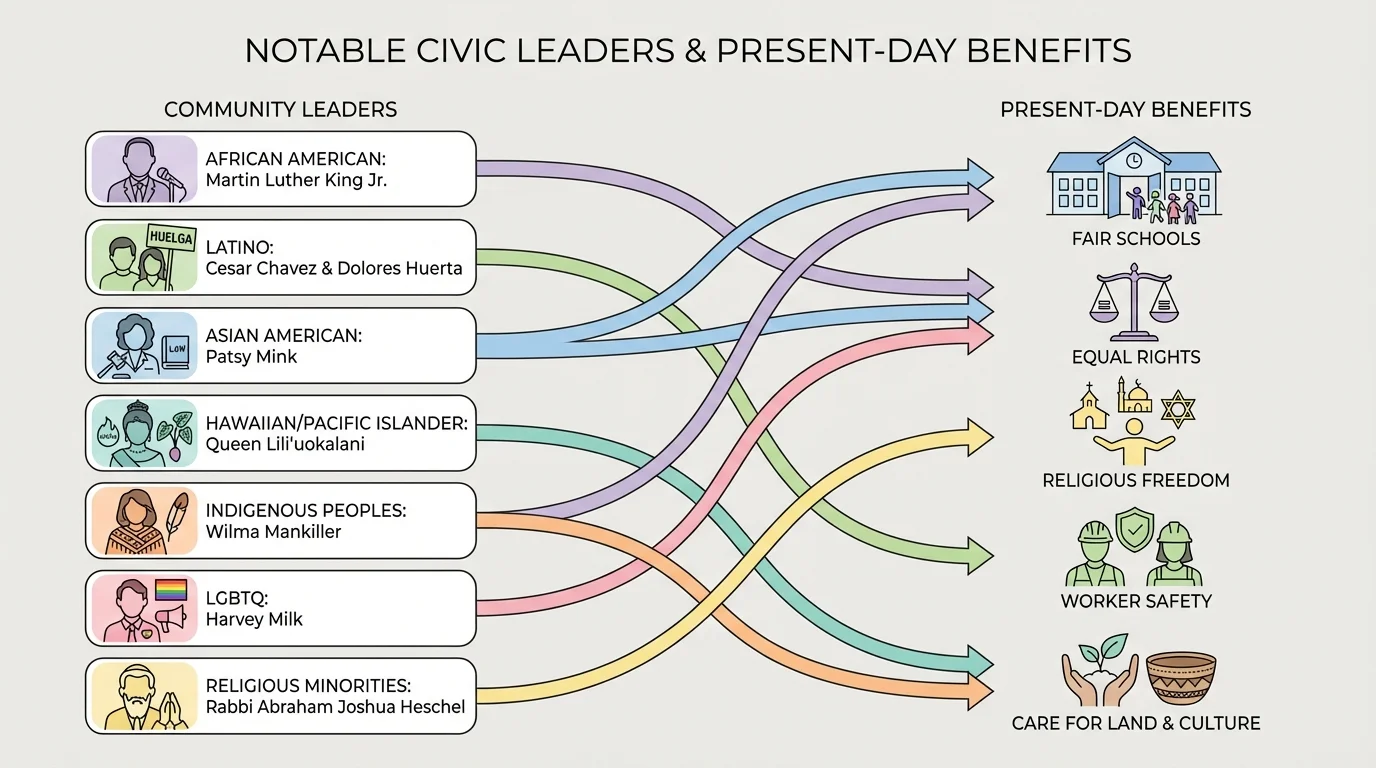
The work of these leaders still matters now. Their efforts connect to things we care about today. When schools welcome all children, when neighborhoods protect people's rights, and when communities respect different religions and identities, we can see the lasting impact of civic leadership.
Martin Luther King Jr. helps us think about equal treatment. Dolores Huerta helps us think about workers and fairness. Fred Korematsu helps us remember that fear should not take away people's rights. Queen Liliuokalani and Wilma Mankiller help us honor land, culture, and self-government for Native and island communities. Harvey Milk helps us remember inclusion. Clara Lemlich helps us remember both worker rights and respect for people from minority faith groups.
When we study these leaders, we also study the values of the nation: liberty, equality, justice, and respect. These are big ideas, but children see them in simple ways too: taking turns, telling the truth, welcoming others, and helping someone who is left out.
Example: How one leader's work can help many people
Step 1: A leader notices a problem.
A group of workers is not being treated fairly.
Step 2: The leader speaks up and brings people together.
This is what Dolores Huerta did for farm workers.
Step 3: The community makes changes.
Workers can become safer and be treated with more respect.
This shows why civic leaders matter in everyday life.
Later, when we think again about the community meeting in [Figure 1], we can see that leadership starts with listening. Big changes often begin with caring about one small problem and helping people work together.
You may be young, but you can practice leadership every day. You can listen when others speak. You can include someone new in a game. You can respect people whose family, language, religion, or identity is different from yours.
You can also care for the places around you. Picking up litter, protecting water, and respecting important community places are civic actions. Leaders like Wilma Mankiller and Queen Liliuokalani teach us that caring for people and caring for place belong together.
"Our lives begin to end the day we become silent about things that matter."
— Martin Luther King Jr.
Looking back at the leaders in [Figure 2], we notice that they did not all lead in the same way. Some gave speeches. Some organized workers. Some led tribal nations. Some went to court. Some helped people feel safe to be themselves. There are many good ways to serve a community.
When communities honor notable civic leaders, they show what they value. Holidays, memorials, books, and lessons teach us that courage, fairness, freedom, and respect matter. Learning about leaders from African American, Latino, Asian American, Hawaiian/Pacific Islander, Indigenous Peoples, LGBTQ, and religious minority groups helps us understand the full story of our country and its people.
