Have you ever walked down a street and seen a mural, smelled different foods cooking, or heard more than one language being spoken? That is a clue that a community is full of many stories. Neighborhoods are not made by buildings alone. They are made by people. As families live, work, celebrate, worship, and help one another, they shape the place where they live.
A community is a place where people live, learn, work, and spend time together. A community can be a neighborhood, a town, or part of a city. People in a community may have different backgrounds, but they share spaces such as homes, parks, schools, libraries, stores, and places of worship.
Neighborhood means a smaller area where people live near one another. Culture means the ways a group of people live, including language, food, music, clothing, celebrations, stories, and beliefs. Migration means moving from one place to another to live.
Communities become richer when people bring many kinds of experiences. One family may teach neighbors a new recipe. Another may start a dance group. Someone else may help build a garden or lead a holiday celebration. Over time, these actions become part of the neighborhood's story.
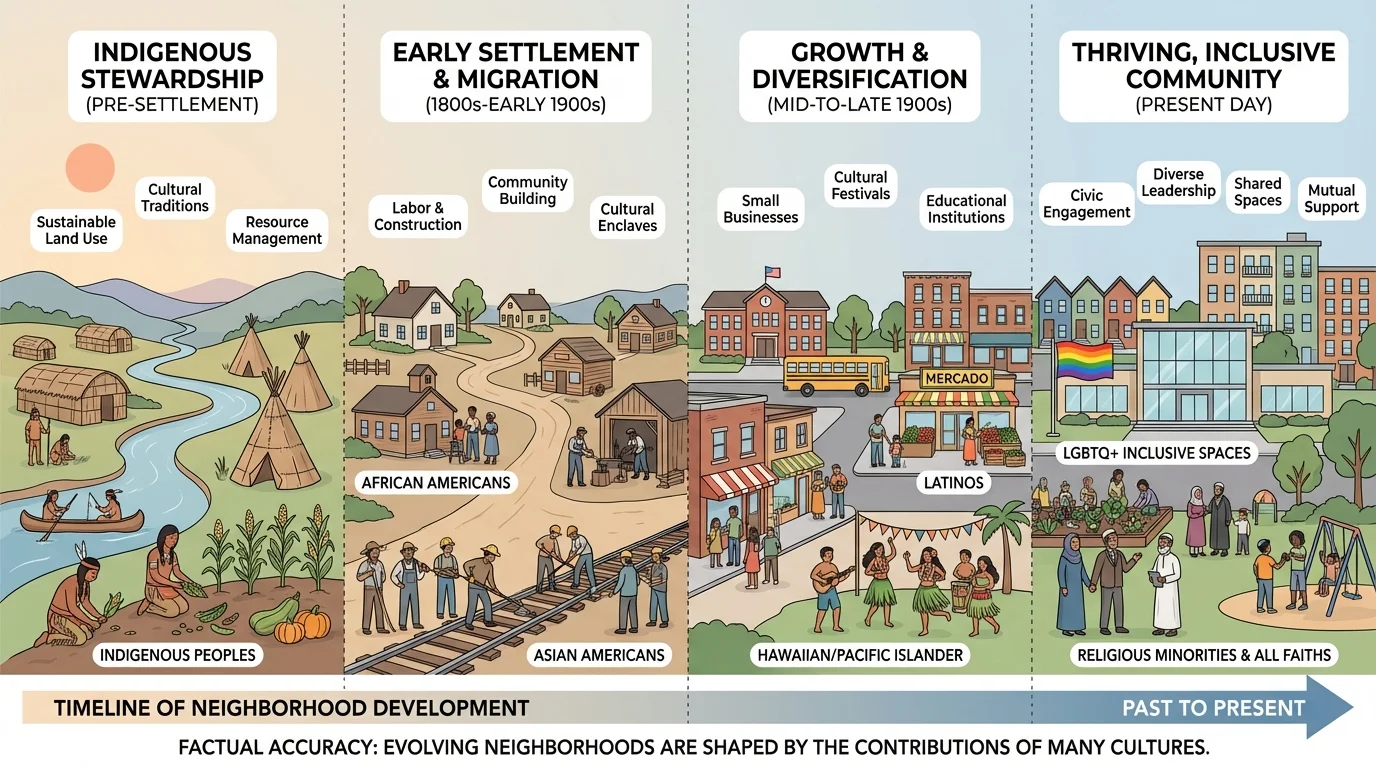
Long ago, many places in the United States were the homelands of Indigenous Peoples. They cared for land, water, plants, and animals, and built strong communities long before other groups arrived. Later, other people moved into these places. [Figure 1] Some came by choice to find jobs, safety, or new opportunities. Some, like many Africans, were forced here through slavery. As more people arrived, neighborhoods changed over time, and one place could grow from early homelands into a busy community with many kinds of people and places.
When new families move in, they may open businesses, join schools, create art, or start traditions. A street might gain a bakery, a market, a barbershop, or a festival. A community can change slowly over many years, or quickly when many people move there at once. These changes become part of local history.
Sometimes change can be hard. People may speak different languages or have different customs. But communities grow stronger when people listen, learn, and make space for everyone. Sharing does not mean people become the same. It means people can keep what is special to them while also being good neighbors.
Some neighborhoods are known for special foods, music, festivals, or art because families from many places brought those traditions with them and shared them over generations.
History helps us see that a neighborhood today is the result of many people's choices, struggles, and contributions. The parks, schools, buildings, and traditions around us did not appear all at once. They were built and shaped over time by many hands.
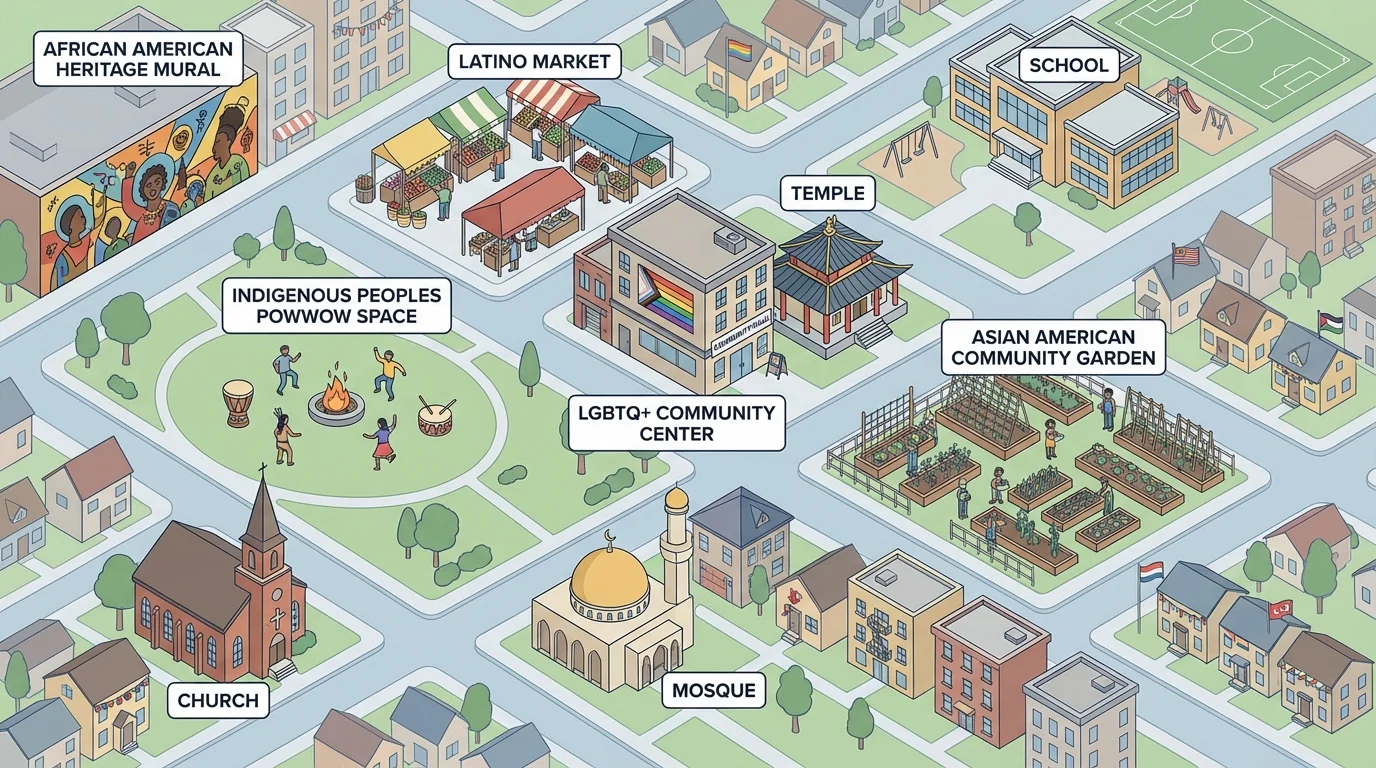
[Figure 2] Many groups help shape neighborhoods. In one community, you might find a mural painted by local artists, a store with foods from many countries, and a school event where families share songs and stories. A neighborhood map makes it easier to notice how many different places in one community connect to culture, history, and daily life.
African Americans have helped build communities in countless ways. They have created churches, schools, music traditions, businesses, newspapers, and civil rights groups. African American leaders and families worked hard for fairness, voting rights, and equal treatment. Their influence can be seen in jazz, gospel, literature, food, sports, art, and neighborhood activism.
Latinos have also shaped neighborhoods through language, family traditions, farming, construction, food, festivals, music, and community leadership. In many places, Latino families have opened markets and restaurants, celebrated with parades, and helped schools and neighborhoods stay connected and strong.
Asian Americans have contributed through businesses, railroad construction in the past, farming, technology, science, art, and local cultural centers. Families from China, Japan, Korea, the Philippines, India, Vietnam, and many other places have brought traditions that became part of community life. Lunar New Year celebrations, gardens, tea shops, temples, and family-owned stores are just a few examples.
Hawaiian/Pacific Islander people have shared strong traditions of family, dance, music, navigation, and care for land and ocean. In communities where they live, they may celebrate with special songs, flower garlands, food, and gatherings that teach younger generations about heritage and respect.
As we saw earlier in [Figure 1], communities often begin with the first people of the land. Indigenous Peoples continue to shape communities today by protecting languages, telling stories, making art, caring for the environment, and leading cultural events such as dances, fairs, or powwows. Their history is not only in the past. It is still alive.
LGBTQ people are also part of many neighborhoods and communities. They are teachers, artists, doctors, parents, helpers, leaders, and friends. LGBTQ people have worked for fairness, safety, and the right to be themselves. When communities respect people for who they are, everyone has a better chance to belong.
religious minorities are people whose religion is different from the religion followed by most people around them. They may be Jewish, Muslim, Sikh, Hindu, Buddhist, or belong to other faiths. Religious minorities contribute by building places of worship, helping neighbors, sharing celebrations, giving to charity, and teaching values such as kindness, peace, and service.
Many cultures, one shared place
A neighborhood does not belong to only one story. It is built from many stories at once. Different groups may have different holidays, foods, clothing, music, or beliefs, but they all help shape the same streets, schools, and parks. A strong community makes room for these differences and learns from them.
Looking again at [Figure 2], we can see that culture is not only inside homes. It appears in public places too. Murals on walls, foods in markets, books in libraries, and songs at festivals all show who has lived in or moved into a neighborhood.
People in communities interact every day. They greet neighbors, learn together in school, work at stores, ride buses, and play in parks. When people from different cultures spend time together, they often share ideas and traditions. A child might learn a greeting in another language. A family might try a new food at a street fair. A class might hear a folktale from a grandparent visitor.
Interactions can also mean helping solve problems. Neighbors may work together to clean a park, protect a playground, or make sure everyone is treated fairly. People do not always agree, but communities become stronger when they listen and act with respect.
Music is one way cultures meet. African American music styles such as jazz and blues influenced songs across the country. Latino rhythms and dances are celebrated in many cities. Asian instruments and melodies are heard in concerts and festivals. Indigenous drumming and songs carry history and meaning. Hawaiian and Pacific Islander dance and music tell stories about land, family, and ocean.
Food is another way people connect. A neighborhood may have tacos, noodles, fry bread, barbecue, lumpia, or dishes shared during religious holidays. Food can teach history. It can show where families came from, what they value, and what they remember.
| Group | Examples of contributions |
|---|---|
| African Americans | Music, art, churches, civil rights work, businesses, literature |
| Latinos | Language, food, markets, festivals, farming, community leadership |
| Asian Americans | Businesses, technology, farming, cultural celebrations, art |
| Hawaiian/Pacific Islander | Dance, music, storytelling, family traditions, care for land and sea |
| Indigenous Peoples | Stewardship of land, languages, art, stories, cultural gatherings |
| LGBTQ people | Leadership, advocacy, art, teaching, creating welcoming spaces |
| Religious minorities | Places of worship, charity, holidays, service, community support |
Table 1. Examples of how different groups contribute to neighborhoods and communities.
These examples are not the only contributions people make. Every community has its own local story. One group might be especially known for music in one city, while in another place the same group may be known for farming, teaching, or leading neighborhood projects.
[Figure 3] History includes people who helped make communities more fair and welcoming. A timeline helps us notice that different people, from different backgrounds, made important changes at different times. Their actions remind us that communities are shaped not only by daily life, but also by brave choices.
Sacagawea, a Lemhi Shoshone woman, helped guide and support the Lewis and Clark expedition, and her knowledge of the land and travel routes was important. Harriet Tubman, an African American woman, escaped slavery and helped others seek freedom. César Chávez, a Latino labor leader, worked for fair treatment of farmworkers. Yuri Kochiyama, a Japanese American activist, stood up for civil rights and justice. Harvey Milk, a gay leader, spoke for equal rights and representation.
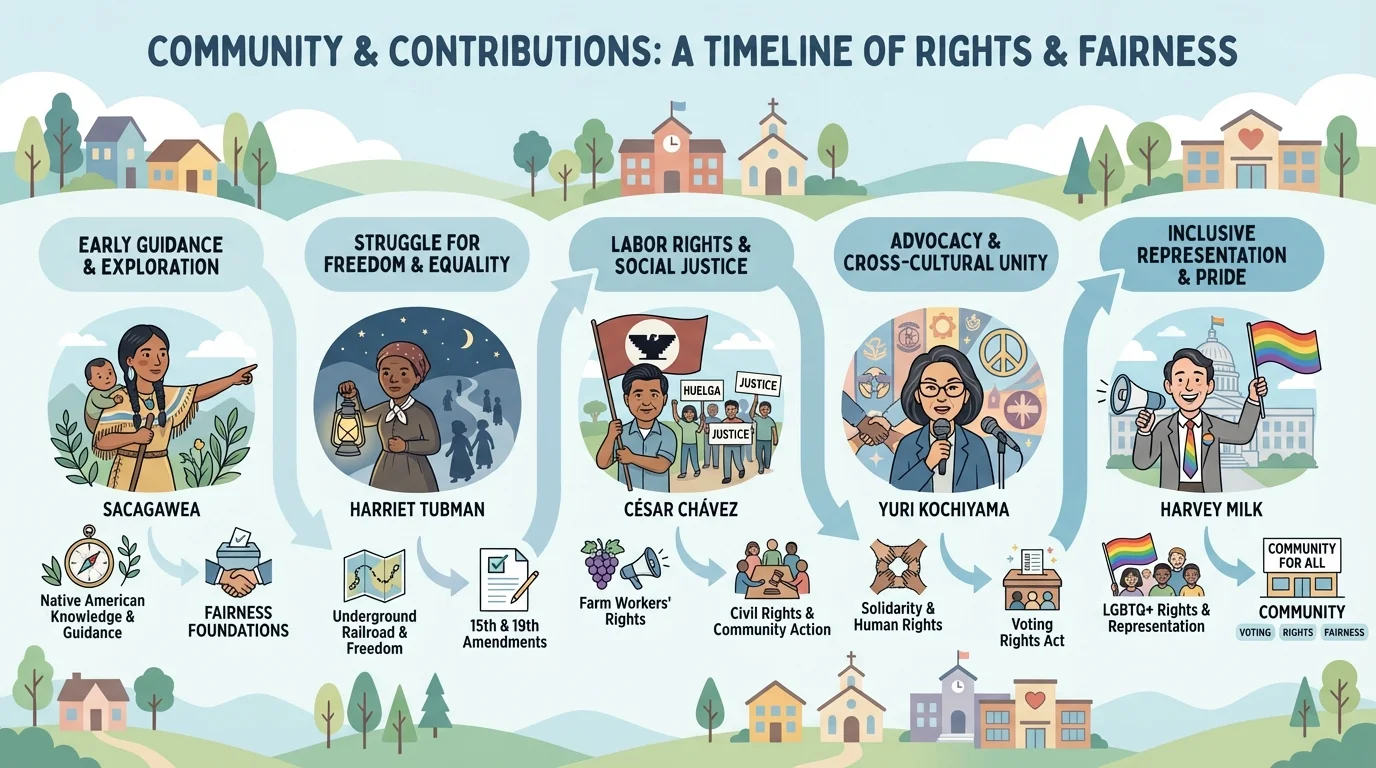
These people lived in different times and places, but they all influenced communities. Some helped others travel safely. Some fought unfair laws. Some encouraged people to speak up. Their lives show that history is made by ordinary people who choose to help others.
Community history case study
A neighborhood has a park, a mural, a weekend market, and a place where families gather for celebrations. How might different groups have helped shape it?
Step 1: Look for clues in the community.
A mural may show local heroes or cultural symbols. A market may sell foods from many traditions. A celebration space may be used for festivals or religious events.
Step 2: Think about who contributed.
Artists, families, workers, faith leaders, activists, and business owners may all have helped create these places.
Step 3: Connect the place to history.
If a mural honors civil rights leaders, that shows how people remember struggles for fairness. If a market has foods from many countries, that shows migration and cultural sharing.
This helps us understand that a neighborhood's history lives in the places people use every day.
Another important part of history is learning that some groups were treated unfairly. Segregation, exclusion, and prejudice hurt communities. People worked hard to change unfair rules and attitudes. Because of that work, more people can take part in schools, jobs, voting, and public life.
When we look back at the timeline, we can see that fairness did not happen all at once. It took many people, over many years, to make communities more just. That work continues today.
To learn about the past, historians use primary sources and secondary sources. A primary source is something made by a person who was there, such as a photograph, diary, letter, map, song, or interview. A secondary source is something created later to explain the past, such as a history book or a video about an event.
You have already learned that the past can be studied through objects, pictures, and stories. Sources help us ask, "Who lived here?" "What did they do?" and "How did they change the community?"
If we wanted to study a local neighborhood, we might look at old photographs, newspaper articles, signs, buildings, oral histories, or flyers from festivals. These sources can tell us who moved there, what languages were spoken, what jobs people did, and what changes mattered most.
Using more than one source is important because every source shows only part of the story. To understand a whole community, we need many voices, especially voices that were sometimes left out in the past.
A caring community includes people of different cultures, races, religions, languages, and identities. Being a good neighbor means showing respect, listening carefully, and treating others fairly. It also means noticing when someone is left out and helping them feel welcome.
Children help shape communities too. They can learn people's names, respect different holidays, listen to family stories, and care for shared spaces. Every act of kindness adds to the neighborhood story.
"We all do better when we all belong."
When people understand one another, communities become stronger, safer, and more joyful. The history of a neighborhood is really the history of many people living side by side, sharing space, solving problems, and building something together.
