Have you ever had a great idea at the exact same time as someone else? In a classroom, on a playground, or at home, many people can have different thoughts about what should happen next. That is normal. What matters is how we share those thoughts. When people speak kindly and listen carefully, their ideas can help everyone.
Every person has thoughts, feelings, and experiences. These help shape what we think. An idea might be something simple, like where to put classroom books. A viewpoint might be how you feel about a rule, a game, or a way to solve a problem. Children and adults both have ideas that can make a group stronger.
In a community, people work better together when they share their thoughts clearly. A class is a community. A family is a community. A neighborhood is a community too. If no one speaks up, good ideas may stay hidden. If people speak up in hurtful ways, others may stop listening. Respect helps ideas travel from one person to another.
Idea means a thought or plan in your mind.
Viewpoint means what a person thinks or feels about something.
Respect means showing care for other people through your words and actions.
Communication means sharing information, thoughts, or feelings with others.
Respectful communication does not mean everyone agrees all the time. It means people can share honestly without being mean. You can say what you think and still be kind. You can disagree and still show care.
A viewpoint comes from what a person knows, sees, needs, or believes. One child may think recess should be longer because playing helps them feel calm. Another child may think reading time should be longer because they love books. Both children have real reasons for their viewpoints.
Sometimes people have different viewpoints because they notice different parts of the same problem. For example, if the lunch line is too noisy, one student may think, "We need a quieter line." Another may think, "We need to move faster." Both are trying to help. Looking at more than one viewpoint can lead to a better answer.
When we understand that different people may think differently, we become more patient listeners. We stop thinking only, "I am right," and begin thinking, "Let me understand your reason too." That helps communities grow stronger.
People can express thoughts in many ways, as [Figure 1] shows. Some people like to speak in front of a group. Others may feel more comfortable writing, drawing, or talking with one person first. What matters most is that the message is clear and respectful.
One way is by speaking. A student may raise a hand and say, "I think we should make teams fairly." Another way is by writing. A child may write a note to the teacher with a class idea. A person can also draw a picture or make a poster to explain a plan. Some groups vote after listening to everyone's ideas. Voting is one peaceful way to make a choice together.
There are also action-based ways to express ideas. Helping clean a park, making a kindness sign, or joining a class meeting are ways to show what matters to you. Actions should be peaceful and safe. Respectful actions help others understand your viewpoint without causing harm.
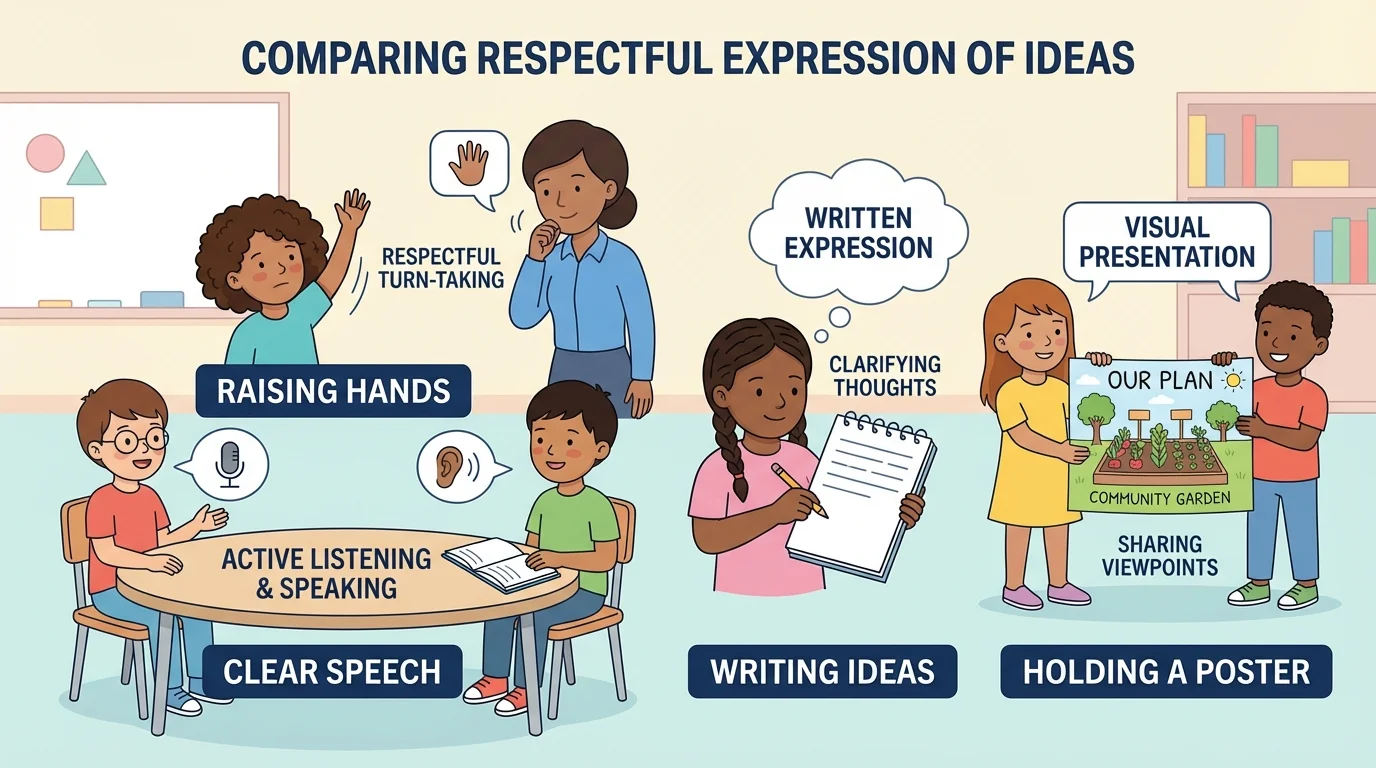
Different ways of expressing ideas can be helpful in different situations. If you have a quick thought during a discussion, speaking may work best. If your idea has several parts, writing may help you organize it. If you want to persuade others, a clear drawing or poster may make your message easy to understand.
Example: One problem, many respectful ways to share a solution
The class notices that crayons are often left on the floor.
Step 1: A student speaks during class meeting.
They say, "I think we need a crayon bin on each table."
Step 2: Another student writes a note.
The note says, "We could have two helpers check the floor before recess."
Step 3: Another student draws a poster.
The poster reminds everyone: "Put crayons back when you finish."
All three students share ideas in different ways, but each way is respectful and helpful.
As we saw in [Figure 1], speaking is not the only useful method. Writing, drawing, listening, and peaceful action also help people take part in community decisions.
Words are important, but faces and actions matter too, as [Figure 2] illustrates. A respectful speaker uses a calm voice, waits for a turn, and looks ready to listen. A respectful listener keeps their body still, looks at the speaker, and does not interrupt.
Helpful sentence starters can make a big difference. You might say, "I think...," "I feel...," "I noticed...," or "Can we try...?" These starters focus on the idea instead of attacking the person. For example, "I think we need a quieter line" is kinder than "You are all too loud."
Tone means how your voice sounds. The same words can feel very different when spoken in a gentle or angry tone. Body language matters too. Crossing arms, rolling eyes, or pointing in someone's face can feel rude. Nodding, waiting, and facing the speaker show respect.
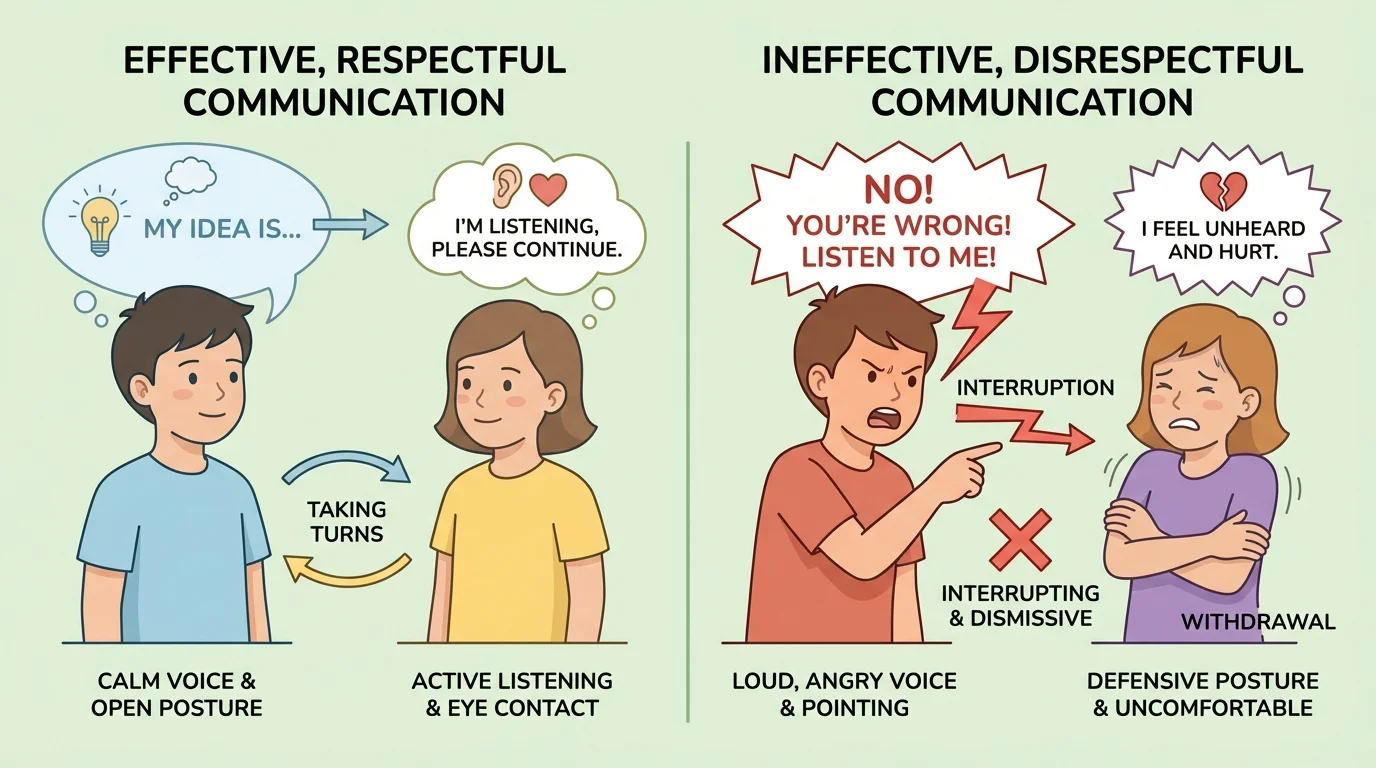
Respectful communication also includes listening. Listening does not mean you must agree. It means you are giving the other person a fair chance to be heard. Good listeners think, "What is this person trying to tell me?" instead of planning a rude comeback.
Respectful disagreement means saying you do not agree without hurting the other person. You can disagree with an idea while still treating the speaker kindly. This helps groups solve problems instead of starting arguments.
Later, when students return to a class discussion, the behaviors in [Figure 2] still matter. Calm faces, turn-taking, and careful listening help ideas get heard. Interrupting and angry pointing usually stop people from working together.
Not every way of expressing a viewpoint works well. Some ways build teamwork. Other ways create hurt feelings. When we compare them, we can see why respect is so important.
| Way to express an idea | How it sounds or looks | What may happen next |
|---|---|---|
| Respectful speaking | "I think we should take turns." | Others are more likely to listen. |
| Respectful writing | A clear note with a suggestion | The idea can be read carefully. |
| Respectful listening | Quiet body, eyes on speaker | People feel heard and valued. |
| Interrupting | Talking over someone | The group may feel frustrated. |
| Name-calling | Using hurtful words | Feelings are hurt and the problem remains. |
| Yelling | Loud, angry voice | People may stop listening. |
Table 1. Comparison of respectful and disrespectful ways to express ideas and their possible results.
Respectful ways often lead to problem-solving. Disrespectful ways often lead to bigger problems. If someone shouts, other people may become upset or defensive. If someone explains their idea kindly, the group can focus on the issue instead of the conflict.
This does not mean respectful speaking is always easy. Sometimes people feel angry, disappointed, or left out. Strong feelings are real, but we still choose how to act. Taking a breath, counting quietly, or asking for a turn to speak can help.
Many class rules and community rules work better when people understand the reason for them and are allowed to share ideas about them. Being heard helps people feel they belong.
Being respectful does not make your idea weak. In fact, it often makes your idea stronger because more people are willing to hear it.
Respectful expression can improve a community, as [Figure 3] shows. When people share ideas kindly, they can fix problems in classrooms, on playgrounds, and in neighborhoods. A community becomes better when members work together instead of against one another.
Think about a playground where children argue over the swings. One child might say, "I want a turn right now!" That shows a feeling, but it may not solve the problem. A more helpful response is, "Can we make a turns rule so everyone gets a chance?" That idea looks beyond one person and helps the whole group.
In a classroom, students may notice that supplies get messy. Respectful expression can help them make a plan: label shelves, assign helpers, or create a cleanup song. In a neighborhood, people may notice litter in a park. They can respectfully suggest a cleanup day, more trash cans, or reminder signs.
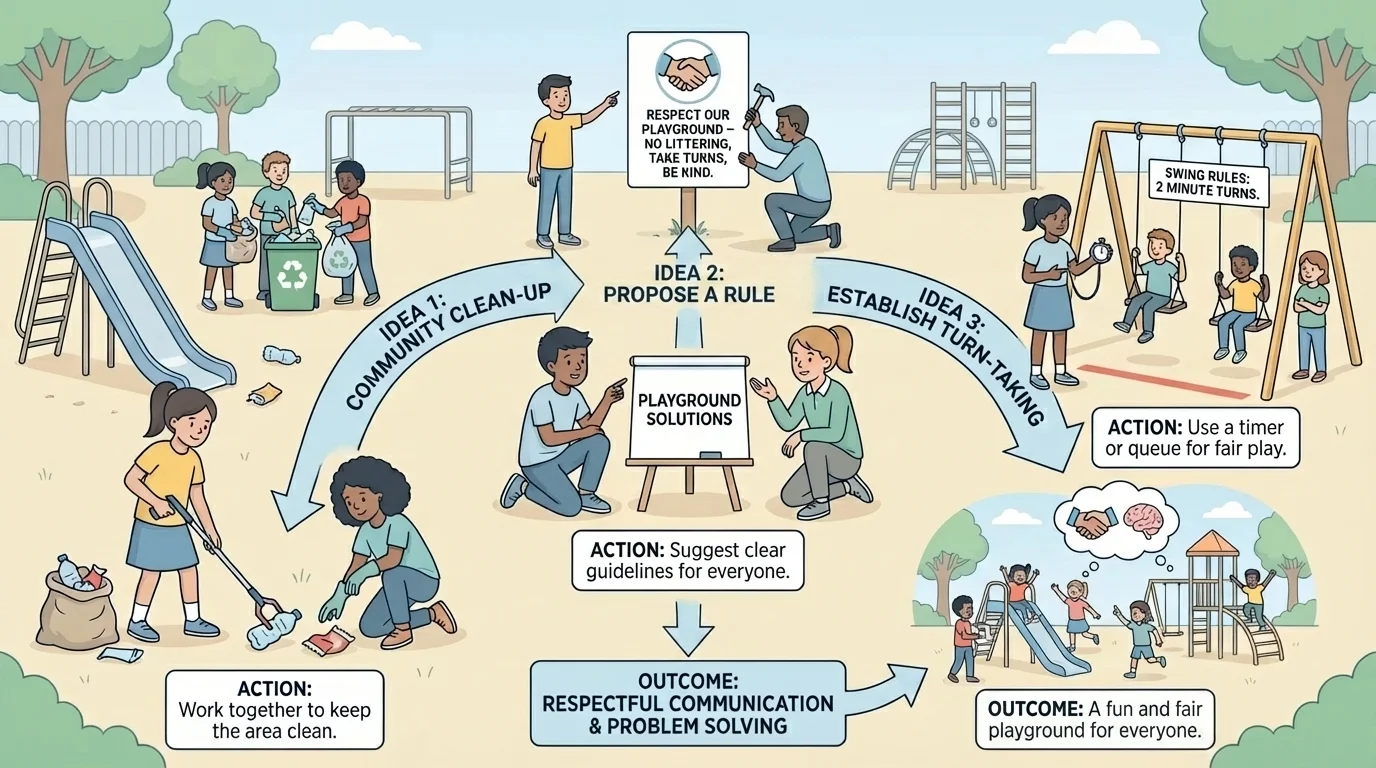
When people work together, they often use more than one skill. They speak, listen, write, and cooperate. The shared goal is not just "my idea wins." The shared goal is "our community gets better."
Case study: Making the lunch line better
A class notices that the lunch line feels crowded and noisy.
Step 1: Students describe the problem respectfully.
They say, "The line gets too loud, and some people get pushed."
Step 2: Students offer different viewpoints.
One wants floor markers. Another wants a quiet reminder sign. Another wants two line leaders.
Step 3: The group chooses a fair plan.
They try floor markers and line leaders first.
Because students shared ideas respectfully, they found a solution that helps everyone.
Later, when the class faces another problem, the teamwork in [Figure 3] reminds us that respectful problem-solving can improve shared spaces.
Disagreement is a normal part of life. Two people can care about the same community and still want different solutions. The important part is what happens next.
If you disagree, start by listening. Then use kind words. You can say, "I understand your idea, but I think...," or "That could help, and I wonder if...," or "Can you explain why you think that?" These sentences keep the conversation open.
Compromise is when people each give a little to reach a fair answer. For example, one group may want silent reading after lunch, while another wants partner reading. A compromise could be silent reading on some days and partner reading on others. Compromise helps people share power.
Sometimes the best answer is not exactly what anyone first wanted. That is okay. A respectful group looks for a solution that is safe, fair, and helpful. Solving a problem together can be more important than "winning" an argument.
"Treat others the way you want to be treated."
— A guiding rule for respectful communities
If someone is disrespectful to you, it is still wise to respond calmly if you can. You might say, "Please do not interrupt me," or "I want to share my idea too." If needed, ask a trusted adult for help.
A good community member cares about others as well as themselves. That means sharing ideas honestly, listening carefully, and choosing peaceful ways to solve problems. It also means noticing when another person has a helpful viewpoint.
You do not have to be the loudest person to make a difference. Some people lead by speaking. Some lead by writing. Some lead by asking thoughtful questions. Some lead by helping others feel included. Respectful expression gives many kinds of people a chance to help.
When children learn to express viewpoints respectfully, they build skills for school, friendships, and the future. They learn how to work in teams, how to solve problems, and how to make communities kinder and stronger.
Remember that rules and decisions work best when people understand them and have a chance to share ideas about them. Respectful communication helps groups make fair choices.
The next time you have an idea, remember this: your voice matters, and so do other people's voices. A strong community is not one where only one person talks. A strong community is one where people share, listen, and work together with respect.
