Have you ever noticed how many people help your day go well? A bus driver may take children to school. A teacher helps students learn. A crossing guard helps people stay safe. A neighbor may pick up litter on the sidewalk. All of these people are part of a community, and when they do their part, the community becomes a better place for everyone.
A community is a group of people who live, learn, work, or play together. Your community can be your classroom, your school, your neighborhood, or even your town. Communities are important because people help one another. They share spaces, follow rules, and work together to solve problems, as [Figure 1] shows with different helpers and places in everyday life.
Some community members are children. Some are adults. Some are leaders, helpers, workers, family members, and friends. Even though people in a community may have different jobs, ages, and ideas, they all matter. A strong community is built when people care about one another and try to make life better for everyone.
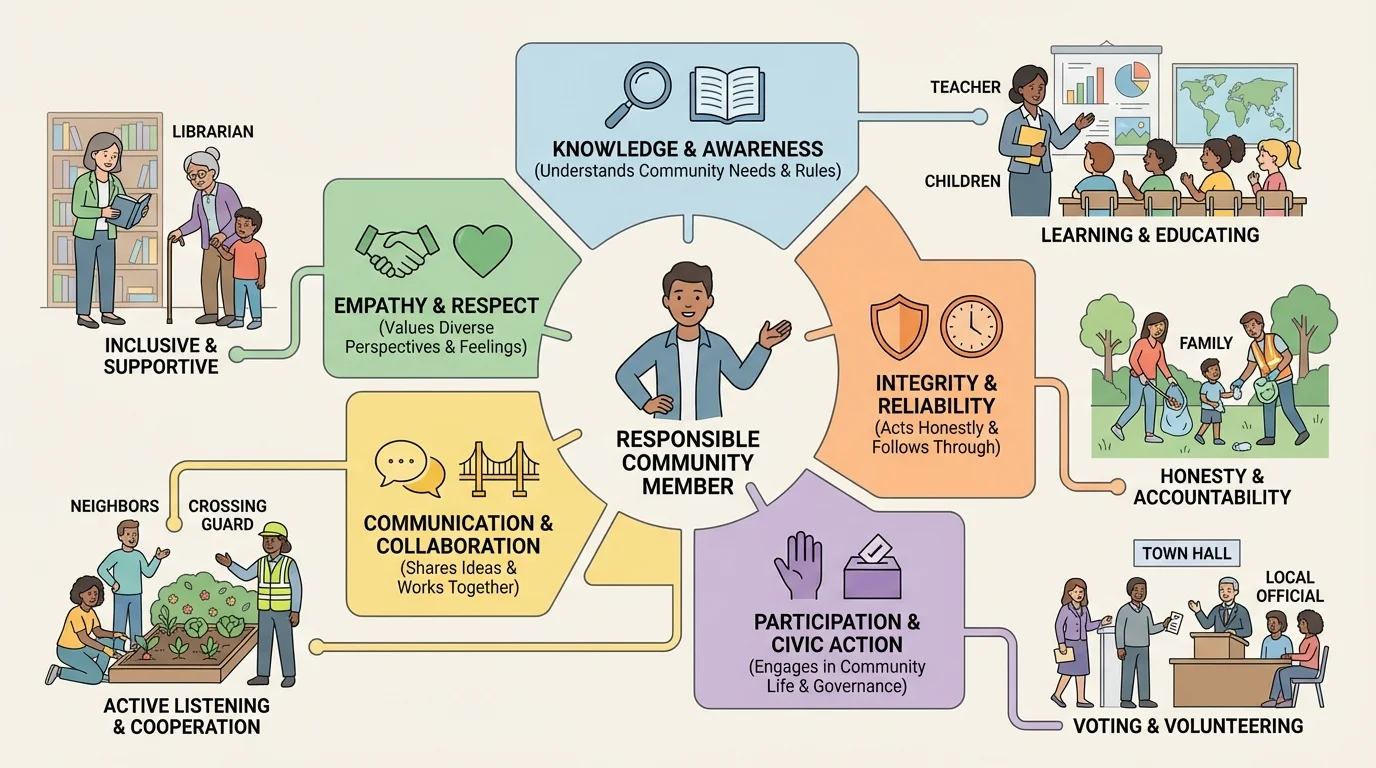
Responsible means doing what you should do, making good choices, and thinking about how your actions affect other people.
Effective means doing something in a way that truly helps and makes a positive difference.
Being a responsible and effective community member does not mean being perfect. It means trying to do the right thing, learning from mistakes, and choosing actions that help instead of harm. Even young children can do this every day.
When people act responsibly, they take care of their own actions. They follow fair rules, tell the truth, and do what they promise when they can. A responsible student returns library books, raises a hand instead of shouting, and cleans up after using materials. A responsible neighbor may keep shared spaces tidy and be careful not to damage property.
Rules help communities stay safe and orderly. Rules are not only about stopping bad behavior. They also help people know what is expected. For example, walking in the hallway, waiting your turn, and stopping at a crosswalk are rules that protect people and help things go smoothly.
Honesty is another important part of responsibility. Honest people tell the truth and admit mistakes. If a child accidentally breaks a crayon box and tells the teacher, that child is showing honesty. Telling the truth helps others trust you.
Trust grows slowly but can be lost quickly. That is why honesty and responsibility are so important in classrooms, teams, and neighborhoods.
Responsible community members also think before they act. They ask themselves questions such as: "Is this safe?" "Is this kind?" "Will this help someone or hurt someone?" Good choices often come from stopping and thinking first.
Many personal qualities help a person take part in community life well. Important traits include respect, kindness, fairness, patience, and cooperation. These traits help people get along, solve problems, and share spaces peacefully, as [Figure 2] illustrates in classroom and playground situations.
Respect means treating people, places, and things with care. Respectful community members listen when others speak. They use polite words. They understand that others may have feelings and ideas that are different from their own. Respect also means taking care of shared places, like parks, classrooms, buses, and libraries.
Kindness means helping and caring about others. A kind student invites a classmate to join a game. A kind neighbor carries in groceries for an older person. Small acts of kindness can make people feel safe, welcome, and valued.
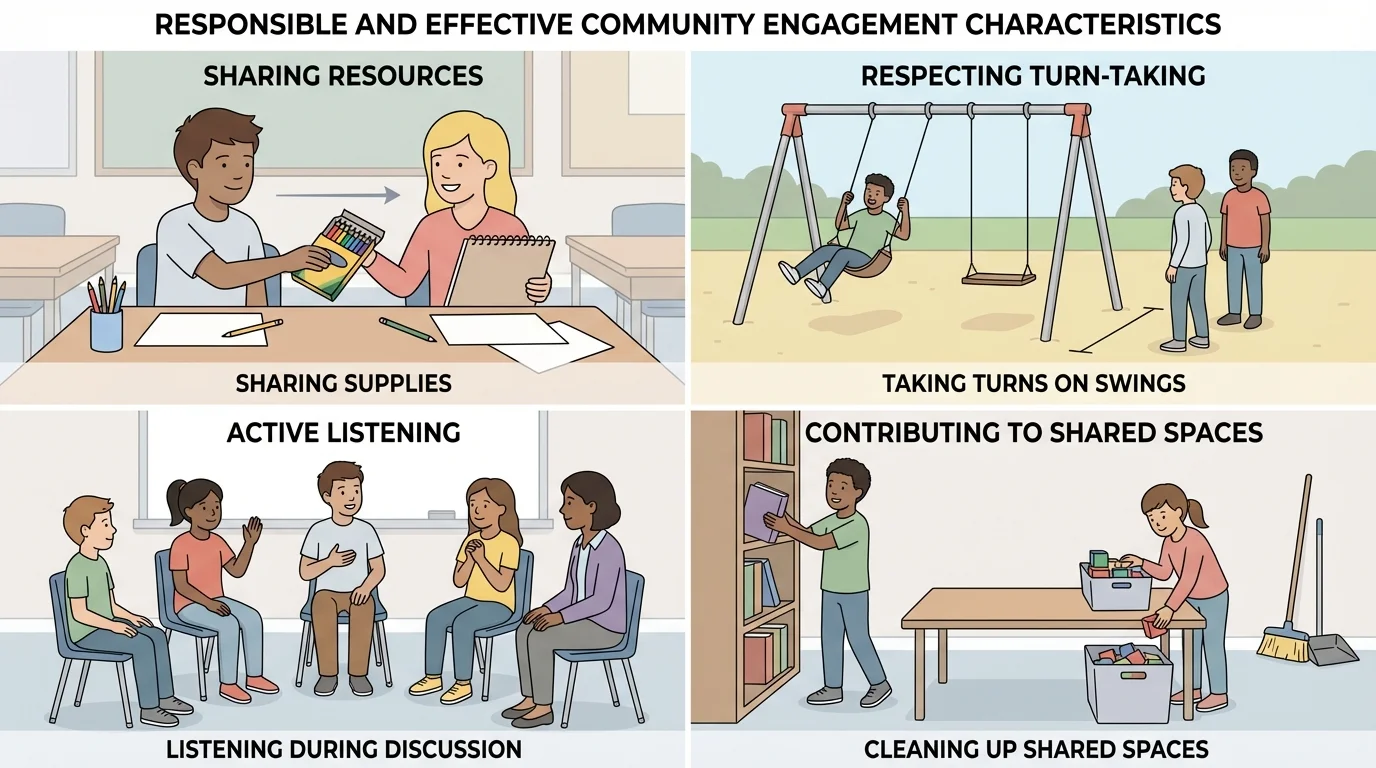
Fairness means treating people in a just way. Fairness includes taking turns, sharing when needed, and following the same rules. It does not always mean everyone gets exactly the same thing. Sometimes fairness means giving people the help they need so they can join in and succeed.
Cooperation means working together toward a goal. When students clean up a classroom together, build a poster in a group, or practice for a music performance, they are cooperating. Communities work best when people understand that they are stronger together than alone.
Self-control is also very important. Self-control means managing your words, actions, and feelings. If someone cuts in line, a person with self-control does not yell or push. Instead, that person uses calm words or asks an adult for help. Self-control helps keep communities peaceful.
Why these traits matter together
A community becomes stronger when people use several good traits at once. For example, solving a playground problem may require respect for others, kindness in words, fairness about turns, cooperation to agree on a plan, and self-control to stay calm.
These qualities do more than prevent trouble. They help communities improve. When people are respectful and cooperative, more ideas can be heard. When people are kind and fair, more people feel included. When people use self-control, disagreements are less likely to grow into bigger problems.
Being part of a community means more than just living in it. It means participating. To participate means to join in, help, and contribute. Children can participate in many ways, even in small everyday moments.
At school, a child can help by following directions, being prepared, sharing supplies, including others in games, and helping keep the classroom clean. At home, a child can do chores, help a younger sibling, feed a pet, or speak politely with family members. In a neighborhood, a child can wave hello, respect others' property, and help keep public places clean.
Community members can also improve their community by sharing ideas. If the playground has too much trash, a child can tell a teacher or trusted adult. If a class rule is not working well, students can talk respectfully about a better idea. Responsible participation includes speaking up in helpful ways.
Everyday example: helping the class
A class is getting ready for art. The markers are mixed up, paper is scattered, and some students do not know what to do.
Step 1: A responsible student listens to the teacher's directions.
Step 2: The student helps sort supplies and shares with others.
Step 3: The student uses polite words and waits for a turn.
Step 4: After art, the student helps clean up.
This student is not only participating. The student is helping the whole class work better together.
Good community members notice what needs to be done and try to help in safe, appropriate ways. They do not wait for others to do everything. They understand that their actions matter.
[Figure 3] Communities are made of people, and people do not always agree. That is normal. What matters is how problems are handled. Peaceful problem-solving uses calm words, careful listening, and fair thinking in a step-by-step way.
Compromise is one way to solve a disagreement. A compromise is an agreement in which each person gives a little so everyone can move forward. If two students want the same ball, they may agree to take turns. If a group cannot choose between two game ideas, they may play one game first and the other game later.
Listening is just as important as speaking. Effective community members listen to understand, not just to answer. When children listen carefully, they learn what others need, feel, or worry about. This helps them make wiser choices.
Sometimes the best choice is to get help from a trusted adult. If a problem is unsafe, mean, or too big to solve alone, children should talk to a teacher, parent, counselor, or another adult they trust. Asking for help is a responsible action, not a weakness.
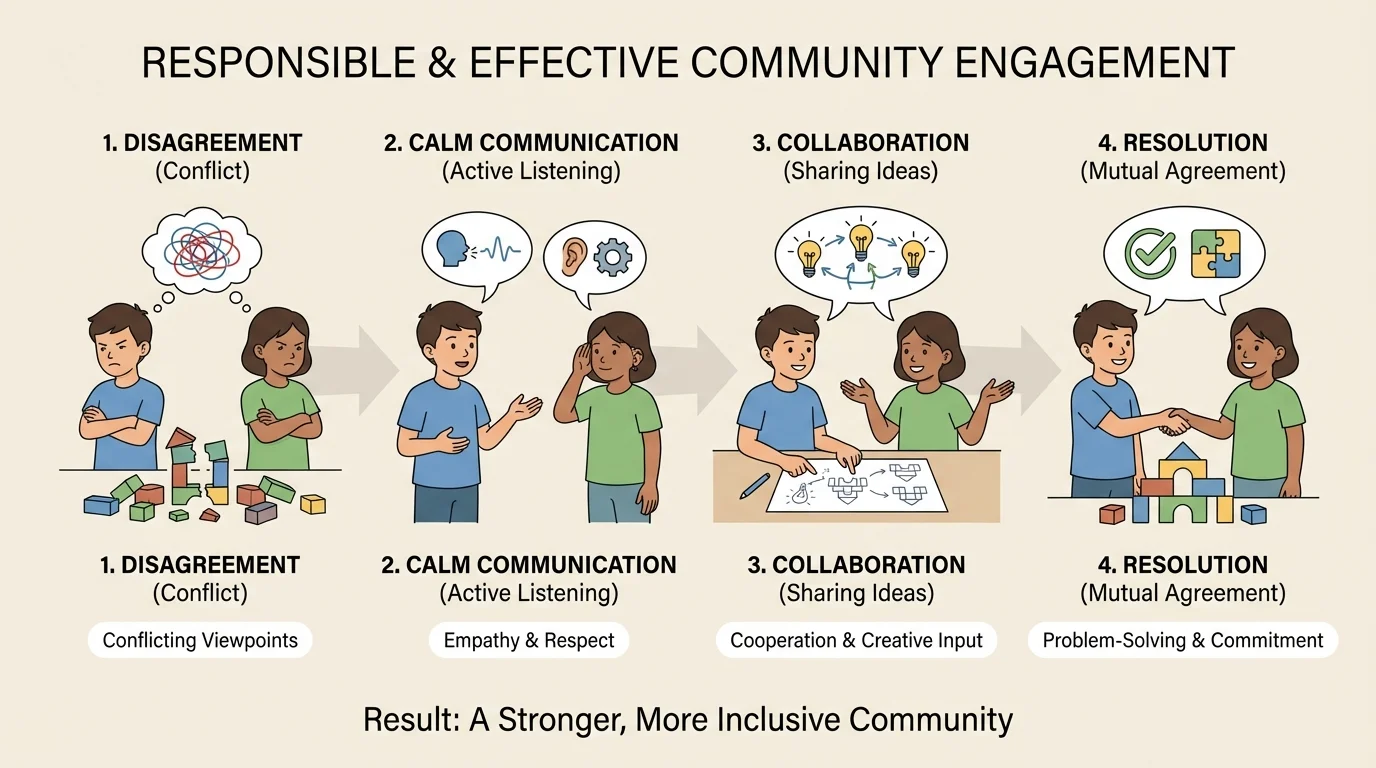
Using calm words such as "Can we take turns?" or "I feel upset when you grab the toy" can stop a problem from growing. We can see in [Figure 3] that problem-solving works best step by step: calm down, listen, share ideas, and choose a fair solution.
You already know that rules help keep people safe. Here, that same idea grows bigger: responsible community members follow rules and also help solve problems when rules alone are not enough.
Making good choices also means thinking about consequences. A consequence is what happens after an action. If someone litters, the space becomes dirty and unpleasant. If someone helps clean up, the area becomes nicer for everyone. Responsible people try to choose actions with positive consequences.
People in a community often have rights and responsibilities. Rights are things people should have or be allowed to do, such as learning in a safe classroom or being treated fairly. Responsibilities are things people should do, such as following rules and treating others well.
Rights and responsibilities go together. For example, students have a right to learn, and they have a responsibility not to interrupt others' learning. People have a right to feel safe, and they have a responsibility to act safely. When community members understand both, the community becomes stronger.
| Right | Matching Responsibility |
|---|---|
| To learn | Listen and let others learn too |
| To feel safe | Follow safety rules |
| To be treated fairly | Treat others fairly |
| To use shared spaces | Take care of shared spaces |
Table 1. Examples of how rights and responsibilities connect in a community.
When people only think about their own rights and forget their responsibilities, problems grow. But when they remember both, the whole group benefits. This is true in families, classrooms, teams, and neighborhoods.
Sometimes it helps to compare choices. A responsible and effective community member thinks, "What action will help most?" The answer is often the action that is respectful, fair, safe, and cooperative.
Suppose a new student joins the class. One choice is to ignore the student. A better choice is to say hello, explain the classroom routine, and invite the student to play. That helps the new student feel included and helps the class become friendlier.
Suppose there is trash on the playground. One choice is to walk past it. A more responsible choice is to tell an adult or pick it up safely if allowed. That improves the shared space for everyone.
Suppose two classmates want the same seat. One choice is to argue. A better choice is to talk calmly and find a fair solution. The same respectful habits we saw earlier in [Figure 2] and the problem-solving steps in [Figure 3] help turn conflicts into cooperation.
"A community grows strong when people care for one another and work together."
Even simple actions can be powerful. Smiling at someone who feels left out, waiting patiently, returning something you borrowed, and using kind words all help build a healthier community. Big improvements often begin with small choices.
Children are important community members right now, not just in the future. They can notice problems, share ideas, include others, and help adults make places better. A second grader can show leadership by being honest, respectful, helpful, and willing to cooperate.
Communities improve when people care not only about themselves but also about others. Responsible and effective community members understand that their actions affect many people. They know that being kind, fair, and thoughtful can spread from one person to another.
When one child helps clean up, another may join. When one student welcomes a classmate, others may do the same. Good actions can grow. That is one of the most exciting things about community life: every person has the power to help make it better.
