What would happen if there were no traffic lights, no firefighters, no one to fix roads, and no rules for keeping parks clean? A community would become confusing very quickly. People live, learn, work, and play together, so they need a way to make decisions and solve problems. That is one big reason government is important.
A community is a group of people who live, learn, or work together. Your classroom is a community. Your school is a community. Your town or city is a community too. In every community, people share spaces and need to get along.
When many people share the same place, they need rules. Rules help people know what to do. Rules can tell us when to stop at a crosswalk, where to throw away trash, and how to act safely at school. Leaders help make sure rules are fair and followed.
Government is the group of people who make rules, help keep people safe, and make choices for a community.
Law is an official rule that people in a community must follow.
Government is not just one person. It is made up of people who work together to help the community. Some leaders are elected, which means people vote to choose them. Other workers in government are hired to do important jobs, such as police officers, firefighters, and people who care for parks and roads.
A government exists at different levels. A school has leaders, such as a principal, while a town or city may have a mayor. A state has a governor. Our country has a president. These leaders do not all do the same job, but they all help guide a group of people.
Government makes plans, solves problems, and helps people live together. It helps decide things that affect everyone, not just one person. For example, a government may decide where to build a new playground, how to make streets safer, or how to help after a storm.
[Figure 1] One important role of government is to establish order. This means helping things stay organized, peaceful, and fair. In a town, people drive cars, ride bikes, walk to school, and play in parks. Government helps set rules so all of these people can share spaces safely in a busy town scene.
Government helps create laws and rules. These rules tell people what is allowed and what is not allowed. For example, people should stop at red lights, keep harmful things out of parks, and respect other people and their property. When rules are followed, communities work better.
Government also helps solve disagreements. If people argue about property, noise, or safety, laws can help decide what is fair. This does not mean every problem disappears, but it gives people a peaceful way to work things out instead of fighting.
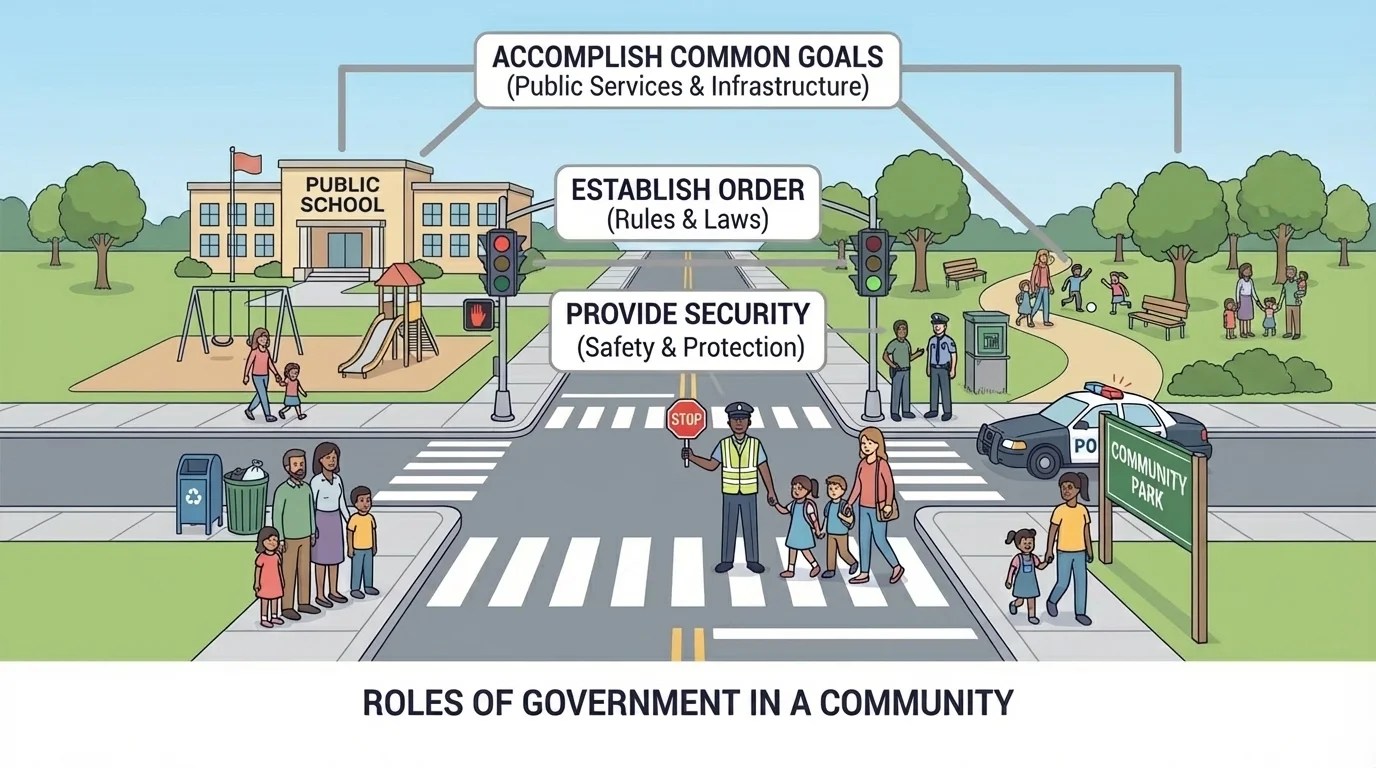
Order also means taking care of shared places. Government workers may help collect trash, repair streets, and keep playgrounds safe. These jobs may seem ordinary, but they matter every day. When roads are full of holes or parks are not cared for, everyone notices.
Think about school. If everyone talked at once, ran in hallways, and ignored the teacher, learning would be very hard. Communities are similar. Rules and leaders help everyone know what to expect. The organized town reminds us that order helps many people use the same places at the same time.
Many community rules are so common that people may forget government helps make them happen, such as stop signs, clean water systems, and safe public parks.
Good order is not about controlling every little thing. It is about helping people live together fairly and safely. That is why governments make laws, guide services, and help protect shared spaces.
[Figure 2] Another important role of government is to provide security. Security means helping protect people from danger. Communities need safety at home, at school, on roads, and in public places. Government workers help with this in many ways.
Police officers help enforce laws and protect people. Firefighters put out fires and rescue people in danger. Emergency workers help when someone is badly hurt or sick. These jobs are part of keeping a community safe.
Government also helps during emergencies such as floods, storms, or other disasters. Leaders can warn people, close dangerous roads, and organize help. They may provide shelters, food, or supplies when families need support.
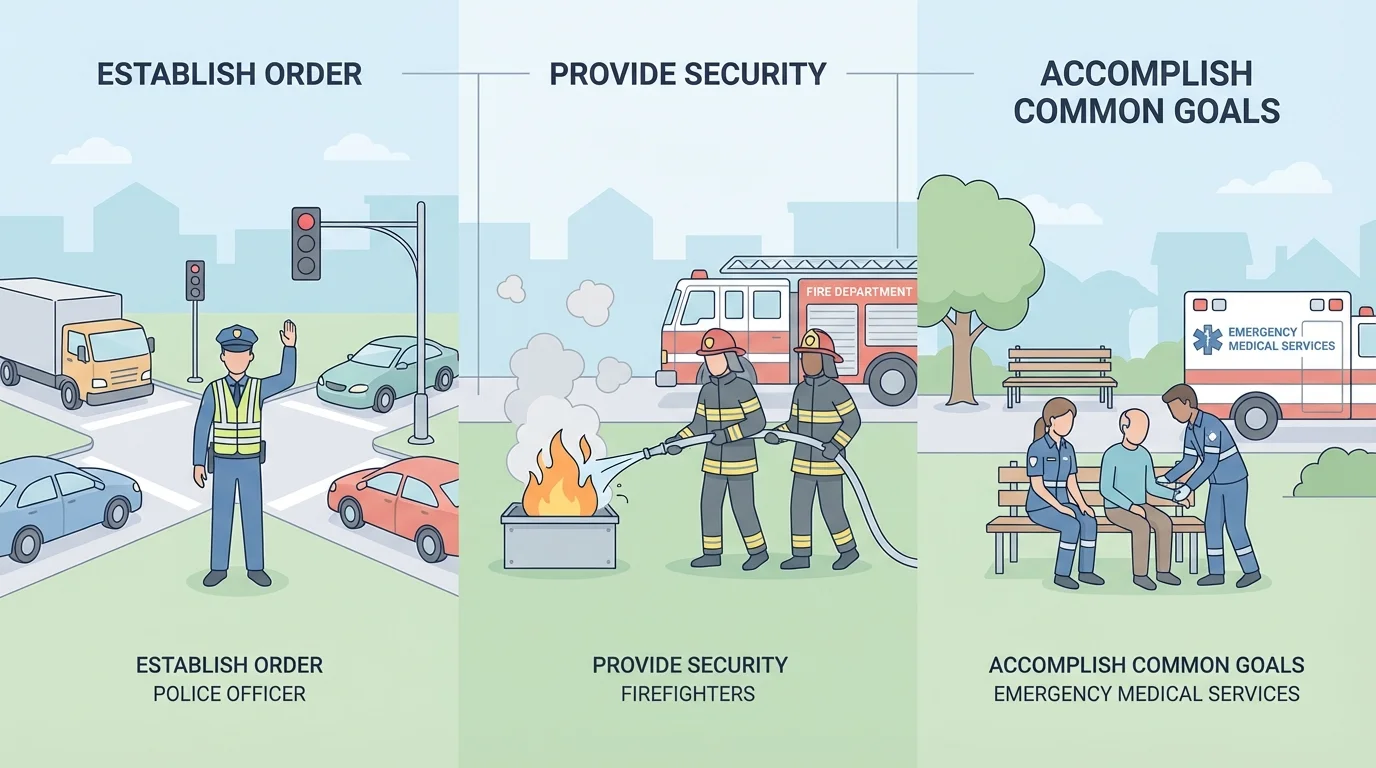
Security can also mean protecting the whole country. Adults in the military help defend the nation. For second graders, the big idea is simple: government helps guard people and places so communities can live in peace.
Safety is not only about emergencies. It also includes checking that buildings are safe, helping buses follow rules, and making sure streets are marked clearly. The helpers shown here each do a different job, but all of them work toward the same goal: keeping people safe.
Safety and security in daily life means more than stopping danger after it happens. Government also tries to prevent problems before they begin by creating safe roads, clear rules, and emergency plans.
When people feel safe, they can learn, play, work, and rest more easily. That is why providing security is one of the most important jobs of government.
Government also helps people accomplish common goals. Common goals are things many people want and need together. One family cannot build all the roads in a city. One child cannot create a public library. But a community can work together through government.
For example, people want clean parks, schools, roads, libraries, and safe water. Government can help plan, build, and care for these things. These are sometimes called public services because they help the public, or all the people.
Government can also help communities grow. Leaders may decide where to build a new school if many families move into an area. They may support a new bridge so people can travel more easily. They may help organize recycling or plant trees in shared spaces.
Community example: Building a new playground
A neighborhood wants a safe place for children to play.
Step 1: People in the community share their idea.
Families and neighbors tell leaders that children need more space to play.
Step 2: Government leaders make a plan.
They choose a place, decide what equipment is needed, and make safety rules.
Step 3: Workers build and care for it.
The playground is built for everyone to use, and it is checked to help keep children safe.
This is one way government helps people work toward a goal they share.
Sometimes common goals are about helping others. A government may help provide food or shelter after a disaster. It may support schools so children can learn. It may help libraries stay open so everyone can borrow books. These are ways communities do more together than one person could do alone.
[Figure 3] People belong to different communities, and each community can have leaders. The comparison shows that leadership can be found in a classroom, a school, a town or city, a state, and a country.
In a classroom, a teacher helps students follow rules and learn together. In a school, the principal helps make decisions for the whole school. In a town or city, a mayor may help lead local government. In a state, a governor helps lead state government. In the country, the president helps lead the national government.
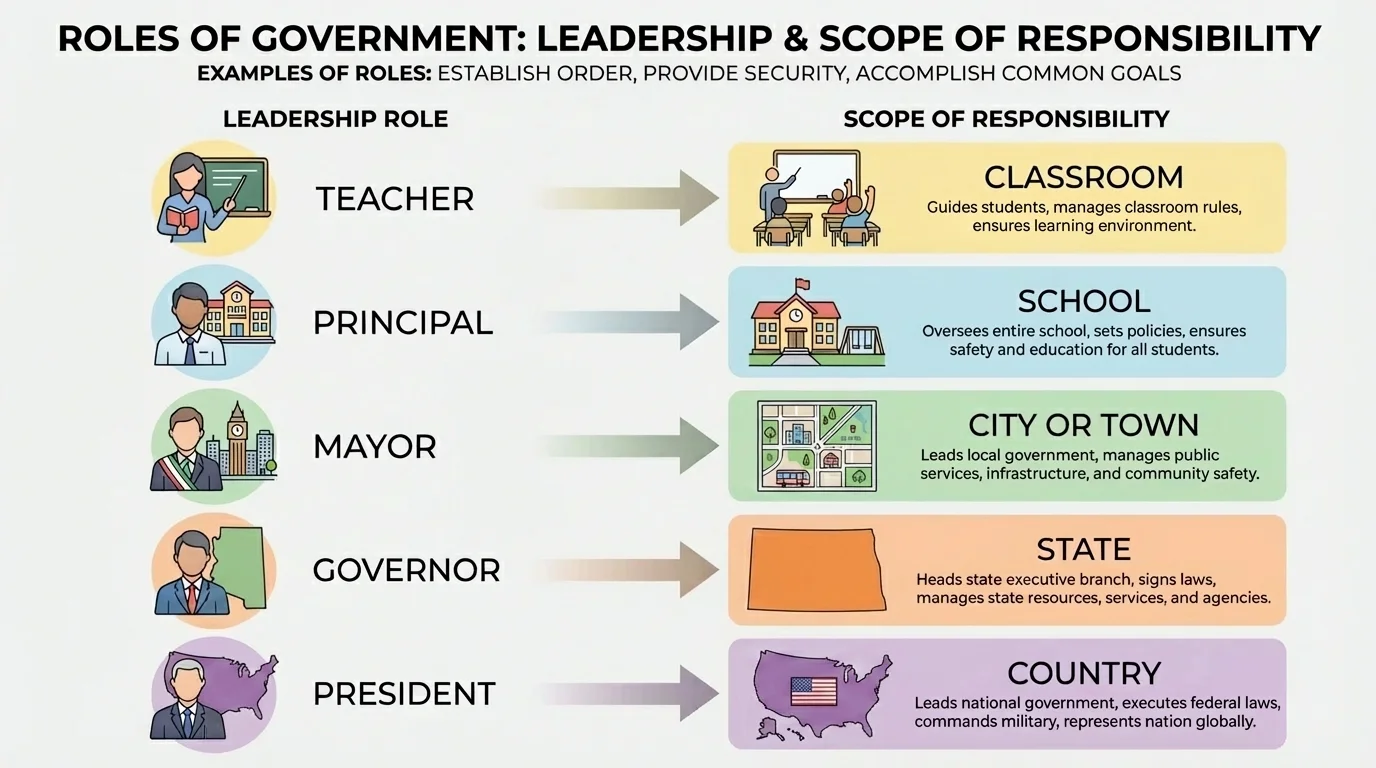
These leaders have different jobs because their communities are different sizes. A teacher does not make rules for the whole country, and a president does not decide where your class lines up for lunch. Different leaders help with different levels of community life.
| Community | Example Leader | What the Leader Helps Do |
|---|---|---|
| Classroom | Teacher | Helps students learn and follow classroom rules |
| School | Principal | Helps the whole school run smoothly |
| Town or City | Mayor | Helps with roads, parks, and local safety |
| State | Governor | Helps lead the state and its services |
| Country | President | Helps lead the nation |
Table 1. Examples of leaders in different communities and the jobs they do.
Even though these leaders do different work, they share a big purpose: helping the people in their communities. The chart helps us see how leadership changes from small communities to larger ones.
You already know that rules help a classroom work well. Government uses a similar idea in larger communities: rules and leaders help many people live and work together.
Some leaders are chosen by voting. Voting lets people have a say in who will represent them. This is one way citizens help shape government.
Government works best when leaders try to be fair, honest, and helpful. They should listen to people and make choices that support the community. Good government is not perfect, but it should try to serve everyone as well as it can.
Citizens help too. A citizen is a member of a country. Citizens can follow laws, respect others, vote when they are adults, and help improve their communities. Children can also be good citizens by following rules, being kind, helping neighbors, and taking care of shared places.
"We can do more together than alone."
When government and citizens both do their parts, communities become safer, cleaner, and stronger. Streets are more organized. Shared spaces are cared for. People can work toward goals that help everyone.
Government matters because people live together. It helps establish order, provide security, and accomplish common goals. From classrooms to cities to the whole country, leaders help communities make decisions and solve problems.
