Have you ever noticed that two families can walk into the same store and buy very different things? One family might pay for a haircut at a salon, while another cuts hair at home. One child may wear brand name shoes, while another wears a less expensive pair. These choices are not always right or wrong. They often show what matters most to a person, a family, or a community.
Money choices are called financial decisions. People make financial decisions every day. They decide what to buy, what to save for, and what they can wait to buy later. People do not all have the same amount of money, the same needs, or the same ideas about what is most important. That is why financial priorities can be different.
A priority is something a person thinks is very important. A family may think healthy food is the most important. Another family may think saving money for rent, gas, or school supplies comes first. Another may spend extra money on something that helps them feel good or look neat, like going to a hairdresser.
Some choices are about needs. Needs are things people must have to live and stay safe, such as food, clothing, and a place to live. Some choices are about wants. Wants are things people would like to have but can live without. A toy, a fancy backpack, or a brand name shirt may be a want.
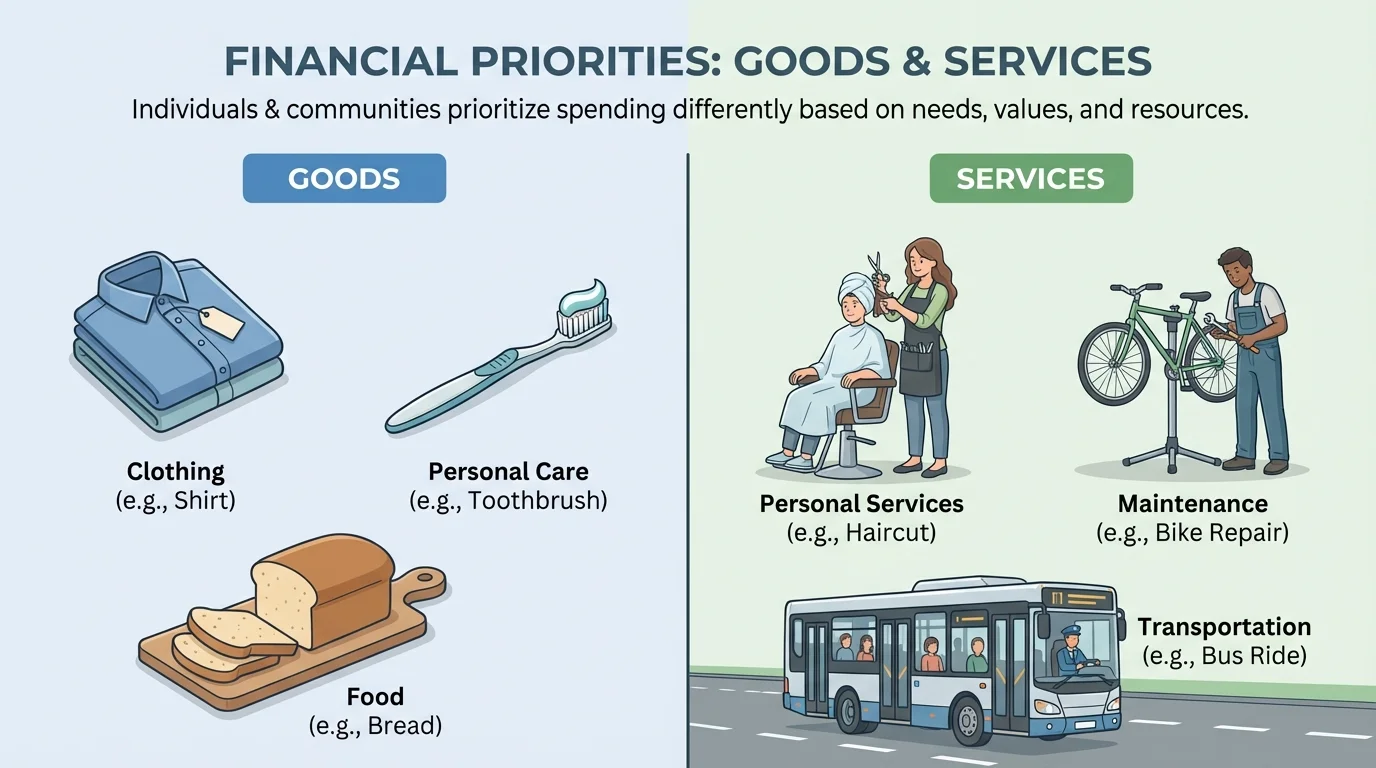
Goods are things people buy or use, like shoes, books, or soap.
Services are jobs people do for others, like cutting hair, fixing a bike, or driving a bus.
Financial priorities are the money choices people decide are most important.
Sometimes a need and a want can mix together. A child may need shoes, but not necessarily the most expensive brand name shoes. A person may need a haircut, but they may choose between a salon haircut or a haircut at home. The need is real, but the way people meet that need can be different.
When people spend money, they may buy a good or pay for a service. Some money buys objects you can hold, and some money pays for work someone does, as [Figure 1] shows. A toothbrush is a good. A haircut is a service. A loaf of bread is a good. A bus ride is a service because someone drives the bus and helps people travel.
Both goods and services can be important. Families must decide which ones matter most to them. One family may buy fewer toys so they can pay for music lessons. Another family may skip music lessons and buy sports equipment instead. These are all financial choices.
People also think about price. If a haircut costs $15 at one place and $25 at another place, a family may compare the two choices. If a shirt costs $10 and a brand name shirt costs $30, a shopper may ask whether the extra cost is worth it. The difference is \(30 - 10 = 20\). That means the brand name shirt costs $20 more.
Sometimes people pay more because they believe the item lasts longer, fits better, or makes them feel proud. Sometimes people choose the less expensive item because it works just as well. Looking carefully at goods and services helps people make informed decisions.
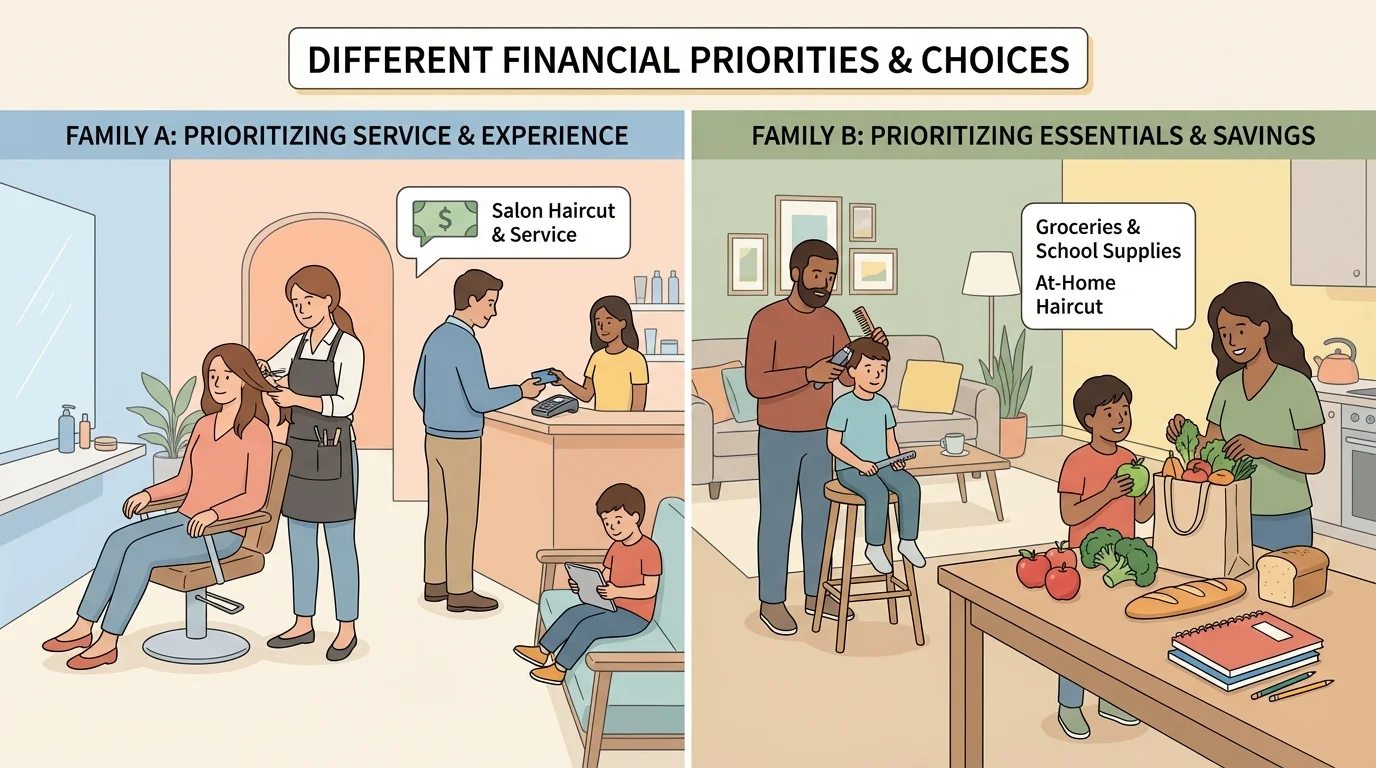
Different families often have different priorities, and [Figure 2] helps us see how two smart choices can look different. For example, one family may go to the hairdresser every month because they like the style and the service. Another family may cut hair at home and use that money for groceries, books, or saving.
Think about brand name items. Some children may want a famous brand because they like the logo, the style, or because friends have it. Another child may choose a less expensive item that does the same job. If two backpacks both carry books, a family may decide the lower-cost backpack is the better choice for them.
Neither choice tells us everything about a family. A family that buys brand name shoes may have saved for them for a long time. A family that chooses a lower-cost pair may be making room in the budget for other important things. Both may be trying to make wise decisions.
Different does not mean better or worse. A good financial decision depends on a person's needs, budget, and goals. What is best for one family may not be best for another family.
Sometimes children compare what they have with what others have. That can make someone feel left out. But money choices are private and personal. It is kind and fair to remember that families make choices for many reasons. Respect means not teasing someone because their backpack, haircut, or clothes are different.
The same idea applies to adults as well. One person may pay for coffee every morning. Another may make coffee at home and save that money. One person may buy a new phone quickly. Another may keep the old phone longer. Each person is deciding what matters most to them.
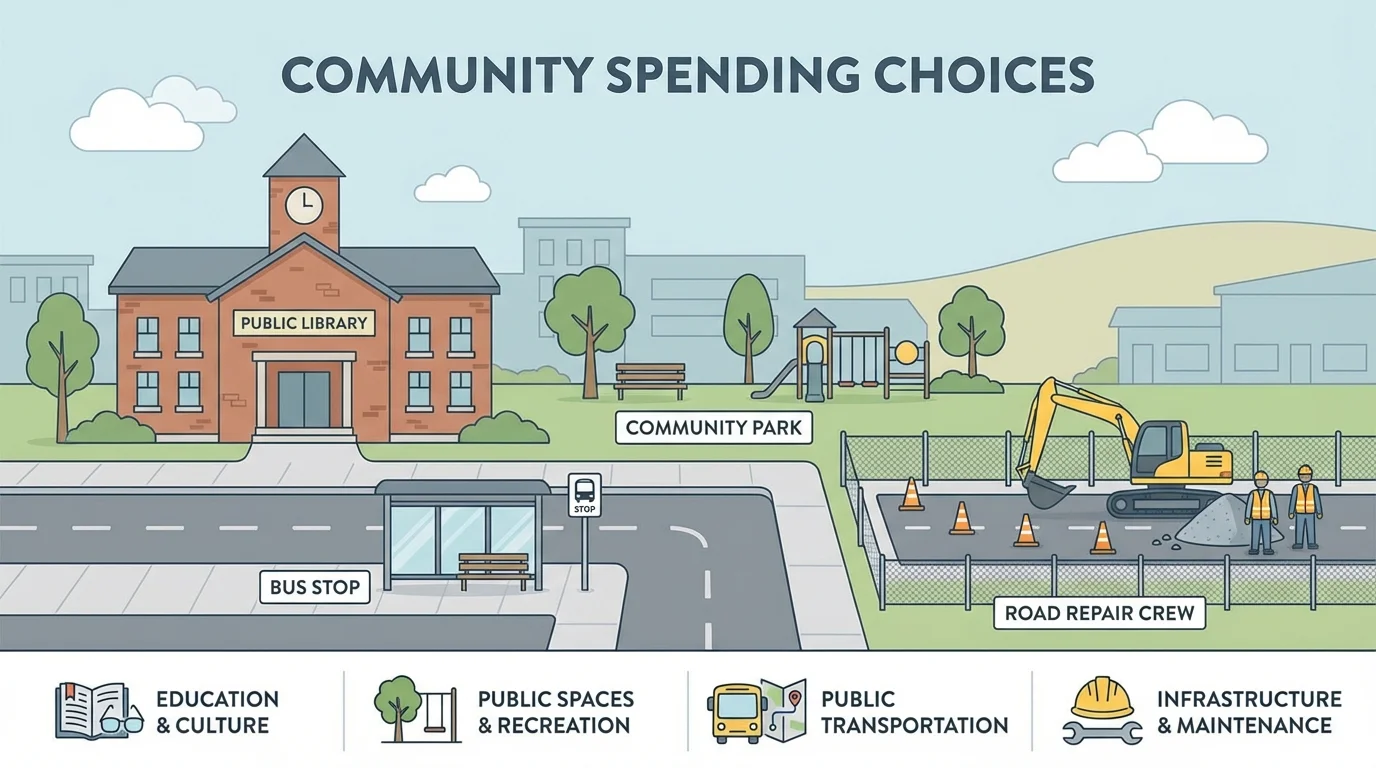
People are not the only ones who make money choices. A community does too. A community is a group of people living in the same place, such as a town or city. Communities use money to pay for shared services, and [Figure 3] shows some examples, like libraries, parks, buses, and road repair.
A town may choose to spend more on keeping a park clean and safe. Another town may spend more on buses so people can get to work and school. Another may fix roads first. These choices depend on what the people in that community need most.
Communities cannot always pay for everything at once. If there is enough money for only one big project, leaders must decide what should come first. For example, if a town has money for either a new playground or fixing old streetlights, people may talk about which choice helps more people right now.
Just like families, communities look at costs and benefits. A library gives books, learning, and a quiet place to read. Road repair helps cars and buses travel safely. A park gives families a place to play. Different communities may choose different priorities because their needs are not all the same.
When people compare choices, they can think about cost and benefit. A cost is what you give up, usually money, time, or the chance to buy something else. A benefit is the good thing you get from a choice.
If a haircut costs $12, the cost is $12. The benefit may be neat hair, comfort, and help from a trained worker. If cutting hair at home costs $0 because a family member does it, the money cost is lower, but it may take more time and may not look the same. People think about both sides.
Example: Comparing two choices
Lena needs a backpack.
Step 1: Look at the prices.
A plain backpack costs $18. A brand name backpack costs $30.
Step 2: Find the difference.
The extra cost is \(30 - 18 = 12\).
Step 3: Think about the benefits.
If the brand name backpack is stronger or lasts longer, Lena's family may think the extra $12 is worth it. If both backpacks work well, they may choose the $18 backpack.
The best choice depends on what Lena's family needs most.
Every choice has an opportunity cost, even if we do not use that big phrase every day. If you spend money on one thing, you may have less money for something else. If a family spends $20 on a special shirt, that same $20 cannot also be spent on another item at the same time.
We can compare choices with simple math. If a family has $40 to spend and buys a haircut for $15, they have \(40 - 15 = 25\) left. If they buy a brand name hat for $25 after that, they have \(25 - 25 = 0\) left. That means they cannot buy anything else from that $40 budget.
Small choices can add up. Spending $5 again and again means that after \(4\) times, the total is \(5 + 5 + 5 + 5 = 20\).
Thinking about costs and benefits does not mean always picking the cheapest item. It means asking, "What do I get, and what do I give up?" As we saw earlier with goods and services in [Figure 1], the answer can be different for different people.
Money choices can feel personal. That is why it is important to be respectful. We should not laugh at someone for getting a haircut at home. We should not think someone is better because they have a brand name item. What people own does not tell us their full story.
Being respectful also means understanding that families have different jobs, different incomes, different numbers of people in the home, and different goals. One family may be saving for a car. Another may be paying doctor bills. Another may be helping grandparents. These reasons can change what they buy.
The same respectful thinking matters when we talk about towns and cities. One community may focus on buses because many people need rides. Another may focus on parks because children need safe places to play. The town picture in [Figure 3] reminds us that shared money choices are about helping groups of people, not just one person.
Before buying a good or service, people can stop and think. They can ask simple questions that lead to better choices.
| Question | Why it helps |
|---|---|
| Do I need this, or do I just want it? | It helps sort needs from wants. |
| How much does it cost? | It helps you stay within a budget. |
| What is the benefit? | It helps you see what good the item or service gives. |
| Is there a lower-cost choice? | It helps you compare options. |
| What else could this money buy? | It helps you think about opportunity cost. |
Table 1. Questions that help people make informed financial decisions.
These questions can help with small choices and big choices. They can help when buying school supplies, choosing shoes, paying for haircuts, or deciding which community service should come first. Smart money decisions begin with careful thinking.
When you understand that people and communities have different financial priorities, you become more thoughtful. You learn that spending is not only about money. It is also about needs, values, goals, and respect for others.
