How can we know what happened long before we were born? We cannot travel back in time, but we can study clues from the past. Historians are like careful detectives. They look at old objects, photographs, letters, and spoken memories to learn what people did, said, made, and experienced. These clues help history feel real because they come from people who were there or from things that were used at that time.
History is the study of the past. When we learn history, we want more than stories. We want factual information. That means information that can be checked with evidence. Evidence is what helps us answer questions such as: Who was there? What happened? Where did it happen? When did it happen? How do we know?
People find evidence in many places. A family might keep an old baby shoe, a report card, or a photo album. A museum might protect tools, clothing, and toys from long ago. A library or archive might store newspapers, maps, and letters. Each of these items can help us learn about a historical event or a time in the past.
Historical event means something that happened in the past and matters to people or communities.
Evidence is information or clues that help prove what happened.
Fact is something that can be checked and supported by evidence.
Not every clue tells us everything. One photograph might show where people stood, but not what they said. One memory might tell how someone felt, but not the exact date. That is why historians try to gather many clues and compare them.
[Figure 1] A primary source is something made, used, or told by people from the time being studied. A letter written during a war, a photograph from a parade, or a tool used by workers long ago are all primary sources. A secondary source is something created later that explains or tells about the past, such as a textbook, a biography, or a history article. The comparison helps show the difference between these two kinds of sources.
Primary sources bring us close to the past. Secondary sources help organize and explain information from many primary sources. Both are useful, but if we want direct clues about a historical event, primary sources are especially important.
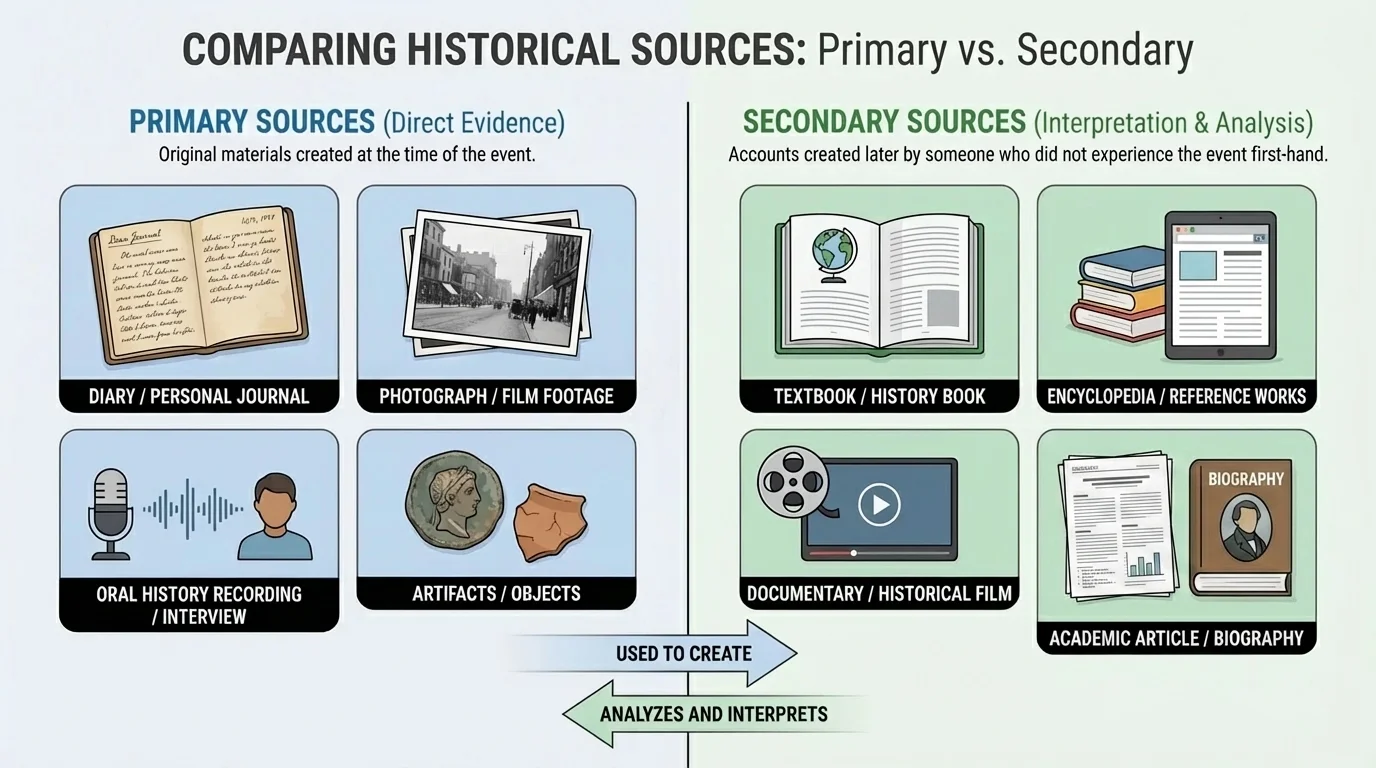
Here is a simple comparison:
| Source Type | What It Is | Example | How It Helps |
|---|---|---|---|
| Primary source | From the time being studied | Old letter, photo, object | Gives direct clues |
| Secondary source | Made later about the past | Textbook, article | Explains and summarizes |
Table 1. This table compares primary and secondary sources and shows how each one helps us learn history.
When students read a textbook about pioneers, they are using a secondary source. When they look at a pioneer family's wagon tool, read a diary entry, or study a photograph taken at that time, they are using primary sources. As we saw in [Figure 1], the biggest difference is whether the source comes directly from the time being studied.
There are many kinds of primary sources. Four important kinds are artifacts, pictures, oral histories, and documents. These four types work together, as [Figure 2] shows, to give us different kinds of information about the same event or time.
An artifact is an object made or used by people in the past. It could be a spoon, a toy, a shoe, a farming tool, or a school desk. Artifacts can show what materials people used, what jobs they did, and how they lived each day.
A picture can be a painting, drawing, or photograph. Pictures help us see clothing, buildings, landscapes, transportation, and faces. Sometimes a picture includes signs, dates, or special events that help us learn even more.
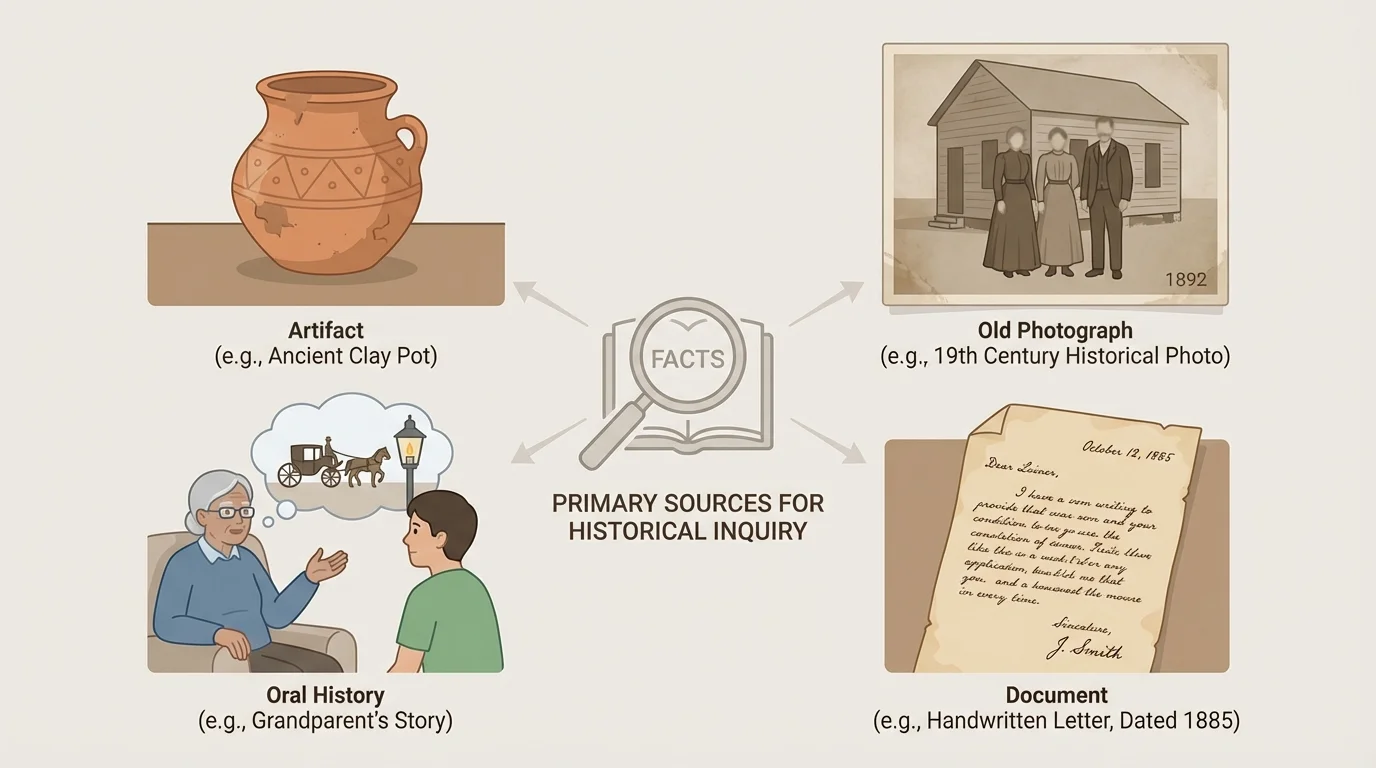
An oral history is a spoken memory told by someone who lived through an event or time. For example, a grandparent might tell what school was like many years ago. Oral histories can help us understand feelings, sounds, and experiences that may not appear in objects or photos.
A document is a written or printed source. Documents include letters, diaries, newspapers, birth certificates, maps, tickets, posters, and school records. Documents can help with dates, names, places, and other details.
Some historians learn from very small clues. A torn ticket stub, a recipe card, or a child's drawing can reveal surprising facts about everyday life in the past.
No single type is best for every question. If we want to know what a classroom looked like, a picture may help most. If we want to know what students studied, a school record or notebook may help more. If we want to know how a student felt, an oral history may be most helpful.
Primary sources can help answer important history questions. They often help us find who, what, when, and where. Sometimes they also help us think about why something happened, although that question can be harder.
Suppose we study a town parade from long ago. A photograph might show who marched and where the parade went. A newspaper might tell the date and explain why people gathered. A trumpet used in the parade could be an artifact showing what kind of music was played. An oral history from someone who watched the parade might describe the cheers and excitement.
Each source gives one part of the story. When we put the parts together, we get a clearer picture of the event.
Different sources answer different questions
Good historians match the source to the question. An artifact often tells about use and daily life. A picture often tells about appearance. An oral history often tells about memory and feeling. A document often tells about words, dates, and records. Using the right source helps us find stronger facts.
Some facts are easy to check. If a document says a school opened in 1925, that is a detail we can compare with another record. Other ideas are not simple facts. For example, if a person says, "It was the happiest day of my life," that tells us about feelings. Feelings matter in history too, but they are different from facts like dates and names.
When historians study artifacts, they do not just glance at them. They look carefully. They ask: What is it made of? Is it worn out? Is it large or small? Who might have used it? What job did it do? A metal lunch pail with dents might tell us it was used often. A tiny shoe might tell us it belonged to a child.
Pictures also need careful study. A photograph may show clothing styles, weather, buildings, tools, and even body language. If students in a class photo wear coats indoors, that may suggest the room was cold. If there are no electric lights, that may tell us something about the building.
Still, we must be careful. A picture shows only one moment. It may leave out what happened before or after. An artifact may survive even if many others are lost. That means these sources are valuable, but they do not tell the whole story by themselves.
Oral histories are special because they carry a person's voice. A person can describe sounds, smells, feelings, and memories. Someone might remember the ringing of a school bell, the taste of a lunch packed at home, or the fear felt during a storm. These details make the past feel alive.
But memories can change over time. People may forget exact dates or mix up details. That does not mean oral histories are not useful. It means we should compare them with other sources when we can.
Documents are often very helpful for facts. A diary can tell what a person did each day. A newspaper can report an event. A census record can show who lived in a household. A map can show where places were located. Because documents were written down, they sometimes preserve exact information that memories do not.
You already know that asking good questions helps you learn. The same idea works in history. Historians ask questions about every source instead of believing it right away.
Still, documents can have problems too. A newspaper writer may make a mistake. A letter shows one person's view, not everyone's. A map may leave out places the maker thought were unimportant. Every source has strengths and limits.
One of the smartest things a historian can do is compare sources. This process is called corroboration. If two or three sources say the same thing, we can feel more confident that the fact is correct.
For example, suppose a family story says a flood happened in spring. A newspaper from that year may report the flood date. A photograph may show high water near homes. A town map may show which streets were affected. Together, these sources support the same event.
Sometimes sources do not match perfectly. One person may say the parade started early, and another may say it started late. A newspaper may give one date, while a handwritten note gives another. When this happens, historians look even more closely. They ask which source was made nearest to the event, who created it, and whether another source can help settle the question.
Using more than one source is like putting together a puzzle. One piece alone does not show much. More pieces make the picture clearer.
Let us see how different sources work together. Suppose we want to learn about a one-room school from long ago. In [Figure 3], several source types connect to the same school story: an object from the classroom, a class picture, a spoken memory, and a written record.
An artifact such as a slate board can tell us students wrote on reusable surfaces instead of paper all the time. A class photograph can show rows of students, the teacher, clothing styles, and the school building. An oral history from a former student can describe walking a long distance to school and sharing one stove for heat.
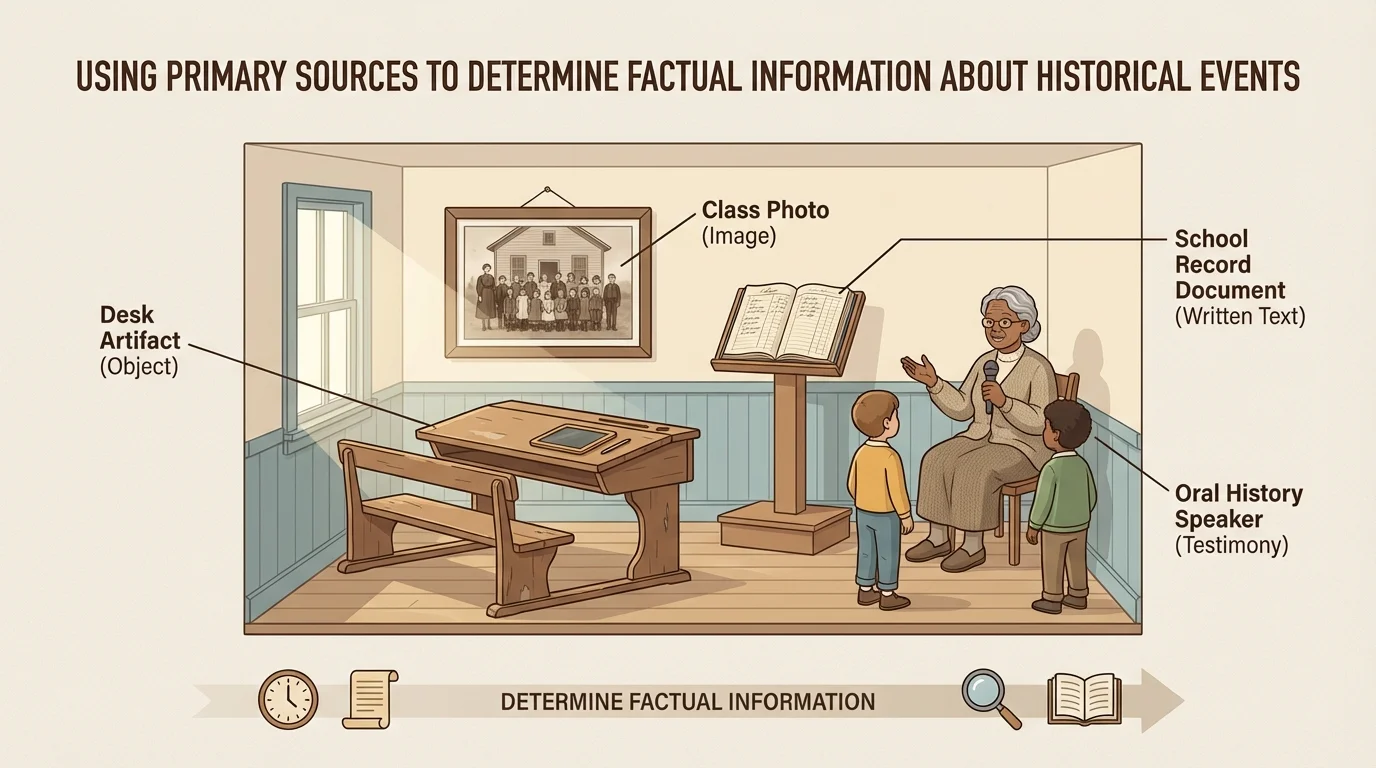
A document such as an attendance book can give names, dates, and the number of days students came to school. If the attendance book shows many absences in winter, and the oral history says snow made travel hard, the sources support each other.
Case study: Learning one fact from several sources
Question: How do we know students in the one-room school used a stove for heat?
Step 1: Look at the photograph.
The picture shows a stovepipe going upward inside the room.
Step 2: Check the oral history.
A former student says everyone sat near one stove during cold weather.
Step 3: Study the artifact.
A coal bucket from the school building suggests fuel was carried for heating.
Step 4: Compare the sources.
Because the photo, spoken memory, and object all fit together, the fact becomes stronger.
Using several primary sources helps us make a careful historical conclusion.
Later, if a textbook explains what one-room schools were like in many places, that textbook would be a secondary source. It would be useful too, but the direct clues come from primary sources. Just as [Figure 3] shows, the strongest understanding often comes from combining different kinds of evidence.
Many people help protect primary sources. A historian studies the past by asking questions and using evidence. An archaeologist studies artifacts, often by carefully digging and examining objects from long ago. Librarians, archivists, and museum workers protect books, records, and objects so people can learn from them in the future.
Families help too. A grandparent who saves letters, a parent who labels photographs, or a community member who tells stories at a local museum is helping preserve history. History is not only about famous leaders. It is also about ordinary people and everyday life.
"The more you know about the past, the better prepared you are for the future."
— Theodore Roosevelt
When we save old photographs, documents, and artifacts, we protect clues that future students may use. A simple object today can become an important historical source tomorrow.
Sometimes students wonder, "If history is about facts, why do sources disagree?" The answer is that people notice different things. They also remember events from different points of view. One child at a parade may focus on the band, while another remembers the horses. Both may be telling the truth about what they noticed.
Also, some sources are incomplete. A photograph may cut off part of the crowd. A letter may mention only one part of a larger event. A newspaper may be written quickly and include an error. Historians must think carefully instead of accepting every detail right away.
This does not make history weak. It makes history thoughtful. Historians gather clues, compare them, and build the strongest explanation they can from the evidence they have.
Primary sources are important and often fragile. Old papers can tear. Photographs can fade. Artifacts can break. Oral histories can be lost if no one records or remembers them. That is why people handle sources with care.
We should also be respectful. If someone shares a family story, we should listen carefully. If we look at an artifact in a museum, we should follow the rules. If we use information from a document, we should try to understand it honestly and not change its meaning.
Learning from primary sources helps us become better thinkers. We learn to observe, ask questions, compare information, and support our ideas with evidence. Those skills are useful not only in history, but in everyday life too.
