Why can one place have snowy mountains, another have wide farms, and another have busy streets full of restaurants, stores, and many languages being spoken? The world is made up of many different places, and each place has features that make it distinctive. Geographers study these patterns to understand why some places are alike and why others are different.
When we look closely at places and communities, we can group them in useful ways. These groups are called regions. A region may be large, like the Midwest of the United States, or smaller, like a coastal town, a farming valley, or a mountain area. Regions help us organize what we see in the world.
A region is an area that has features in common. These features might be natural, like mountains or rivers, or human, like language, jobs, or traditions. The first thing geographers look for is what places share, and [Figure 1] shows how nearby places can be grouped into different regions because of shared traits.
For example, several towns might be part of the same farming region if many people grow crops there. Several neighborhoods might be part of the same city region if they are close together and have many stores, roads, and homes. A desert region is dry, while a forest region has many trees. The idea of a region helps us describe the world in a clear way.
Regions are also about similarities and differences. Two places may both be in the same country, but one may have flat land and cornfields while another has hills and forests. One community may celebrate many different cultural traditions, while another may be known for fishing or ranching. Regions help us notice these patterns.
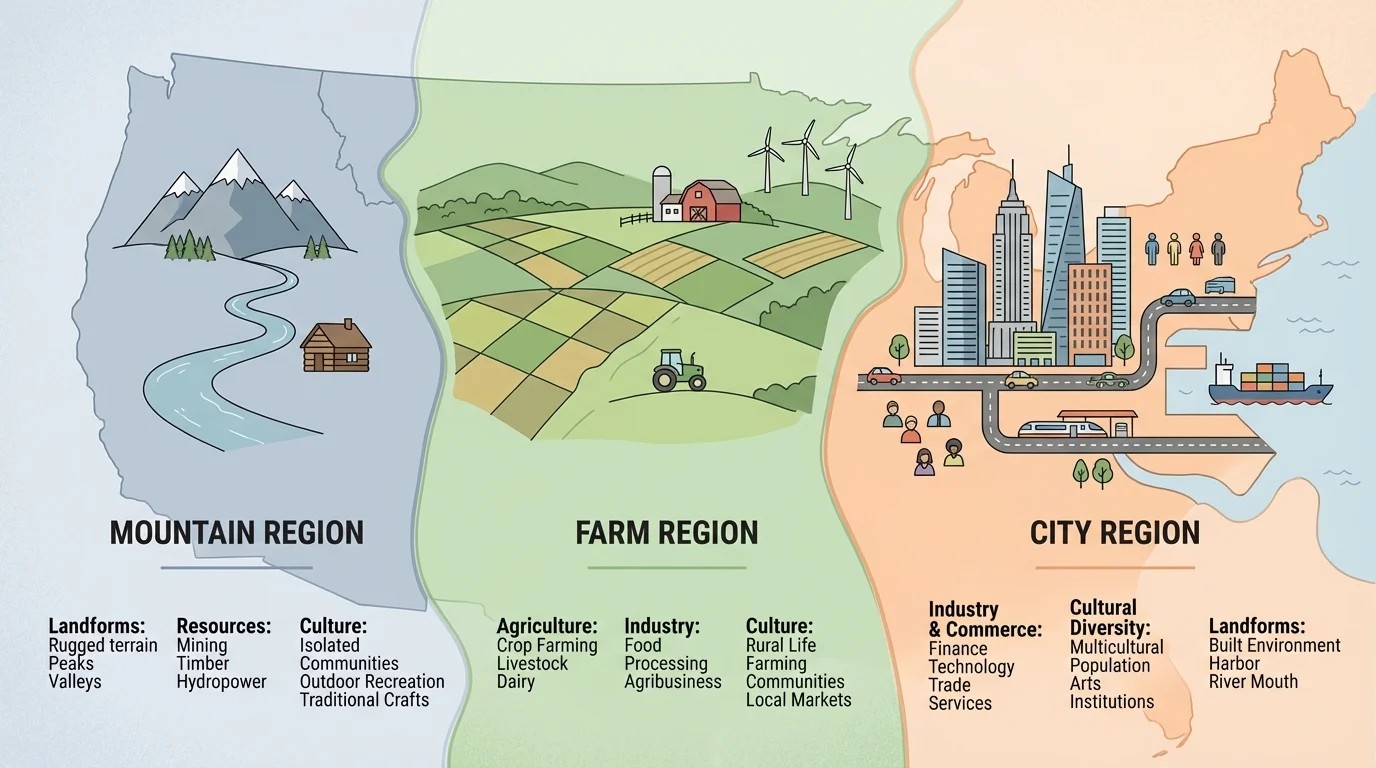
Region means an area that is grouped together because it shares one or more features, such as landforms, climate, culture, or types of work.
Sometimes a place belongs to more than one region at the same time. A town can be part of a river region because it is near water, a farming region because crops are grown there, and a cultural region because people share traditions. This is one reason geography is so interesting: places can be connected in different ways.
Some of the strongest clues about a place come from nature. Landforms, water, weather, plants, and animals can make one region look very different from another, as [Figure 2] illustrates with several kinds of landscapes.
Landforms are the natural shapes of Earth's surface. Mountains, hills, plains, valleys, deserts, and coastlines are all landforms. A mountain region may have steep slopes and cooler weather. A plain is wide and flatter, which can make it easier to farm. A coastal region is close to the ocean, so people there may fish, use boats, or enjoy beaches.
Water also helps define a region. Rivers, lakes, and oceans can affect where people live and work. Communities near rivers may use the water for travel, farming, and trade. People living near lakes may fish or enjoy tourism. In dry regions with little water, farming can be more difficult, and people may need to save water carefully.
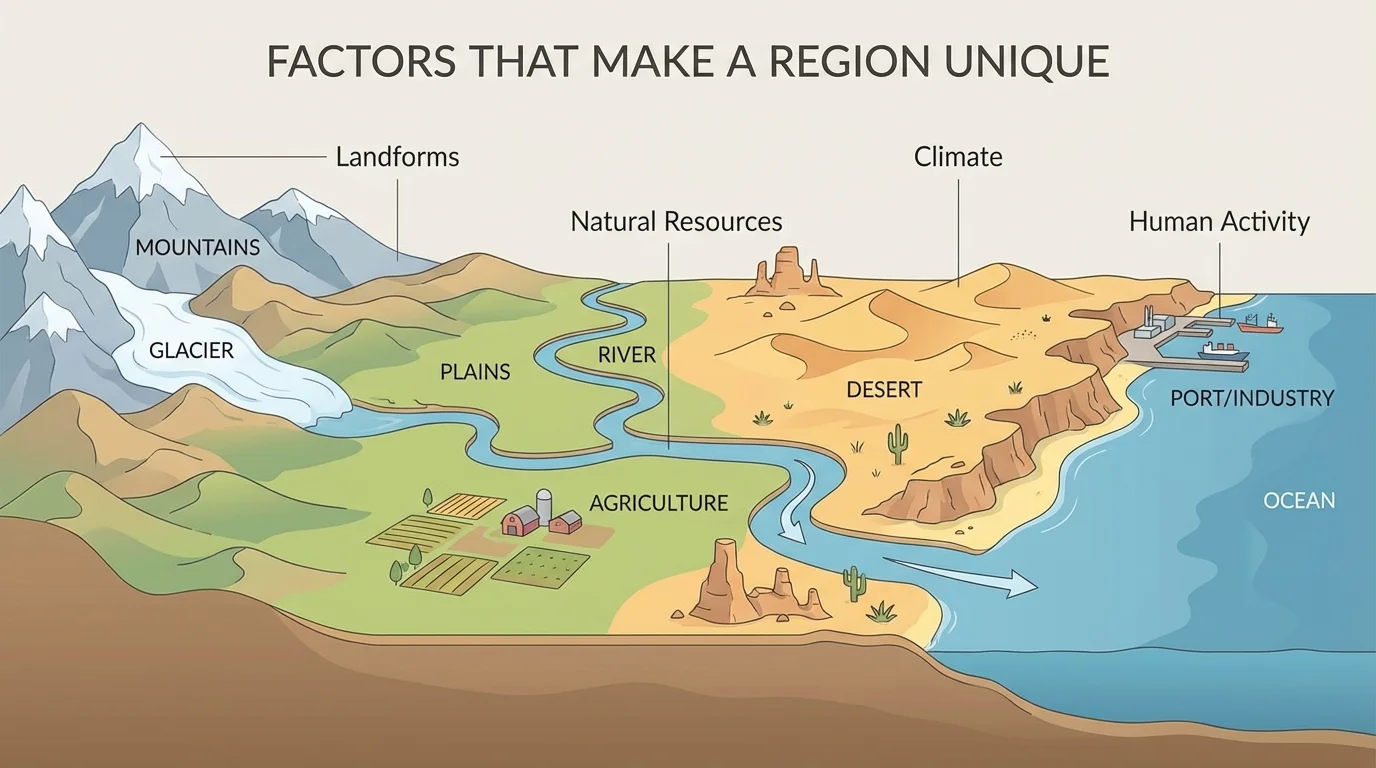
Climate matters too. Climate is the usual pattern of weather in a place over time. Some regions are warm and rainy. Others are cold and snowy. Climate affects what plants grow, what animals live there, and what kinds of houses people build. In a cold region, homes may need thick walls and heating. In a rainy region, roofs may be shaped to help water run off.
Natural features can also affect transportation. In a flat region, roads and railways may be easier to build. In mountain regions, people may need tunnels, bridges, or winding roads. As we saw earlier in [Figure 2], the shape of the land changes how people move from place to place.
Some regions are named after natural features. For example, places may be called the Great Plains, the Rocky Mountains, or the Gulf Coast because those landforms and water features are so important to the area.
Plants and animals are clues as well. A forest region may have many evergreen or deciduous trees. A grassland region may have tall grasses and fewer trees. These living things are part of the natural environment, and they help make each region recognizable.
Nature is important, but people also make regions unique. [Figure 3] Cultural diversity means that different groups of people live in the same place and bring their own languages, foods, music, beliefs, holidays, and traditions. This mix of people and ideas gives a region its own special character and shows how one community can include many cultures.
A city neighborhood might have markets selling foods from many countries. One community may celebrate a harvest festival, another may hold a parade, and another may be known for special music or dance. Buildings can also tell us about culture. Some regions have homes made from wood because forests are nearby. Others may use stone, brick, or clay because those materials are easier to find.
Language is another clue. In some regions, many people speak the same language. In other regions, you may hear several languages spoken in schools, stores, and parks. This does not separate people; it often enriches the region. Different cultures can share one place and help make it more interesting and more connected to the world.
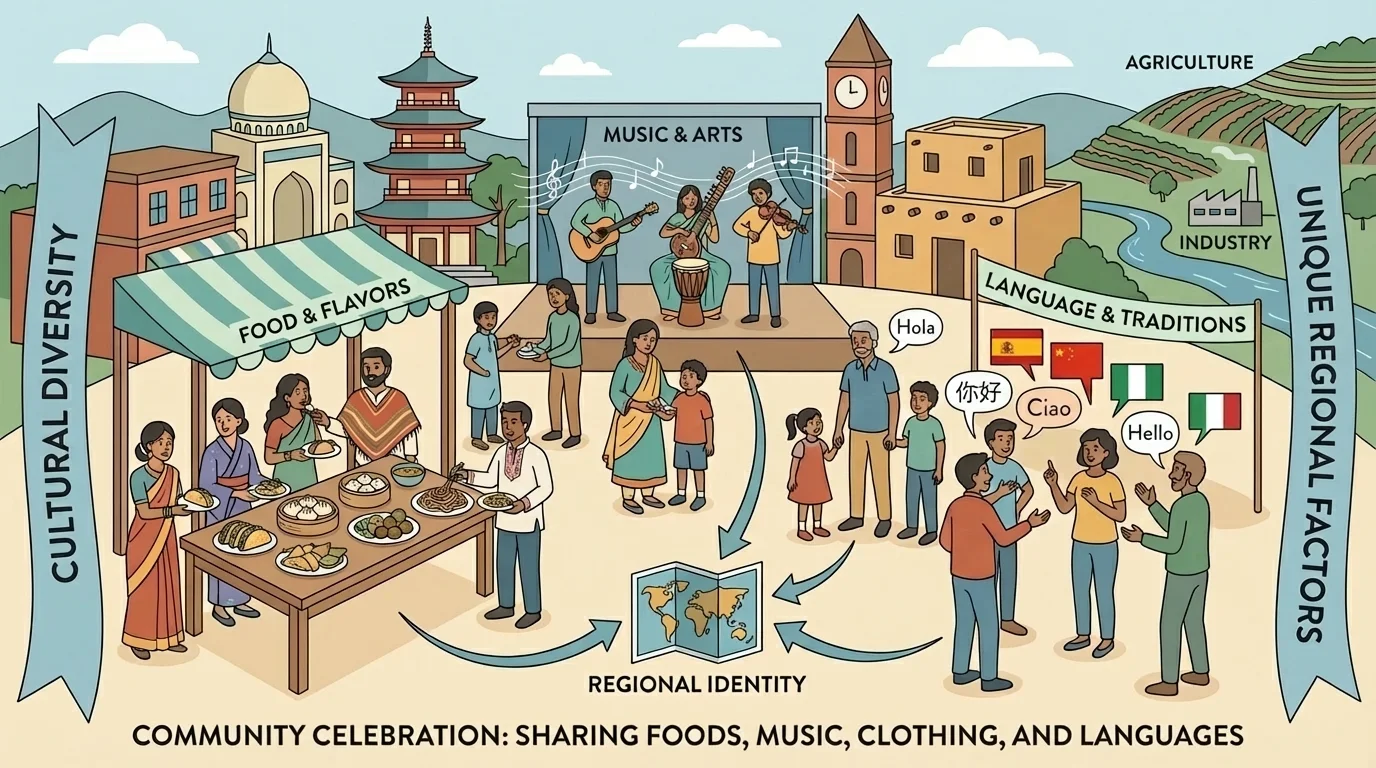
Communities also develop local traditions. A town may be known for a fair, a rodeo, a fishing festival, or a holiday light display. These traditions help people feel they belong. Over time, they become part of the region's identity.
How culture shapes a region
Culture includes the ways people live, celebrate, communicate, and solve everyday problems. When many people in a region share certain customs, foods, music, or beliefs, those patterns become part of what makes the region unique. When many different cultures live together, the region often becomes known for its diversity.
Culture can change too. New families may move into a region. People may bring new foods, stories, and celebrations. A region is not only a place on a map; it is also a living community shaped by the people who live there.
Another important way to understand a region is to ask, "What kinds of work happen here?" [Figure 4] The answer often depends on the land, water, climate, and resources in that place. Industry and agriculture are two big parts of many regions, and the figure connects different jobs to different kinds of places.
Agriculture means growing crops and raising animals. In a farming region, you may see fields of corn, wheat, rice, fruits, or vegetables. You may also see ranches with cattle, sheep, or chickens. Flat land, rich soil, and enough water often help farming succeed. Because of this, many plains and valleys become agricultural regions.
Industry means the kinds of businesses and work people do to produce goods or provide services. Some regions have factories that make cars, clothing, or tools. Other regions depend on fishing, mining, forestry, technology, shipping, or tourism. A coastal region may have harbors, fishing boats, and seafood markets. A mountain region may attract hikers and skiers. A city region may have offices, stores, hospitals, and schools.
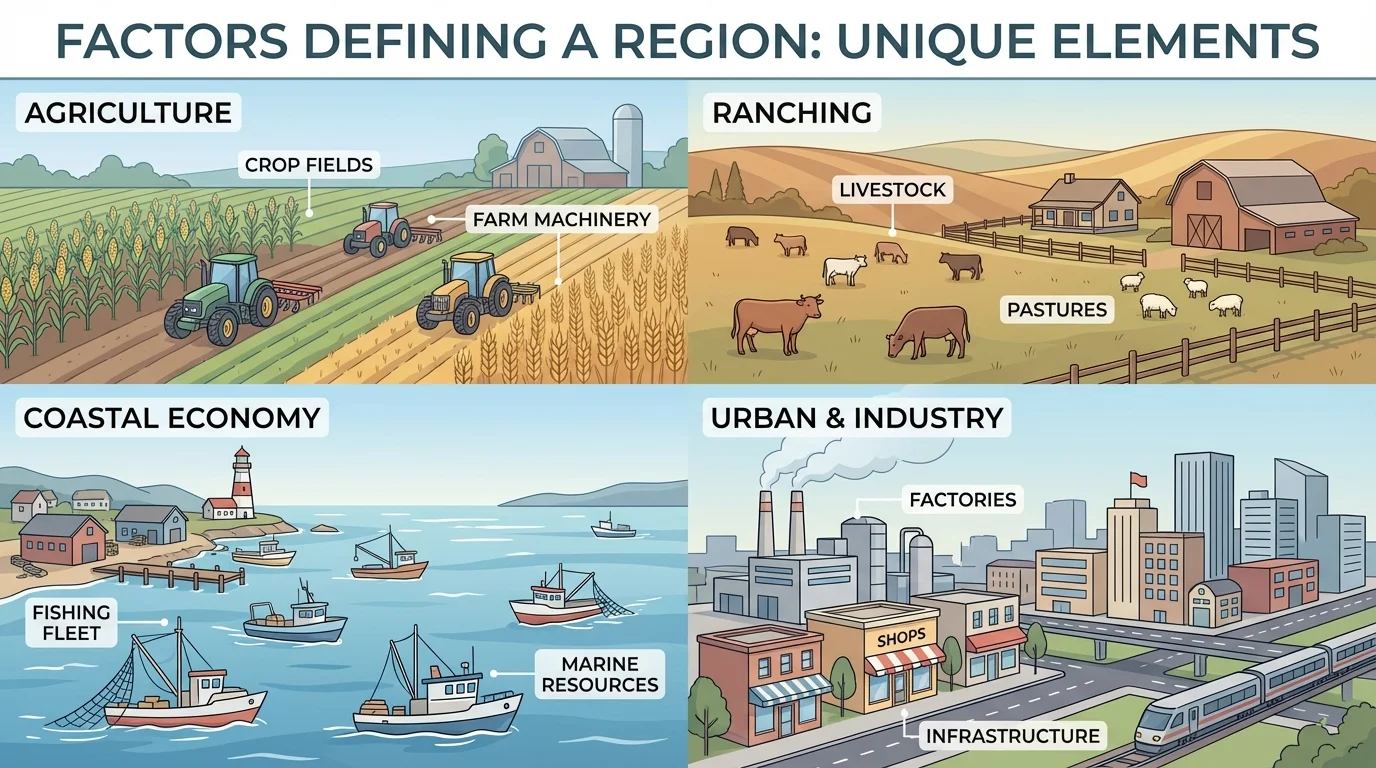
Resources matter a lot. If a region has forests, wood products may become important. If it has fertile soil, farming may be common. If it has a good harbor, trade and shipping may grow. This is why the same kind of work does not happen everywhere. People often choose jobs that fit the region around them.
Regions are rarely just one thing. A place can have both farms and factories. It can have tourism and fishing. It can have neighborhoods where people work in offices and nearby land where food is grown. Looking at industry and agriculture helps us understand how people use the land and how they meet their needs.
Case study: Three different regions
Step 1: A coastal region
This region may have beaches, a harbor, and a mild climate. People might work in fishing, shipping, tourism, and restaurants.
Step 2: A plains region
This region may have broad, flat land and rich soil. People might grow wheat or corn and raise cattle.
Step 3: A mountain region
This region may have steep slopes, forests, and colder weather. People might work in forestry, tourism, or mining.
Each region is unique because natural features and human activities work together.
As shown earlier in [Figure 4], the kinds of jobs people do often match the kind of place where they live. Geography and work are closely connected.
To identify what makes a region unique, geographers compare places carefully. They ask questions like these: What landforms are here? What is the climate like? What crops grow well? What jobs are common? What traditions do people share? What languages are spoken? These questions help us notice both common traits and important differences.
Look at the table below.
| Type of Region | Natural Features | Human Features | Examples of Work |
|---|---|---|---|
| Coastal region | Ocean, beaches, bays | Ports, seaside towns | Fishing, shipping, tourism |
| Farming region | Flat land, rich soil, rivers | Barns, silos, small towns | Growing crops, raising animals |
| Mountain region | High elevations, forests, valleys | Cabins, ski areas, small roads | Tourism, forestry, mining |
| City region | Often less open land | Tall buildings, roads, neighborhoods | Business, services, manufacturing |
Table 1. Comparison of several kinds of regions using natural features, human features, and common work.
This table shows that a region is not defined by only one thing. Usually, many features work together. A city region may be known for buildings and businesses, while a farming region may be known for fields and crops. Both are regions, but they are unique in different ways.
Remember that a community is a group of people living in the same place. Communities are part of regions, and the choices people make in their communities help shape the region around them.
Comparing regions also teaches respect. When we notice that people live in different ways because of climate, resources, history, or culture, we learn that no one region is the "normal" one. Each region has strengths and challenges.
Regions are not frozen in place. They change as people and environments change. A quiet town can grow into a larger city region. A farming area may add factories or stores. A region that once depended on mining may later depend on tourism or technology.
People moving from one place to another can change a region too. New families bring new languages, traditions, foods, and skills. This can increase cultural diversity and create new businesses. Roads, bridges, airports, and railways can also connect a region to other places and help it grow.
Nature can cause change as well. Floods, droughts, storms, and wildfires may affect where people live and work. A river can help a region grow, but a flood can also damage farms and towns. Regions keep changing because both people and nature are active.
A region can become famous for something new. A place known long ago for farming might later become known for music, technology, or tourism as people and businesses change over time.
This is why geographers keep studying regions. Understanding change helps communities make decisions about homes, schools, roads, water, and jobs.
Maps help us find patterns that are hard to notice from the ground. A map can show mountains, rivers, roads, cities, farms, forests, and borders. When we study these patterns, we can identify regions more clearly, and [Figure 5] displays how symbols and colors help readers recognize regional traits.
Some maps show physical features such as rivers and mountains. Other maps show human features such as population, land use, crops, or industries. A map key, or legend, explains what symbols and colors mean. If a map shows many farms in one area and many forests in another, we can begin to see two different regions.
Maps are useful because they let us compare large areas at once. They also help us understand distance and location. For example, a town near a river and a highway may become a trade center. A remote mountain village may stay smaller because travel is harder.
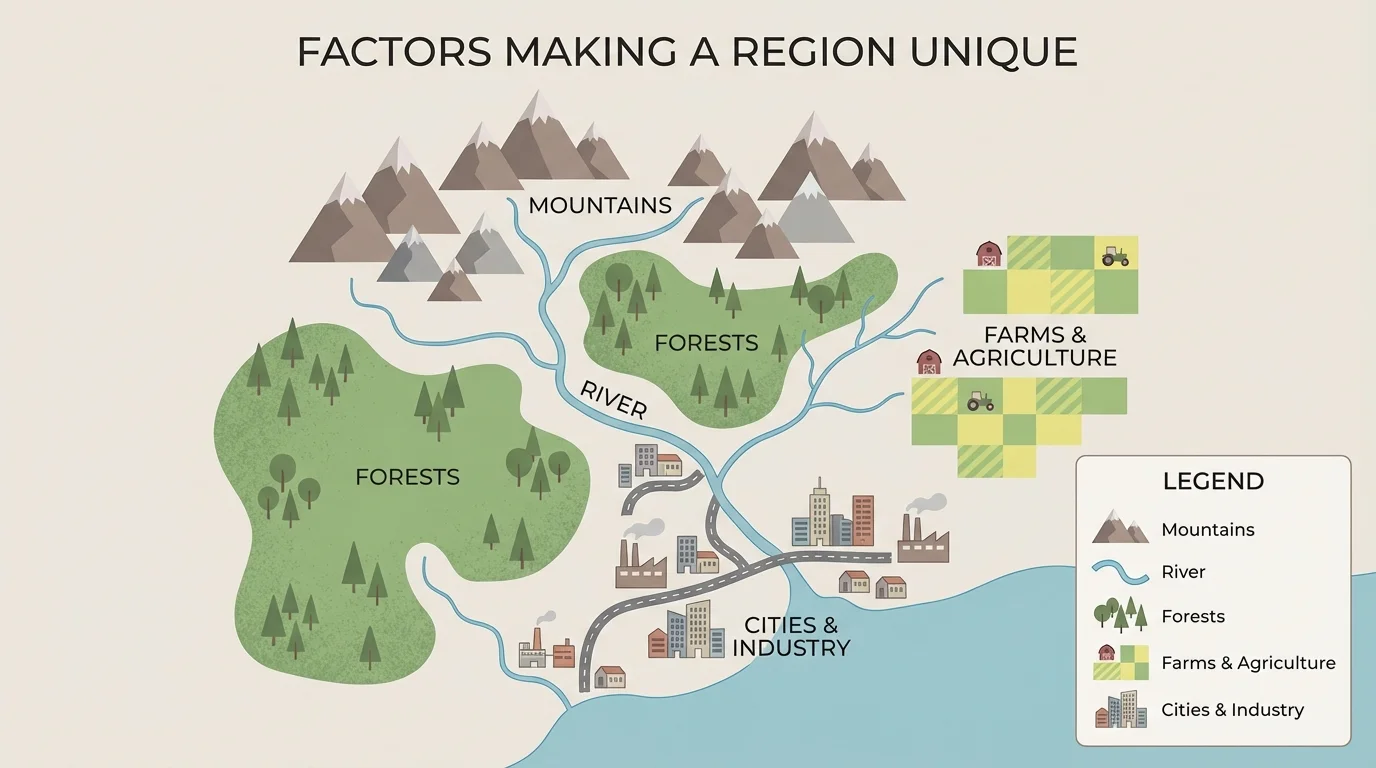
Earlier in the lesson, [Figure 1] grouped places into regions by shared features. Now [Figure 5] helps us see how maps provide evidence for those groupings.
Understanding regions matters in everyday life. Farmers need to know where crops grow best. Builders need to know the land and climate before making homes and roads. Businesses need to know what people in a region need. Travelers need to know what weather, landforms, and customs to expect.
Studying regions also helps us be thoughtful citizens. We learn that places are shaped by both the natural world and human choices. We see how communities depend on water, land, work, and culture. We also learn to appreciate the many ways people live across towns, states, countries, and continents.
When you identify what makes a region unique, you are doing real geography. You are noticing patterns, asking good questions, comparing places, and understanding how people and the environment connect. That is how geographers make sense of the world.
