Have you ever traded snacks at lunch or used money to buy something at a store? Those are both forms of exchange. People exchange things every day. A farmer may exchange eggs for money. A child may exchange allowance money for a book. Long ago, and sometimes even today, people also trade one item for another. Learning about exchange helps us understand how people get the things they need and want.
People cannot usually make everything by themselves. One person grows vegetables. Another person fixes bikes. Another person teaches music. Because people have different jobs and skills, they depend on one another. This is why exchange is important.
In economics, a producer is a person or business that makes goods or provides services. A consumer is a person who buys and uses goods or services. Producers and consumers are connected. Producers offer things people want or need, and consumers exchange something in return.
A good is an object that people can buy or use, such as shoes, bread, pencils, or a soccer ball. A service is work that someone does for another person, such as cutting hair, delivering mail, teaching, or repairing a sink. Goods and services both can be exchanged.
Exchange is giving one thing and receiving another thing in return. The exchange might use money, or it might happen by trading goods or services directly.
Value means how useful or important something is to a person. Different people may value the same thing in different ways.
Exchange happens because people think they will be better off after the trade. If a baker has extra bread and wants milk, and a dairy farmer has extra milk and wants bread, both people may gain by exchanging. This helps resources move from people who have them to people who need or want them.
Exchange is not only about objects. People can exchange services too. For example, a family may pay a dentist for a checkup. The family receives a service, and the dentist receives money. In another situation, one person might help a neighbor rake leaves, and the neighbor helps fix a bicycle later. That is also a kind of exchange.
Exchange also depends on agreement. Both sides must decide that the trade is worth it. If one child wants to trade a baseball card for a cookie, the other child must agree that the cookie is worth the card. If not, the exchange does not happen.
Sometimes exchange is easy, and sometimes it is hard. It depends on what people have, what they want, and what they think is fair. Two major forms of exchange are barter and monetary exchange.
Barter is a direct trade of goods or services without using money. In barter, one person gives something and gets something else in return. For example, someone might trade apples for bread, or a child might trade two stickers for one eraser.
[Figure 1] Barter was common in many places before money was widely used. It can still happen today. Friends may trade toys. Neighbors may trade chores. One person may mow a lawn while another person babysits later. No coins or bills are needed.
Barter can be helpful when both people have something the other wants. It can also help when money is not available. If one family grows tomatoes and another family raises chickens, they may barter tomatoes for eggs.
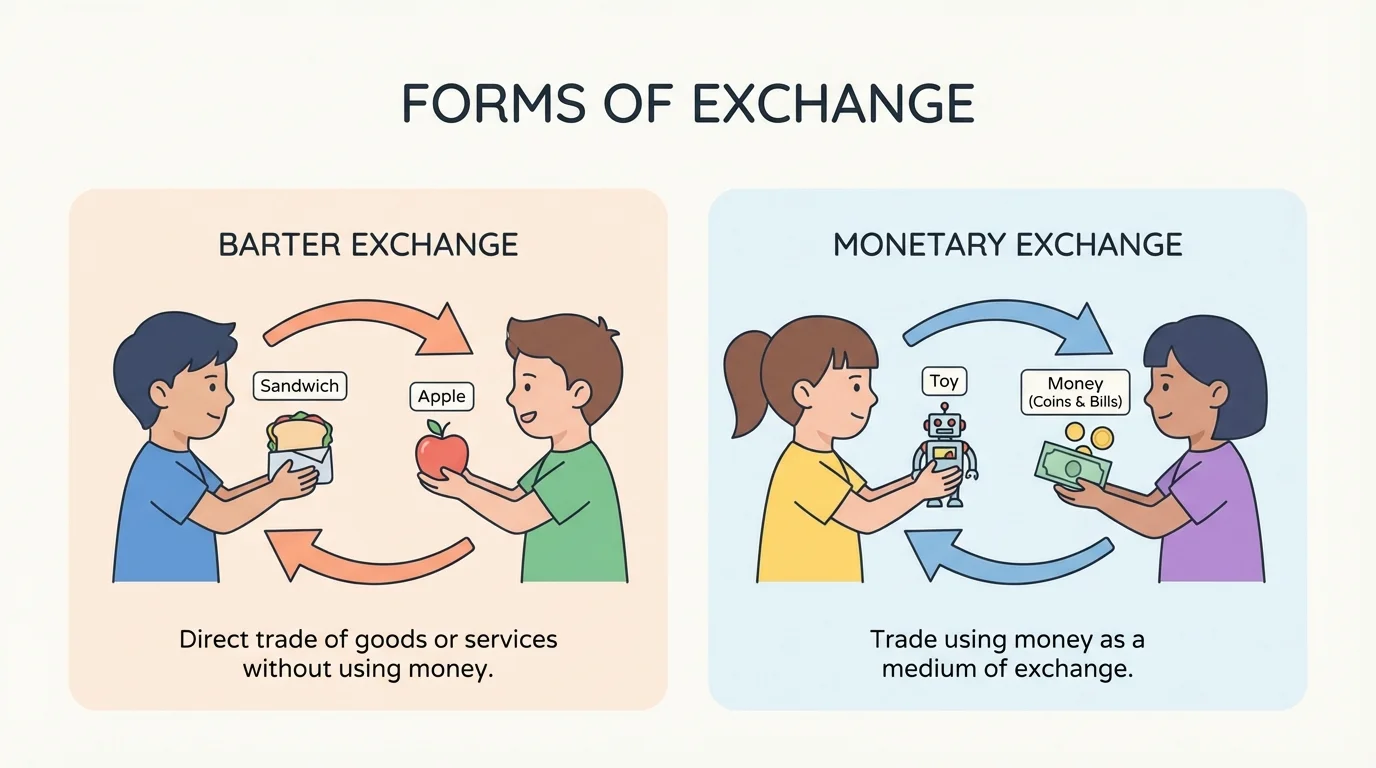
But barter can also be tricky. First, both people must want what the other person has. This is sometimes called a "double coincidence of wants." If Maya has grapes and wants crackers, but Leo has cheese and wants a pencil, Maya and Leo cannot barter unless they can find someone who wants grapes and has crackers.
Second, it can be hard to decide what is fair. Is one bag of popcorn worth one apple, or should it be two apples? Different people may think differently. Because value can change from person to person, barter may take a long time.
Third, some things are difficult to divide. If someone wants only a little bit of rice, it may be hard to trade exactly the right amount for a large item, such as a basket. As we saw in [Figure 1], barter works best when the items are easy to trade and both sides clearly agree.
Examples of barter
Step 1: A child trades a comic book for a puzzle.
No money is used. Each child gives one good and gets one good.
Step 2: A neighbor waters plants while another neighbor feeds a pet later.
This is a service traded for a service.
Step 3: A farmer trades corn for milk.
This is a good traded for another good.
Barter teaches us that exchange can happen in more than one way. People do not always need money to trade, but barter often takes more time and effort.
Money makes exchange easier because people can use it to buy goods and services. Monetary exchange means using money to buy or sell something. Most exchanges in stores, restaurants, and businesses use money.
[Figure 2] Money can be coins, bills, or money in a bank account used with a card or digital payment. The important idea is simple: money is something people agree can be used to pay for things.
Here is how monetary exchange works. A producer offers a good or service. A consumer chooses it and pays money. Then the producer can use that money to buy other things. A baker sells bread for money. Later, the baker may use that money to buy flour, fruit, or shoes.
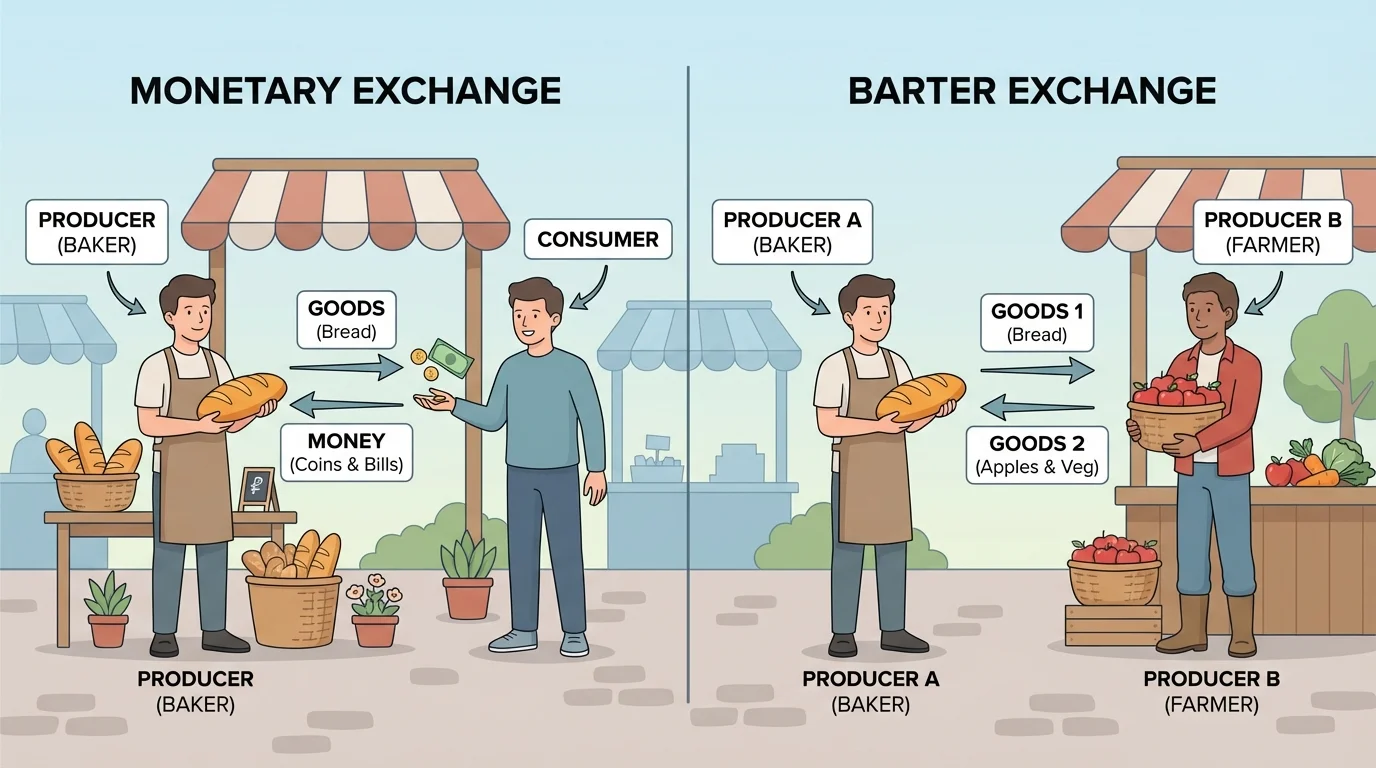
Money solves some of the problems of barter. A person selling shoes does not have to find someone who wants shoes and has exactly the thing the seller wants. Instead, the seller can accept money from many customers. Then the seller can use the money to buy many different goods and services.
Money also helps people compare prices. A sandwich might cost $4, and a juice might cost $2. The prices help consumers decide what they can afford. If a student has $6, then buying both would use all the money because the total is \(4 + 2 = 6\).
Monetary exchange is common in everyday life. Families pay for groceries, bus rides, doctor visits, haircuts, and school supplies. Workers provide services or make goods, and they are paid money. Later, they use that money as consumers.
The market scene in [Figure 2] helps us remember an important idea: money moves through the community. It goes from consumers to producers when people buy something, and then producers use that money to pay workers or buy materials.
Why money is useful
Money is useful because it is easier to carry than many traded goods, easier to count, and easier to use with many different people. It helps exchanges happen faster and more fairly because prices can be listed clearly.
Monetary exchange does not mean every choice is easy. Consumers still need to think carefully. They may compare prices, quality, and how much they really need something before spending money.
Today, exchange happens in many places. People exchange in stores, at markets, through delivery services, and online. The form is still usually barter or money, but the setting may look different. A customer might hand cash to a cashier, swipe a card, or click a button online. The basic idea stays the same: one side gives something, and the other side gives something in return.
Services are a big part of exchange today. A teacher provides teaching. A bus driver provides transportation. A doctor provides medical care. A mechanic fixes cars. In each case, consumers receive a service and the worker receives money.
Some communities hold swap events where people bring books, clothes, or toys and trade them instead of buying new ones. This can save money and reduce waste at the same time.
Even when technology is involved, exchange still depends on trust, agreement, and value. If a family orders a backpack online, the family expects the backpack to arrive, and the seller expects payment. Exchange works best when both sides act honestly.
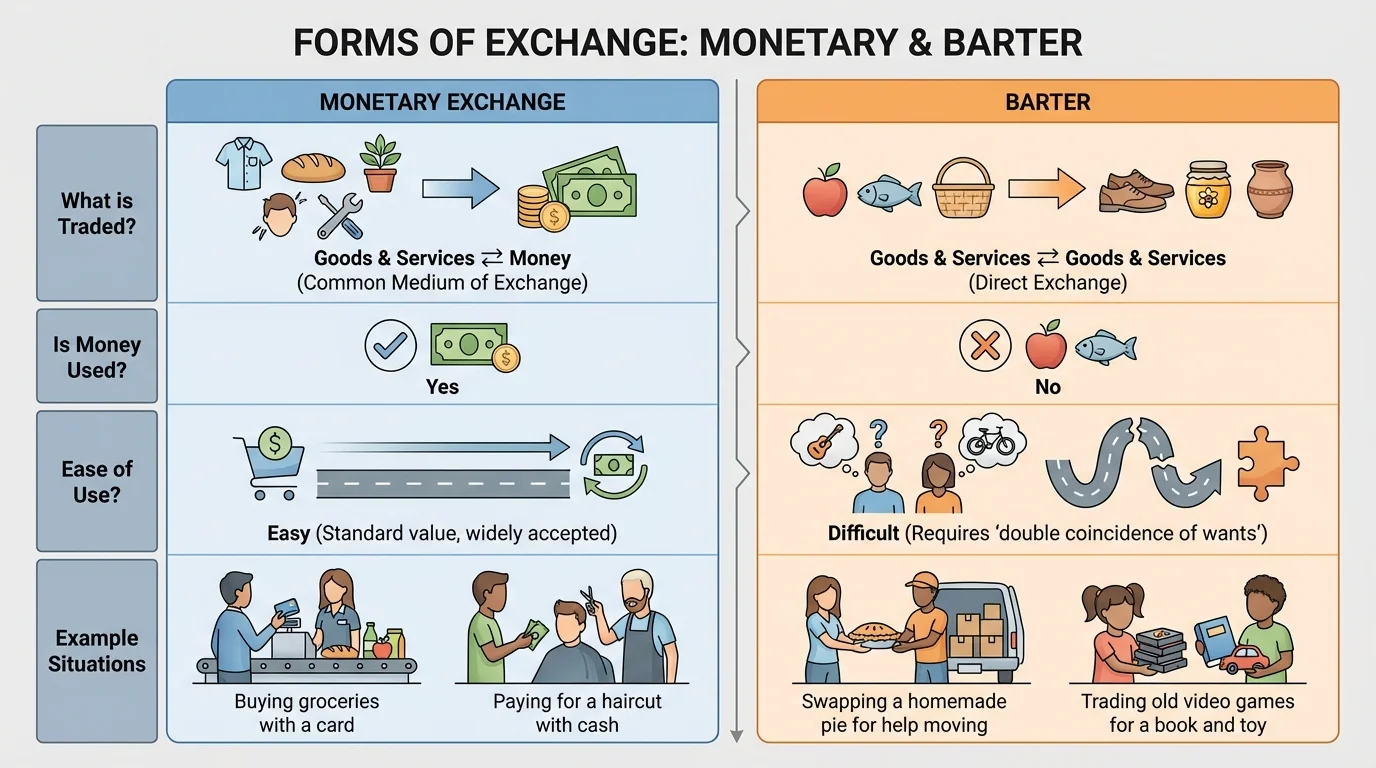
Barter and money are both ways people exchange goods and services. In both forms, people give something and receive something. The main difference is that barter uses direct trade, while monetary exchange uses money.
[Figure 3] Barter can work well in small situations, especially when two people each have something the other wants. Monetary exchange works better in larger communities because it is faster and easier to use with many people.
| Form of exchange | What happens | Money used? | Example |
|---|---|---|---|
| Barter | People trade goods or services directly | No | Trading fruit for eggs |
| Monetary exchange | People buy and sell using money | Yes | Buying bread at a bakery |
Table 1. This table compares barter and monetary exchange.
Another difference is that money gives a common way to describe price. In barter, people must talk and decide what seems fair each time. In monetary exchange, a price tag already gives a value, such as $3 for a notebook or $5 for a game ball.
When students compare the two systems, [Figure 3] helps them see that barter is more direct, but monetary exchange is usually more convenient. Both forms are important to understand because both show how people meet needs and wants.
A fair exchange is one that both sides agree to and understand. Fair does not always mean equal in size. It means each person believes the trade or purchase is acceptable. If someone buys a sandwich for $4 because they are hungry and think the sandwich is worth that amount, that exchange feels fair to them.
Consumers should make smart choices before exchanging. They can ask questions such as: Do I need this? Is the price reasonable? Is this item in good condition? Could I save my money for something more important?
Producers also make choices. They think about how much to charge, how to make a good product, and how to serve customers well. If producers are honest and goods are made carefully, consumers are more likely to buy from them.
People have needs, such as food, water, and shelter, and wants, such as toys or games. Exchange helps people get both needs and wants, but needs are usually more important.
Saving is also part of smart exchange. A consumer does not have to spend money right away. Sometimes it is better to save for a future purchase. If a student gets $2 each week, then after \(3\) weeks the student has \(2 + 2 + 2 = 6\) dollars, which may be enough to buy a book that costs $6.
A community is full of exchange. Farmers grow food. Truck drivers move it. Stores sell it. Families buy it. Doctors, teachers, builders, and many other workers provide services. Each person depends on others.
When a consumer buys apples at a market, the exchange may seem simple, but many producers helped make it happen. A farmer grew the apples. Workers picked and packed them. A driver transported them. A store worker placed them on the shelf. Exchange connects many people.
This is one reason economics matters in everyday life. It helps explain how goods and services move from producers to consumers. It also shows why rules, honesty, and fairness matter. When exchange works well, communities can meet more needs and wants.
Community exchange example
Step 1: A baker makes loaves of bread.
The baker is the producer.
Step 2: A family buys bread at the shop.
The family is the consumer, and this is monetary exchange.
Step 3: The baker uses the money to buy flour and pay workers.
The same money continues moving through the community.
Sometimes one person can be both a producer and a consumer. A music teacher provides lessons and earns money as a producer of a service. Then the teacher buys groceries as a consumer. Many adults switch between these roles every day.
Understanding forms of exchange helps students notice the busy system around them. Every lunch bought at school, every haircut, every repaired bicycle, and every traded toy is part of economic life.
