Every day, money, goods, and services move all around us. A family buys milk at a store. A barber cuts hair for a customer. A restaurant serves lunch to hungry people. It may seem like these are small moments, but they are part of something big: the way people and businesses depend on one another. When goods and services are exchanged, both sides can gain something important.
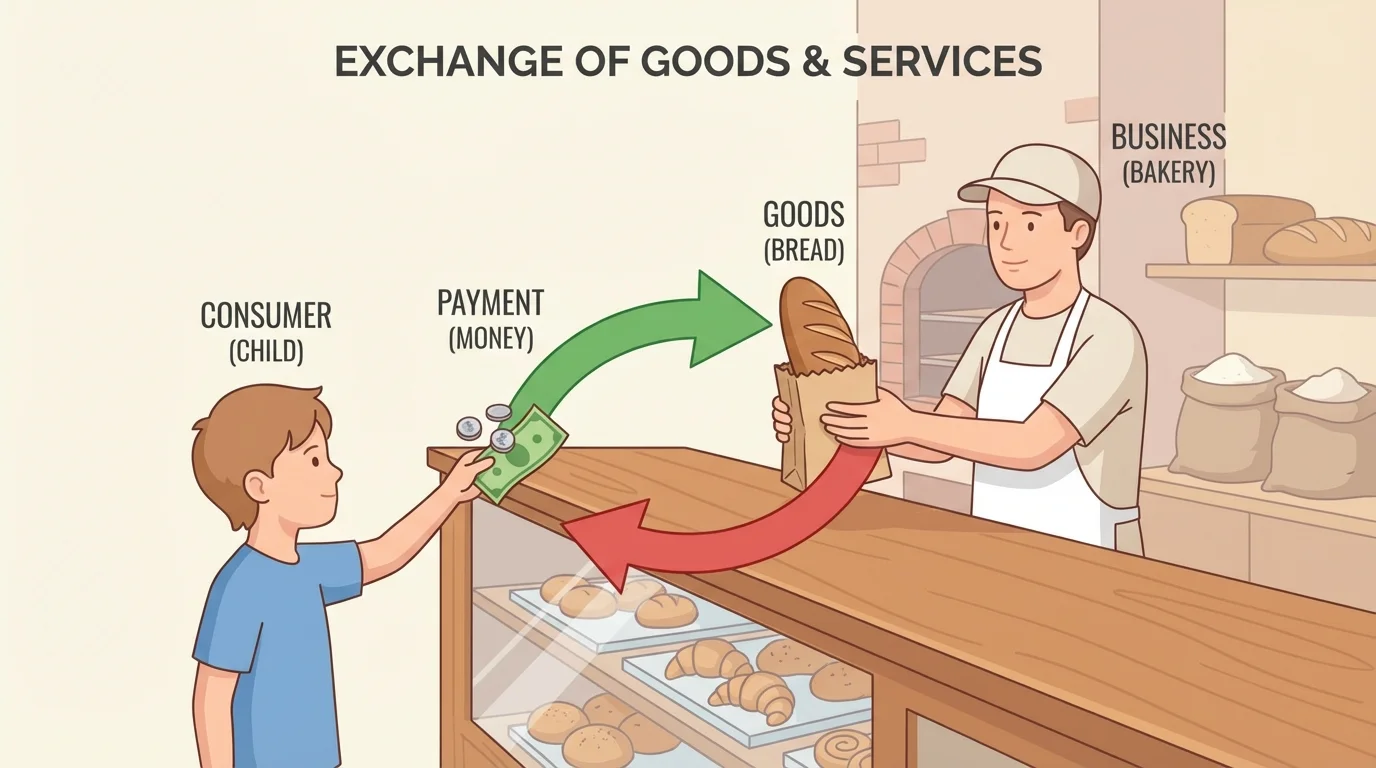
An exchange happens when one side gives something and gets something in return. In economics, this often means a business gives a good or service, and a person gives money. This two-way action matters because both sides are trying to meet a need or want, as [Figure 1] shows with a simple purchase at a bakery.
A good is something you can touch, use, or own, such as a sandwich, a backpack, or a toy. A service is work someone does for another person, such as fixing a bike, teaching a class, or washing a car. Businesses may sell goods, services, or both.
Business means a person or company that makes, sells, or provides goods or services. Consumer means a person who buys and uses goods or services. Producer means a person or business that makes goods or provides services for others.
When a child buys a muffin at a bakery, the bakery gives the muffin, and the customer gives money. The customer gets food, and the bakery gets money to pay workers, buy ingredients, and keep the business open. That is why exchange affects both sides.
A producer creates or provides something. Farmers grow vegetables. Bakers make bread. Drivers provide rides. Doctors provide care. All of these people or businesses are producers because they offer goods or services.
A consumer buys and uses goods or services. If you buy a notebook, you are a consumer. If your family pays for internet service, they are consumers. Consumers make choices about what to buy, when to buy it, and where to buy it.
Sometimes a business can be a consumer too. For example, a pizza shop buys cheese, flour, and boxes from other businesses. That means businesses do not only sell things. They also buy what they need in order to make their own goods and services.
People have needs, such as food, clothing, and shelter. They also have wants, such as games, treats, or movie tickets. Businesses often try to provide both needs and wants.
This is one reason economics can feel like a giant web. One business may be a producer in one exchange and a consumer in another exchange. A bakery sells bread to families, but it buys flour from a mill and ovens from another company.
Exchange is important because it can help everyone involved. Consumers get things they need or want. Businesses receive money so they can continue operating. If people stop buying from a business, that business may struggle to stay open.
Consumers benefit in many ways. They can save time by paying someone to do a job. They can buy items they cannot make themselves. They can choose from different prices, brands, and services. For example, a family may choose one grocery store because it is close to home, or another because prices are lower.
Businesses benefit because selling goods and services brings in income. That money helps them pay workers, buy supplies, improve products, and sometimes open new locations. A business that serves customers well may earn more trust and more sales.
Exchange works best when both sides believe the trade is worth it. A customer gives money because the item or service seems useful, enjoyable, or necessary. A business accepts the money because it helps cover costs and support the work of the business. When both sides feel satisfied, exchange can continue again and again.
Think again about the bakery in [Figure 1]. The customer leaves with food, and the bakery gains money. If the bread is fresh and the service is kind, the customer may return. Repeated exchanges help build strong businesses and happy customers.
Goods and services are exchanged in many places. Some exchanges happen in stores, such as grocery stores, toy stores, and clothing shops. Some happen in service businesses, such as salons, repair shops, and restaurants. Others happen online, where people order books, shoes, or games from websites.
Different ways of exchange can fit different needs. A local store lets customers see items right away. Online shopping can offer more choices and home delivery. A farmers market lets people buy fresh food directly from the people who grew it. A restaurant provides both a good, the food, and a service, preparing and serving the meal.
Even schools see exchange around them. The cafeteria provides meals. The book fair sells books. A school photographer offers pictures. In each case, goods or services are provided, and consumers choose whether to buy them.
One item you buy may connect many businesses. A simple pencil may involve wood from one company, paint from another, metal from another, and a store that sells the finished pencil.
This means exchange can happen in person, by phone, or on a computer. The method may change, but the basic idea stays the same: one side provides something of value, and the other side gives something in return.
Many goods do not go straight from the maker to the buyer. Instead, they move through several businesses before reaching the consumer. The path of apples from a farm to a family, shown in [Figure 2], helps explain how many producers work together.
First, a farmer grows apples. Then a truck company transports them. After that, a grocery store sells them. Finally, a family buys them. Each business in the chain provides a service or good that helps the apples reach the consumer.
This shows that exchange is not only between one business and one person. It can also happen between businesses. The grocery store buys apples from the farm. The farm may buy tools, seeds, and boxes from other businesses. By the time the apples reach a family, many exchanges have already taken place.
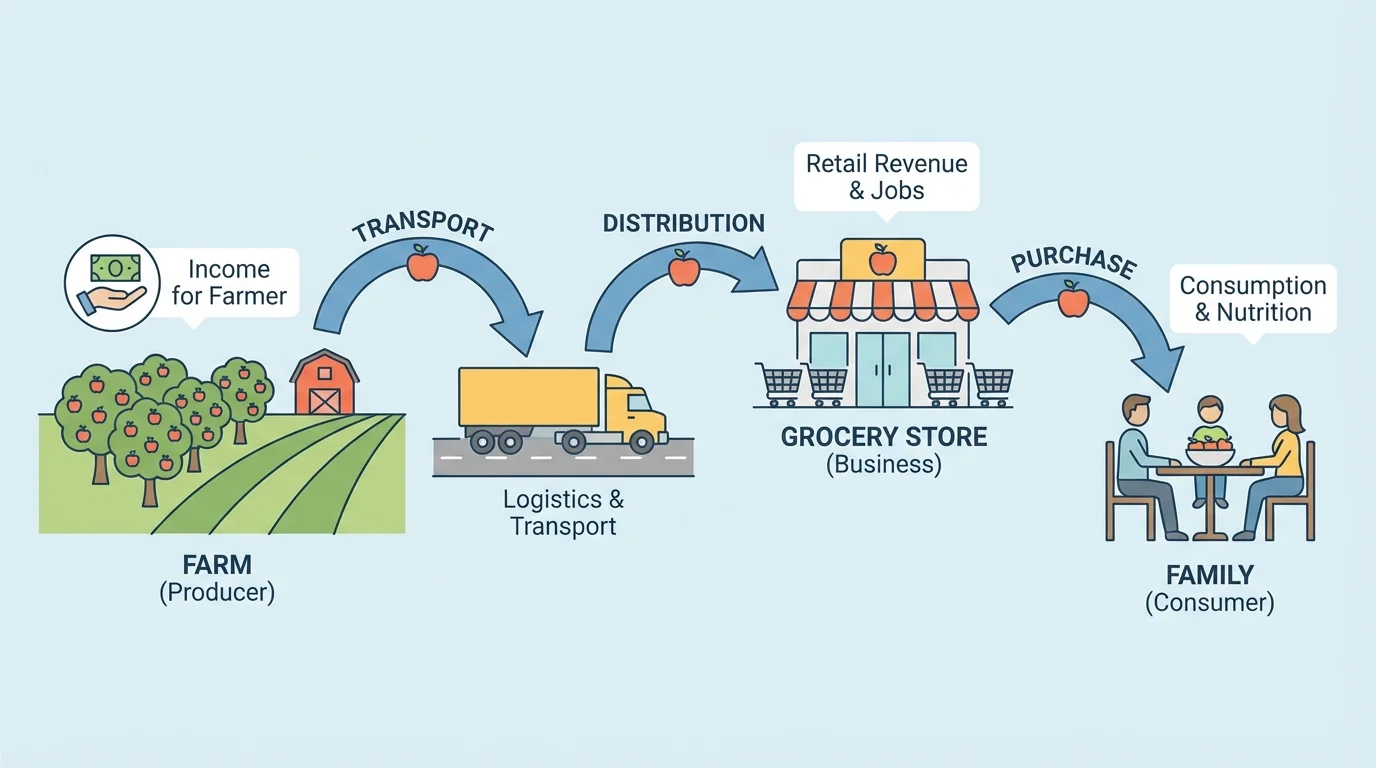
This path matters because each business depends on the others. If the truck company cannot deliver the apples, the store may not have enough to sell. If the store cannot sell enough apples, it may buy fewer from the farm next time. Exchanges connect many people.
Money is not the only thing consumers give to businesses. Consumers also give information through their choices. When many people buy one product, the business learns that the product is popular. When very few people buy something, the business may decide to change it or stop selling it.
This idea is called demand. Demand means how much people want and are willing to buy a good or service. If many students want notebooks with colorful covers, a store may order more of them. If very few people want a certain snack, the store may order less.
Example: How consumer choices affect a store
A small shop sells two kinds of water bottles.
Step 1: Customers buy many blue bottles and only a few green bottles.
Step 2: The shop notices which bottles sell faster.
Step 3: The shop orders more blue bottles and fewer green bottles.
The consumers help the business decide what to sell by making choices.
Reviews, friendly comments, and complaints also matter. If customers say a toy breaks too easily, a business may try to improve it. If customers praise quick service, the business may keep using the same system. So consumers help shape business decisions.
Not all exchange is equally good. For exchange to work well, businesses should be honest, prices should make sense, and goods and services should be safe and useful. Consumers should also make thoughtful choices and pay fairly for what they buy.
Price is the amount of money paid for a good or service. A low price may attract buyers, but customers also care about quality. A backpack that costs less but tears quickly may not be the best choice. A slightly higher price might be worth it if the backpack lasts longer.
Good customer service matters too. If workers are respectful and helpful, consumers may want to return. If a business is careless or rude, customers may shop somewhere else. Fair exchange depends on trust.
Quality and trust help exchanges continue. When businesses offer safe products, clear prices, and good service, consumers are more likely to return. When consumers pay and follow rules fairly, businesses can keep serving the community.
Sometimes consumers compare choices before buying. They may ask: Is this useful? Is the price fair? Is this store trustworthy? These questions help consumers become smart decision-makers.
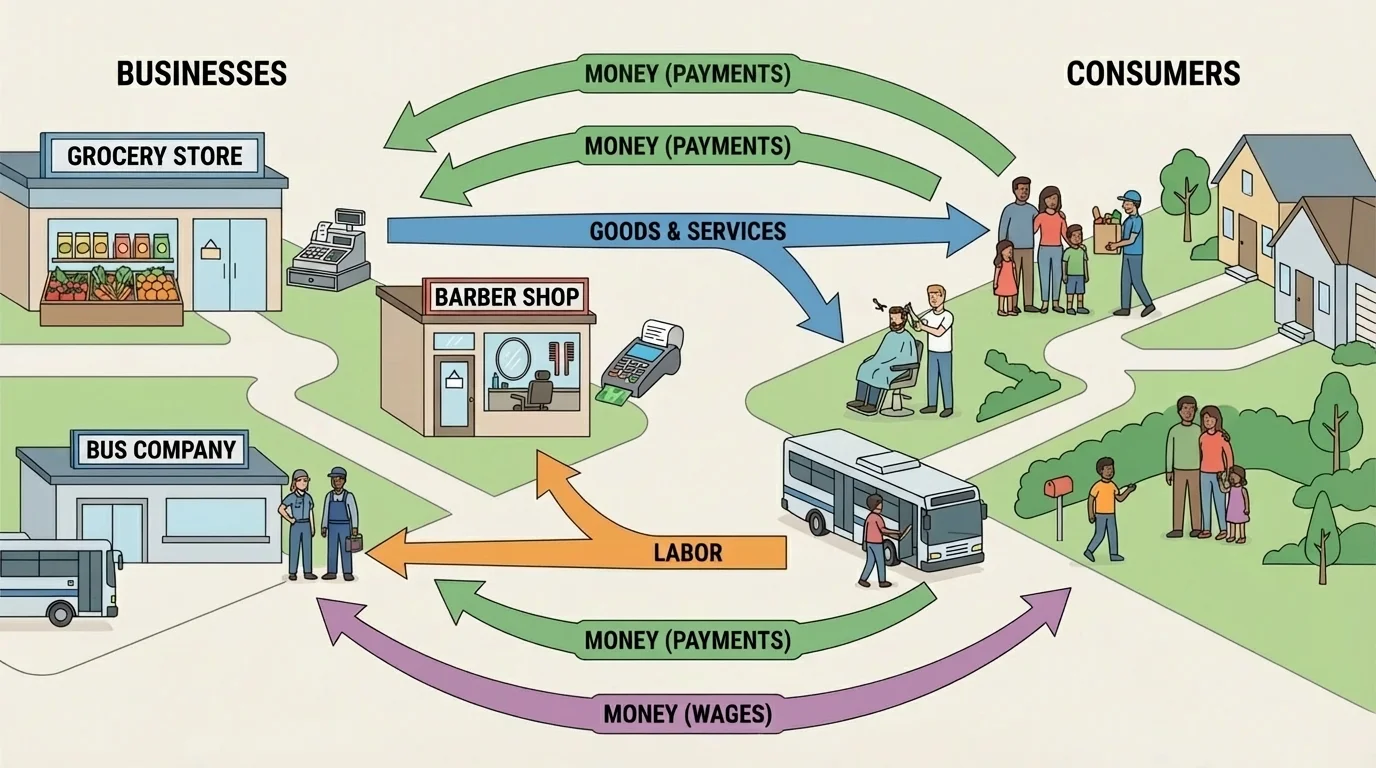
Exchange does not affect only one buyer and one seller. It can affect many people in a neighborhood or town. A busy grocery store can hire workers, buy from nearby farms, and serve many families. A strong pattern of exchange helps money move through the community, as [Figure 3] illustrates.
When businesses earn money, they often pay workers. Workers then use their money to buy food, clothes, haircuts, and other goods and services. Those businesses then pay their workers too. In this way, one exchange can lead to many more exchanges.
Communities can benefit when local businesses stay open and grow. They can provide jobs, useful services, and convenient places to shop. Families benefit because they have access to what they need nearby.
Communities also use money from taxes to pay for public services such as roads, parks, libraries, and schools. While children do not usually pay business taxes themselves, the buying and selling in a community can help support shared places and services.
This town scene reminds us that exchange creates connections. A shopper, a store worker, a delivery driver, and a farmer may never all meet, but their actions still help one another.
Consider a haircut. A barber provides a service. The customer pays for the haircut. The customer leaves with cleaner, shorter hair. The barber receives money to support the business. But that is not the end. The barber may use some of that money to buy shampoo, scissors, electricity, and snacks for home. One service leads to many other exchanges.
Now think about a grocery store. Families buy bread, fruit, milk, and cereal. The store uses the money from those sales to restock shelves, pay cashiers, and keep refrigerators running. The store also buys from farms, bakeries, and delivery companies. This is similar to the product path we saw earlier in [Figure 2], where many businesses help a product reach the final buyer.
A school book fair is another good example. Students and families are consumers when they buy books. The company or group running the book fair is the producer or seller. The school may also benefit if it receives books or part of the money earned. A single event can help readers, sellers, and the school community.
| Exchange | What the Consumer Gets | What the Business Gets | Who Else May Be Helped |
|---|---|---|---|
| Buying bread at a bakery | Fresh bread | Money from the sale | Bakers, delivery workers, farmers |
| Getting a haircut | A grooming service | Payment for work | Shop workers, suppliers |
| Buying apples at a store | Food to eat | Money from the sale | Farmers, truck drivers, store workers |
| Ordering a book online | A book to read | Money from the sale | Warehouse workers, drivers, publishers |
Table 1. Examples of how exchanges help consumers, businesses, and other people connected to the exchange.
When we look closely, exchange is happening almost everywhere. It helps people meet needs and wants. It helps businesses continue their work. It helps communities stay active and connected.
"People depend on businesses, and businesses depend on people."
That simple idea explains why exchange matters so much. Consumers make choices. Businesses respond to those choices. Goods and services move from place to place. Money moves back through the system. Because of exchange, daily life works more smoothly for everyone involved.
