Have you ever eaten a banana that grew far away, worn a shirt made in another place, or ridden in a car that used parts from many factories? That happens because of trade. Trade is one of the big ways people get what they need and want. It connects families, workers, stores, and whole communities. Even a simple lunch can be part of a long story of buying, selling, and sharing work, as [Figure 1] shows.
Trade is when people or groups exchange things of value. They may exchange goods, which are things you can touch like apples, shoes, or books. They may also exchange services, which are jobs people do for others, such as haircuts, bus rides, or fixing a sink. In trade, one thing often moves one way while money moves the other way.
A producer makes or provides goods or services. A consumer buys and uses them. When a baker makes bread and a family buys it, that is trade. When a dentist helps a patient and the family pays for the visit, that is also trade.
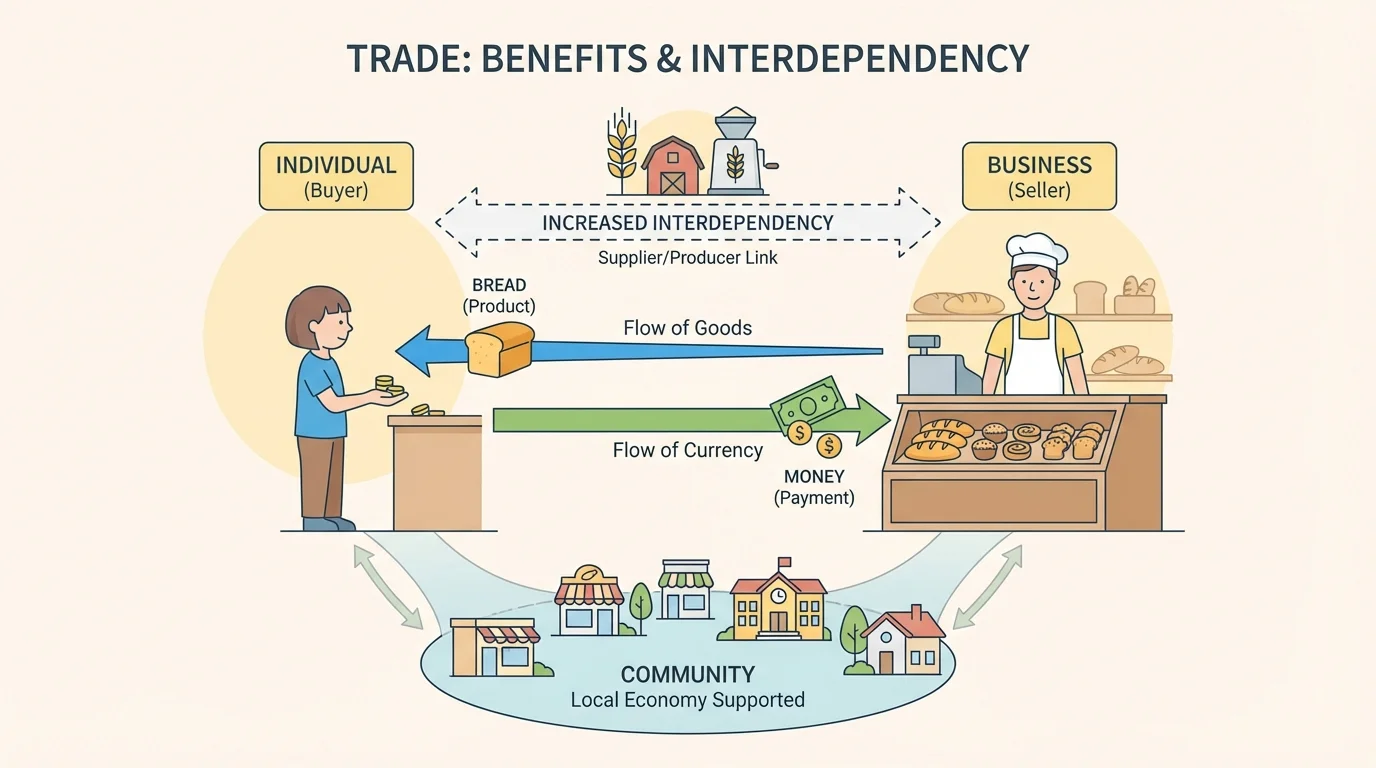
Trade can happen in different ways. Sometimes people trade by using money. Sometimes they trade by bartering, which means swapping one thing for another without money. Long ago, one person might trade eggs for milk. Today, most trade uses money because it is easier to count value and make many kinds of exchanges.
Goods are things people can make, grow, or sell that you can touch.
Services are actions or work people do for others.
Producers create or provide goods and services, and consumers buy or use them.
Every day, producers and consumers depend on exchange. Stores need customers. Customers need stores and workers. This back-and-forth helps people meet needs and enjoy wants.
People trade because no one can make everything alone. A farmer grows food. A carpenter builds tables. A teacher helps students learn. A doctor helps people stay healthy. When each person does what they do well and then trades, everyone can have more goods and services than they could by themselves.
This idea is called specialization. Specialization means people focus on making one kind of good or doing one kind of job especially well. A person who spends time baking bread can make better bread than someone who only bakes once in a while. Then other people can trade for that bread instead of trying to make all their own food.
Why specialization matters
When people specialize, they often become faster and better at their work. That can help lower costs, improve quality, and increase the number of goods and services available. Trade lets everyone share in those benefits.
Trade saves time too. If one family had to grow cotton, make cloth, sew clothes, grow food, build furniture, and fix every tool, life would be very hard. Trade lets families get many things from many skilled producers.
Trade benefits individuals in many ways. First, it gives people more choices. A shopper can choose between different fruits, shoes, books, or toys. Second, it can help people save money when stores compete to offer good prices. Third, it gives access to things people cannot make for themselves.
Think about breakfast. One child may drink orange juice, eat cereal, and spread butter on toast. The oranges may come from one place, the grains from another, and the butter from a dairy farm. Because of trade, that child can enjoy many foods without growing or producing all of them at home.
Trade also helps individuals earn income. A worker may teach school, repair bicycles, cook meals, or drive a truck. In return, the worker is paid money. Then that money can be used to buy other goods and services. So people often help others through their work, and trade helps them meet their own needs too.
Example: Evidence that trade helps a family
A family buys milk from a store, shoes from another store, and gets haircuts from a barber.
Step 1: Identify what the family receives.
The family receives two goods, milk and shoes, and one service, haircuts.
Step 2: Identify the evidence of benefit.
The family does not need to raise cows, make shoes, or cut everyone's hair at home.
Step 3: State the conclusion.
Trade helps the family by saving time, giving choices, and providing useful goods and services.
When students cite evidence, they can point to real details: a family bought food they did not grow, received a service they could not easily do alone, or chose among several products. Those details are evidence that trade helps individuals.
Businesses benefit from trade because they need to buy, sell, and work with other businesses. A small shop does not usually make every item it sells. It buys supplies, tools, or products from other producers. One business often relies on many others.
For example, a pizza shop may buy flour from one company, cheese from another, tomato sauce from another, and boxes from a packaging company, as [Figure 2] illustrates. Then the pizza shop sells pizza to customers. The shop earns money, and the supplying businesses earn money too.
Trade helps businesses grow. If a toy maker can sell toys to more stores, it may need more workers, more materials, and more trucks for delivery. That can increase jobs and help the business improve its products. A store with many customers may stay open longer and serve more families.
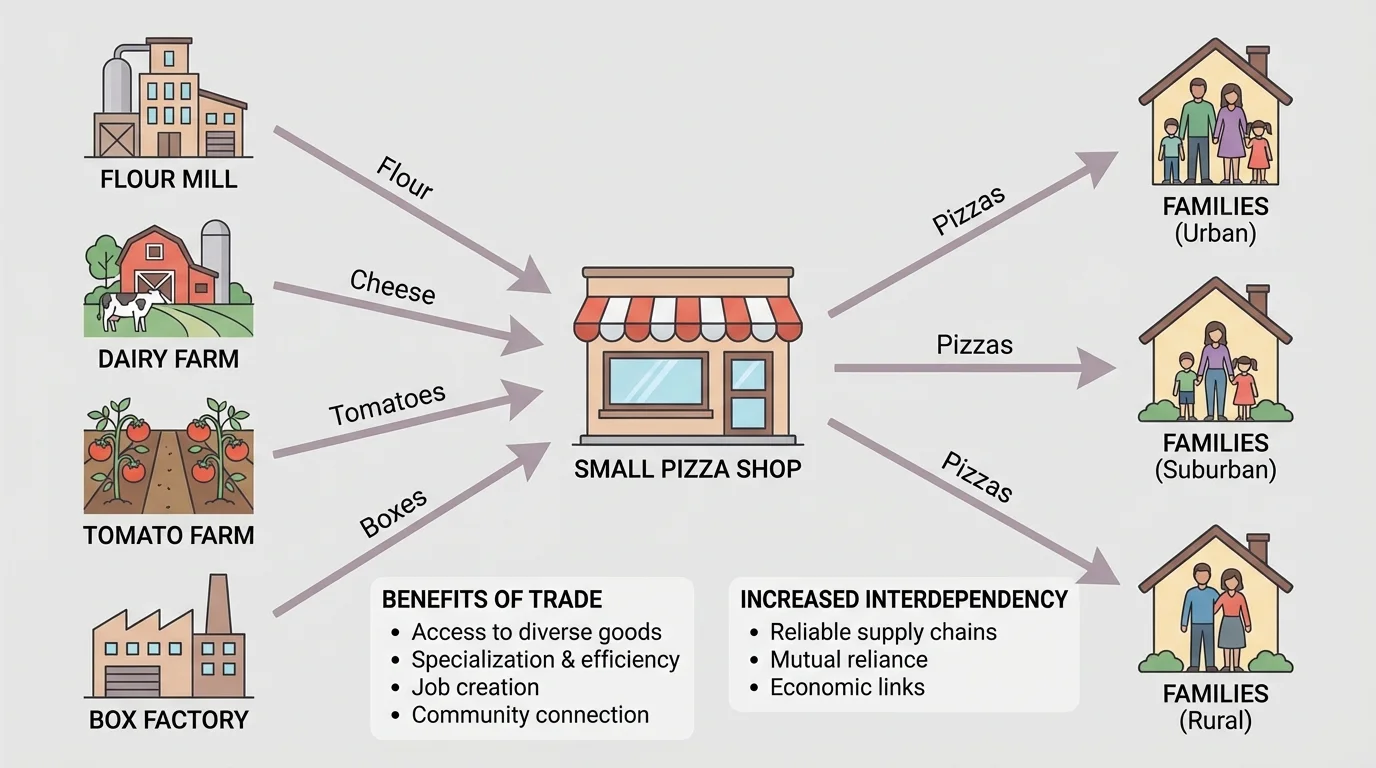
Trade can also help businesses solve problems. If one supplier runs out of something, a business may trade with a different supplier. If customers want a new item, the business may order it from another producer. Businesses are always making choices about what to buy, what to sell, and how to serve consumers.
A single grocery store may carry food from many farms, factories, and trucks before it reaches the shelf. Even one loaf of bread can involve farmers, mill workers, bakers, drivers, and store employees.
Evidence that trade helps businesses includes signs such as more products on shelves, more customers, more workers hired, or a business being able to open another location. These details show that exchange supports business success.
Trade does not help only one buyer or one seller. It can help a whole community. When local stores and businesses do well, they may hire workers from the area. Those workers earn money and spend it in other places in the community. This keeps money moving from one person to another.
Communities also benefit because trade increases access to useful goods and services. A town may have a grocery store, clinic, school, repair shop, and farmers market. If these places trade with customers and with one another, families can get what they need close to home.
Trade can also support community services. Businesses and workers often pay taxes, and those taxes can help pay for roads, parks, libraries, and schools. So trade can help build stronger neighborhoods in ways people see every day.
Example: Evidence that trade helps a community
A new bakery opens in town.
Step 1: Look for direct effects.
The bakery sells bread and cakes, so families have another place to buy food.
Step 2: Look for indirect effects.
The bakery hires workers and buys ingredients from suppliers.
Step 3: Cite evidence of community benefit.
The town now has more jobs, more shopping choices, and more business activity.
A community with trade often has more variety. People may find food from different regions, tools made by skilled workers, and services from trained professionals. This variety helps meet the needs of many different people.
Interdependence means people, businesses, and places rely on one another. Trade creates interdependence because each person or group does part of the work and depends on others to do their parts too. A town's connections help explain why trade ties many people together.
Think about an apple in a lunchbox. A farmer grows the apple. Workers pick it. A truck driver moves it. A store sells it. A family buys it. If one part of that chain stops, getting the apple becomes harder. This is evidence of interdependence: many people rely on one another so the apple reaches the lunchbox, as [Figure 3] shows.
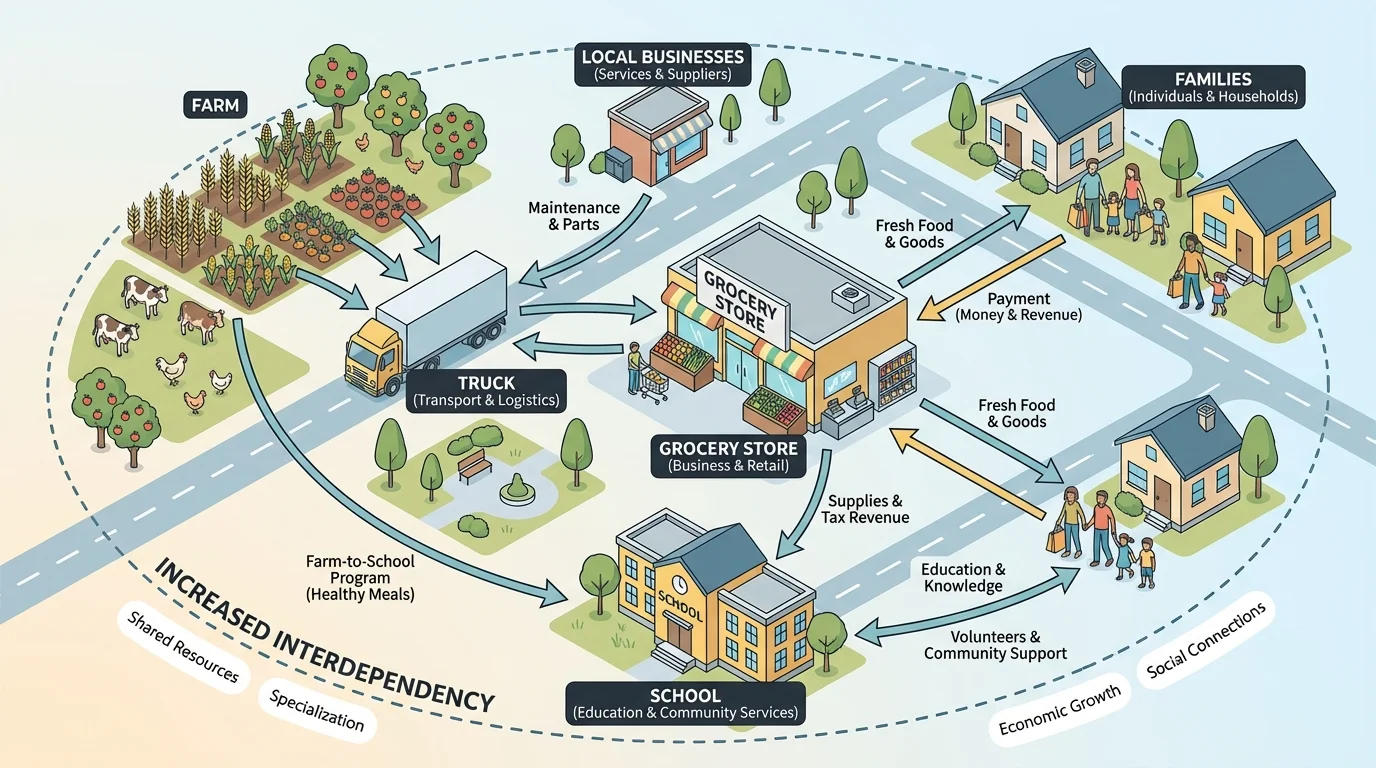
Interdependency can happen inside one town, between towns, or across long distances. A school depends on bus drivers, food workers, book companies, and electricity providers. Families depend on stores. Stores depend on producers. Producers depend on workers and transportation. Everyone is connected.
Trade and connection
Interdependency is not a weakness by itself. It means people can share work, use different talents, and enjoy more goods and services. But it also means a problem in one place can affect others, such as when bad weather harms crops or a truck delivery is late.
Later, when students study maps, transportation, and jobs, they can see these connections clearly. As we saw earlier in [Figure 2], even one small business may depend on several suppliers. In the same way, a whole community depends on many exchanges happening every day.
To cite evidence means to point to facts, details, or examples that support an idea. If someone says trade helps people, you should ask, "What evidence shows that?" Good evidence can come from stories, observations, signs in a community, or simple information in a chart.
For example, if a store has many kinds of fruit in winter, that is evidence that trade brings goods from other places. If a repair shop hires more workers after getting more customers, that is evidence trade helps businesses grow. If a town has more stores and services than before, that is evidence trade can benefit the community.
Strong evidence is specific. Instead of saying, "Trade is good," a student can say, "Trade helps families because they can buy food, clothing, and services they cannot easily make themselves." Specific details make the answer stronger.
| Claim | Evidence | What It Shows |
|---|---|---|
| Trade helps individuals | A family buys food, shoes, and medical care | People get needed goods and services |
| Trade helps businesses | A store buys products and sells them to many customers | Businesses can earn money and grow |
| Trade helps communities | New shops open and hire workers | Communities gain jobs and more choices |
| Trade creates interdependence | Farmers, drivers, stores, and families all rely on one another | People and places become connected |
Table 1. Examples of claims about trade, supporting evidence, and what each piece of evidence shows.
As shown earlier in [Figure 3], one good often passes through several hands before reaching the consumer. That picture is evidence of interdependence because it shows connected jobs and places working together.
Producers and consumers exchange goods and services in different ways. Some trade happens in stores, where customers choose items from shelves. Some happens at markets, where farmers or makers sell directly to people. Some trade happens online, where shoppers order from a computer or tablet and items are delivered later.
Services are traded in different ways too. A piano teacher may give lessons in person. A doctor may meet a patient in a clinic. A mechanic may repair a car in a garage. In each case, a consumer receives a service and the provider receives payment.
These different ways of trading all have one thing in common: they connect producers and consumers. Whether the exchange happens face to face or through a delivery system, trade helps move goods and services to the people who need or want them.
People have needs, such as food, water, clothing, and shelter, and they have wants, such as games or treats. Trade helps people get both needs and wants by connecting them with producers.
Sometimes local trade is best because it is fast and supports nearby workers. Sometimes trade over long distances is helpful because it brings goods a community cannot produce easily. Both kinds of trade can be important.
From morning to night, trade is part of daily life. Breakfast foods are bought from stores. Buses provide transportation. Schools use books, paper, computers, and electricity. At home, families may pay for internet service, water service, or home repairs. Even a soccer game may involve traded goods such as uniforms, shoes, and snacks.
This means trade is not just about stores or money. It is about connection. People work, earn, buy, sell, deliver, build, grow, teach, and help. Each exchange links one person's effort to another person's needs or wants.
When you cite evidence about trade, look for real details: who made something, who bought it, what service was provided, what businesses needed, and how the community changed. Those details help prove that trade benefits individuals, businesses, and communities and increases interdependence.
