What if everyone in a classroom talked at once, grabbed what they wanted, and ignored other people's feelings? It would feel unfair and unsafe very quickly. A democratic society is different. In a democracy, people matter, rules matter, and fairness matters. People have rights, but they also have to respect the rights of others.
Personal rights are a big part of everyday life. They help protect our thoughts, choices, safety, and dignity. Even children use rights every day when they share ideas, ask questions, learn in school, and expect to be treated fairly. Understanding rights helps us become kind, responsible citizens.
A democratic society is a community or country where people have a say in how things are done. Adults often vote for representatives and public officials, and laws are made to protect people and keep order. In a democracy, people are not supposed to be controlled unfairly by one person. Instead, rules are meant to help everyone live together.
Democracy is not only about voting. It is also about respect, fairness, and listening. People in a democracy may have different ideas, religions, cultures, and opinions. They do not all have to agree, but they should treat one another with care and follow laws that protect everyone.
Rights are freedoms and protections people should have. Responsibilities are the actions people should take to use their rights in a safe and fair way. Equality means people should be treated fairly and given the same basic rights.
When people understand rights, they can better understand why rules exist. A rule like "raise your hand before speaking" is not there to silence students. It helps everyone have a fair chance to speak and be heard.
Personal rights are rights that belong to each person. They protect important parts of life, such as safety, thoughts, beliefs, learning, and fair treatment. No one should lose these rights just because someone else is louder, stronger, or more popular.
Some personal rights are protected by laws, while others are practiced through everyday respect. Children may not make all the same choices as adults, but they still have important rights. They have the right to be safe, to learn, to be treated with dignity, and to share ideas in appropriate ways.
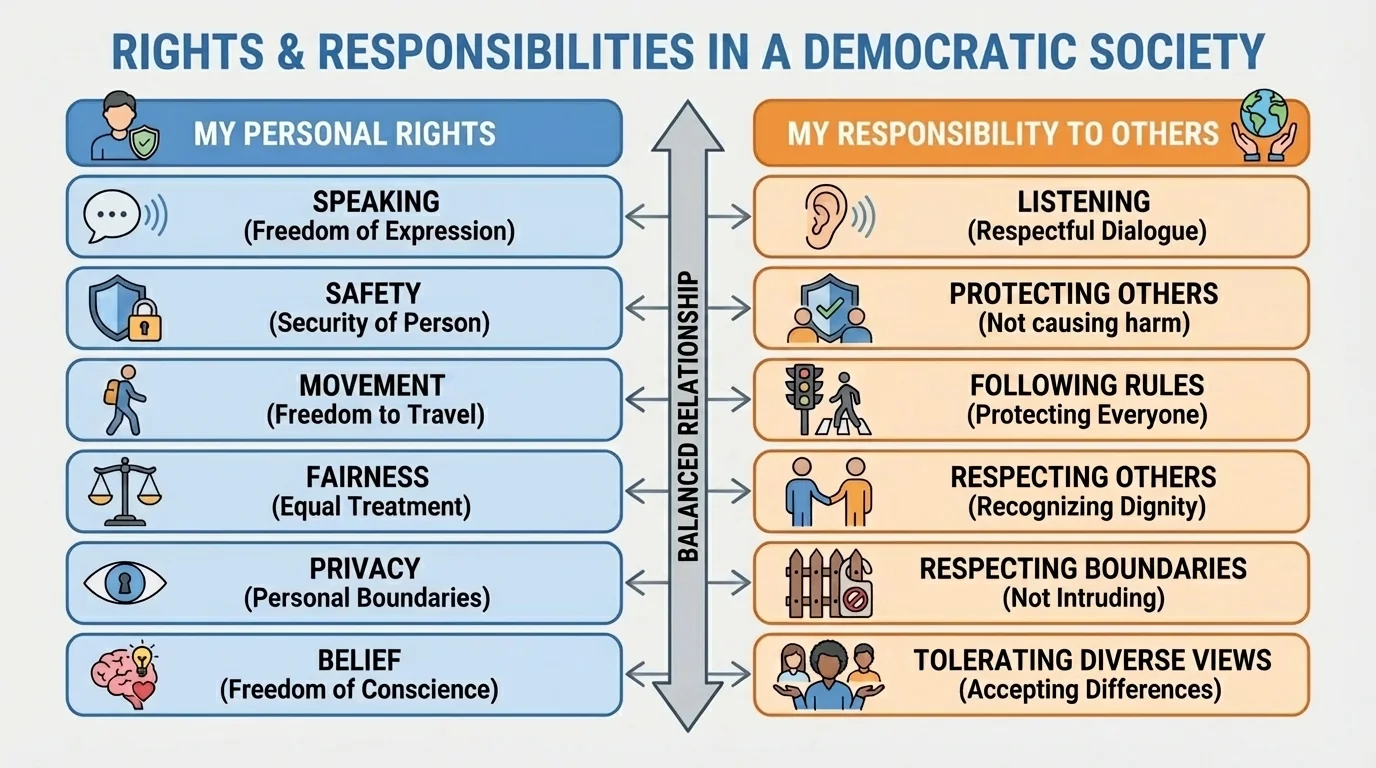
Some of the most important rights in a democracy work together, as [Figure 1] shows when rights are matched with responsibilities. One important right is freedom of speech. This means people can share thoughts and ideas. In school, this may mean answering a question, giving an opinion about a book, or suggesting a class rule.
Another important right is the right to fairness. Fairness means people should be treated justly, not judged badly because of how they look, what language they speak, what they believe, or where they come from. Students should have the same chance to learn, join activities, and be heard.
People also have the right to safety. Everyone should be protected from harm. This includes being safe at school, at home, and in the community. A safe classroom is one where bullying, threats, and violence are not accepted.
Another right is privacy. Privacy means some parts of a person's life belong only to them or their family. For example, someone should not read another student's private note, open their backpack without permission, or share personal information just to embarrass them.
People also have the right to freedom of belief and religion. This means people can have their own beliefs and practices. In a democratic society, others should not be teased or excluded because they believe differently. Respecting this right helps a community stay peaceful and welcoming.
There is also the right to learn. School helps children grow into informed citizens. If one student keeps interrupting class, that behavior affects the learning rights of everyone else. That is one reason classroom rules matter so much.
Many rights that seem simple in daily life, such as speaking your mind or practicing your beliefs, were won through long struggles in many countries. People worked hard to make societies more fair and more free.
Being treated with dignity is another important right. Dignity means every person has value and deserves respect. Even when someone makes a mistake, that person should still be treated as a human being who matters.
Rights are powerful, but they do not mean "I can do anything I want." In a democracy, rights and responsibilities go together. If you have the right to speak, you also have the responsibility to listen. If you have the right to be safe, you also have the responsibility not to hurt others.
This idea is very important because everyone has rights, not just one person. A student cannot claim a right as an excuse to be rude, loud, or harmful. For example, saying "I have freedom of speech" does not mean it is okay to insult classmates or shout during a test.
Why rights need limits
In a democratic society, rights are protected so people can live freely, but rights also have limits when they harm others. A fair system tries to protect both freedom and safety at the same time. That is why rules often focus on behavior, not on stopping people from being themselves.
Responsibilities include following fair rules, telling the truth, taking turns, caring for shared spaces, and respecting differences. These actions help everyone enjoy their rights. When people act responsibly, communities become more peaceful and more just.
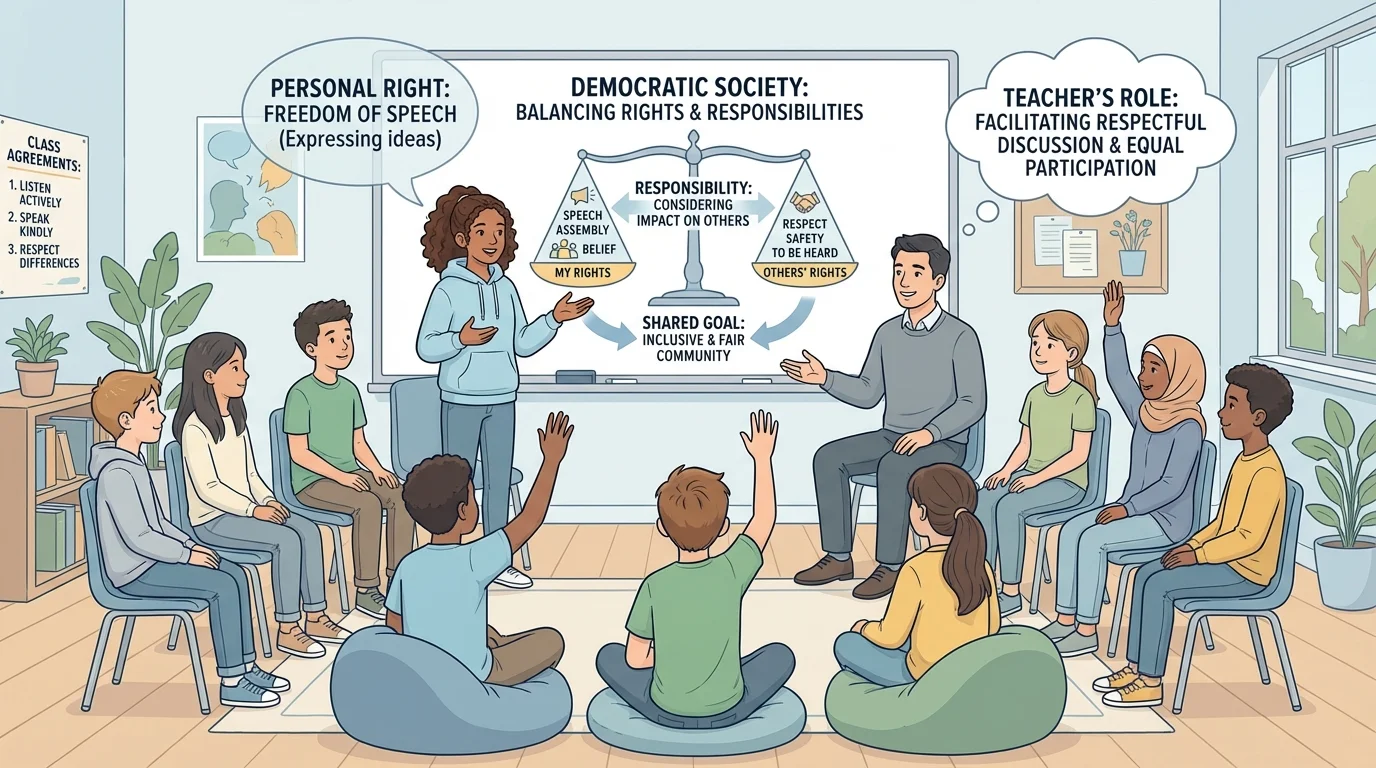
Sometimes rights bump into one another, and people must find balance, as [Figure 2] illustrates in a classroom discussion. For example, one student has the right to share an opinion, but classmates have the right to learn without being interrupted again and again. The solution is not to erase anyone's rights. The solution is to use rights respectfully.
Think about recess. Everyone has the right to enjoy playtime, but no one has the right to push others out of a game or make unsafe choices. If one child takes over all the equipment, other children lose their chance to play fairly.
Another example happens in conversations. A person may disagree with someone else's idea, but that does not give permission to call names or mock them. In a democracy, people can disagree strongly and still show respect. Listening, waiting for a turn, and using calm words protect everyone's rights.
Privacy rights can also meet other concerns. Suppose a student wants privacy in a journal. That should usually be respected. But if a trusted adult believes a child may be in danger, adults may need to step in to protect the child's safety. Safety is one of the most important rights, so adults must sometimes act carefully to help.
Fairness can also be misunderstood. Fair does not always mean everyone gets the exact same thing. Sometimes fairness means giving people what they need to succeed. For instance, one student may need extra time, quiet space, or special tools for learning. Respecting that support helps protect equal opportunity.
Real-life example: Sharing ideas during class
A class is discussing whether homework should be shorter.
Step 1: One student shares an opinion politely.
The student says, "I think homework should be shorter on weekends."
Step 2: Others listen without interrupting.
This protects the speaker's right to be heard.
Step 3: Another student disagrees respectfully.
The second student says, "I disagree because homework helps me practice."
Step 4: The class takes turns and stays kind.
This protects everyone's rights at the same time.
The discussion is fair because students use their rights without taking away someone else's rights.
The same idea appears in communities and countries. People may support different leaders or different plans. Democracy works best when people can speak, listen, disagree, and still follow laws that protect one another.
One of the most important parts of civics is respecting the views and rights of others. You do not have to agree with every person you meet. But you should remember that other people are thinking and feeling human beings, just like you.
Respecting different views means listening carefully, asking questions kindly, and avoiding mean words. It also means noticing that people may come from different backgrounds. Their family traditions, religion, language, or life experiences may shape how they think.
Sometimes students worry that respect means they must stay silent. That is not true. You can speak honestly and still be respectful. For example, you can say, "I see it differently," or "Can you explain why you think that?" Those words open a conversation instead of starting a fight.
"My rights end where your rights begin."
— Civic principle
This principle helps explain why democracies need both freedom and limits. If everyone remembers that other people have rights too, communities become fairer and safer. The classroom scene in [Figure 2] shows that respectful disagreement is possible when people take turns and listen.
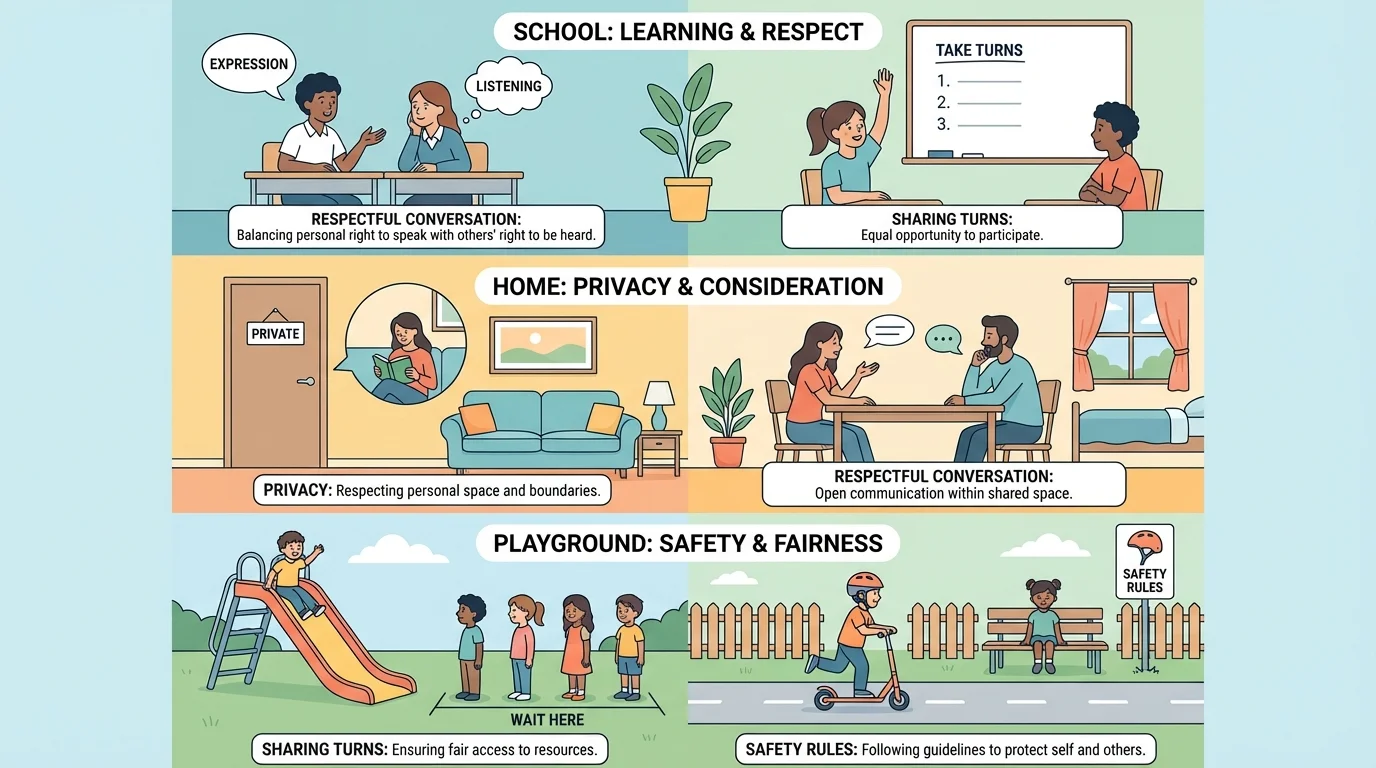
Personal rights are not just ideas in a book. They show up in places you know well, as [Figure 3] shows across school, home, and community settings. At school, students have the right to learn, to feel safe, and to be treated fairly. Teachers and school staff help protect those rights by making rules and solving problems.
At home, family members also balance rights and responsibilities. A child may want privacy, but must also follow family safety rules. Brothers and sisters may each want a turn with a game or a quiet place to rest. Respect helps family members solve these problems without hurting one another.
In the community, people use rights in parks, stores, libraries, and neighborhoods. A person may enjoy speaking with friends in a park, but should not shout in a way that ruins other people's peace. People can use public spaces, but they should also keep them clean and safe.
The community also includes people who may be different ages, cultures, or abilities. Respect means making room for others. For example, leaving space on a sidewalk, using kind words with workers, and including others in games all show respect for rights.
When students understand rights in these everyday places, civics becomes real. Rights are not only for history books or courtrooms. They affect how people treat each other every single day.
Rights need protection. That is one job of laws and rules. Laws are created to help people live safely and fairly together. School rules do something similar on a smaller scale. They help everyone know what behavior is acceptable.
Trusted adults, teachers, principals, police officers, judges, and community leaders may all play a role in protecting rights. Their jobs are different, but each can help when rules are broken or when people are being treated unfairly.
| Place | Right Being Protected | Rule or Support |
|---|---|---|
| School | Learning | Raise hands, no bullying, follow directions |
| Home | Safety | Adult guidance, family rules, emergency plans |
| Library | Quiet use by all | Soft voices, shared space rules |
| Park | Fair use of space | Take turns, follow safety signs |
Table 1. Examples of how rules and supports protect rights in everyday places.
Laws and rules should not be used to be unfair or cruel. In a democracy, rules are meant to protect people, not to take away dignity. When rules are fair and applied fairly, they help rights stay strong.
Remember that rules work best when they are clear, fair, and used the same way for everyone. Fair rules protect the group while also respecting each person.
Adults in a democracy also vote and speak up about laws. Children may not vote yet, but they can still learn how fairness, respect, and participation help a society stay democratic.
Sometimes rights are not respected. A student may be left out, bullied, or treated unfairly. When that happens, people should seek help in peaceful and responsible ways. Telling a trusted adult, writing a respectful complaint, asking for a meeting, or calmly explaining the problem are strong actions.
Standing up for rights does not mean fighting, threatening, or being unkind. It means using words, rules, and peaceful actions to ask for fairness. That is an important habit in democratic life.
If you see someone else being treated unfairly, you can help in safe ways too. You can include them, speak kindly, or tell a trusted adult. Protecting rights is not only about defending yourself. It is also about caring for others.
By learning about rights now, students build the habits of good citizens. They learn to value freedom, fairness, safety, privacy, and respect. They also learn that their choices affect the people around them.
