Have you ever said, "That's not what I meant!" That happens when someone does not listen carefully or does not repeat our idea correctly. In a classroom, on a team, or at home, people often have different ideas. Good citizens do not have to agree all the time. But they do need to listen, understand, and speak with respect. One very important skill is being able to restate someone else's idea, including the reason for it, even when you hold a different view.
People in a class or community all have thoughts, feelings, and rights. When we listen to another person and restate what they think, we show respect. Respect means treating others as important. It does not mean you must agree. It means you show that the other person deserves to be heard.
This skill also helps stop arguments from growing bigger. Sometimes people get upset because they think no one understands them. If you can say, "You think we should read outside because the room feels noisy," the other person may feel calmer. They can tell that you listened.
Many problems become smaller when people feel heard. Sometimes the first step to solving a disagreement is not choosing a side right away. It is showing that you understand what each person is saying.
Restating another person's view is also part of fairness. If you only repeat part of what they said, or if you change it to make it sound silly, that is not fair. Fairness means giving the idea back correctly.
An opinion is what a person thinks or believes about something. A person may say, "We should have more art time," or "The class pet should be a fish." Those are opinions. People can have different opinions, and that is normal.
Reasoning is the "why" behind an opinion. If a student says, "We should have more art time because drawing helps me focus," the opinion is having more art time, and the reasoning is that drawing helps the student focus.
Opinion is a person's belief or choice about something.
Reasoning is the explanation for why a person thinks that way.
Restate means to say the idea again in your own words without changing its meaning.
When you restate someone's view, you tell what the person thinks and why. You do this in your own words, but you keep the meaning the same. A strong restatement is clear, fair, and calm.
Here is a simple pattern: "You think ___ because ___." This pattern helps you include both the opinion and the reason.
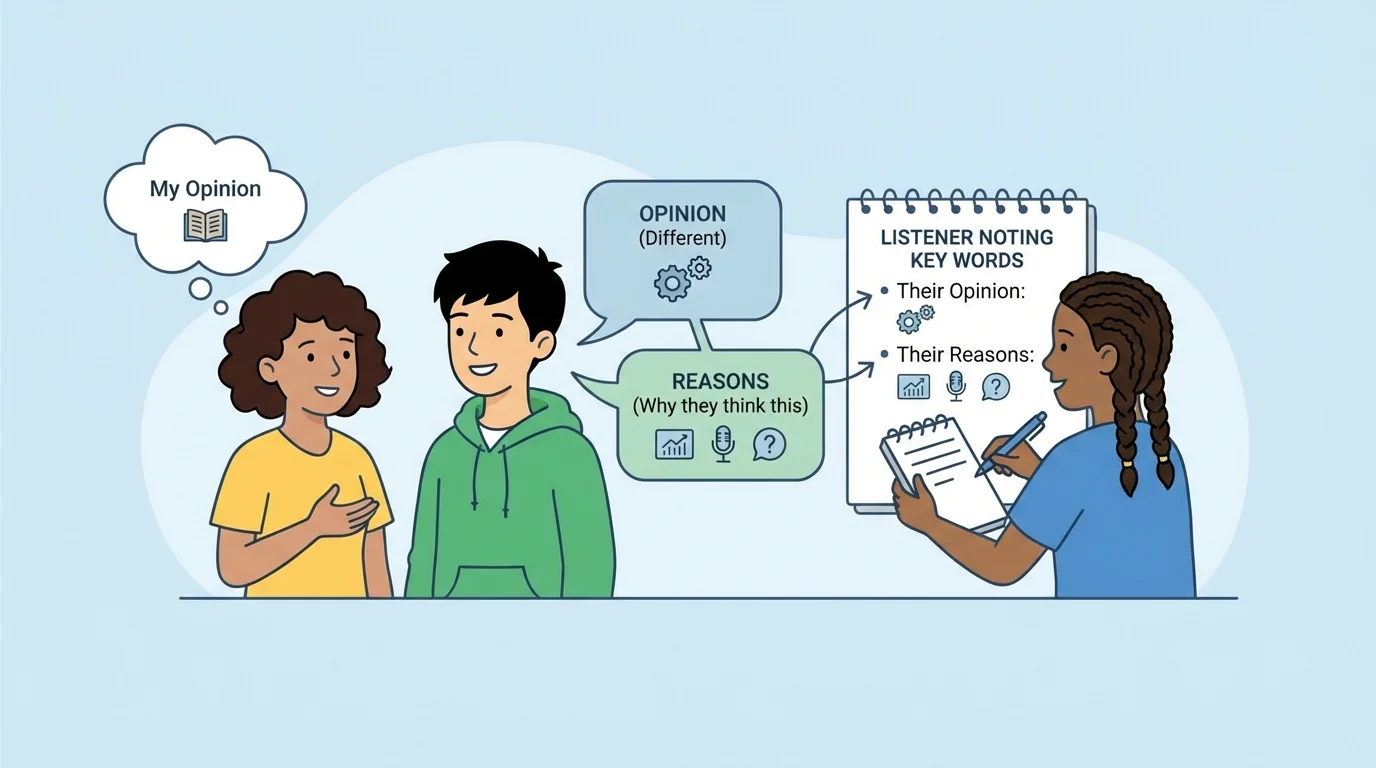
Careful listening is the first step. As [Figure 1] shows, a speaker usually shares two main parts: what they think and why they think it. If you only hear one part, your restatement may be incomplete. Good listeners pay attention to words like because, since, and so. These words often lead to the reason.
It helps to ask yourself three quiet questions while another person talks: What does this person want? What is this person saying? Why does this person think that? If you can answer all three, you are ready to restate fairly.
Listening carefully also means not interrupting. If you jump in too soon, you may miss important details. The other person may have more than one reason. For example, a student might say, "I want indoor recess because it is raining and the playground is slippery." There are two reasons there: rain and safety.
Another helpful skill is noticing feeling words. A person may say, "I think we should work in pairs because I feel nervous working alone." The feeling does not replace the reason; it is part of the reason. Knowing this helps you restate kindly and accurately.
A good restatement includes the idea and the reason, as [Figure 2] illustrates in a class discussion. You do not need to copy every word. You do need to keep the meaning the same. If the other person hears your restatement and says, "Yes, that's what I mean," then you probably did it well.
You can use sentence starters like these: "You think... because..." "If I understand you, you believe... because..." "So your idea is... since..." These sentence frames help you stay organized and respectful.
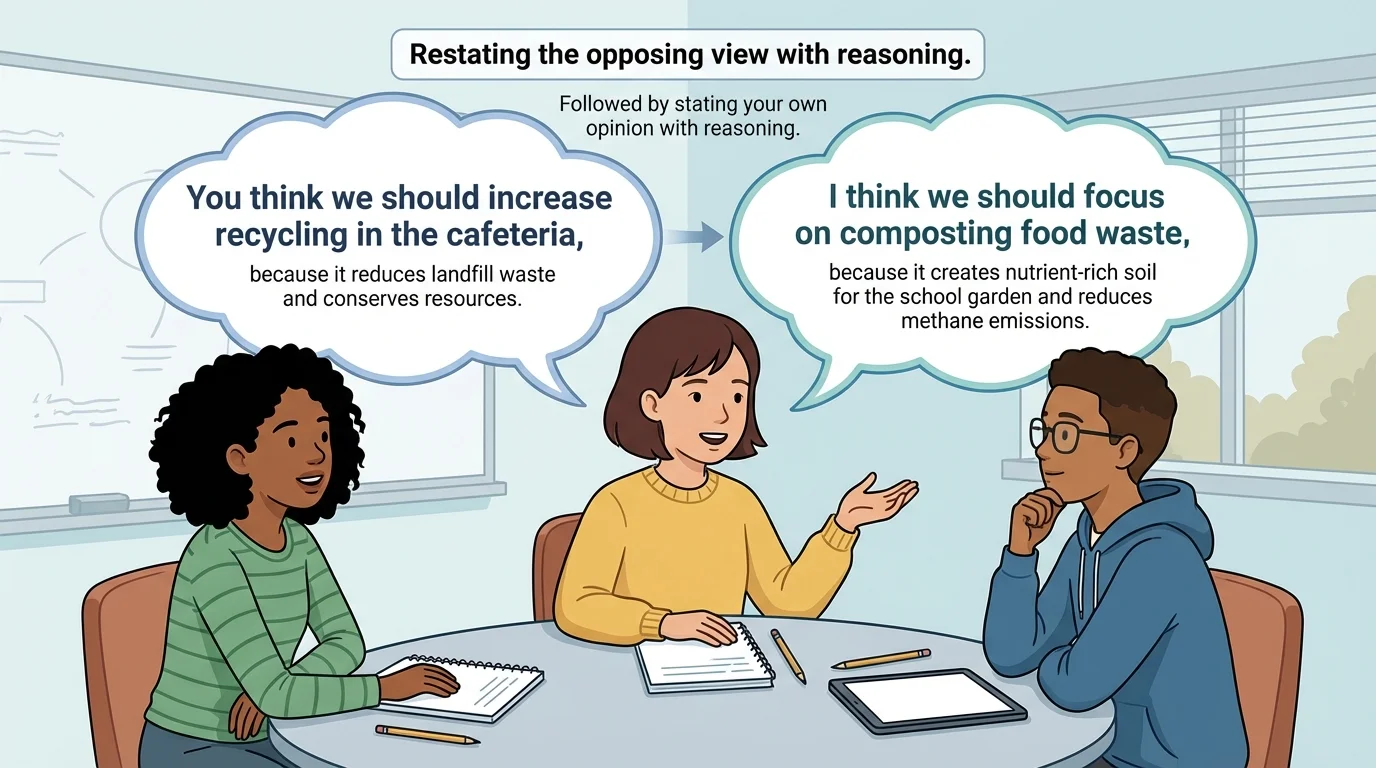
After restating, you can share your own view. For example: "You think we should do our poster with markers because they are brighter. I think we should use crayons because they do not smear as easily." This shows understanding first and then disagreement.
Understanding before responding
Restating someone else's view does not make your own idea weaker. In fact, it makes discussion stronger. When people feel understood, they are more willing to listen back. This creates a better conversation for everyone.
Sometimes you may not be sure you understood. Then you can say, "Do you mean that you want to sit near the window because it helps you see better?" Asking politely is better than guessing.
Disagreement is a normal part of life. Friends may want different games. Family members may choose different dinner ideas. Classmates may have different project plans. Respectful disagreement means you say your own opinion without attacking the other person.
One useful way to do this is in two parts. First, restate the other view. Second, say your own idea. For example: "You think we should line up by height because it would be faster. I think we should line up alphabetically because that feels more organized."
Notice that the speaker does not say, "That's dumb," or "You're wrong." Instead, the speaker focuses on the ideas. Respectful language keeps the conversation safe and fair.
"I can disagree with you and still listen to you."
If you restate someone's view in a rude voice, it may still hurt feelings. Tone matters. Your words and your voice should both show care.
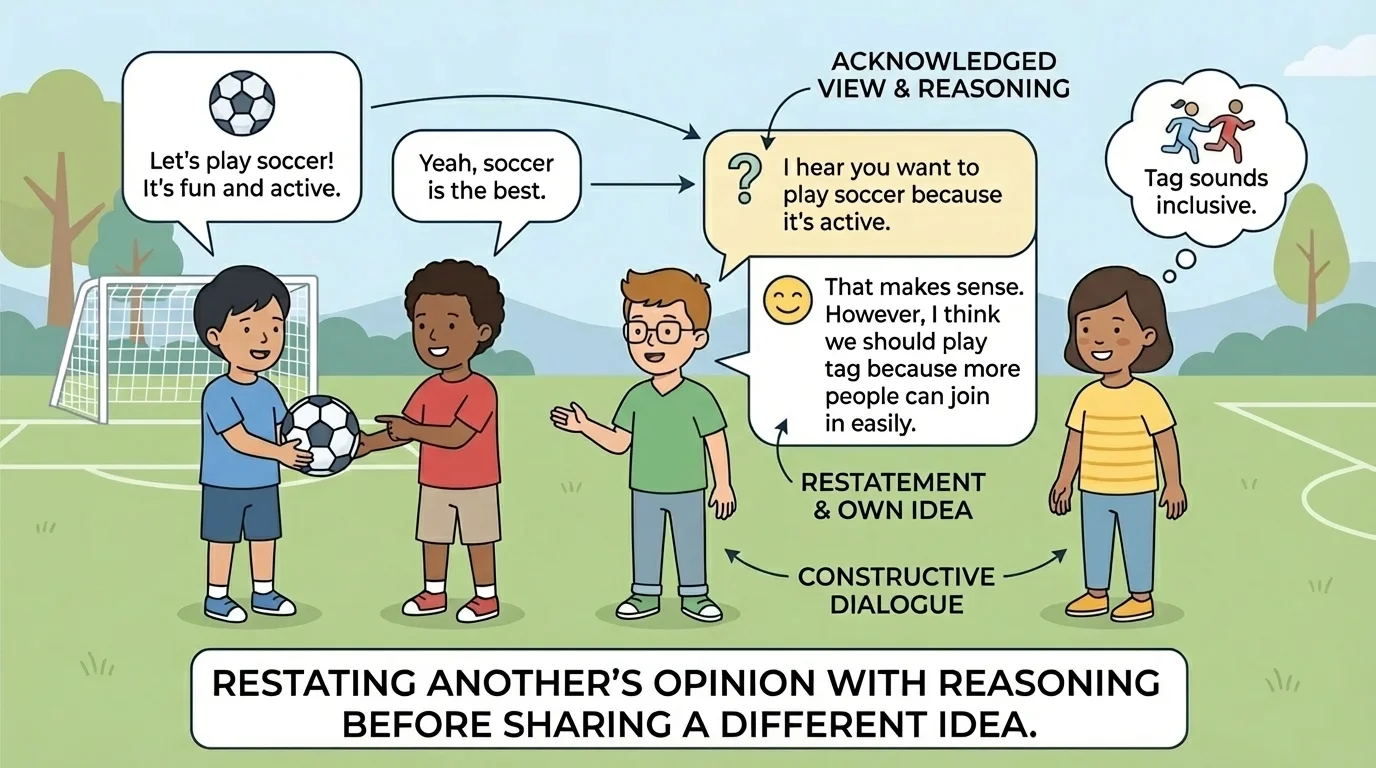
Real-life situations help us see this skill in action. In the playground example shown in [Figure 3], children want to choose different games. One child might want soccer, while another wants tag. The important part is hearing the reasons behind each choice, which often makes disagreements easier to solve.
Suppose Maya says, "I want to play soccer because more people can join." A fair restatement would be: "You want to play soccer because it lets more kids play." That restatement keeps Maya's meaning.
Now suppose Leo disagrees. He can say, "You want to play soccer because more people can join. I want to play tag because we can start faster." Leo does not ignore Maya's idea. He shows he understands it first.
At home, a brother might say, "We should clean the kitchen now because Grandma is coming soon." A sister might respond, "You think we should clean now because Grandma will be here soon. I think we should finish setting the table first." Again, both opinion and reason are included.
In the community, people may have different ideas about a park. One person may say, "The park should have more trees because they give shade." Another person may prefer a bigger play area. If people restate each other's views fairly, they can discuss the ideas more peacefully.
Example conversation
Topic: choosing a class read-aloud book
Step 1: Hear the first student's opinion.
"I think we should choose the animal book because it has real facts."
Step 2: Restate the opinion and the reason.
"You think we should choose the animal book because it teaches real facts."
Step 3: Add a different opinion respectfully.
"I think we should choose the adventure book because it has a stronger story."
This conversation is respectful because the second speaker shows understanding before disagreeing.
Later, when students work in groups, the same pattern still helps. Hearing the reason behind a choice often makes disagreements easier to solve.
One mistake is repeating only part of the idea. If a student says, "We should sit closer because I cannot hear well," and you answer, "You want to move seats," you left out the reason. The restatement is incomplete.
Another mistake is changing the meaning. If the student says, "We should sit closer because I cannot hear well," and you answer, "You just want special treatment," that is not a fair restatement. It adds something unkind that the speaker did not say.
A third mistake is making the idea sound silly. For example, "Oh, so you think your idea is the best ever?" That twists the other person's words. Fair restating means staying truthful.
Good listening includes looking at the speaker, waiting your turn, and paying attention to important words. Those habits make it easier to understand what someone really means.
It is also important not to rush. Sometimes a person needs a few extra seconds to explain. Patient listening helps you catch the full reasoning.
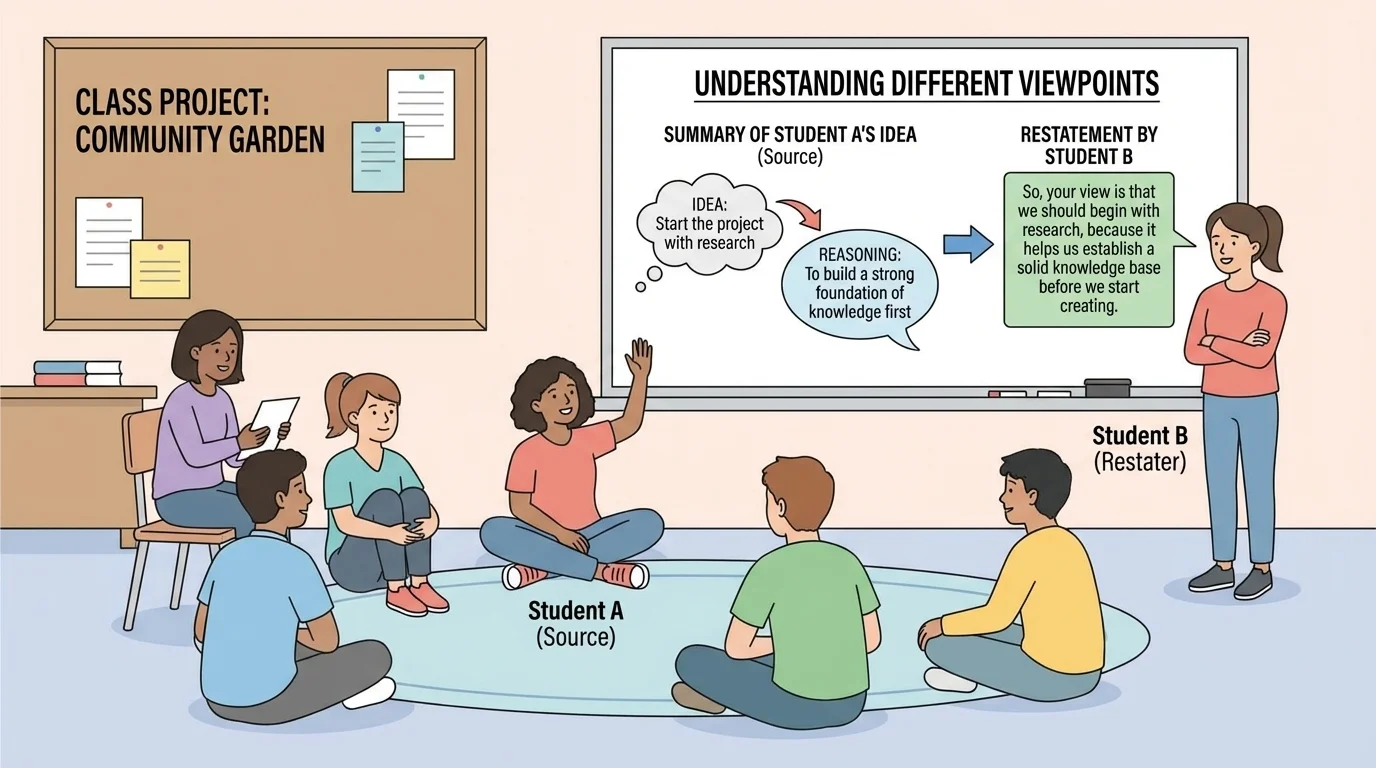
Classrooms and communities work better when people can talk through different ideas. As [Figure 4] shows in a class meeting, students often need to make shared decisions. They may choose a project topic, a class job system, or a way to celebrate a goal. Before a group decides, people need to understand what others think and why, so good decisions are not only about winning but also about hearing different voices fairly.
When one student restates another student's idea, it helps the whole group. Everyone hears the idea clearly. It also helps protect each person's rights. People have the right to share their views and be treated fairly.
This skill matters in civics because citizens in a community do not all think the same way. People may have different needs, hopes, and plans. A strong community is not one where everybody agrees all the time. It is one where people can listen, speak, and disagree with respect.
During a vote or group choice, restating can prevent confusion. A student might say, "Before we decide, Jalen thinks we should plant flowers because they attract butterflies." Now everyone understands Jalen's reason before choosing.
Later in the discussion, this same lesson still matters because good decisions are not only about winning. They are also about hearing different voices fairly.
When you restate someone else's opinion correctly, you show honesty, fairness, patience, and respect. Those are important habits for school life now and for community life as you grow older.
