Have you ever said, "That's not fair"? People often say that when they think a right is being ignored. A right is something people should have or be allowed to do fairly and safely. But there is another important idea that goes with every right: a responsibility. Responsibilities are the things we should do to help protect rights for ourselves and for others. Rights and responsibilities are partners. When people remember both, homes, schools, and communities work better.
People have rights because every person matters. Children have the right to learn, the right to be safe, the right to be treated with respect, and the right to share ideas. These rights help people grow, feel included, and take part in their school and community.
A responsibility is a duty or job that a person should do. Responsibilities are not punishments. They are helpful actions. For example, if students have the right to learn, they also have the responsibility to let others learn. That means listening, following directions, and not distracting classmates.
Rights are freedoms and protections people should have so they can live, learn, and be treated fairly.
Responsibilities are actions and duties people should carry out to respect rules and protect the rights of others.
You can think of rights and responsibilities as two sides of the same coin. One side is what people should receive. The other side is what people should do. If we only think about our own rights and forget our responsibilities, things can quickly become unfair to others.
Rights and responsibilities fit together like matching pieces, as [Figure 1] shows. If one student has the right to speak, then everyone else has the responsibility to listen without interrupting. If everyone has the right to feel safe, then everyone has the responsibility to act safely and kindly.
This relationship is important because people live together. In a classroom, on a playground, or in a neighborhood, one person's choices affect other people. Rights protect people, and responsibilities help make those protections real in everyday life.
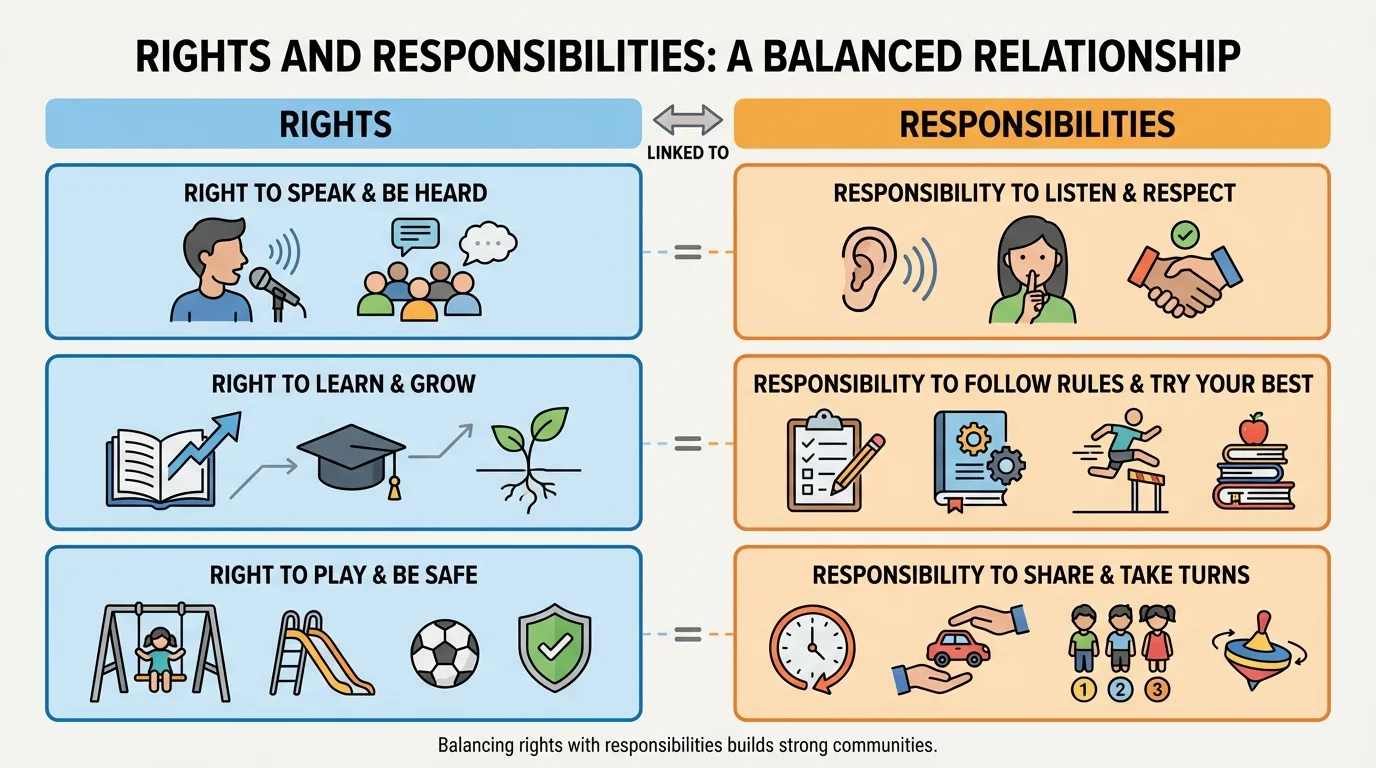
Here are some simple examples. A child has the right to use school supplies, but also the responsibility to use them carefully. A child has the right to play a game, but also the responsibility to follow the rules of the game. A child has the right to be heard, but also the responsibility to hear others.
When rights and responsibilities are balanced, people feel respected. When responsibilities are ignored, someone's rights may be hurt. For example, shouting while another student is working may interfere with that student's right to learn. Pushing in line may interfere with others' right to be safe and treated fairly.
How one person's responsibility protects another person's right
Rights are not just personal. They are shared. That means one person's responsible behavior helps protect another person's freedom, safety, and dignity. In a group, responsibility is one of the main ways people show respect.
The idea in [Figure 1] can be used in many places. Whenever you name a right, you can usually name a matching responsibility. This helps us understand that being part of a group means caring about more than ourselves.
School is one of the best places to see rights and responsibilities working together, as [Figure 2] illustrates. Students share space, materials, time, and learning opportunities. Because so many people are together, school needs fairness and cooperation.
Students have the right to learn. That means they should be able to hear the lesson, ask questions, and do their work. The matching responsibilities include coming prepared, paying attention, trying your best, and letting classmates concentrate.
Students also have the right to feel safe at school. They should not be bullied, threatened, or hurt. The matching responsibilities include using kind words, keeping hands and feet to yourself, following safety rules, and telling an adult if someone is in danger.
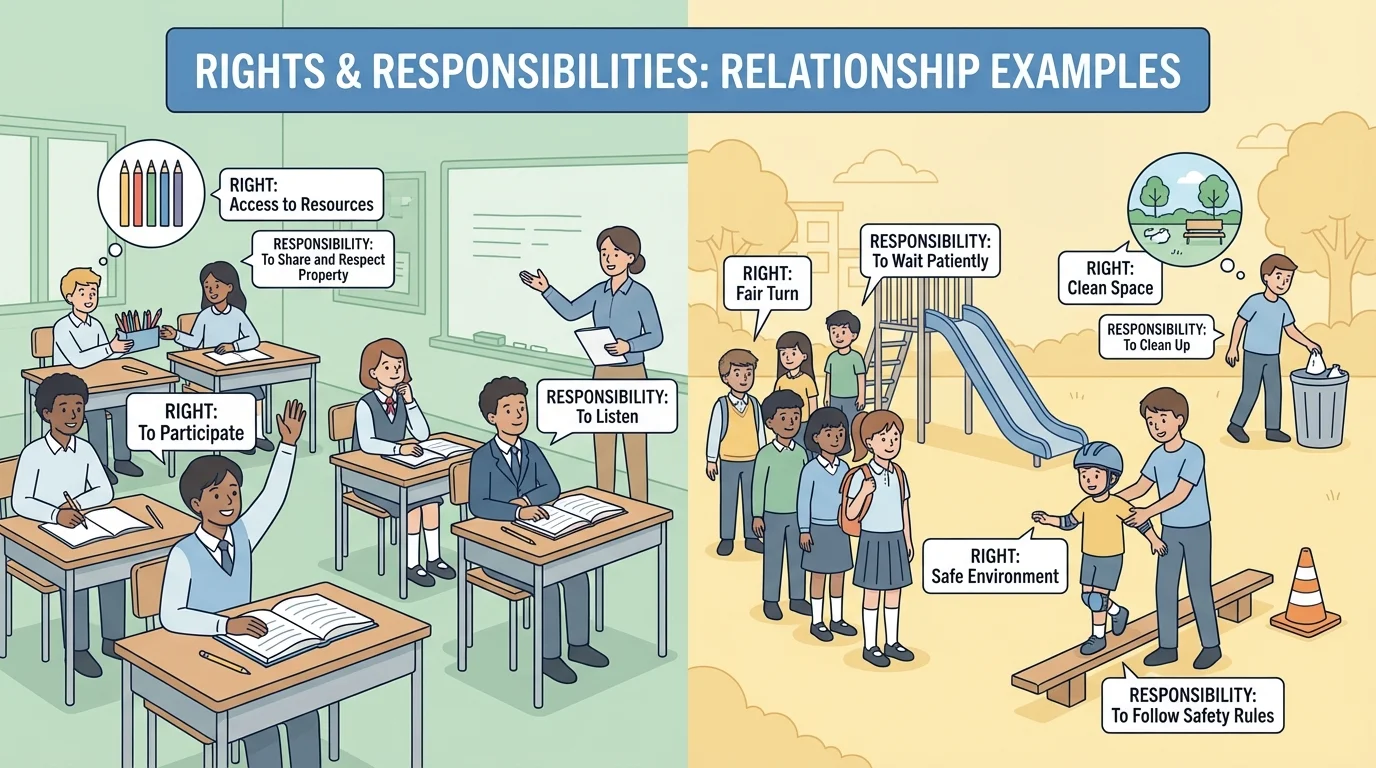
Another school right is the right to be respected. Students should not be laughed at for their ideas, names, clothes, or differences. The matching responsibilities include speaking politely, using respectful language, and treating others fairly even when they are not close friends.
On the playground, students have the right to play and enjoy recess. But they also have responsibilities: taking turns, sharing equipment, following game rules, and including others when possible. If one child refuses to take turns, that child may be keeping others from enjoying their right to play fairly.
In the lunchroom, students have the right to eat in a clean and orderly place. Their responsibilities include cleaning up after themselves, using quiet voices, and waiting patiently in line. These actions help everyone else too.
School examples of rights and responsibilities
Step 1: Right to learn
Example: A student may ask a question during class.
Step 2: Matching responsibility
Other students listen quietly so the class can hear the question and answer.
Step 3: Why it matters
The class becomes a place where everyone can learn and feel included.
This shows that one student's right is supported by other students' responsible choices.
Later in the day, the same school ideas still matter. During group work, students may have different jobs, but each person should contribute. During art or science, students may use special tools, but they should handle them carefully. At dismissal time, students should follow procedures so everyone gets home safely.
Rights and responsibilities do not stop at the school door. They continue at home and in the community, as [Figure 3] shows with places children know well. Families, neighbors, and community helpers all depend on people doing their part.
At home, children have the right to be cared for and to feel safe. They should have food, shelter, rest, and love. Their responsibilities may include helping with chores, following family rules, and speaking respectfully to family members. These responsibilities help the home run smoothly for everyone.
In a library, people have the right to read and learn in a quiet place. Their responsibilities include using soft voices, returning books on time, and taking care of materials. If someone damages a book, other readers may not be able to use it.
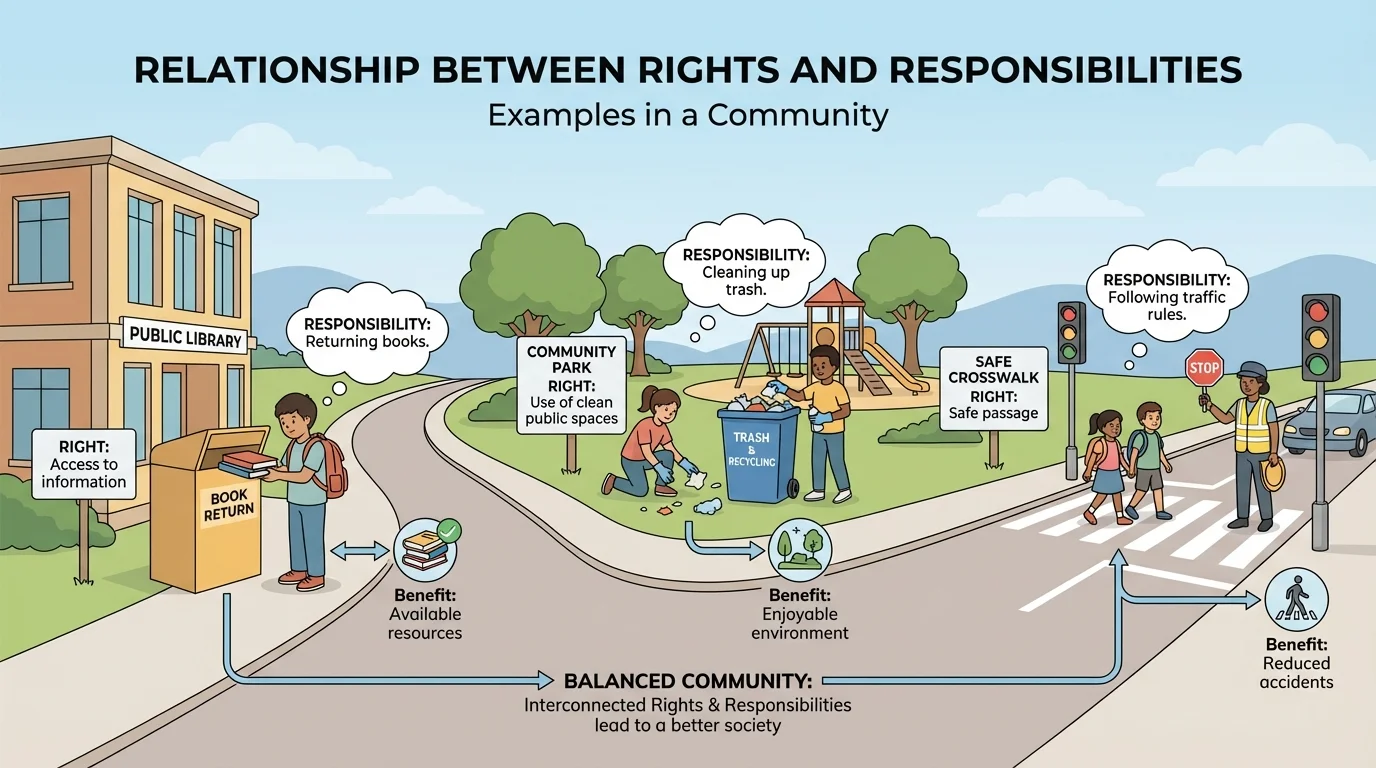
In a park, people have the right to enjoy clean, safe spaces. Their responsibilities include throwing away trash, using equipment correctly, and being kind to others. If a person litters or breaks equipment, that can affect everyone else's right to enjoy the park.
On roads and sidewalks, people have the right to travel safely. Responsibilities include following traffic rules, looking both ways, using crosswalks, and wearing safety gear like a helmet when needed. Community safety depends on many people making careful choices.
The same idea appears in neighborhoods. People may have the right to peaceful homes, but they also have the responsibility not to damage property, not to disturb others, and to help when they can. Good communities grow when people respect shared spaces and shared rules.
| Place | Example of a Right | Matching Responsibility |
|---|---|---|
| Home | To feel safe and cared for | Follow family rules and help when possible |
| Library | To read and learn quietly | Use soft voices and return books |
| Park | To play and relax | Clean up and use equipment safely |
| Road or sidewalk | To travel safely | Follow safety rules and watch carefully |
Table 1. Examples of rights and matching responsibilities in common places.
Sometimes the most important responsibility is not about objects or places. It is about people. Everyone has thoughts and feelings, and people may not always agree. Respect means treating others with care and fairness, even when opinions are different, as [Figure 4] illustrates.
Students often have the right to share ideas in class discussions. That does not mean everyone will have the same idea. One student may like one book, while another student likes a different book. One student may think a class rule is helpful, while another sees it differently. The responsibility is to listen, wait your turn, and respond kindly.
Respecting views does not mean you must agree with everything. It means you understand that other people also have the right to speak and be heard. Good citizens can disagree without being rude. They can say, "I see it differently," or "I understand your idea, but I think..." instead of insulting someone.
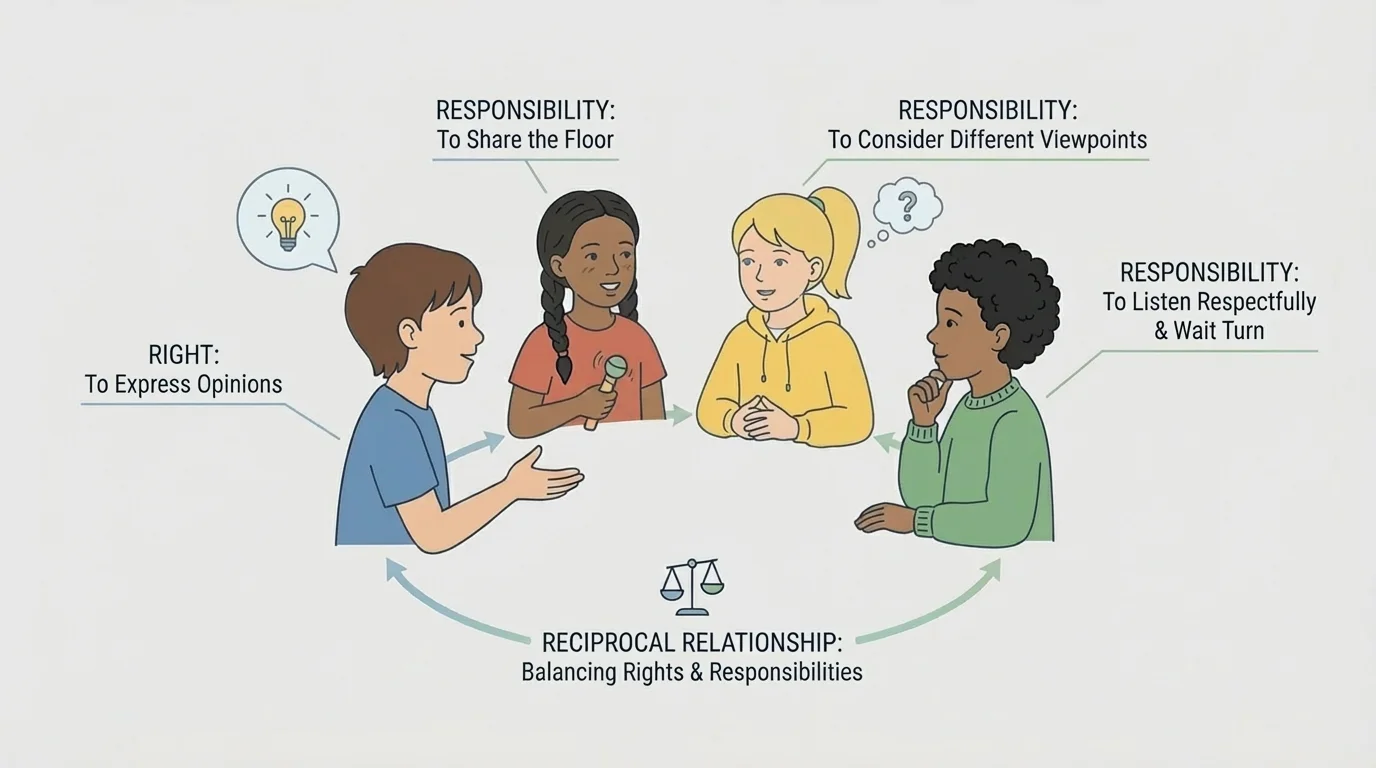
This kind of respect protects both rights and relationships. If one person laughs at another person's opinion, the second person may feel afraid to speak. Then the right to share ideas is weakened. But when classmates listen and answer politely, everyone feels safer joining the discussion.
Many classroom rules are really there to protect rights. A rule like "raise your hand" is not just about order. It helps make sure everyone has a fair chance to speak and to hear.
The same idea from [Figure 4] also matters in games, group projects, and family talks. People may want different things, but listening and speaking respectfully helps solve problems without hurting others' rights.
"My rights end where your rights begin."
— A simple civics principle
This short saying helps explain a big idea. We are free to make many choices, but we must not use our choices to harm others or take away what they fairly deserve.
When people ignore responsibilities, problems often follow. Learning may be interrupted, people may feel unsafe, materials may be damaged, or someone may feel left out. Rules and consequences are often created to prevent these problems and to protect rights.
For example, if a student runs in the hallway, that student may cause an accident. The right to move safely through the school is put at risk. If a person writes in a library book, future readers may not be able to use it well. If players cheat in a game, others lose the chance for fair play.
Consequences are not only about punishment. They also teach. A reminder, a warning, a loss of a privilege, or having to fix a mistake can help a person understand how actions affect others. In this way, consequences connect to responsibility.
When responsibility is ignored
Step 1: A right
All students have the right to work in a calm classroom.
Step 2: A responsibility is ignored
One student keeps shouting and distracting others.
Step 3: Result
Other students have trouble thinking and learning.
Step 4: Consequence
The teacher may move the student, give a reminder, or ask for a better choice next time.
The consequence helps protect the class's right to learn.
Knowing this helps us see rules in a smarter way. Rules are not just lists of "don'ts." Many rules are there because they protect fairness, safety, respect, and learning. They help rights and responsibilities stay connected.
A citizen is a member of a community. Even children can be good citizens. Good citizens act responsibly, think about how their actions affect others, and help their group work well together.
Being a good citizen can look simple, but it is powerful. It means taking turns, telling the truth, following fair rules, including others, and helping solve problems peacefully. It also means standing up for what is right, such as getting help if someone is being treated unfairly.
You do not need to do something huge to connect rights and responsibilities. Small daily choices matter. Holding the door, returning borrowed items, waiting patiently, cleaning up your space, and listening when others speak are all examples of responsibility in action.
When people understand both rights and responsibilities, communities become stronger. Classrooms become better places to learn. Playgrounds become safer. Homes become more peaceful. Neighborhoods become places where people can trust one another.
Fairness means treating people in a way that is just and respectful. Rights and responsibilities help fairness happen in real life because they remind us that everyone matters.
As we saw earlier in [Figure 1], rights and responsibilities belong together. Whether you are in class, at home, in a park, or talking with someone who has a different opinion, your choices can help protect both your own rights and the rights of others.
