Have you ever ridden on a smooth road, checked out a library book, played at a park, or seen a firefighter rushing to help someone? Those things do not just happen by accident. In every town, city, or county, people work together through government to make community life safer, cleaner, and better organized. That nearby government is called local government, and it affects your life almost every day.
Local government is the part of government that serves the people in one community. It may serve a city, a town, or a county. While state and national governments make some bigger decisions, local government handles many jobs close to home.
A local government may include a mayor, a city council, a board of county commissioners, or a school board. These leaders make rules, plan services, and decide how to spend community money. Their job is to help people live and work together in a safe and healthy place.
Local government is the government for a city, town, or county. It provides services people in that community use every day.
Service means something helpful that a government provides for the public, such as road repair, parks, or police protection.
Funding means the money used to pay for those services.
Local government is important because many community needs must be organized for everyone. One family cannot build all the roads in a town. One person cannot run a fire department for thousands of people. By working together, a community can pay for and share services.
Local governments provide many services students see every day, as [Figure 1] shows in one community scene. These services help protect people, keep places clean, and make neighborhoods work well.
One major service is public safety. This includes police officers, firefighters, and emergency medical personnel. Police officers help enforce laws and keep people safe. Firefighters put out fires and help in emergencies, such as car crashes or storms. Some local governments also support ambulance services that help sick or injured people quickly.
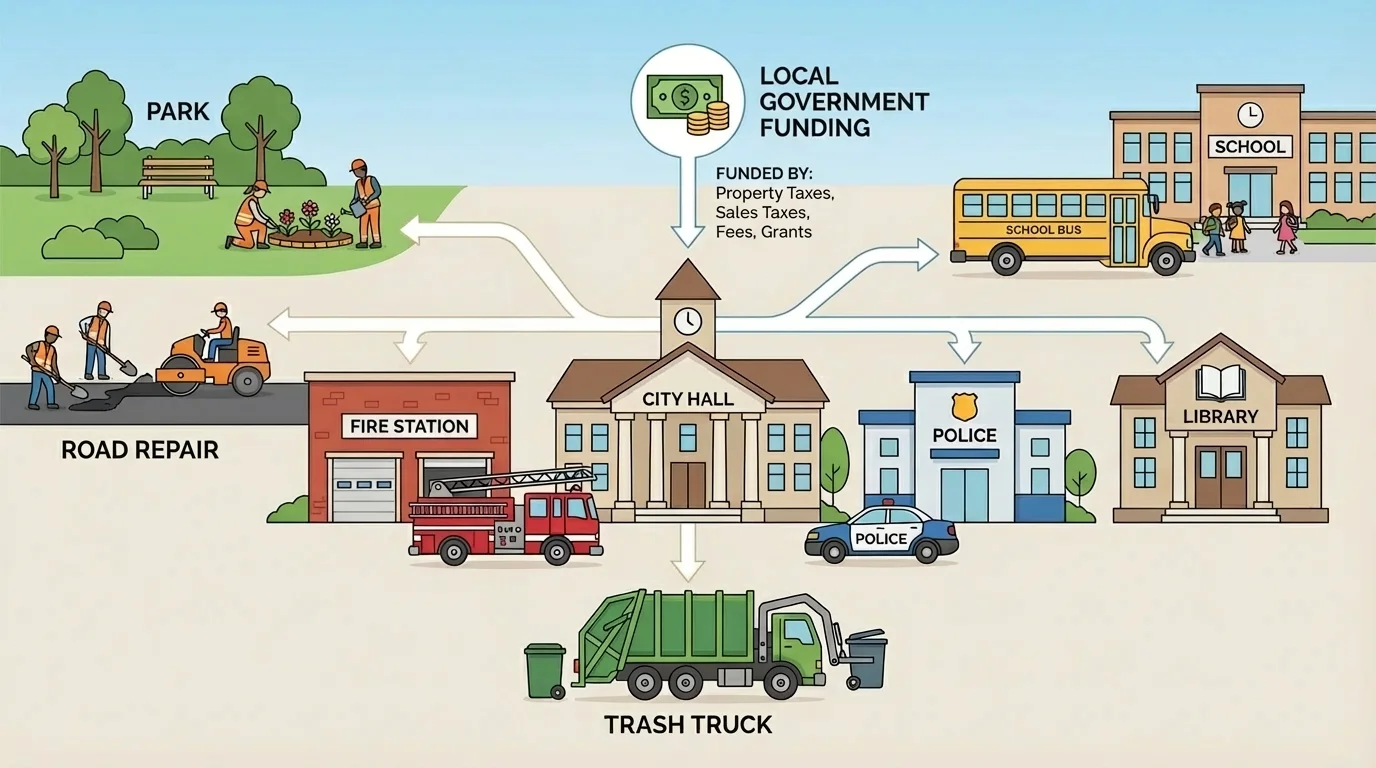
Another important service is taking care of roads and transportation. Local governments repair streets, paint crosswalks, add traffic signs, and sometimes provide buses. If a pothole is fixed on a street near your home, local workers may have done that job. Sidewalks, streetlights, and bridges may also be cared for by local government.
Local governments also help keep communities healthy and clean. They may pick up trash, manage recycling, and make sure wastewater is handled safely. In many places, local systems provide clean water to homes and schools. These services protect people from dirt, disease, and pollution.
Many communities have parks, playgrounds, sports fields, and community centers because local government plans and pays for them. These places give people room to play, exercise, and gather with neighbors. Libraries are another local service. A library lets people borrow books, use computers, attend programs, and learn new things.
Schools are also connected to local government in many places. A school board may help make decisions about local public schools, buildings, buses, and supplies. Even when school systems have their own leaders, they are still part of local government in an important way.
| Service | What It Does | Example Students May Notice |
|---|---|---|
| Police | Keeps order and protects people | An officer directing traffic near a school |
| Fire department | Responds to fires and emergencies | A fire truck helping after an accident |
| Road crews | Repairs and maintains streets | Workers fixing a pothole |
| Parks department | Cares for parks and playgrounds | Mowed fields and safe swings |
| Library | Provides books, programs, and computers | Checking out a library book |
| Sanitation | Collects trash and recycling | Trash trucks on collection day |
| Water services | Supplies clean water | Drinking fountain water at school |
Table 1. Common local government services and examples of how students may experience them.
The services in [Figure 1] are all different, but they have something in common: they are meant to help many people at once. A park is for the whole community. A library helps many readers. A road can be used by thousands of drivers, bike riders, and walkers.
Some local governments even take care of animal shelters, public swimming pools, and community festivals. The services can change depending on what a community needs most.
Not every local government provides the exact same list of services. In one place, the town may run the water system. In another place, a separate district may do that job. But the big idea stays the same: local government handles many practical needs close to home.
Sometimes local government seems invisible because it works best when daily life runs smoothly. When roads are clear, trash is collected, and firefighters are ready, people may not stop to think about how much planning is happening behind the scenes.
These services matter because communities share space and resources. Many people use the same streets, parks, schools, and emergency services. If each person had to solve every problem alone, it would be hard and unfair. Working together through local government helps everyone.
Shared services help the whole community
Some services are too big, too costly, or too important for one person or family to provide alone. Local government collects money from many people and uses it to provide services that benefit the public, such as safety, clean water, and public spaces.
Think about a stoplight near a busy school crossing. One stoplight helps many families every day. The same is true for a fire station, a library, or a city park. Local government helps organize these shared needs so the community can work better.
Local governments need money to pay workers, buy equipment, repair buildings, and keep services running, and [Figure 2] illustrates how money flows from the community into a budget and then out to services. The money used to pay for local services is called funding.
One major way local governments get money is through taxes. A tax is money people or businesses pay to help support government services. For example, property owners may pay property taxes based on the land or buildings they own. People may also pay local sales taxes on some things they buy, depending on the community.
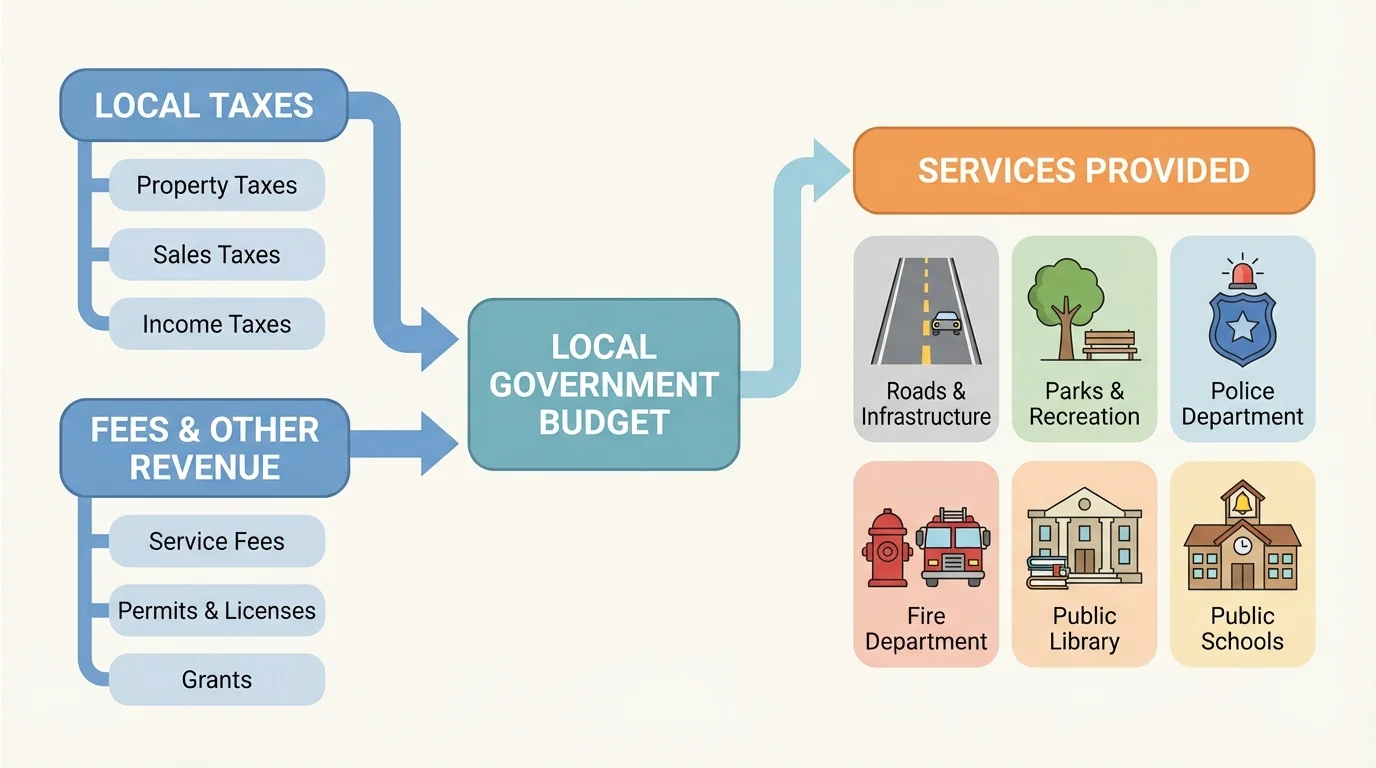
Local governments may also collect fees. A fee is a payment for a certain service. For example, families might pay a small fee to join a recreation program, use a community pool, or get a building permit. Fees usually help pay for a specific service, while taxes help support many services for everyone.
Another source of money can come from the state government or the national government. Sometimes a local government receives help called a grant. A grant is money given for a special purpose, such as road repair, school programs, or safety improvements.
After money comes in, local leaders create a budget. A budget is a plan for how money will be spent. It helps leaders decide how much money goes to roads, parks, police, libraries, schools, and other services. If a town has only a certain amount of money, leaders must make careful choices.
Simple budget example
Suppose a town collects $100 for a small pretend budget.
Step 1: The town decides its needs.
It may need safety services, road repair, parks, and library support.
Step 2: The town divides the money.
For example, it might use $40 for police and fire services, $25 for roads, $15 for parks, $10 for the library, and $10 for trash collection.
Step 3: Leaders check whether the plan fits the money available.
The parts must add up to the whole amount. Here, \(\$40 + \$25 + \$15 + \$10 + \$10 = \$100\).
This simple example shows how a budget helps leaders organize spending.
The budget in [Figure 2] helps us see that funding is not just about getting money. It is also about deciding fairly and wisely how to use it. A community may want many things, but leaders have to make choices based on needs and available money.
If a fire truck gets old, the town may need to spend more on safety. If roads are badly damaged after a storm, road repair may need extra money. Budgets can change because community needs can change.
Local leaders help make spending choices, and [Figure 3] shows a simple picture of how residents and leaders connect in local decision-making. Different communities may have different leaders, but many local governments include a mayor, a city council, county commissioners, and a school board.
The mayor or other top local leader may help guide plans and speak for the community. A city council or county commission often votes on rules and spending decisions. A school board usually focuses on school-related needs, such as buildings, buses, and learning materials.
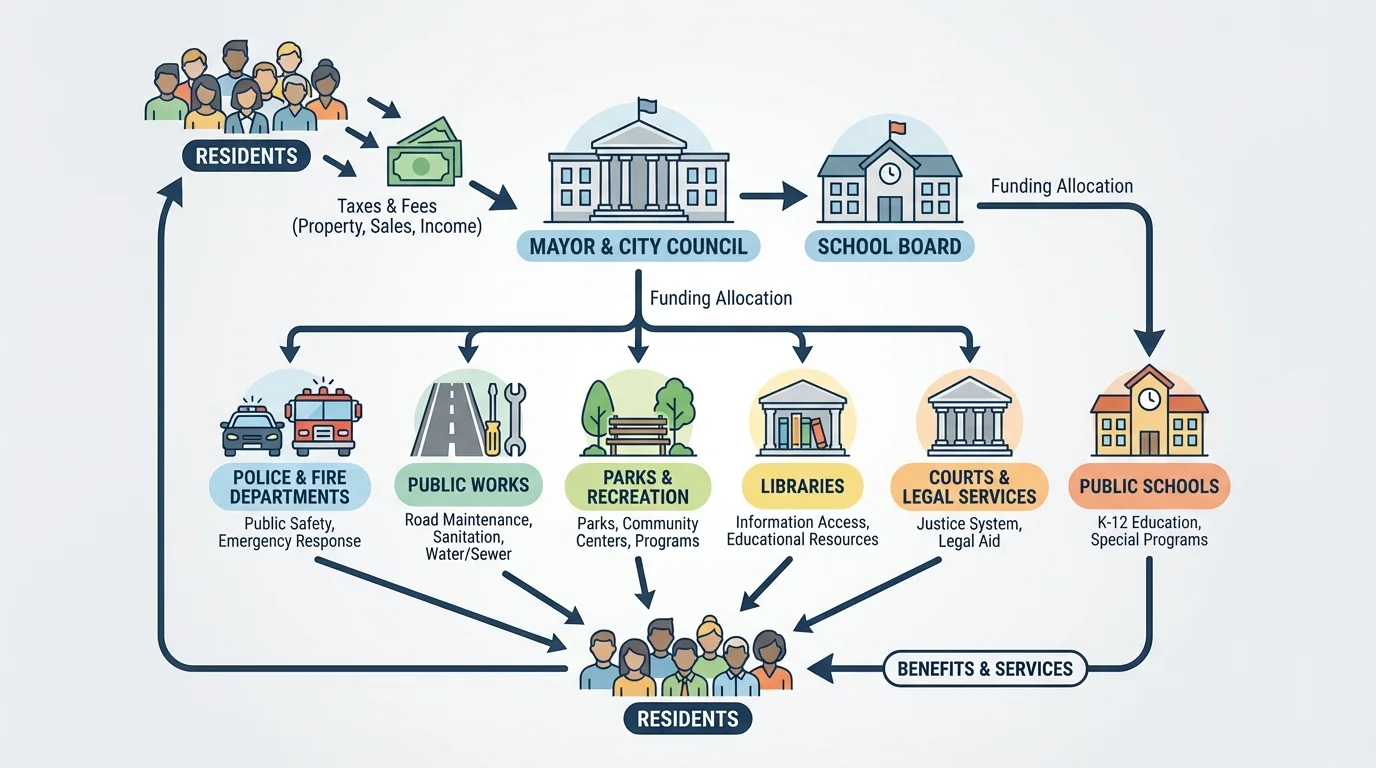
Citizens also matter. Adults can vote for local leaders. Community members may attend meetings, ask questions, or share ideas. Even children can learn about local issues, speak respectfully, and notice ways to improve their neighborhoods.
Government leaders do not usually decide everything alone. In a democracy, people help choose leaders and can share their opinions about what the community needs.
Sometimes local leaders must make hard choices. If there is not enough money for every project, they may have to decide whether to repair a road first, improve a park first, or buy new emergency equipment first. These choices affect many people, so planning matters a lot.
Looking back at [Figure 3], we can see that local government works best when leaders listen to the people they serve. Residents, leaders, and departments all play a part in making services happen.
Not all communities are the same. A big city may need extensive bus service, inspections for tall apartment buildings, and large police and fire departments. A small town may focus more on local roads, water systems, and a smaller number of public buildings. A rural county might cover a wide area with fewer people spread farther apart.
This means local government services can look different from place to place. One community may spend more on snow removal because winters are harsh. Another may spend more on storm drains because heavy rain causes flooding. A town near the ocean may need beach safety workers, while an inland farming area may need different road and land services.
Local needs shape local services
Because communities are different, local governments do not all spend money in the same way. Leaders study what the people, land, weather, and buildings in their area need most.
Even though the details can differ, all local governments try to meet basic community needs. They aim to keep people safe, care for shared places, and use public money responsibly.
People help local government work well when they use services responsibly. Throwing trash in a bin instead of on the ground helps sanitation workers and keeps parks clean. Returning library books on time helps others use them. Following traffic rules helps keep roads safe.
Students can also learn the names of local places and leaders. You might know the name of your town hall, public library, mayor, or school board. Paying attention to local issues helps people become informed citizens.
"Communities are strongest when people work together to solve shared problems."
When people understand where services come from and how they are funded, they can better appreciate their community. The next time you see a crosswalk, a playground, a library shelf, or a fire truck, you can remember that local government helps make those things possible.
