Have you ever seen a broken swing at a park, a pothole in the street, or a crosswalk that feels unsafe? Problems like these do not usually get fixed by the president or a state governor. They are often handled by local government, the part of government that is closest to the people. Local government is where communities make many everyday decisions, and it gives people real chances to speak up, ask for help, and improve the places where they live.
Local government is the government of a city, town, village, or county. It helps run nearby services and places, as [Figure 1] shows in a community with schools, roads, parks, and safety workers. Because it is close to home, local government often knows what people in the community need most.
Local government may help take care of roads, parks, libraries, garbage pickup, water systems, fire stations, police departments, and public schools. Different communities organize local government in different ways, but the main idea is the same: it serves the people who live there.
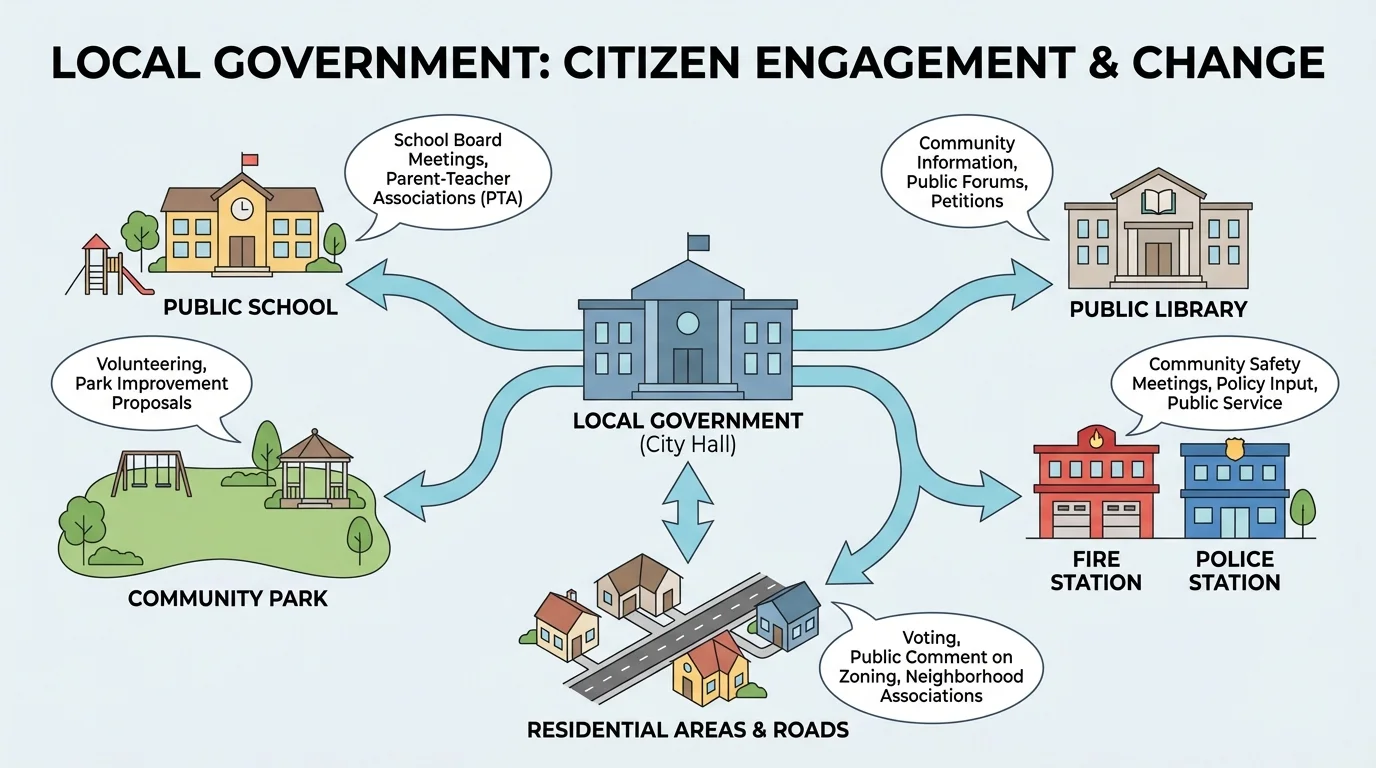
Think about your own neighborhood. If a tree falls on a sidewalk, if the library needs more books, or if a playground needs repair, local leaders are often the people who can help. That is why learning about local government matters. It helps us understand where change can begin.
Rights are freedoms and protections people have. Citizen means a member of a community, state, or country. Community is a group of people living and working in the same place.
Even though children are not old enough to vote in public elections, they are still important members of the community. They can notice problems, share ideas, and work with adults to help make their town or city better.
Local government affects many parts of daily life. When a firefighter comes to help, when a librarian organizes story time, or when workers repair a street, local government is often involved. These services may seem ordinary, but they are important because they help people stay safe, learn, travel, and enjoy their community.
Local governments also make decisions about places people use together. They may decide where to build a new park, how to improve traffic safety near a school, or what rules keep neighborhoods clean and peaceful. Since these decisions affect everyone nearby, people should have chances to share their opinions.
That is one reason local government is special. It is the level of government where people can often be heard most directly. A family might attend a school board meeting, speak at a city council meeting, or write to a town official. These actions can lead to real change in a place they know well.
Many local decisions begin with a simple observation from a resident, such as "This corner needs a stop sign" or "Our park needs more trash cans." Big improvements often start with one person paying attention.
Because local government is nearby, community members can often see the results of decisions more quickly than they can at other levels of government. A new bench in a park, a repaired sidewalk, or a safer bus stop may appear because people spoke up.
People in the United States have rights that help them take part in civic life. One important right is the freedom to speak and share ideas. Another is the freedom to meet peacefully with others. People can also ask questions, contact leaders, and express concerns about community issues.
Adults also have the right to vote in local elections. Voting helps people choose leaders such as mayors, council members, or school board members. When adults vote, they help decide who will make important local choices. Children cannot vote yet, but they can learn how voting works and why it matters.
Another important part of exercising rights is doing it in a respectful and peaceful way. People may disagree about what is best for the community. For example, one group may want more sports fields, while another group may want more trees and gardens. Local government gives people places and ways to discuss these ideas and try to find fair solutions.
Rights and change work together. Rights are not only protections people have. They are also tools people use to improve their community. When people speak, meet, write, vote, and ask leaders to listen, they are using their rights to help shape local decisions.
Using rights does not mean always getting exactly what you want. It means having a chance to be heard. In a healthy community, local government creates ways for many voices to be included, not just the loudest ones.
There are many ways for people to join in and help local government understand community needs, as [Figure 2] illustrates through meetings, letters, surveys, and petitions. Participation means taking part in civic life instead of staying on the sidelines.
One way is by attending public meetings. A city council or school board may hold meetings where community members can listen, learn, and sometimes speak. At these meetings, people may ask for a new crosswalk, share concerns about school safety, or support a plan for a new playground.
Another way is by writing letters, sending emails, or making phone calls to local leaders. A short, polite message can explain a problem and suggest a solution. For example, a family might write, "The park trash cans fill up quickly on weekends. Could the city add one more can near the swings?"
People can also sign or create a petition. A petition is a request signed by many people who agree about an issue. If many neighbors sign a petition asking for a speed bump near a school, local leaders may pay closer attention because they see that the concern is shared by many residents.
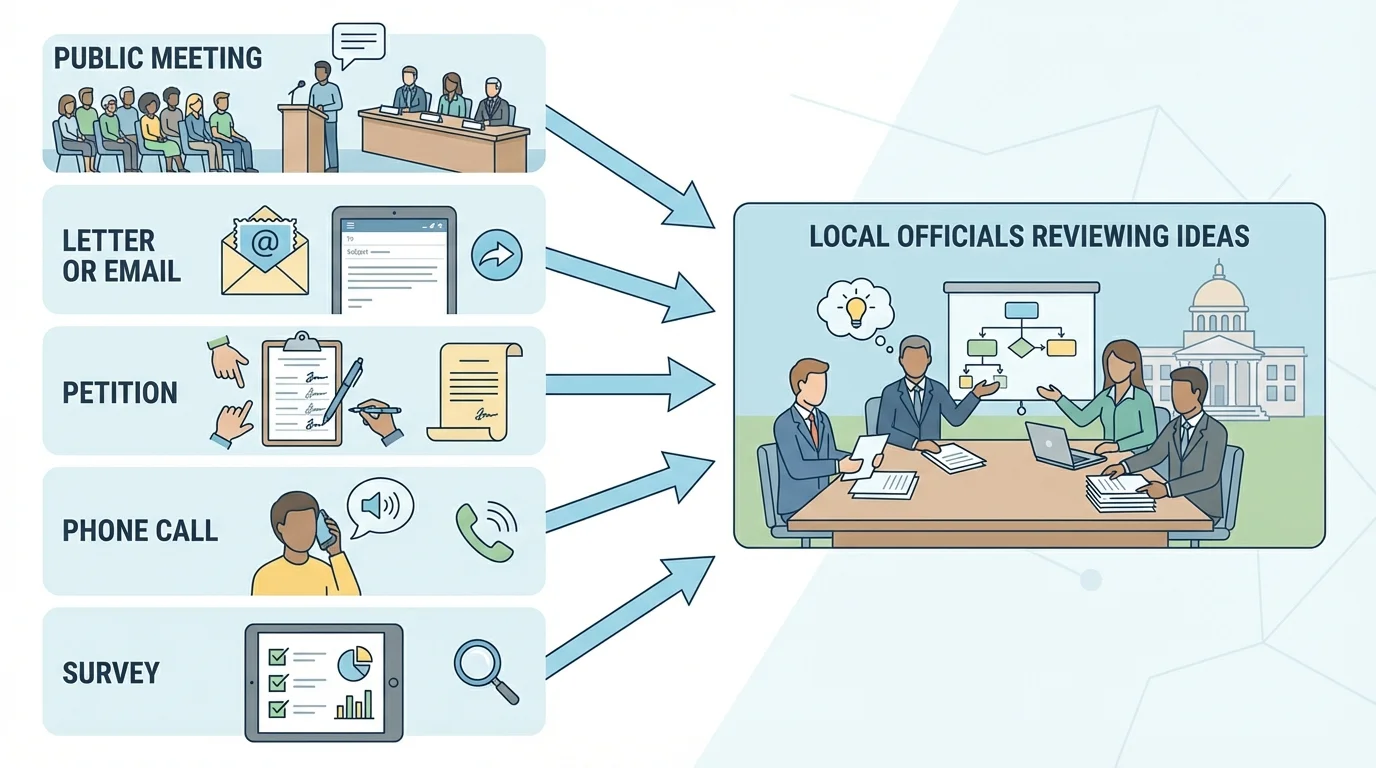
Surveys are another tool. Sometimes local governments ask people to answer questions about parks, traffic, libraries, or building projects. This gives residents a chance to share ideas even if they cannot attend a meeting in person.
Children can participate too. They can help make posters for a community clean-up, speak respectfully at a school meeting, write class letters to local leaders, or join a student council. These actions teach civic habits and show that young people can help solve problems.
Later, when we think about the steps of making change, [Figure 2] remains useful because it shows that participation can happen in more than one way. A person does not need to be famous or powerful to be involved.
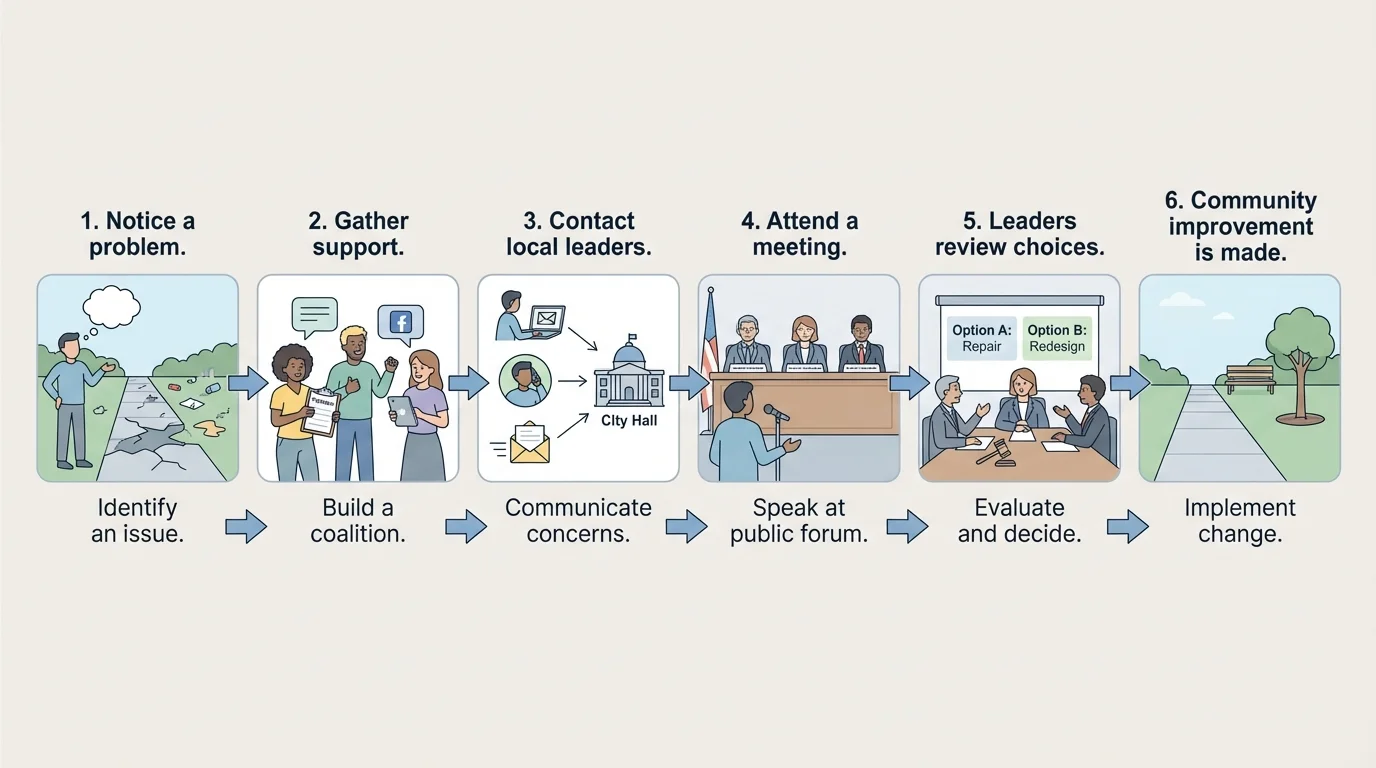
Community change often happens in a series of steps, as [Figure 3] shows. Usually, it begins when someone notices a problem or a need. Then people gather information, share ideas, talk with others, and contact the right part of local government.
For example, suppose families see that cars drive too fast near a school. They may first observe the problem and talk with neighbors. Next, they may write down their concerns, collect signatures, and bring the issue to a school board or city meeting. Local leaders may then study the problem, discuss choices, and decide whether to add signs, paint a crosswalk, or change traffic rules.
This process does not always happen quickly. Local government often has to listen to different opinions, follow rules, and make decisions that fit the budget. Still, people can begin the process by participating and speaking up.
Example: Getting a safer crosswalk
Step 1: People notice a problem.
Families see that crossing the street near school feels dangerous.
Step 2: They gather support.
Neighbors talk about the problem and sign a petition.
Step 3: They contact local government.
A parent speaks at a city meeting and shares the petition.
Step 4: Leaders study the issue.
The city checks traffic, safety, and cost.
Step 5: A decision leads to change.
The city paints a crosswalk and adds a crossing sign.
This example shows how rights and participation can lead to a practical improvement.
The same pattern works in many situations: cleaner parks, better library hours, safer sidewalks, or new bike racks. As seen earlier in [Figure 3], change often moves from problem to action to decision.
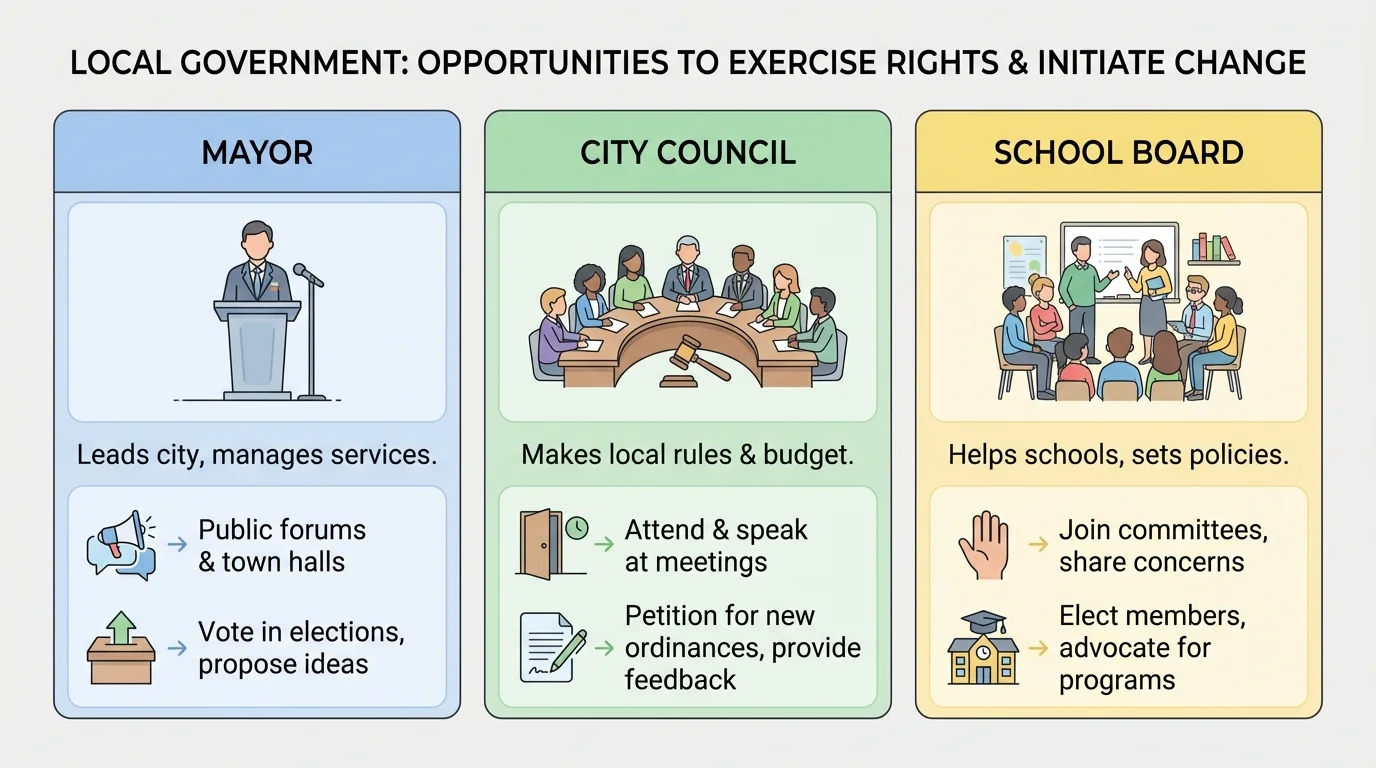
[Figure 4] Different local leaders have different jobs. In a city, a mayor may help lead the city government. A city council often makes local laws or rules and decides about services and spending. In school matters, a school board helps make decisions about public schools.
Some places also have county commissioners, town boards, or village trustees. Communities are not all organized the same way, but they usually have leaders who listen to community concerns and make local decisions.
It is also important to remember that local government is not only elected leaders. Workers in local departments help too. Librarians, sanitation workers, engineers, crossing guards, park workers, and emergency responders all play important parts in carrying out local decisions.
| Local leader or group | What they may do | Example of a community issue |
|---|---|---|
| Mayor | Helps lead city government | Supporting a plan to improve parks |
| City council | Makes local rules and decisions | Discussing safer streets |
| School board | Makes decisions about public schools | Improving playground safety |
| County leaders | Help with county services | Road repairs outside a city |
Table 1. Examples of local leaders or groups and the kinds of issues they may address.
Knowing who does what helps people direct their ideas to the right place. If the concern is about school lunches, the school board may be important. If the concern is about streetlights, the city or town government may be the right place to ask. This is another way local government creates opportunities for change: it gives people clear paths for where to go with their ideas.
Children and families can make a real difference. A third-grade class might notice that the school playground has too little shade on hot days. With help from a teacher, students could write letters to the principal or school board asking for more trees or a shade structure. Their idea may start a conversation that leads to a real improvement.
In another example, neighbors may see litter collecting in a park. They might organize a clean-up day and then ask the city for more trash cans. The volunteering helps right away, and the request to local government can help prevent the problem from returning.
A community library might ask families what books or programs they want. If many children request more science books or after-school reading clubs, the library can use those ideas to plan new services. This shows that local government does not only respond to complaints. It also listens to ideas for making good places even better.
Example: Improving a park
Step 1: Kids and adults notice overflowing trash cans.
Step 2: They tell neighbors and gather support.
Step 3: They contact the parks department or city council.
Step 4: The city adds another trash can and changes pickup times.
The result is a cleaner park that everyone can enjoy.
These examples show something important: local government works best when people pay attention, care about their community, and take part in solving problems.
Rights are powerful, but they go along with responsibilities. A responsible citizen listens to others, tells the truth, follows rules, and treats people fairly. When sharing opinions, people should be respectful even when they disagree.
Suppose two groups want different things for the same empty lot. One group wants a dog park. Another wants a garden. Local government gives both groups ways to share ideas. Leaders then listen, ask questions, and try to make a decision that helps the community. This process is not always easy, but respectful participation helps communities solve problems peacefully.
Being informed is also important. Before asking for change, people should learn about the issue. They can ask questions, read notices from local leaders, and understand why a decision may cost money or take time. Careful thinking makes participation stronger.
"A community gets stronger when people do more than notice problems. They help solve them."
When people use their rights wisely, they help local government become more responsive. That means leaders and workers are better able to understand and meet community needs.
Local government is the part of government people can often reach most directly. It provides opportunities for people to exercise their rights by allowing them to speak at meetings, write letters, sign petitions, answer surveys, volunteer, and vote when they are adults. It also gives people ways to start change by connecting ideas and concerns to leaders who can act on them.
Even young students can be part of this process. They can observe their community, ask thoughtful questions, work with others, and share ideas respectfully. A safer crossing, a cleaner park, a better library program, or an improved playground may all begin with people who care enough to participate.
When communities use local government well, they do not wait for change to happen by itself. They help create it.
