What if you found a dusty old diary in an attic and one sentence said, "We crossed the river at sunrise and hoped the snow would not trap us before dark"? That one sentence would not tell you everything, but it would give you clues. Historians work like detectives in this way. They study old words, pictures, maps, and stories to learn what life was like long ago. When we study Colorado history, we can learn a great deal from the actual records people left behind.
A primary source is something made or used by people who were there at the time. A letter written by a miner in Colorado during the Gold Rush is a primary source. So is a map drawn long ago, a treaty signed by leaders, or a recorded interview in which a person shares a family memory. A secondary source is created later by someone who studies the past, such as a textbook, article, or documentary.
Both kinds of sources matter. Primary sources bring us close to the people of the past. Secondary sources help organize information and explain big events. Good historians use both. They look at original evidence and also read what other historians have learned from it.
Primary source means a source from the time being studied, such as a diary, photograph, map, treaty, or oral history.
Secondary source means a source created later that explains or interprets the past.
Inference means a smart conclusion based on clues and what you already know.
When learning about Colorado, historians ask questions such as: Who made this source? When was it made? Why was it made? What does it show clearly, and what does it only hint at? These questions help turn old documents into useful evidence.
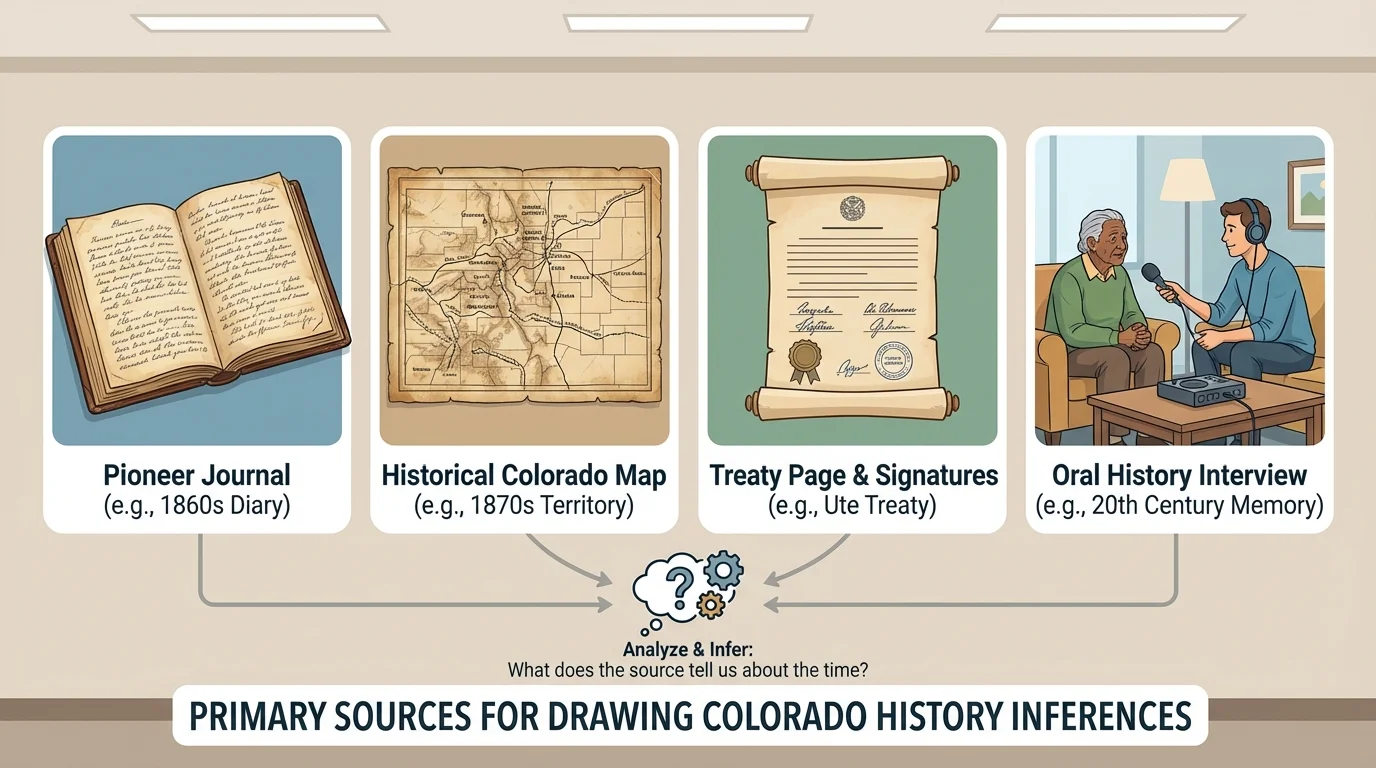
Colorado history includes many kinds of primary sources, and [Figure 1] introduces several important ones. A journal might describe a long trip through mountains. A diary might tell what food a family ate in winter. A map might show a trail, river, fort, or town. A treaty might show an agreement between Native nations and the United States government. An oral history might preserve memories that were shared by speaking rather than writing.
Each source gives a different kind of clue. Journals and diaries often tell about daily life. Maps help us see location and movement. Treaties tell us about power, land, promises, and conflict. Oral histories keep personal and community memories alive, especially when events were not written down in the same way by everyone.
For example, many Native peoples lived in the area we now call Colorado long before it became a state. Their histories are important to Colorado history. Some of that history is preserved in oral traditions and oral histories. These sources may tell about migration, hunting grounds, sacred places, trade, or changes caused by newcomers. Historians must listen carefully and respectfully to these voices.
Artifacts can also be primary sources. An old tool, a cooking pot, a piece of clothing, or a railroad spike can teach us about work, travel, and technology. Even though an artifact may not use words, it still gives evidence.
Colorado became a state in 1876, so it is sometimes called the "Centennial State" because that was 100 years after the United States declared independence.
Later, when historians compare diaries, maps, and oral histories, the different source types shown in [Figure 1] help them build a fuller picture than any single source could give by itself.
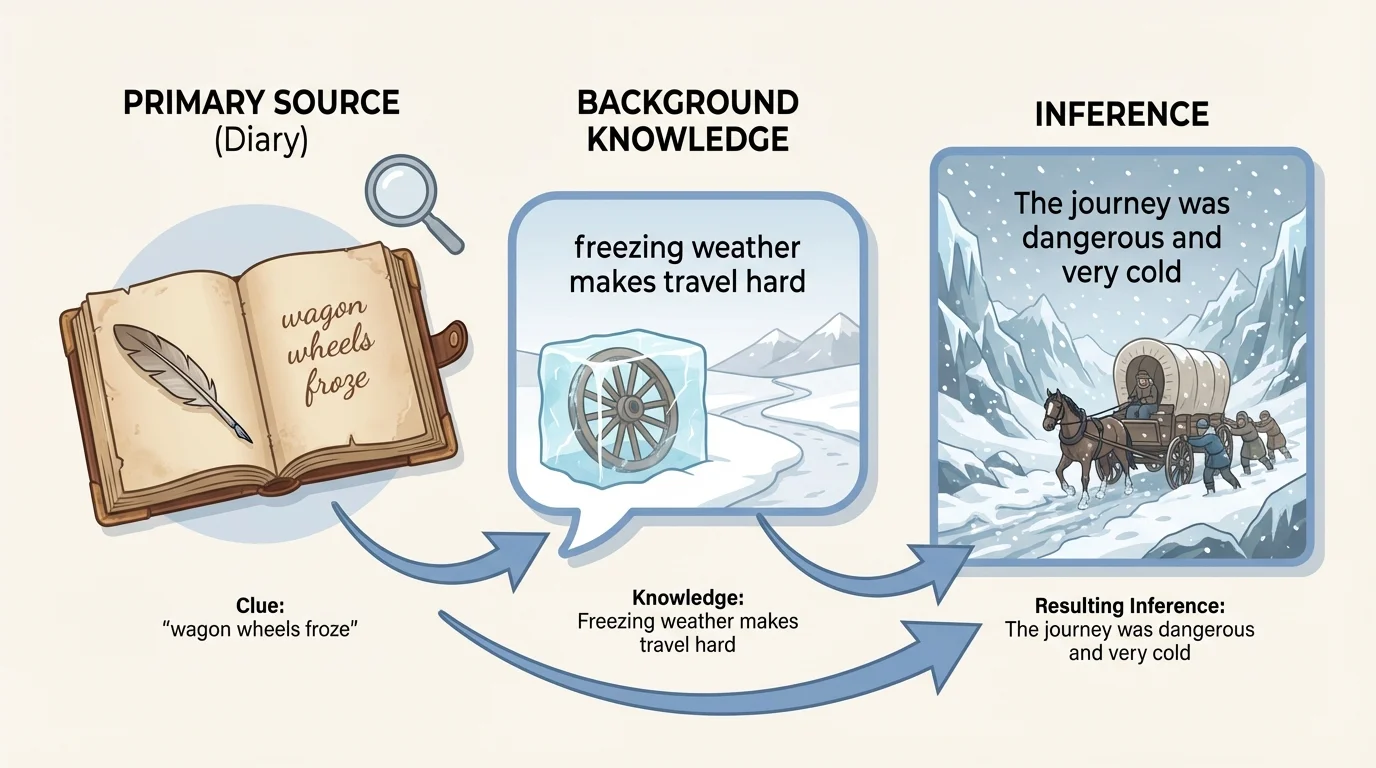
Historians do not only collect facts. They also make inferences, and [Figure 2] shows how that works. An inference is not a wild guess. It is a careful conclusion based on clues in a source and on what we already know.
Suppose a traveler's diary says, "Our wagon wheels froze hard in the night, and we could not feel our fingers by dawn." The diary does not directly say, "It was extremely cold in the mountains." But you can infer that the weather was freezing and travel was difficult. The words about frozen wheels and numb fingers are your clues.
Here is another example. If a map from long ago shows a town next to a river and a trail, you can infer that the location was useful for water and travel. The map may not say, "People settled here because it helped trade," but the location gives that clue.
Making inferences is like putting puzzle pieces together. One piece alone is not enough. But when clues fit together, the picture becomes clearer. Historians must always be ready to explain which clues support their inference.
Case example: Inferring from a diary entry
A settler writes, "We traded two blankets for flour before the storm came."
Step 1: Find the clue.
The clue is that blankets were traded for flour.
Step 2: Connect background knowledge.
People trade important items when supplies are low or when stores are far away.
Step 3: Make the inference.
The family may have been running low on food and preparing for a hard storm.
As with the winter travel example in [Figure 2], the best inference is the one most strongly supported by the evidence.
A source does not float in space. It comes from a real person with a real point of view. A Ute leader, a Spanish explorer, a fur trader, a gold miner, a farmer, and a railroad worker might all describe the same place in Colorado differently.
This matters because history is not only about what happened. It is also about how different people experienced what happened. A miner might write excitedly about finding gold. A Native community might describe the same event as a time of danger, disruption, or loss of land. Both are part of history, but they do not tell the same story in the same way.
Point of view shapes evidence. People notice what matters to them. A rancher may focus on grass and water. A soldier may focus on safety and roads. A child may remember school, chores, or weather. Historians look at these differences to understand the past more completely.
Some sources also leave people out. In the past, many official records were written by government leaders or powerful groups. That means historians must search for voices that were not always included in official papers. Oral histories, family letters, photographs, and community records can help fill those gaps.
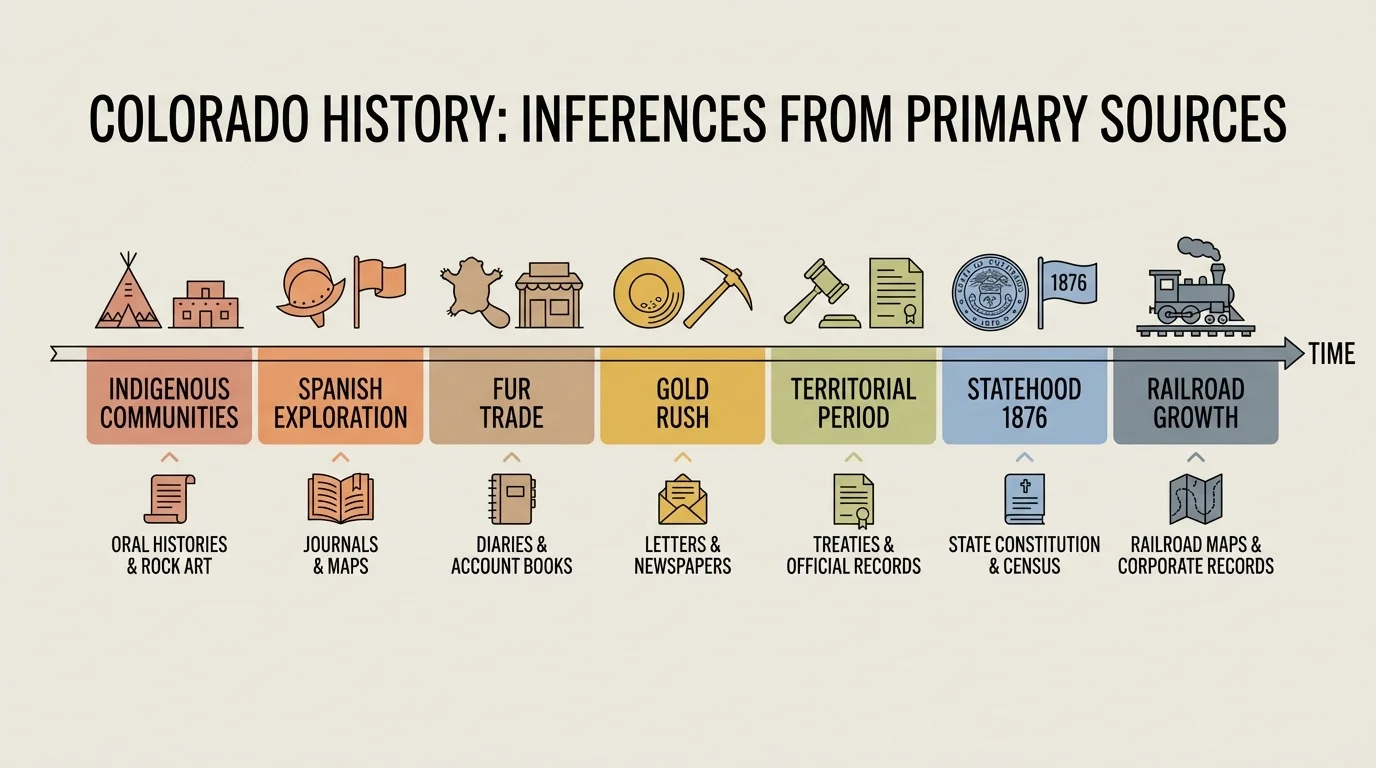
Colorado history stretches back long before the name "Colorado" was used. The timeline in [Figure 3] places key periods in order, which helps historians see change over time. Indigenous peoples, including Ute, Arapaho, Cheyenne, and others, lived in this region for many generations. They built communities, traded, traveled, hunted, farmed in some areas, and developed deep knowledge of the land.
Later, Spanish explorers came into parts of the region. Traders and trappers traveled through the area. In the 1800s, the Gold Rush brought many newcomers. Towns grew quickly. Conflicts over land and resources increased. Colorado became a territory and then a state in 1876. Railroads later connected places more easily, helping people and goods move faster across long distances.
When historians study these periods, they use sources from each one. Earlier times may have fewer written English records, so oral histories and archaeology become especially important. Later periods may have newspapers, maps, government documents, and photographs.
| Time in Colorado History | Examples of Sources | What They Can Help Us Infer |
|---|---|---|
| Indigenous communities before statehood | Oral histories, artifacts, traditions | How people lived on and understood the land |
| Spanish exploration and trade | Maps, travel journals | Routes, goals, and challenges of travel |
| Gold Rush | Diaries, letters, newspapers | Why people came and what life was like |
| Statehood and railroad growth | Photographs, maps, government records | How towns grew and changed |
Table 1. Examples of Colorado historical periods, source types, and possible inferences.
When students place events in order, they can better understand cause and effect. For example, growth in mining towns often led to roads, businesses, and new forms of government. The order of events matters.
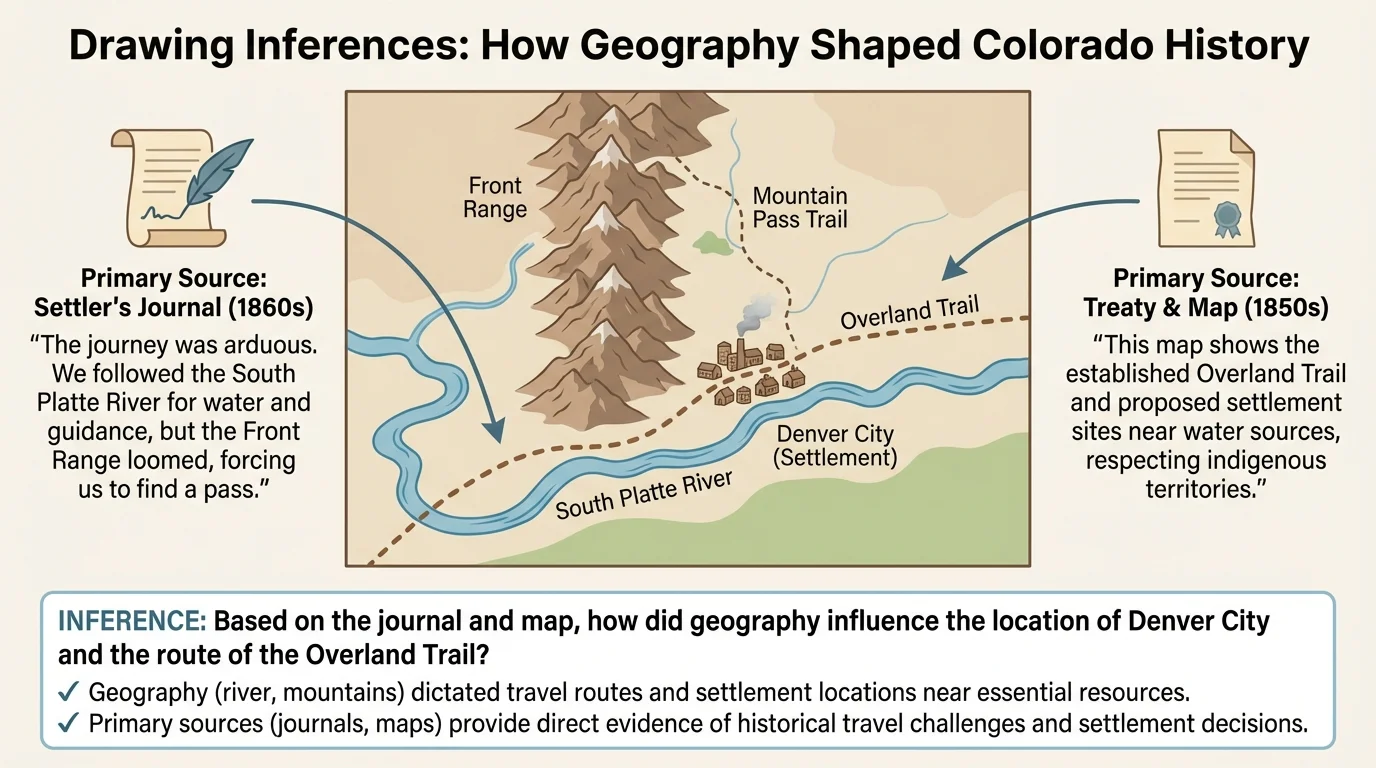
Different sources require different reading strategies, and [Figure 4] helps show why a historical map is more than a picture. With a diary or journal, look for who wrote it, when it was written, and what daily details appear. Small details, such as weather, food, clothing, or distance traveled, can reveal a lot.
With a map, look at rivers, mountains, trails, settlements, and labels. Ask what is included and what is missing. If a trail follows a river valley, you can infer that people chose a route that made travel easier. If a settlement appears near a mountain pass, you can infer that the location had transportation value.
Treaties should be read carefully because they involve promises and power. Ask who signed the treaty, who had the power to make decisions, and what land or rights were being discussed. Some treaties were not followed fairly, so historians must compare the treaty with later events.
With an oral history, listen for memories, family stories, and community knowledge. Oral histories may use strong feelings, rich details, and personal meaning. They are valuable because they preserve voices that might not appear in official documents.
A treaty and a map can work together. If a treaty discusses land boundaries and a map shows those boundaries changing, historians can infer how control of land shifted over time. The route patterns on the map in [Figure 4] also remind us that geography shapes decisions.
Earlier, you may have learned that geography affects how people live. Mountains, rivers, plains, and weather all influence travel, settlement, and trade. In Colorado history, those same land features appear in many primary sources.
A source can be useful even if it is not perfect. A map might be incomplete. A diary might only tell one side. An oral history may focus on one family's memories. Historians still learn from each one by asking careful questions.
Let us look at a few examples of how evidence leads to historical thinking. Suppose a miner's letter says, "The town doubled in size before spring, but prices rose so fast that eggs felt like treasure." From this, we can infer that many people were arriving quickly and supplies were limited. Rapid growth often causes shortages.
Now suppose a photograph shows railroad tracks being laid across open land near a new settlement. The photo alone does not explain everything, but historians can infer that transportation was expanding and that the settlement might grow because it was easier to move goods and people.
Case study: Using more than one source
A student compares a map, a diary, and an oral history about the same area in Colorado.
Step 1: Read the map.
The map shows a river, trail, and nearby settlement.
Step 2: Read the diary.
The diary mentions crossing the river often and trading in town.
Step 3: Listen to the oral history.
The speaker remembers that families gathered near the river because it provided water and a meeting place.
Step 4: Make a supported inference.
The river was important for daily life, travel, and community connection.
Here is a final example. If one source praises a new settlement but another source describes the loss of hunting grounds in the same area, historians learn that the same event brought opportunity to some people and hardship to others. That is why point of view matters so much.
A single source can be powerful, but several sources together are stronger. Historians compare evidence to see where sources agree and where they disagree. This process is sometimes called corroboration. Even if students do not use that long word often, the idea is simple: check one source against another.
If a diary says travel was dangerous in winter, a map showing steep mountain routes supports that idea. If an oral history describes a community gathering place, and a photograph shows many people there, those sources work together. If sources disagree, historians do more thinking instead of giving up.
"History is not just what happened. It is what we can learn from the evidence people left behind."
Sometimes disagreement itself teaches us something. Two people may remember the same event differently because they had different roles, hopes, fears, or goals. Historians do not simply pick the source they like best. They ask why the sources differ.
Learning from historical sources also means treating them with care and respect. This is especially true when working with community stories and Native histories. Oral traditions carry knowledge across generations. They are not "less than" written records. They are another important way people preserve the past.
When we make inferences, we should stay close to the evidence. Good historians avoid jumping to conclusions without enough proof. They also admit when something is uncertain. Saying "This source suggests..." is often more accurate than pretending we know everything.
Colorado history becomes richer when we include many voices: Native peoples, explorers, traders, miners, farmers, ranchers, railroad workers, children, and families. Each source is one window into the past. Together, they help us understand how Colorado changed over time and how people experienced those changes in very different ways.
