If you and a friend watched the same soccer game, you might tell the story differently later. One of you might remember the winning goal. The other might remember a missed call by the referee. History can be like that too. The story of Westward Expansion in the place we now call Colorado is not just one story. It is many stories told by Native nations, settlers, soldiers, miners, railroad workers, Hispano families, and government leaders.
When we study Colorado's past, we need to ask an important question: Whose voice are we hearing? Some people saw new towns, railroads, and mines as signs of progress. Other people saw the loss of homes, hunting lands, safety, and power. Looking at more than one point of view helps us understand history more honestly.
As [Figure 1] shows, long before Colorado became a state, the region was home to many communities. Native nations such as the Ute, Cheyenne, Arapaho, and Apache lived in or traveled through this land. In southern Colorado, many Hispano families with roots in Spanish and Mexican history also built homes, farms, and villages. Rivers, plains, mountains, and valleys supported trade, travel, hunting, and farming.
These groups knew the land well. They had routes through the mountains, names for places, and traditions connected to the land. The land was not empty. It was already full of life, memory, and meaning.
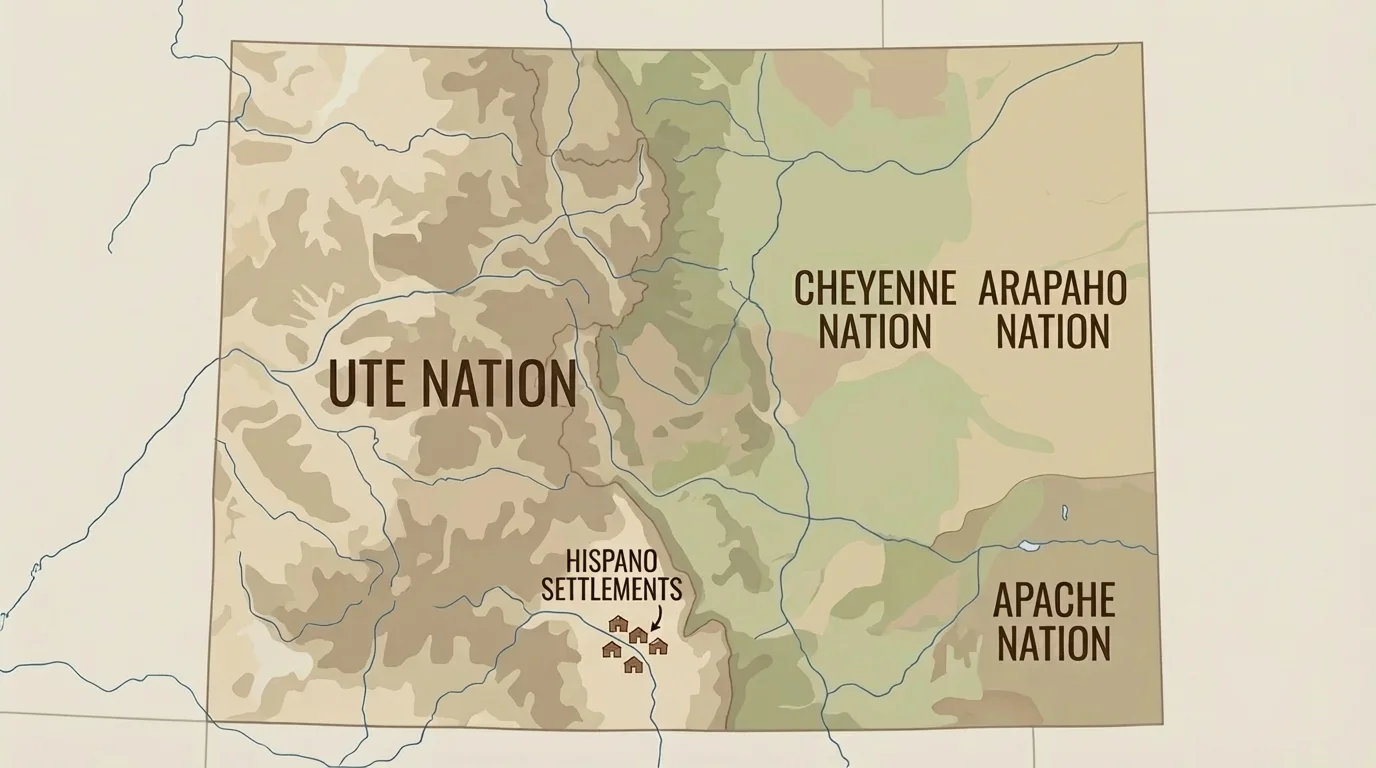
For the Ute people, mountain valleys and high country were connected to community life. For Cheyenne and Arapaho people, the plains were important for buffalo hunting and travel. Hispano communities in the south built settlements, raised animals, and farmed. Each group had its own relationship with the land.
Westward expansion means the movement of many people from the eastern United States into lands farther west.
Settler colonialism is a process in which newcomers move into a place, claim control of land, and build a new society there, often pushing out the people already living there.
Primary source is something made during the time being studied, such as a letter, diary, map, speech, photograph, or treaty.
Secondary source is something created later to explain the past, such as a textbook, article, or documentary.
These words help us talk clearly about Colorado's history. Westward expansion describes movement. Settler colonialism helps explain what happened when that movement changed who controlled the land.
In the 1800s, the United States grew larger and pushed farther west. Many settlers believed they had a right to move into western lands. Some hoped for gold, farmland, jobs, or a fresh start. Government leaders often supported this movement with laws, forts, and railroad plans.
But from Native points of view, this movement often meant something very different. It could mean broken promises, soldiers entering homelands, fewer buffalo, and pressure to leave familiar places. A person writing from a settler town might describe "new opportunity." A Native leader might describe "loss" or "invasion." Both sources tell us something important, but they do not tell the same story.
Colorado has many place names that come from different cultures and languages. Some names reflect Spanish roots, while others connect to Native histories and later U.S. settlement.
That is why historians compare many sources instead of trusting only one. A single diary or newspaper may show only one angle. Putting voices together helps us see a fuller picture.
One big reason people rushed into Colorado was gold. In 1858, news spread that gold had been found near the Front Range. This helped spark the Gold Rush in the region. Miners, shopkeepers, cooks, teamsters, and families moved in quickly, hoping to make money or build a new life.
Transportation mattered too. As roads improved and railroads expanded, it became easier to move people and goods. Towns grew near mines, forts, and railroad lines. Some people came for farming and ranching. Others came to open stores, print newspapers, or work for the government.
From one point of view, these changes looked exciting. New buildings went up. Businesses opened. Maps were redrawn. But the same changes often harmed Native peoples by taking away land, disturbing animal routes, and bringing more conflict.
Case study: one event, different reactions
Think about a new mining town being built.
Step 1: A settler merchant might write that the town brings business, roads, and customers.
Step 2: A miner might write that the town offers hope and quick riches.
Step 3: A Native family might describe the same place as part of a hunting ground now crowded with strangers.
Step 4: A historian compares these sources to understand how the same event had different meanings.
This is the heart of studying history from multiple perspectives. The event is real, but people experience it differently.
To understand Colorado's history, students and historians read primary sources and secondary sources. A primary source from a soldier might describe building a fort. A newspaper article from a mining town might celebrate growth. A speech by a Native leader might warn that treaties are being ignored.
A treaty is an agreement between groups or governments. On paper, treaties sometimes promised peace or certain lands. In real life, many treaties with Native nations were broken or changed when settlers wanted more land. This made mistrust and conflict worse.
When reading a source, it helps to ask: Who made it? When? Why? What might this person know well, and what might they leave out? A newspaper editor in a growing town may cheer for more settlers. That same editor may ignore Native voices. A later history book may add more information and compare many sources.
| Source | Point of view it may show | What it can teach us |
|---|---|---|
| Diary of a settler | Daily life, hopes, fears | Why some families moved west |
| Speech by a Native leader | Protection of land and people | How expansion affected Native nations |
| Newspaper article | Town growth, business interests | How communities promoted settlement |
| Modern history book | Later analysis using many sources | How historians combine evidence |
Table 1. Different kinds of sources and the points of view they can reveal.
Sources do not all agree, and that is useful. As [Figure 2] illustrates, disagreement can help us ask better questions and think more carefully.
Several fast-moving events reshaped Colorado. In 1858 and 1859, the Gold Rush drew many newcomers. Camps became towns. More military forts appeared. Government officials worked to increase U.S. control over the area.
Conflict grew as more settlers moved into lands used by Native peoples. In 1864, the Sand Creek Massacre became one of the most painful events in Colorado history. Colorado soldiers attacked a village of Cheyenne and Arapaho people at Sand Creek, killing many, including children and elders. Some people at the time tried to excuse the attack, but many others condemned it, and historians today recognize it as a massacre.
This event matters because it shows how dangerous and violent westward expansion could be. It also reminds us that official reports do not always tell the whole truth. Some early reports made the attack sound like a battle, but eyewitness accounts and later research revealed what really happened.
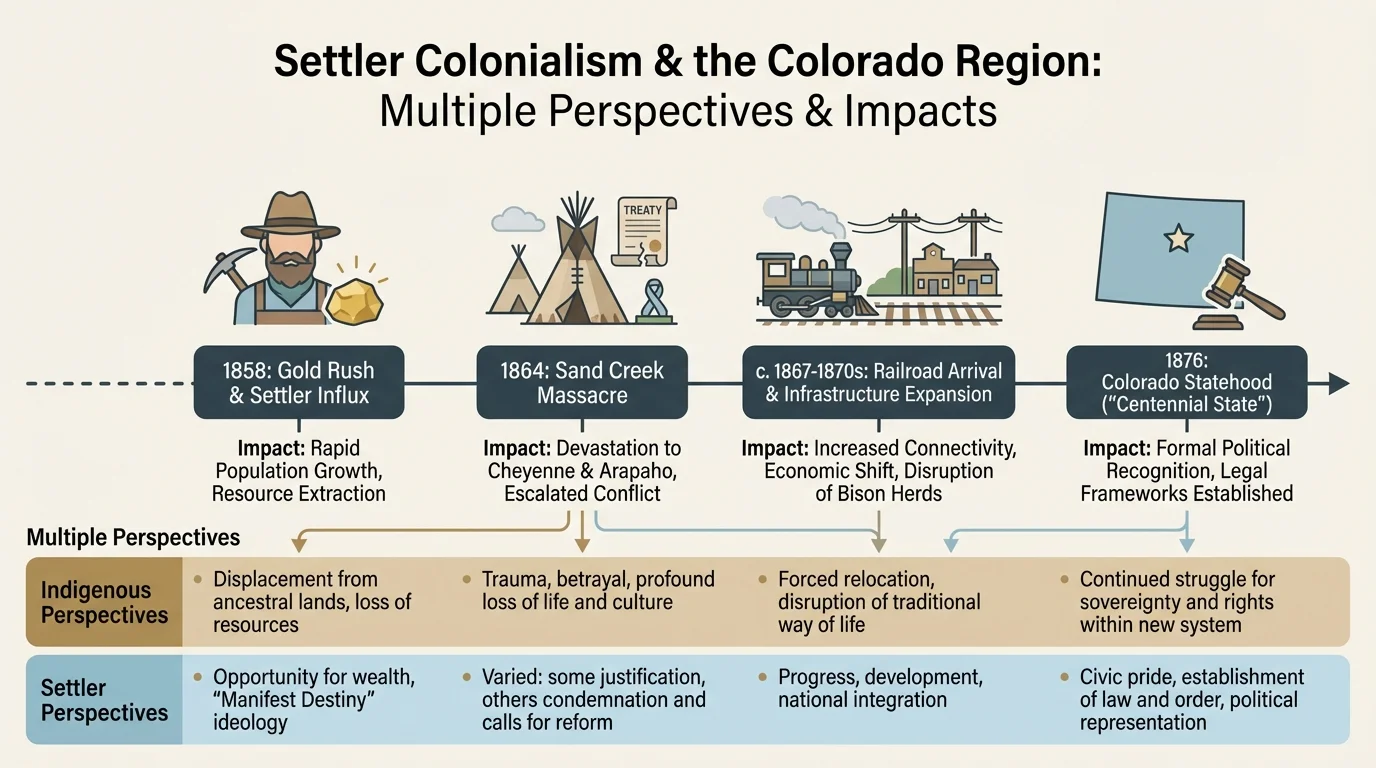
After the Civil War, railroads helped connect Colorado more strongly to the rest of the United States. Rail lines brought more settlers, goods, and political control. In 1876, Colorado became a state. From one angle, statehood looked like success and growth. From another angle, it marked how far U.S. power had spread over lands once controlled by Native nations and other earlier communities.
"History is not just what happened. It is also how we learn about what happened."
Looking back at these events, we can see that Colorado changed quickly in less than twenty years. Fast change often benefits some groups while harming others, and history asks us to notice both.
As [Figure 3] shows, westward expansion changed who held power over land. Native nations had long governed their own communities and used lands in ways shaped by their traditions and needs. As the United States expanded, federal and territorial officials claimed authority, made laws, sent soldiers, and drew new borders.
Towns, counties, and later the state government grew stronger. Land was surveyed and divided. Mining claims, ranches, farms, and railroad routes spread across the region. Reservation systems and forced removal limited where many Native people could live.
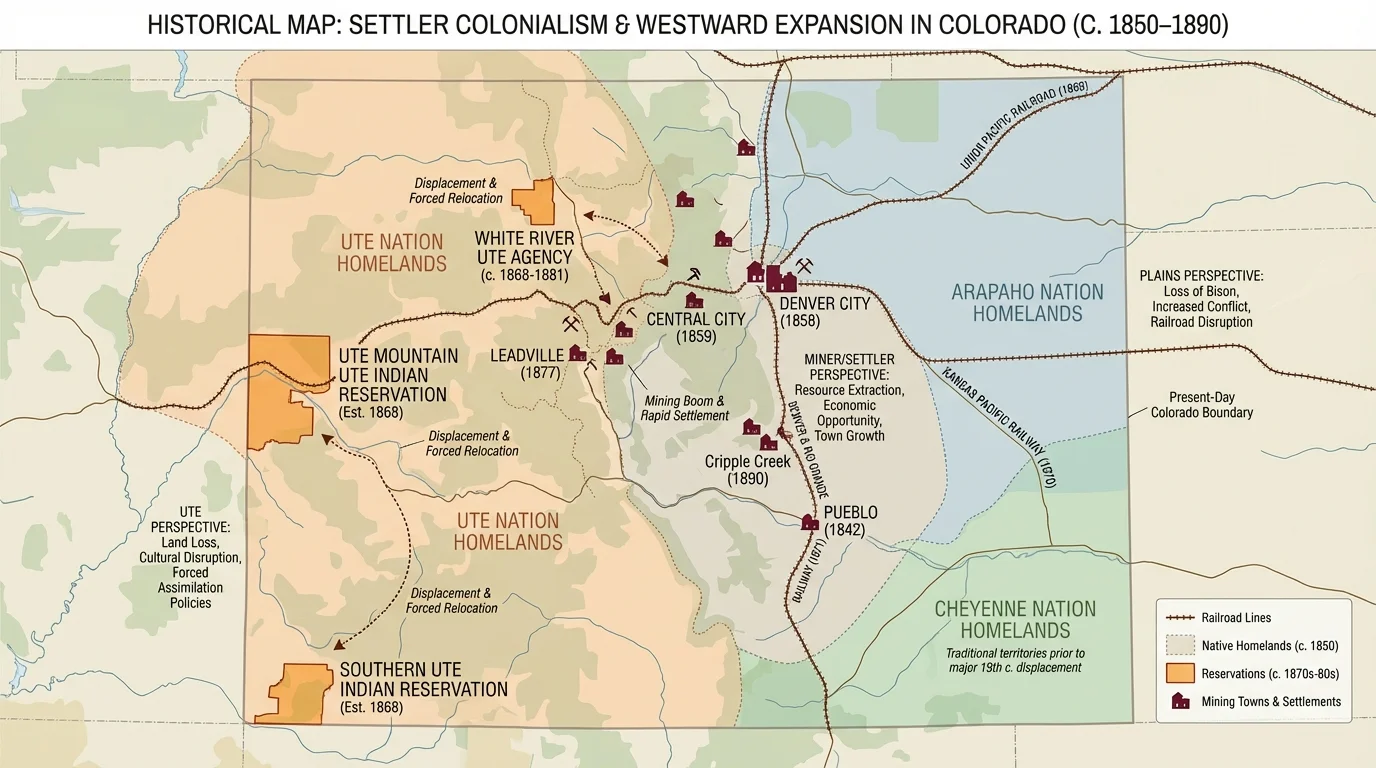
This is part of the political landscape. The political landscape means who has power, how land is ruled, and how decisions are made. In Colorado, that landscape shifted from many Native and local systems of control toward U.S. territorial and state systems.
How political change affects daily life
Political change is not only about maps and leaders. It affects homes, schools, laws, taxes, voting, property, and safety. When one group gains control, other groups may lose the power to make choices about their own land and community.
For settlers, new laws could protect land claims, businesses, and town governments. For Native peoples, those same laws often ignored older rights and relationships to the land. This is why two groups could look at the same law and feel completely different about it.
Later, Colorado's government became part of decisions about roads, schools, mining rules, and water use. These choices helped shape the state we know today.
The cultural landscape also changed. Cultural landscape means the languages, traditions, foods, buildings, music, beliefs, and place names that people leave on a region. When new groups moved into Colorado, they brought their customs with them.
Mining camps grew into towns with stores, churches, newspapers, and schools. Railroads connected distant places and helped ideas travel quickly. English became more powerful in government and business, but Spanish continued in many communities, and Native languages remained important in Native families and nations.
Yet change did not erase everything that came before. Ute, Cheyenne, Arapaho, Apache, and other Native traditions continued. Hispano communities kept strong family, farming, and religious traditions. Today, Colorado's culture still reflects all of these influences.
Remember that culture is more than holidays or food. It includes the ways people speak, learn, work, worship, build homes, and tell stories about the land.
Place names are a good example. Some names come from Native languages. Some come from Spanish. Some come from U.S. settlers. A map can become like a history book if we know how to read it. That is another reason [Figure 1] remains helpful: it reminds us that many communities shaped Colorado long before and during settlement.
Studying history fairly does not mean pretending all actions caused equal harm. It means using evidence carefully and listening to more than one voice. A textbook from long ago may praise settlers and barely mention Native peoples. A modern historian may use letters, speeches, maps, oral histories, and archaeology to tell a fuller story.
Oral history is history shared by speaking and listening, often passed through families and communities. Oral histories are important because not every group wrote the same kinds of documents. Native communities have protected history through memory, storytelling, and tradition for generations.
Comparing two sources about one event
Suppose historians study a conflict near a settlement.
Step 1: They read a newspaper from the town. It may say settlers acted bravely and defended themselves.
Step 2: They examine Native oral histories or speeches. These may explain that promises were broken first.
Step 3: They compare details, ask what each source leaves out, and look for other evidence.
Step 4: They build a stronger understanding than either source alone could provide.
This careful work helps us avoid simple stories like "everyone welcomed expansion" or "all people experienced change in the same way." History is usually more complicated than that.
Colorado today has cities, farms, ski towns, tribal connections, old villages, rail lines, highways, and landmarks from many eras. Some people remember westward expansion mostly as growth and opportunity. Others remember it as loss, violence, and broken promises. Both memories are part of the historical record, but they do not carry the same experience. To understand Colorado well, we must notice who gained power, who lost power, and how those changes still matter.
When we study the region now called Colorado, we are not only learning names and dates. We are learning how land, power, and culture changed over time. We are also learning to read sources with care, ask whose voice is present or missing, and understand that the past can look very different depending on where a person stood.
