Colorado may look like a place of mountains, snow, and wide-open skies, but it is also a place of stories. Long before Colorado became a state, many different peoples lived here, traveled through here, traded here, worked here, and made homes here. When we study Colorado history, we learn that the state was never shaped by just one group. It was built through the actions, ideas, struggles, and celebrations of many cultures.
People in Colorado have not always agreed. Sometimes they worked together, shared goods, ideas, music, foods, and traditions. At other times, groups faced unfair treatment, violence, or laws that pushed them aside. Learning both sides of this history helps us understand Colorado more clearly and more honestly.
Culture means the ways of life of a group of people, including language, food, music, celebrations, beliefs, and traditions.
Interaction means how people or groups affect one another by trading, living near one another, working together, or even disagreeing and competing.
Migration is the movement of people from one place to another to live or work.
Colorado's land helped bring people together. The Rocky Mountains, rivers, plains, and mountain passes made the area important for travel, hunting, farming, mining, and trade. Because of this, Colorado became a crossroads of migration. Different groups came for different reasons: some had lived here for thousands of years, some were forced to move, and others came hoping for work, land, safety, or freedom.
Even today, Colorado is a meeting place. In cities like Denver, Pueblo, and Aurora, and in small towns across the state, families with many backgrounds live side by side. They meet in schools, parks, places of worship, workplaces, and neighborhoods. These daily connections are part of Colorado history too.
Long before Colorado became a state, Indigenous Peoples lived across the region, as [Figure 1] shows in different parts of the state. The Ute people lived mostly in the mountain and western areas. The Cheyenne and Arapaho lived mainly on the plains. Other Native nations also traveled, traded, hunted, and formed relationships in the region.
These groups had rich cultures and strong knowledge of the land. They understood seasons, plants, animals, rivers, and weather. They traded with one another and with peoples far beyond Colorado. They told stories, held ceremonies, created art, and taught children how to live responsibly within their communities.
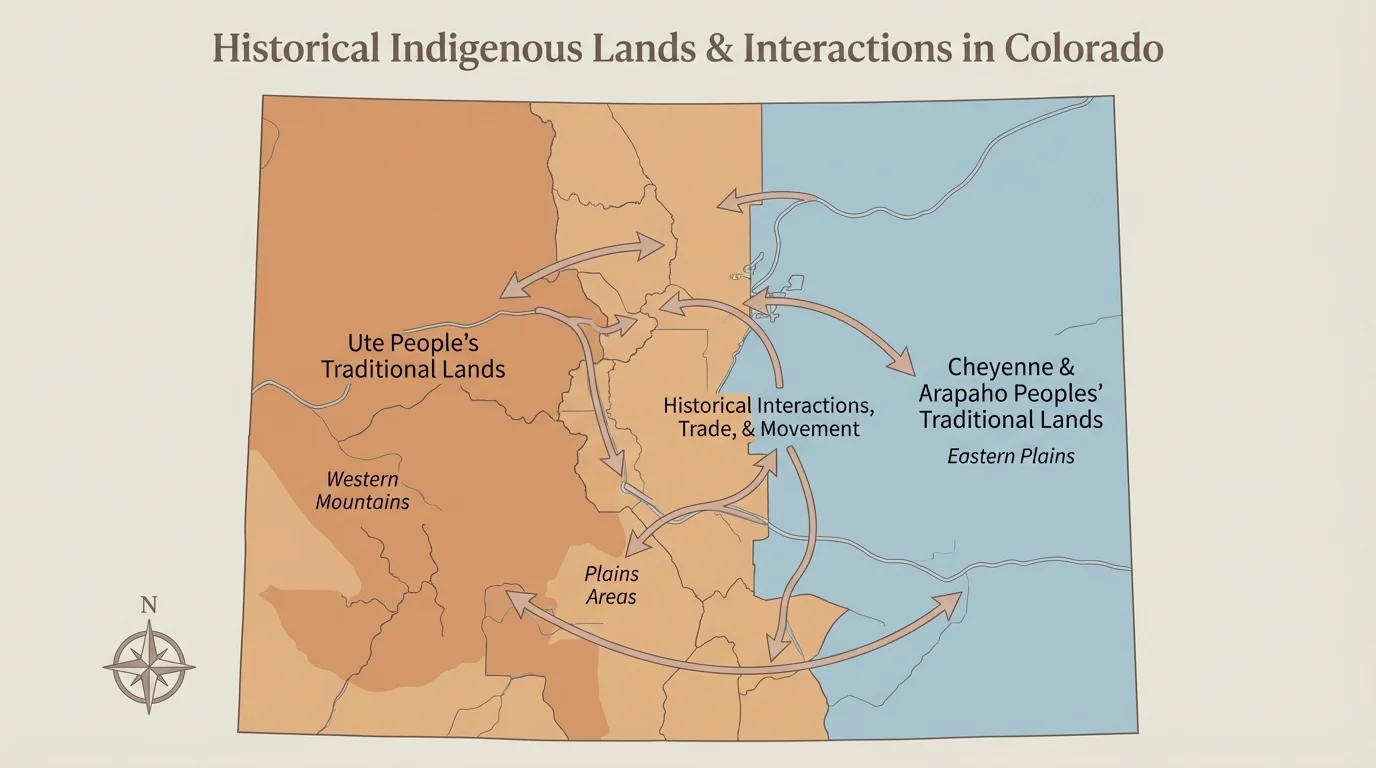
When Spanish explorers and settlers moved into the Southwest, new interactions began. Horses, new trade goods, and new diseases changed life for many Indigenous communities. Later, when the United States expanded westward in the 1800s, pressure on Native lands increased. Treaties were made and broken. Many Indigenous people were forced from their homes.
One painful event was the Sand Creek Massacre in 1864. Colorado soldiers attacked a camp of Cheyenne and Arapaho people, including many women, children, and elders. This event reminds us that Colorado history includes great harm as well as growth. It also shows why Native communities remember history from their own point of view.
Even after forced removals, Indigenous cultures did not disappear. Ute communities remain in and near Colorado today. Native people continue to protect traditions, languages, and sacred places. When we look back at the regions in [Figure 1], we can better understand that Colorado began as Native homelands, not empty land waiting to be settled.
Many Colorado place names come from Native languages or from words connected to Native history. Learning a place name can reveal who lived there first and how people understood the land.
In the late 1800s, gold and silver discoveries changed Colorado quickly. The Gold Rush and the growth of railroads brought many newcomers, as [Figure 2] traces over time. People arrived from other parts of the United States and from countries around the world. They came to mine, build railroads, farm, open stores, or offer services.
Latinos have deep roots in Colorado history. Long before Colorado became a state, Spanish-speaking people lived in and traveled through the region because it was part of Spanish and later Mexican territory. Later, Mexican and Mexican American families built communities in southern Colorado and other parts of the state. They worked as farmers, ranchers, railroad workers, miners, and business owners. They brought language, music, foods, and celebrations that remain important in Colorado today.
Asian Americans, especially Chinese immigrants in the 1800s and later Japanese Americans and others, also helped shape Colorado. Some worked on railroads, in laundries, restaurants, farms, and small businesses. They often faced unfair treatment and racism, but they still built communities and contributed greatly to the state.
African Americans came to Colorado for many reasons. Some moved west seeking more freedom and economic opportunity after slavery ended. Some were soldiers known as Buffalo Soldiers who served in the West. Others built churches, newspapers, businesses, and neighborhoods, especially in Denver and other growing towns.
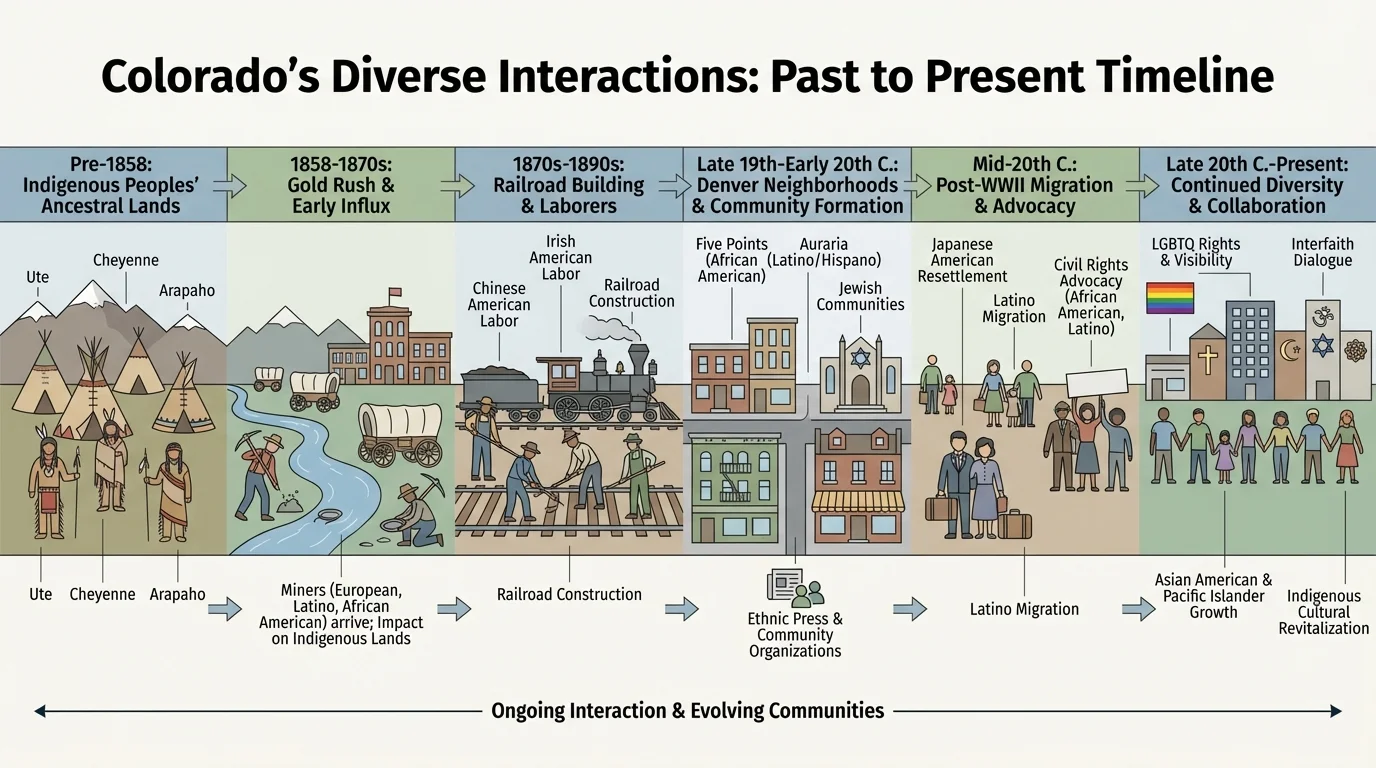
Railroads connected mining towns and cities, but they also changed Native lands and increased settlement. This meant that one group's opportunity often came at another group's loss. Colorado history is full of this difficult truth: growth for some communities was sometimes tied to unfairness toward others.
Still, many communities shared ideas and traditions. People traded foods, learned words from other languages, and worked together in towns and markets. Over time, neighborhoods became places where cultures mixed. Looking at the sequence in [Figure 2] helps us see that Colorado's population did not grow all at once; it grew through many waves of newcomers and long-settled peoples living together.
Interactions among cultures can be peaceful, creative, and helpful, but they can also be unfair. In Colorado, some groups were treated differently because of race, religion, language, or identity. Native peoples lost land. Chinese immigrants faced violence and exclusion. African Americans and Latinos often faced segregation, which meant being separated or denied equal treatment in housing, schools, jobs, and public places.
At the same time, people also found ways to cooperate. Workers joined together to demand safer jobs and better pay. Neighbors supported one another after disasters, during wars, and through hard winters. Churches, mutual-aid groups, and community clubs helped families find homes, food, and friendship. Cultural interaction does not mean everyone agreed; it means their lives affected one another in powerful ways.
How conflict and cooperation can happen at the same time
Two groups may face unfair laws and still share parts of daily life. For example, people might work together in the same city, shop at nearby stores, or celebrate public holidays together, while one group still has fewer rights. History often includes both connection and inequality at once.
A good example is farming and labor in southern Colorado. Workers from different backgrounds, including Latino families, European immigrants, and others, helped build farms, mines, and industries. They did not all share the same language or traditions, but they often depended on one another to get work done and support their towns.
During the 1900s, Colorado communities grew more diverse. New arrivals and long-time residents shaped schools, neighborhoods, sports teams, newspapers, and music scenes. Religious groups such as Catholics, Protestants, Jews, Muslims, Buddhists, Hindus, and others formed congregations and community centers. These groups created places for worship, charity, education, and celebrations.
Religious groups sometimes experienced acceptance and sometimes prejudice. Jewish families, for example, helped build businesses and cultural life in Colorado, yet they also faced discrimination. Japanese Americans experienced severe injustice during World War II, when many were forced from their homes on the West Coast and sent to camps, including Amache in southeastern Colorado. Some Coloradans supported them, while others accepted the unfair policy. This shows again that Colorado history includes both kindness and injustice.
African American communities in Denver, Colorado Springs, and other cities created strong institutions. Churches, civic clubs, newspapers, and musicians helped build community pride. Latino neighborhoods did the same, preserving family traditions and creating new art, food, and celebrations. These communities were not separate from Colorado history; they were central to it.
Children often experienced cultural interaction in simple but meaningful ways. They sat in classrooms with classmates from different backgrounds, heard different languages, tasted different foods, and learned new holiday traditions. Music, sports, and neighborhood events helped cultures meet and influence one another.
Case study: A Colorado neighborhood
Think about a busy Denver neighborhood in the 1900s.
Step 1: Families from different backgrounds move there.
African American, Latino, European immigrant, and Jewish families might all live within a few blocks of one another.
Step 2: They build community places.
People open shops, start churches or synagogues, publish newspapers, and organize festivals.
Step 3: They share and change culture.
Neighbors learn foods, songs, and customs from one another, even while some still face unfair treatment.
This is one way Colorado communities grew through many interactions at once.
Many Colorado groups asked for fairness, equal treatment, and respect, as [Figure 3] illustrates through public action. Civil rights efforts in Colorado were connected to larger movements in United States history. People protested unfair laws, challenged segregation, defended voting rights, and demanded dignity in schools, housing, and work.
Latino activists were important in the Chicano movement, which pushed for better education, labor rights, political representation, and respect for Mexican American identity. Indigenous activists worked to protect treaty rights, culture, land, and sovereignty. African American leaders fought discrimination and helped expand opportunities in education, politics, and public life.
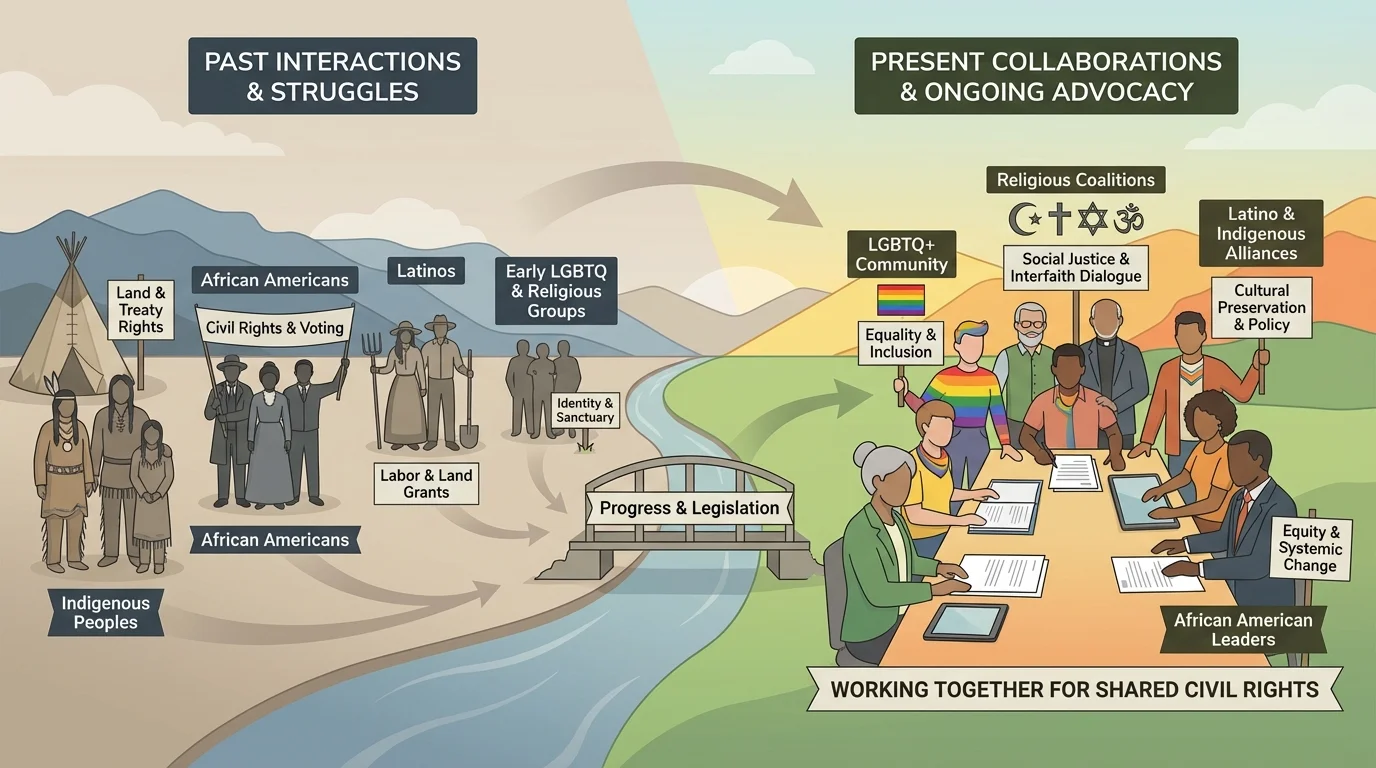
LGBTQ people are also part of Colorado's story. They have built communities, created art, served in jobs and public office, and worked for equal rights. In earlier times, many LGBTQ people had to hide who they were because of fear or unfair treatment. Over time, activists and allies helped Colorado become more inclusive in many places, though the struggle for fairness has continued.
Religious freedom has mattered too. Different faith communities have worked to protect the right to worship freely. Sometimes groups disagreed, but Colorado's history shows that many people believed a community is stronger when people can live according to their beliefs without being harmed.
The actions in [Figure 3] connect to a big idea in American history: rights are often expanded because ordinary people speak up. Colorado's people were part of those national movements, not separate from them.
"We are stronger when every voice matters."
— A guiding idea in democratic communities
Today, Colorado continues to be shaped by many cultures. Powwows, Juneteenth celebrations, Cinco de Mayo events, Lunar New Year festivals, Pride parades, and interfaith gatherings are just a few examples. These events are not only celebrations. They also teach history, honor ancestors, and help neighbors understand one another.
Food is one easy way to notice cultural interaction. Colorado families may eat tamales, dumplings, fry bread, green chile, matzo ball soup, or foods from many other traditions. Music and art show this too. Murals, dance performances, museums, and public events share stories from many communities.
Government and schools also reflect this diversity. Colorado students learn from classmates with different languages, religions, and family histories. Leaders from many backgrounds now serve in public office, advocate for communities, and help make decisions for the future.
Colorado has one of the most diverse refugee and immigrant communities in the Rocky Mountain region. New families continue to add languages, traditions, and ideas to the state.
Learning about present-day Colorado helps us remember that history is not only in the past. The interactions among groups continue every day in classrooms, sports teams, libraries, neighborhoods, and workplaces. The choices people make now will become Colorado history later.
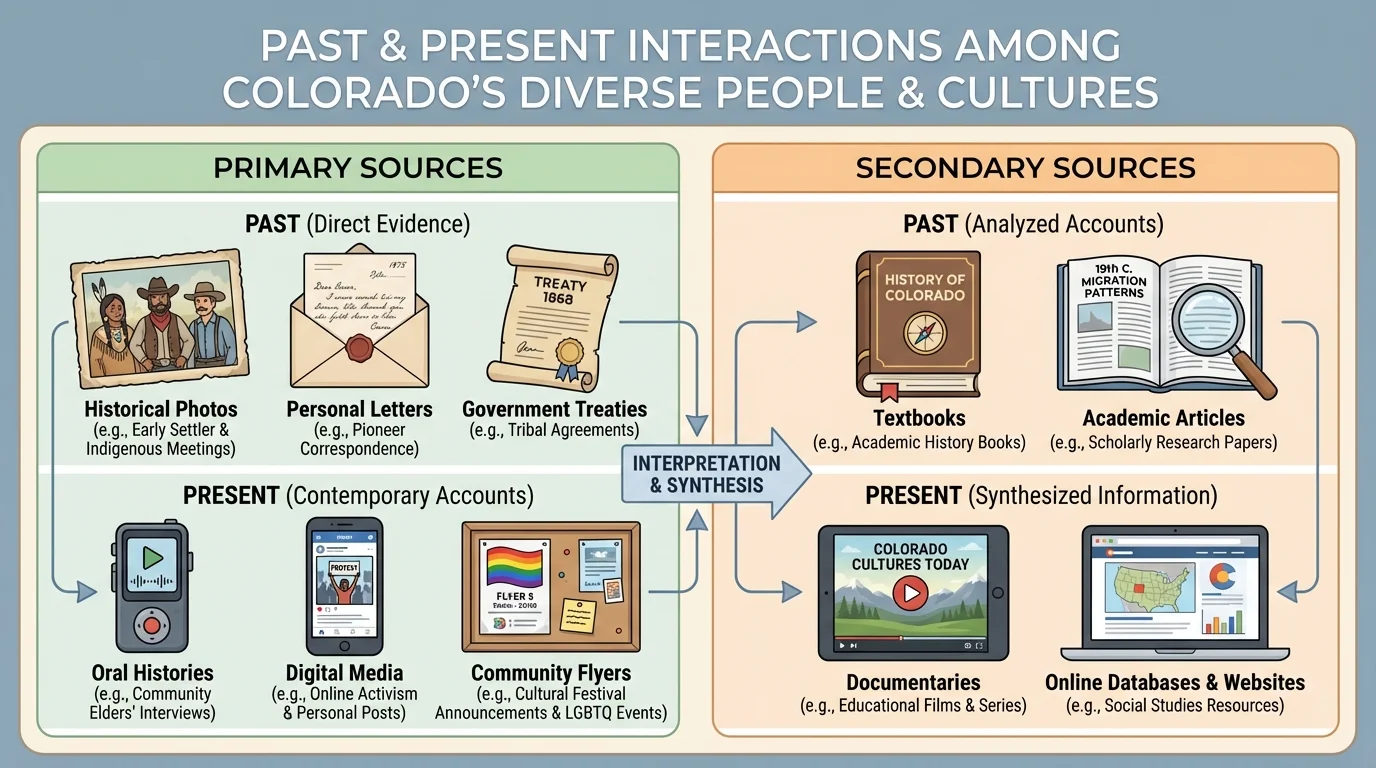
To understand these interactions, historians use different kinds of sources, and [Figure 4] compares the most important types. A primary source comes from the time being studied. Examples include photographs, letters, diaries, oral histories, maps, government records, and newspaper articles from that time. A secondary source is something written later by a person studying the past, such as a textbook or history article.
For Colorado history, oral histories are especially important. Some communities were left out of older textbooks, so family stories, interviews, songs, and community memory help historians learn what happened. Native communities, African American families, Latino communities, Asian American communities, LGBTQ people, and religious groups all have stories that add important details to the historical record.
| Source Type | Colorado Example | What It Helps Us Learn |
|---|---|---|
| Primary source | A treaty, a photograph, or a letter from a miner | What people at the time saw, felt, or decided |
| Primary source | An oral history from a community elder | Memories and experiences that may not be in textbooks |
| Secondary source | A history book about Colorado | How historians explain and connect past events |
Table 1. Examples of primary and secondary sources used to study Colorado history.
When historians compare many sources, they can ask better questions. Who was included? Who was left out? Whose voice was strongest? Whose story needs more attention? The categories in [Figure 4] remind us that learning history means listening carefully to many kinds of evidence.
Colorado's story is really a story of relationships among peoples and cultures. Some interactions brought trade, art, celebration, and strong communities. Others brought broken promises, exclusion, and pain. Both are part of the past, and both help explain the present.
