Why do so many towns and cities begin near rivers, coasts, or flat land? That is not an accident. People make careful choices about where to live. A place may have fresh water, rich soil, safe harbors, or roads that make travel easier. Over time, people also change those places by building farms, houses, roads, and walls. Geography helps us understand why settlements begin, grow, and change.
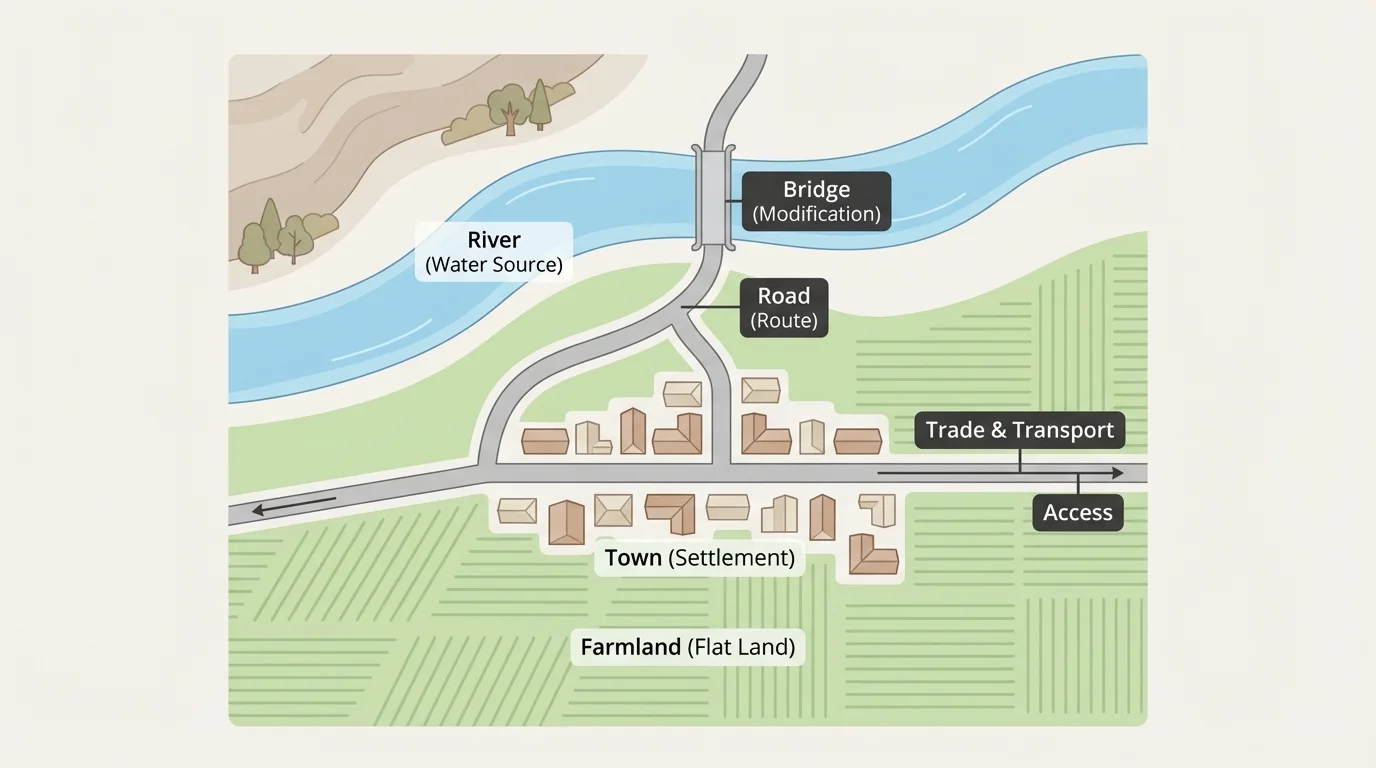
A settlement is a place where people live. It can be a small village, a town, or a large city. Many settlements begin where the land and water make life easier, as [Figure 1] shows with a town built near a river, roads, and farmland. People need water for drinking, cooking, washing, farming, and transportation.
Flat land is often a good place for settlements because it is easier to build homes, schools, and roads there. Farmers also like flat land because it can be easier to plant crops. Places near rivers often have rich soil. Rich soil helps plants grow well, so people can raise food nearby.
Geographic factors are parts of a place that affect how people live there. These include landforms, climate, water, natural resources, and location.
Physical environment means the natural features of a place, such as mountains, rivers, soil, weather, plants, and animals.
Transportation matters too. In the past, rivers and coastlines were like highways. Boats could carry people and goods more easily than wagons on rough land. Today, settlements still grow where roads, railways, airports, and ports connect people to other places. A good location can help a settlement become a busy center of trade.
Natural resources are another reason people choose a place. Natural resources are useful things found in nature, such as water, trees, fish, fertile soil, coal, or metals. If an area has forests, people may use wood to build homes. If it has good fishing waters, people may catch fish for food and jobs.
Still, not every promising place is easy to live in. Some places flood often. Some are very dry. Others are so cold or steep that building is difficult. People must weigh the benefits and challenges of a place before building a settlement.
The landforms of a region strongly affect settlement patterns, and [Figure 2] compares how plains, mountains, and coasts offer different advantages and problems. A plain is a broad area of mostly flat land. Plains are often good for farming, building, and travel. Because of this, many large settlements grow on plains.
Mountains can protect people from enemies and may contain valuable resources, but mountain land is steep and harder to build on. Roads and railways can be difficult to construct there. A mountain village may be smaller and more spread out because there is less flat space.
Coasts can be excellent places for settlements. A coastal city may have a harbor where ships bring goods and people. Fishing and trade can help the city grow. But coasts can also face storms, strong winds, and flooding from the sea.
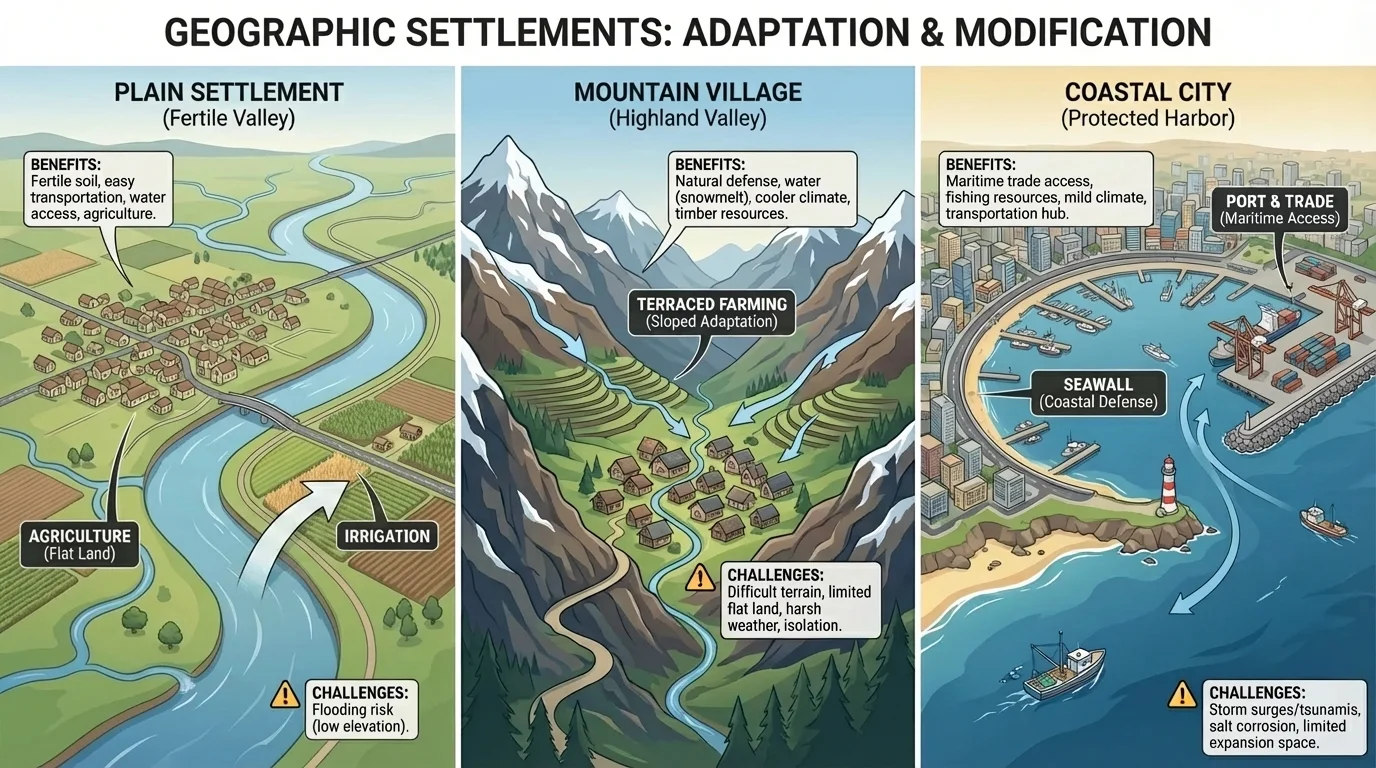
Rivers are especially important. A river can provide fresh water, transportation, food, and fertile land. Some of the world's earliest settlements grew beside rivers because rivers helped people farm and travel. However, rivers can also overflow and flood nearby land.
Climate also shapes settlements. Climate is the usual weather of a place over a long time. A warm, wet climate may support thick forests or farming. A hot, dry climate may require irrigation, which is bringing water to crops through canals or pipes. In very cold places, people may need special homes, warm clothing, and strong heating systems.
Some deserts become home to settlements because underground water or oases make farming and daily life possible. Even harsh places can support people when water is available.
Forests, grasslands, deserts, wetlands, and tundra all shape human activity in different ways. Forests can provide wood, but thick trees may need to be cleared for farms or roads. Wetlands hold water and support wildlife, but they can be muddy and flood-prone. Tundra is very cold and has frozen ground, which makes building difficult.
People do not live the same way in every place. They adapt to the environment by changing their homes, clothing, work, and habits to fit local conditions. Adaptation means adjusting to a place so life can work better there.
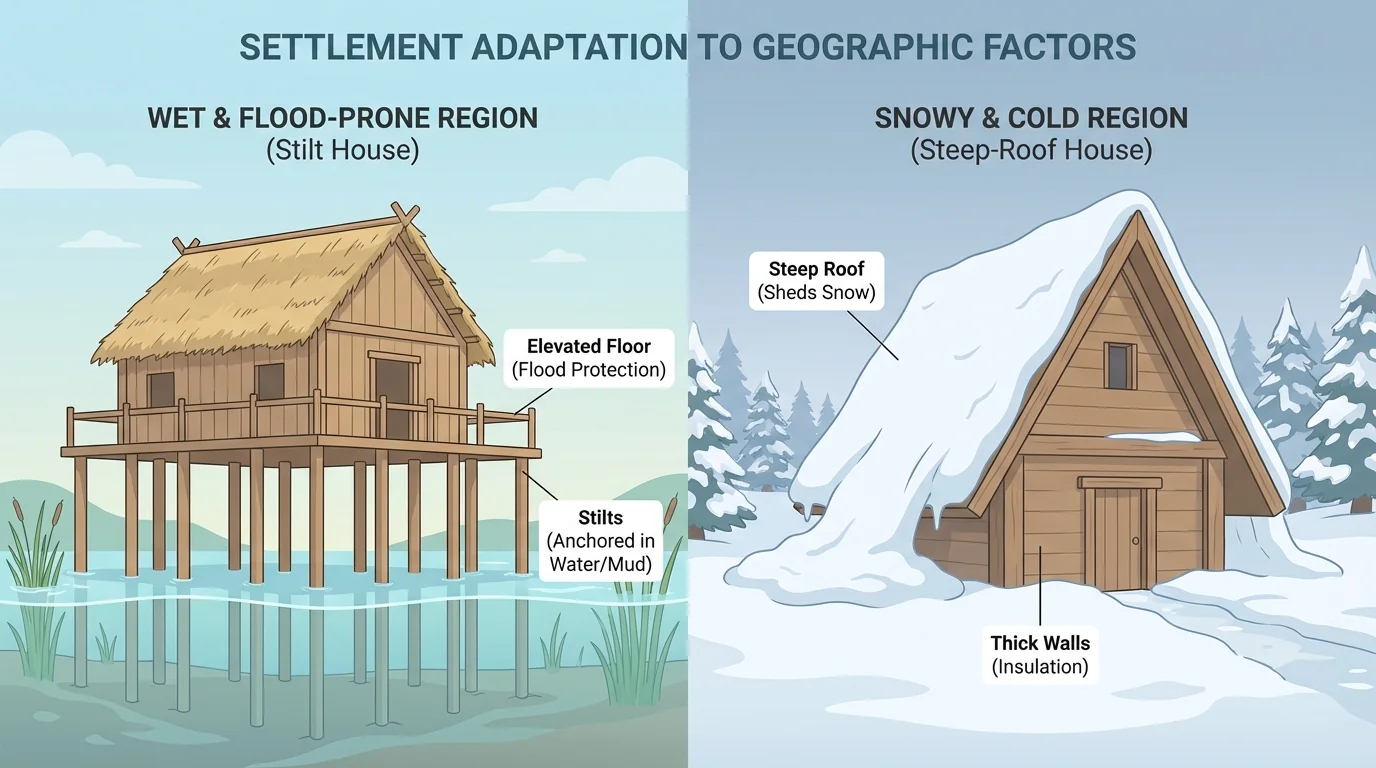
In places with heavy rain or flooding, some people build houses on stilts. Stilts lift the house above wet ground or floodwater. In snowy regions, roofs may be steep so snow slides off more easily. In hot climates, homes may have thick walls or shaded windows to stay cooler inside.
People also adapt through the jobs they do, as [Figure 3] helps show through different kinds of houses. In fertile valleys, many people farm. Near coasts, some fish or work in shipping. In mountain regions, some raise animals such as goats or sheep because those animals can move over rough land. In cold areas, people may travel by snowmobile or wear layers of warm clothing.
Adaptation and survival
Adapting does not mean changing everything about nature. It means learning how to live safely and successfully in a place. People study the weather, land, water, and plants around them. Then they make choices that help them use the environment wisely.
Food can also reflect adaptation. People often grow crops that match the climate and soil. Rice grows well in many wet places. Wheat often grows well in broad plains. In dry areas, people may raise animals that need less water or grow crops that can survive with little rain.
As we saw earlier with different landforms in [Figure 2], adaptation depends on local conditions. The same type of house or job will not fit every place. Geography helps explain why people live differently in different regions.
People do more than adapt. They also modify the environment to meet their needs. To modify means to change something.
One common change is clearing land, as [Figure 4] shows through examples such as a dam, levee, bridge, and farmland. People cut trees or remove plants so they can build homes, schools, farms, or roads. Another change is digging canals or building irrigation systems to move water where it is needed. This helps crops grow in places that do not get enough rain.
People also build structures to control water. A levee is a wall or raised bank built to help keep a river from flooding nearby land. A dam blocks a river to store water or produce electricity. These structures can help people, but they can also change habitats for plants and animals.
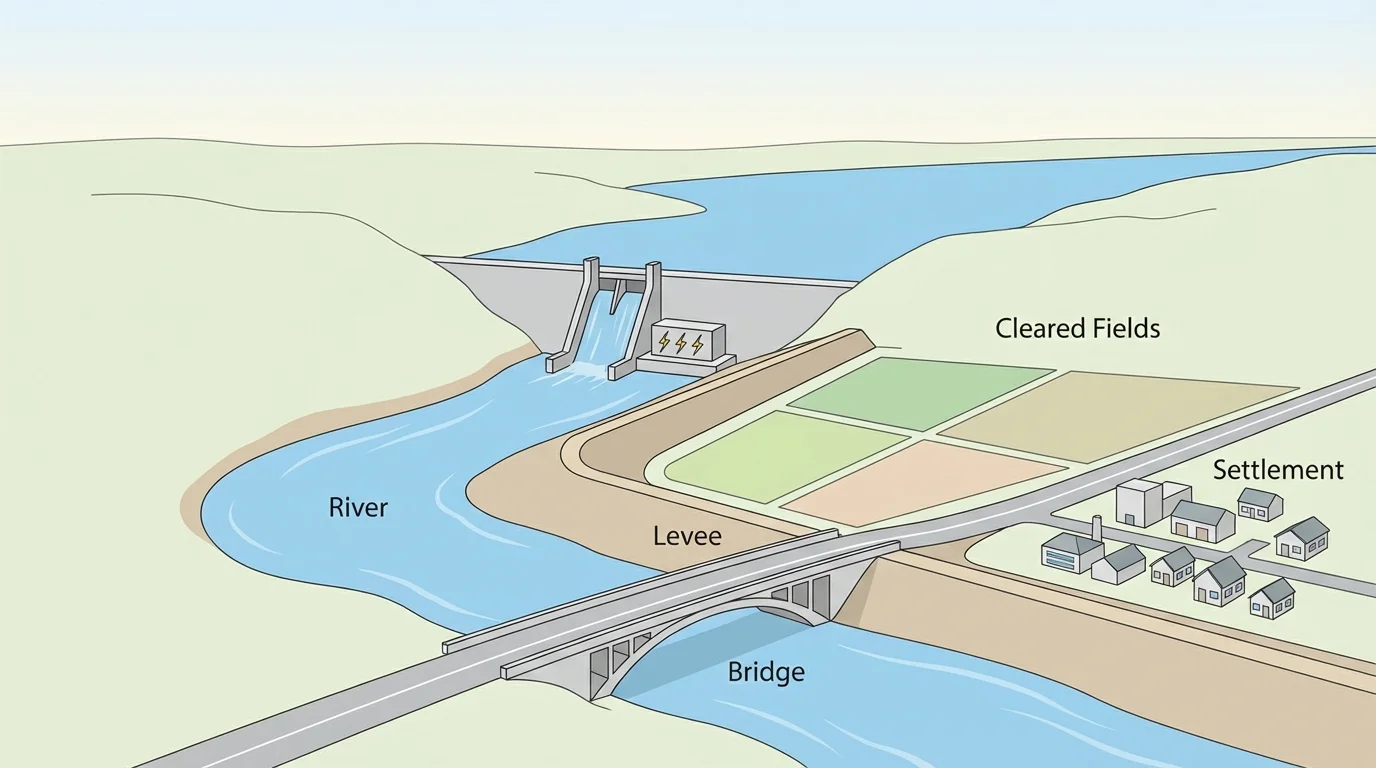
Bridges, tunnels, and roads make travel easier across rivers, mountains, or valleys. Ports and harbors help ships load and unload goods. In some places, people even create new land by filling shallow water areas with soil and rock. This gives them more space for homes, businesses, or airports.
Modifying the environment can bring benefits. It can create jobs, improve transportation, prevent some flooding, and provide more food or water. But changes can also cause problems. Clearing too many trees can increase erosion, which is when soil is worn away by wind or water. Building too close to rivers or coasts can place people in danger during floods or storms.
Case study: A river town
A town forms along a river because the water helps people farm, drink, and travel.
Step 1: People choose the location.
The river provides water, fish, and a route for boats. Flat nearby land makes building easier.
Step 2: People adapt to the river.
They build some homes on higher ground because floods may happen during heavy rain.
Step 3: People modify the river area.
They build docks for boats and a levee to reduce flood damage.
Step 4: New effects appear.
The town grows because trade becomes easier, but the levee may also change the natural flow of water.
This example shows that geography affects human choices, and human choices affect geography too.
The housing examples in [Figure 3] show adaptation, while the river structures in [Figure 4] show modification. These are connected ideas. People often adapt first and then change the environment more as settlements grow.
Looking at real places helps us understand these ideas better. Different regions have different physical environments, so people make different choices about settlements.
Along the Nile River in Egypt, people have lived for thousands of years because the river provides water in a dry region. The nearby land could be farmed more easily because the river helped create fertile soil. Settlements formed close to the river because the surrounding desert was much harder to live in.
In the Arctic, the climate is extremely cold. The ground may stay frozen for long periods. People adapt with warm clothing, insulated buildings, and tools made for snow and ice. Settlements are often smaller because farming is difficult and transportation can be challenging.
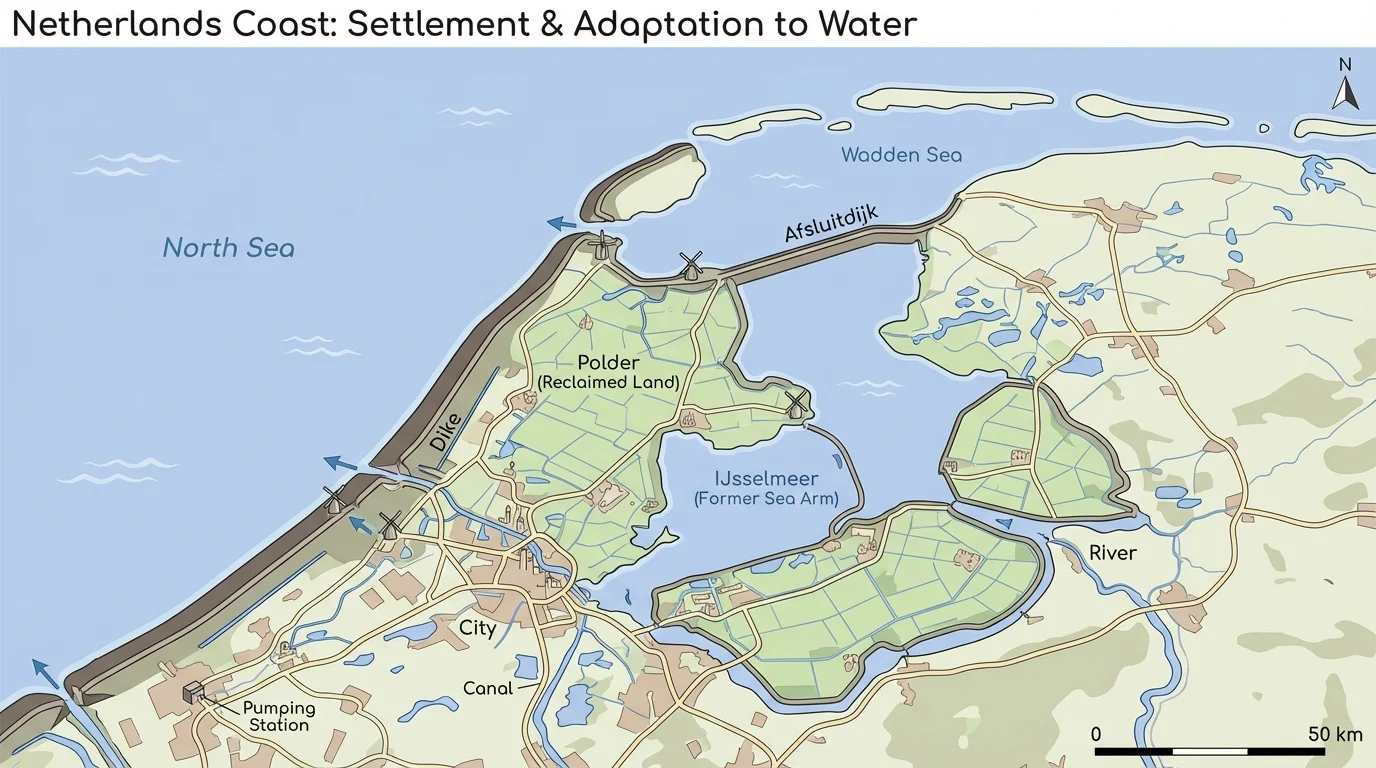
In the Netherlands, as [Figure 5] shows, people have long worked to protect land from the sea. They built dikes, pumps, and barriers to keep water out. They also reclaimed land, which means they created usable land where water used to be.
In coastal cities such as New Orleans in the United States, water has helped transportation and trade, but it has also created danger from flooding and storms. Levees, pumps, and raised buildings are important there. Geography gives the city both opportunities and risks.
| Place | Important Geographic Factor | How People Adapt or Modify |
|---|---|---|
| Nile River Valley | River in a dry region | Farm near water and settle along the river |
| Arctic | Very cold climate and frozen ground | Build insulated homes and use special clothing and transport |
| Netherlands | Low land near the sea | Build dikes and reclaim land |
| New Orleans | Coastal and river flooding risk | Use levees, pumps, and raised structures |
Table 1. Examples of how settlements in different places depend on geographic factors and human choices.
The Netherlands example in [Figure 5] is especially striking because people there have changed the environment on a large scale. They did this because the location is useful for farming, cities, and trade, even though water creates major challenges.
Settlements do not stay the same forever. Some grow into big cities. Others shrink or disappear. Geography plays a large part in these changes. If a port city gains more trade routes, it may grow. If a river changes course, a settlement may lose water or transportation access.
Natural hazards can also affect settlements. Earthquakes, floods, hurricanes, droughts, wildfires, and volcanoes may damage homes and roads. People may rebuild, move away, or create new safety systems. For example, a town in a wildfire area may clear dry brush around buildings. A coastal area may raise buildings higher to prepare for storm surges.
Earlier geography learning shows that maps help us study where places are located. Here, we go a step further by asking why people choose those places and how they respond to the physical environment.
New technology can change settlement patterns too. Air conditioning has helped more people live in hot places. Stronger building materials help people build on coasts or in earthquake-prone regions. But technology does not erase geography. It helps people respond to geographic challenges.
When geographers study a settlement, they ask several important questions. What physical features are nearby? Is there water? What is the climate like? Is the land flat, steep, wet, dry, fertile, or rocky? What resources are available? These questions help explain why a settlement exists where it does.
Then geographers ask how people live with those conditions. Do they adapt by changing homes, clothing, or work? Do they modify the environment by building roads, dams, canals, or levees? What good and bad effects come from those choices?
This kind of analysis shows that people and the environment affect each other all the time. The environment influences where settlements begin and what they need to survive. People then shape the environment through farming, construction, transportation, and water control. Understanding both sides helps us better understand communities around the world.
"Where people live is closely tied to the land, water, and climate around them."
From river valleys to snowy regions to low coastal lands, settlements reveal a close relationship between geography and human activity. The choices people make are not random. They are connected to real physical features and real human needs.
