Why do some kids finish their chores quickly when they hear they can earn extra game time, while other people hurry to return a library book before a fee is charged? Those choices may seem very different, but they are connected by an important idea in economics: people often change their behavior when there is a reward to gain or a cost to avoid.
In economics, people make choices because they cannot have everything they want all at once. Time, money, and resources are limited. An economic incentive is something that encourages a person to make one choice instead of another. An incentive can push someone toward a behavior or away from it.
Economic incentive means a reward or a cost that influences a choice. A reward encourages a behavior, and a cost or unpleasant result can discourage a behavior.
Positive incentive is a reward people may receive for doing something.
Negative incentive is a cost, penalty, or unpleasant result people may face if they do something or fail to do something.
People respond to incentives all the time, even if they do not use that word. A sale sign at a store can encourage a family to buy now instead of later. A late fee can encourage someone to return an item on time. A gold star in class can encourage careful work. Incentives are part of everyday life.
Economics studies how people use limited resources to meet their needs and wants. Incentives matter because they help explain why people choose one action over another. They do not force every choice, but they often influence decisions.
A positive incentive is something good that a person may get by choosing a certain action. As [Figure 1] shows, rewards can encourage people to do something they might otherwise delay or ignore. People often respond to positive incentives by trying harder, acting faster, or choosing the behavior that leads to the reward.
Positive incentives can be money, prizes, praise, extra time, discounts, or other benefits. For a child, a positive incentive might be earning a sticker, extra recess time, or a chance to choose a class game. For an adult, it might be a paycheck, a bonus, or a coupon.
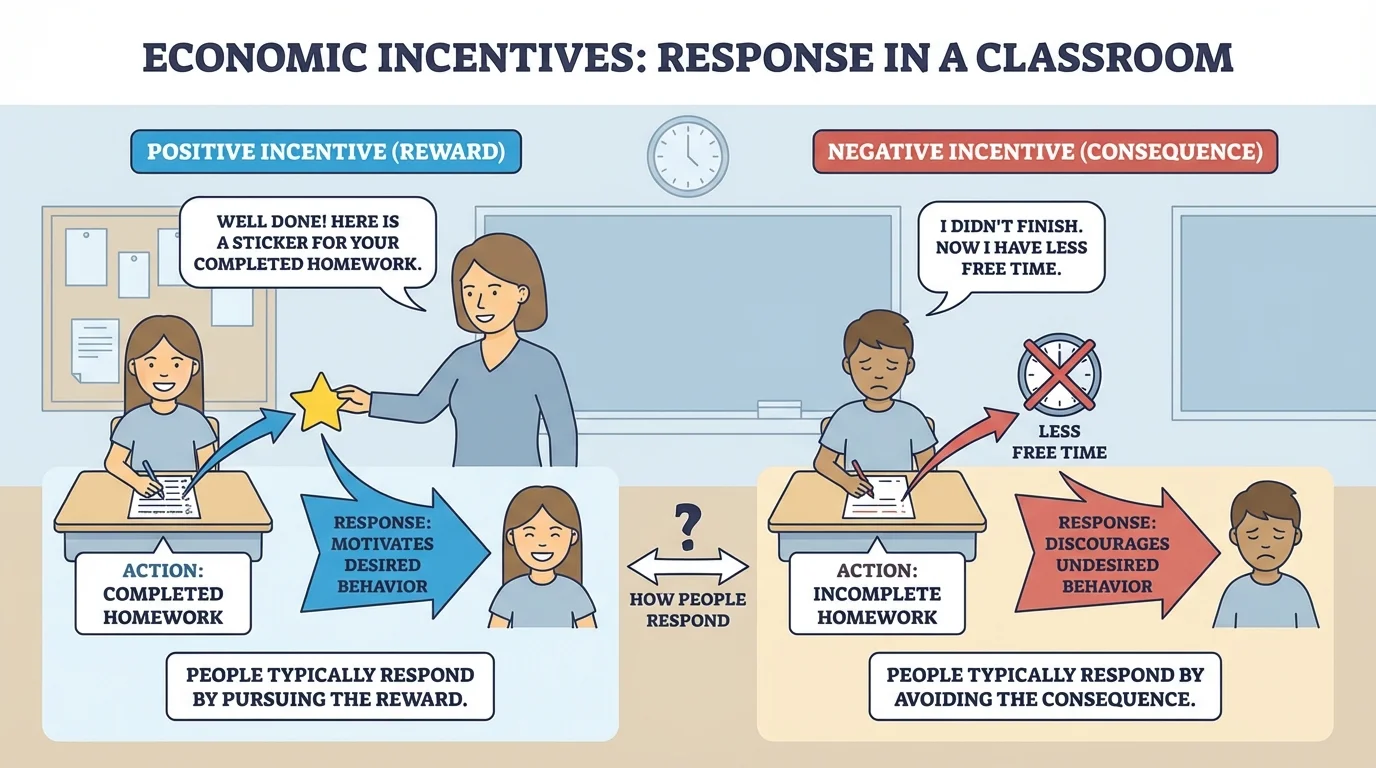
Here are some examples of positive incentives:
Notice what these examples have in common: there is something desirable at the end. That expected benefit can change behavior. If a store offers notebooks for less money during a back-to-school sale, more shoppers may decide to buy notebooks then. The lower price acts like a reward because it lets people keep more of their money.
Example: A positive incentive at home
A parent says, "If you finish cleaning your room before dinner, you may choose the family movie tonight."
Step 1: Identify the choice.
The child can clean the room now or wait until later.
Step 2: Identify the reward.
The reward is getting to choose the family movie.
Step 3: Predict the response.
The child is more likely to clean the room soon because the reward is appealing.
The movie choice is the positive incentive.
Positive incentives do not always have to be money or objects. Sometimes recognition matters too. A student may study hard because the teacher will display excellent work on a bulletin board. That reward is not cash, but it still encourages effort.
Later, when we compare different situations, [Figure 1] still helps us remember the main idea: when people see a benefit they want, they often move toward the action that gives that benefit.
[Figure 2] A negative incentive is something unpleasant that people want to avoid. A cost or penalty can push someone to make a different choice. People often respond to negative incentives by changing their behavior so they do not have to face the unwanted result.
Negative incentives can include fines, fees, losing privileges, extra work, or other costs. In economics, the word "negative" does not mean evil or bad in every way. It means the incentive works by adding a cost or creating something a person does not want.
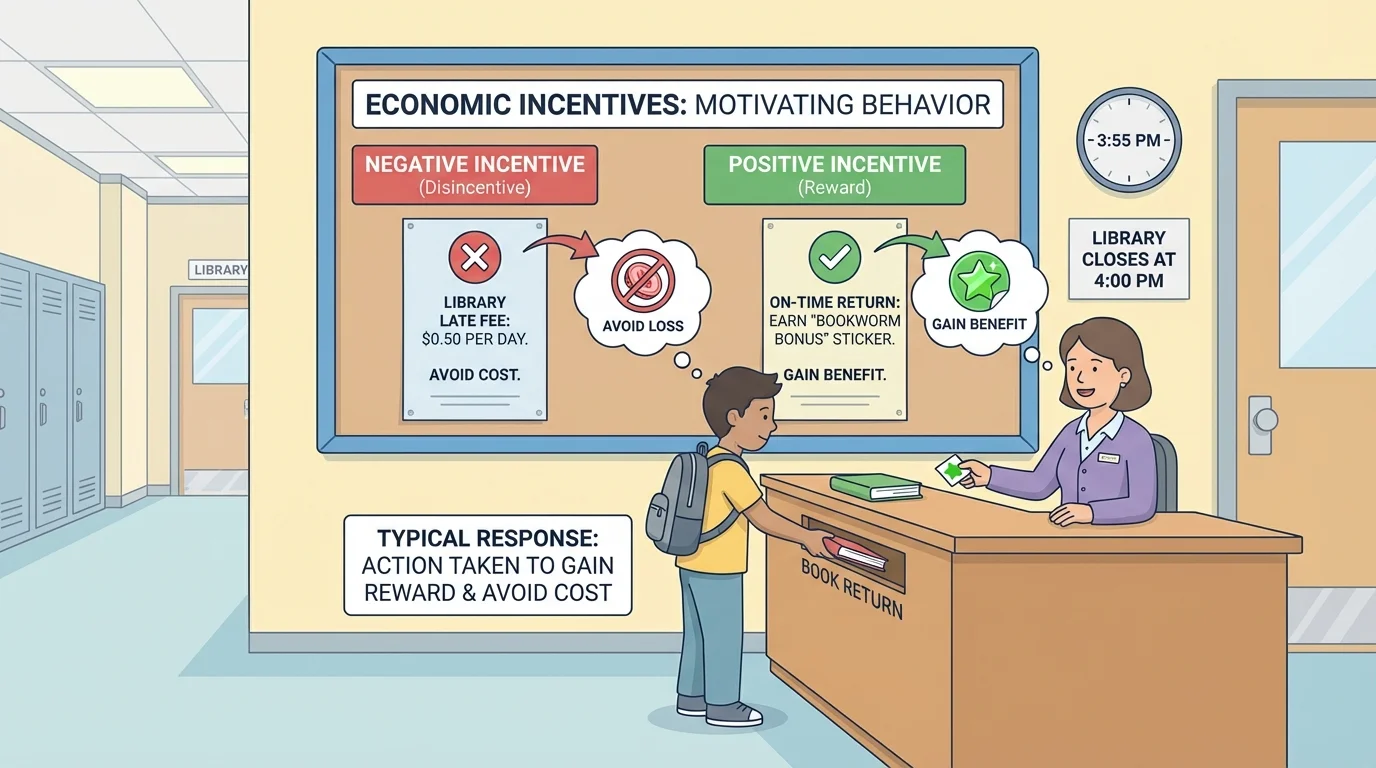
Here are some examples of negative incentives:
These examples show that people often try to avoid extra costs. If returning a book late means paying money, many people will try to return it on time. If leaving lights on causes a bigger bill, a family may be more careful to switch them off.
Negative incentive versus punishment
These ideas can overlap, but they are not exactly the same. A punishment is something done because a rule was broken. A negative incentive is the cost or unpleasant result that influences behavior. In economics, we focus on how that cost changes choices.
Negative incentives can sometimes work quickly because people usually do not want to lose money, time, or privileges. Still, a negative incentive does not guarantee the same response from everyone. Some people may ignore the cost if they think the benefit is worth it.
Think again about [Figure 2]. The student returns the book because avoiding the late fee matters. The fee does not force the action, but it strongly encourages timely behavior.
In general, people tend to move toward benefits and away from costs. That means they often respond to positive incentives by trying to gain a reward, and they often respond to negative incentives by trying to avoid a penalty or loss.
This idea is simple, but it is powerful. Stores use it when they offer sales. Schools use it when they offer rewards for attendance or assign consequences for missing work. Families use it when they create rules and rewards at home. Communities use it when they make laws with fines or offer programs with benefits.
Economists often explain behavior with a simple pattern: if the reward gets bigger, more people may want it; if the cost gets bigger, more people may try to avoid it. For example, if a store lowers the price of a toy from $12 to $8, some shoppers may decide to buy it because the savings are greater. If a fee rises from $1 to $5, more people may work harder to avoid paying it.
| Situation | Type of incentive | Likely response |
|---|---|---|
| Reading chart with a prize | Positive | Students may read more |
| Late fee for overdue books | Negative | People may return books sooner |
| Discount on winter coats | Positive | Shoppers may buy during the sale |
| Fine for littering | Negative | People may avoid littering |
Table 1. Examples of positive and negative incentives and how people often respond.
Even though people usually respond this way, choices are not exactly the same for every person. What matters to one person may not matter as much to another person. A reward must feel valuable, and a cost must feel important enough to influence behavior.
Incentives appear in many places every day, as [Figure 3] shows through examples from homes, stores, and communities. Once you learn to notice incentives, you can see them in shopping, school, work, and even environmental programs.
At a store, a positive incentive might be a sale or coupon. A sign that says "Buy one, get one free" encourages people to purchase more. A lower price can make something feel like a better deal. Businesses use these incentives because they want customers to choose their products.
At home, incentives can shape saving and spending. A child may save allowance money longer if a parent promises to match part of the savings. For example, if a child saves $4 and a parent adds $4, the child ends up with more than expected. That extra help is a positive incentive to save instead of spend right away.
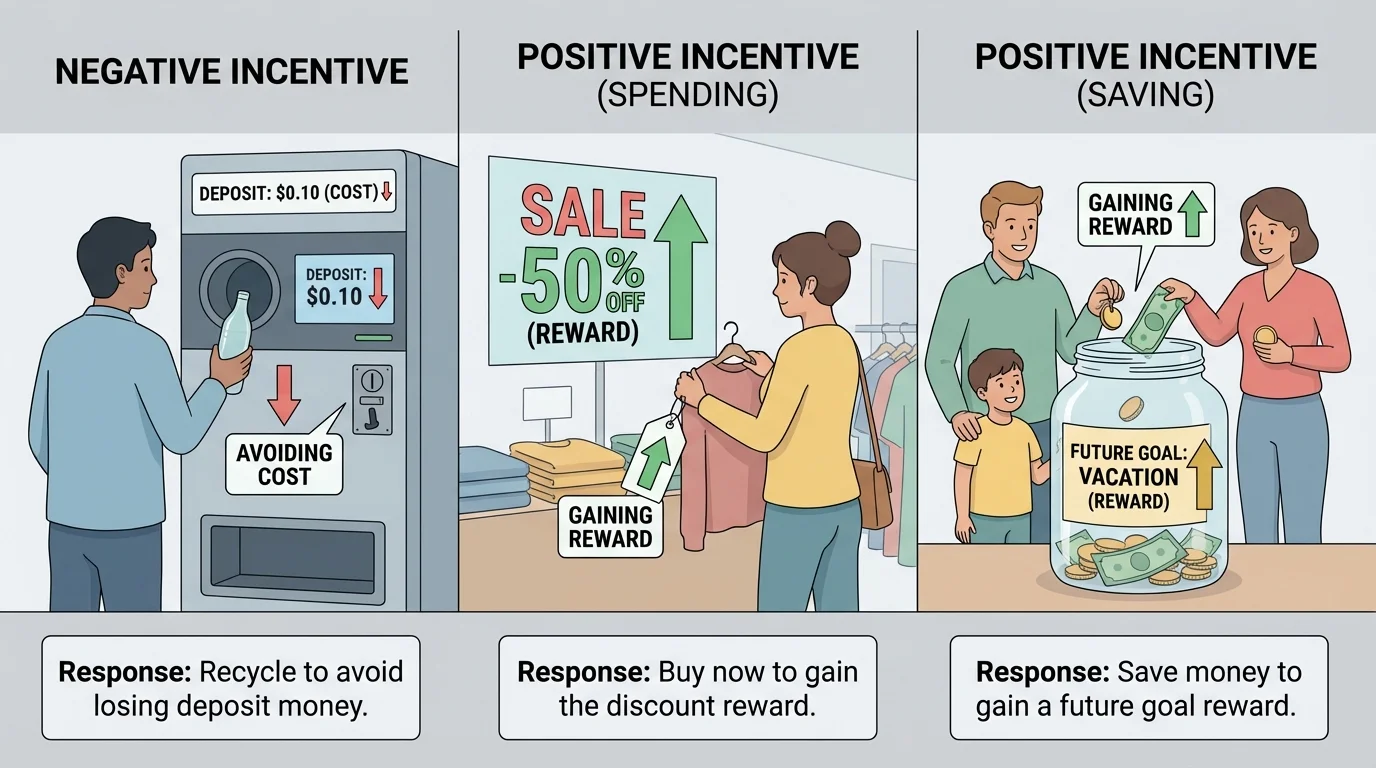
Communities also use incentives. Some places give money back for returning cans and bottles. That refund is a positive incentive that encourages recycling. Other places charge fines for polluting or littering. Those fines are negative incentives meant to discourage harmful actions.
Some recycling programs work because people respond to even small rewards. A small refund on each bottle may not seem like much, but when many bottles are returned, the incentive can change behavior in a big way.
Schools use incentives too. A class may earn extra recess for meeting a goal, which is a positive incentive. A missing assignment may lead to losing part of a privilege, which is a negative incentive. In both cases, the incentive is designed to influence choices.
When we look back at [Figure 3], we can compare settings easily: the sale sign encourages buying, the savings jar encourages waiting and planning, and the recycling refund encourages helping the environment.
Not all people respond in the same way to the same incentive. A coupon for dog food matters a lot to someone with a dog and not much to someone without one. A school reward that excites one student may not be as motivating to another student.
People differ in their needs, wants, goals, and budgets. A person with very little money may pay close attention to small price changes. Another person may care more about time than money. A child may be excited by a sticker, while an adult might be more interested in earning extra pay.
Sometimes incentives can even compete with each other. A student may want the reward for finishing homework, but also want to keep playing outside. The student must choose which incentive matters more at that moment. Economics is often about comparing choices and deciding which result matters most.
Example: The same incentive, different responses
A store offers a discount on soccer balls.
Step 1: Think about one shopper.
A family whose child needs a new soccer ball may buy one because the lower price is helpful.
Step 2: Think about another shopper.
A person who does not play soccer may ignore the sale completely.
Step 3: Compare the responses.
The incentive is the same, but the shoppers respond differently because their wants are different.
This is why incentives often influence behavior, but they do not control everyone in exactly the same way.
This idea is important because it helps us avoid oversimplifying human behavior. We can say people typically respond to incentives, but we should not say everyone always responds in one exact way.
Learning about incentives can help people make better choices. When you notice an incentive, you can stop and ask: "Why am I being encouraged to do this?" and "Is this choice really best for me?"
Sometimes a positive incentive is useful, such as saving money with a coupon on something you already need. But sometimes a reward may tempt people to buy things they do not need. A smart decision means thinking carefully, not just reacting quickly.
Negative incentives can also help people make better choices. Rules and fines can protect safety, property, and the environment. At the same time, people need to understand the reason behind the cost. If a community fines littering, the goal is not only to charge money. The goal is to encourage cleaner public spaces.
Economics also connects incentives to another idea called opportunity cost. Opportunity cost is what you give up when you choose one thing instead of another. If you spend your allowance on candy today, you may give up the chance to save for a book or game later. Incentives can affect which opportunity cost seems worth it.
Earlier economics ideas help here: people have needs and wants, resources are limited, and every choice means giving up another choice. Incentives help explain which choice people are more likely to make.
When you understand incentives, many actions around you start to make more sense. Why do people shop during sales? Why do families save for larger goals? Why do students work for rewards or avoid penalties? Why do communities offer refunds for recycling? In each case, incentives influence behavior.
So the big idea is clear: positive incentives usually encourage people by offering a reward, and negative incentives usually encourage people by adding a cost or unpleasant result. People often respond by trying to gain benefits and avoid losses, but their responses can differ depending on what matters most to them.
