Why do some students hurry to return library books on time, while others forget? Why does a clean-up contest make the playground sparkle faster than a regular reminder? The answer often has to do with incentives. People make choices every day, and those choices can change when there is a reward to earn or a consequence to avoid.
In economics, people are often said to respond to incentives. That means they pay attention to what they might gain and what they might lose. A student may choose to read more if there is a special bookmark for finishing a book. A team may work faster if everyone earns extra recess after finishing a job well. These are examples of incentives guiding behavior.
An incentive plan is not just about giving out prizes. It is about thinking carefully: What result do we want? What action will help us reach that result? What reward or consequence will encourage that action? Good plans connect the right incentive to the right behavior.
Incentive is something that encourages a person to act in a certain way.
Positive incentive is a reward or benefit that encourages a behavior, such as praise, a sticker, or extra playtime.
Negative incentive is something that encourages a behavior by making an unwanted outcome more likely, such as losing a privilege or receiving a warning.
Desired result is the goal you want to achieve, such as a cleaner playground or more homework turned in on time.
People do not all respond in exactly the same way. One student may work hard for a certificate, while another may care more about being team captain for a day. That is why planning matters. An incentive should match the people, the situation, and the goal.
Some incentives are easy to see. A prize for picking up the most trash on the playground is a positive incentive. So is earning points toward a class party for keeping desks organized. Other incentives are about avoiding something unpleasant. For example, students may walk quietly in the hallway to avoid losing free-choice time. That is a negative incentive.
Positive and negative incentives are both important. Positive incentives often feel cheerful and encouraging. Negative incentives can still be useful, but they should be fair, safe, and clearly explained. A consequence should never be mean or embarrassing. It should help students understand what behavior is expected.
People make choices because they cannot do everything at once. They must choose how to use time, effort, and resources. Incentives matter because they can make one choice seem better than another.
Economics is the study of how people make choices. A person often thinks about the benefit, or good result, and the cost, or what must be given up. If a reward feels worth the effort, the person is more likely to act.
Suppose a class wants the room to stay neat. The teacher could simply say, "Please clean up." Some students may help, but others may not. Now suppose the teacher adds an incentive: each table group that leaves the area neat for a week earns a homework pass coupon to use later. Suddenly, more students may pay attention because there is a reward connected to the behavior.
People usually ask themselves questions like these, even if they do not say them out loud: "Is this worth my effort?" "Can I really earn it?" "Is it fair?" "Do I care about the reward?" A good incentive plan answers those questions in a positive way.
There is also a difference between short-term and long-term behavior. A lollipop may encourage a small action once. For a habit such as reading each night, however, a stronger plan may be needed. Praise, progress charts, family support, and meaningful rewards often work better over time than tiny prizes used again and again.
How incentives guide choices
People compare choices. If one action brings a reward, saves time, avoids trouble, or helps them feel proud, they may choose that action more often. Incentives change behavior by making one choice more attractive or another choice less attractive.
Sometimes incentives shape group behavior too. If the whole class earns a reward when everyone brings back permission slips, students may remind one another. In that case, the incentive encourages teamwork, not just individual effort.
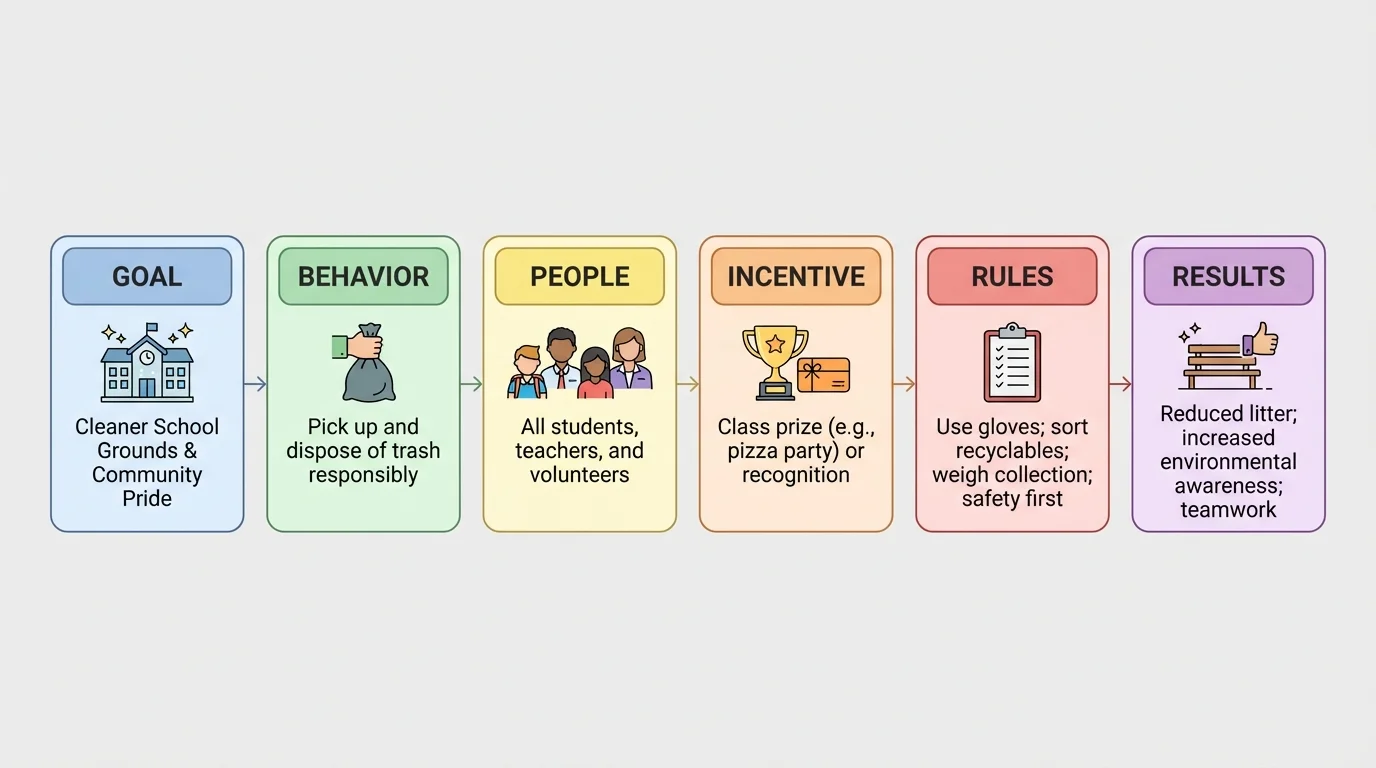
Creating a good plan works best when you follow a clear process, as [Figure 1] shows. Instead of picking a random reward, think step by step about the goal, the behavior that leads to it, and the kind of incentive that fits the situation.
Step 1: Name the goal. What desired result do you want? Maybe the goal is a cleaner playground, more completed homework, quieter group work, or better attendance.
Step 2: Identify the behavior. What action will help reach the goal? If the goal is a cleaner playground, the behavior might be picking up litter and putting it in bins.
Step 3: Think about the people involved. What matters to them? Younger children may love stickers. Older students may prefer extra game time, special jobs, or public recognition.
Step 4: Choose the incentive. Decide whether a positive incentive, a negative incentive, or a combination works best.
Step 5: Make clear rules. People should know exactly what to do, how the incentive is earned, and when it will be given.
Step 6: Check the results. Did behavior improve? If not, the plan may need to change.
If a plan is confusing, it will not work well. For example, if a teacher says, "There will be some kind of reward for good behavior sometime," students do not know what behavior counts or when the reward comes. Clear plans help people trust the system.
Case study: Playground cleanup contest
A school wants less trash on the playground after lunch.
Step 1: Set the goal
The desired result is a cleaner playground with less litter.
Step 2: Name the behavior
Students should pick up trash and put it in the correct bins.
Step 3: Pick an incentive
The student who picks up the most trash safely earns a small prize, and the class with the cleanest lunch area earns extra recess.
Step 4: Set fair rules
Students must wear gloves if needed, count only trash from the ground, and avoid unsafe items.
Step 5: Check results
After one week, the school compares how much cleaner the playground looks.
This plan uses both an individual reward and a group reward, which can motivate more students.
Later, when you look back at the planning process in [Figure 1], notice that each step helps prevent problems. A plan is stronger when the reward, the rules, and the goal all match.
Positive incentives are often the easiest to use in schools because they focus on what people can earn. Rewards can be objects, but they do not have to be. Many strong incentives cost little or nothing.
Examples of positive incentives include praise, certificates, points, extra recess, choosing a class game, sitting in a special seat, being line leader, or earning time for a favorite activity. Some students are motivated by public recognition. Others prefer a private reward. That is why it helps to know your audience.
A positive incentive should feel connected to the effort. If students spend a week improving hallway behavior, a reward like extra class choice time may feel fair. But if they work very hard and the reward is tiny or boring, they may stop trying. The reward does not need to be expensive; it just needs to matter to the people earning it.
Small rewards can be powerful when they are immediate and meaningful. A simple note saying "Great teamwork" can motivate people because being noticed feels important.
Praise works best when it is specific. Saying "Good job" is nice, but saying "You returned every book on time this month, and that helped our class" tells exactly what behavior mattered.
Negative incentives encourage behavior by making an unwanted outcome more likely if the behavior does not occur. For example, students may bring materials to class so they do not lose participation points. A team may clean up properly so they do not miss part of a game.
Negative incentives should be used carefully. If consequences are too harsh, students may feel angry or embarrassed instead of motivated. If rules are unclear, students may think the system is unfair. Fair consequences are calm, reasonable, and linked to the behavior.
For example, if library books are returned late, a student might lose borrowing privileges until the book is returned. That consequence connects directly to the problem. But making the student miss lunch for a late book would not fit as well. Good consequences make sense.
Many successful plans use mostly positive incentives with a few fair consequences. This balance encourages good behavior while still keeping clear limits.
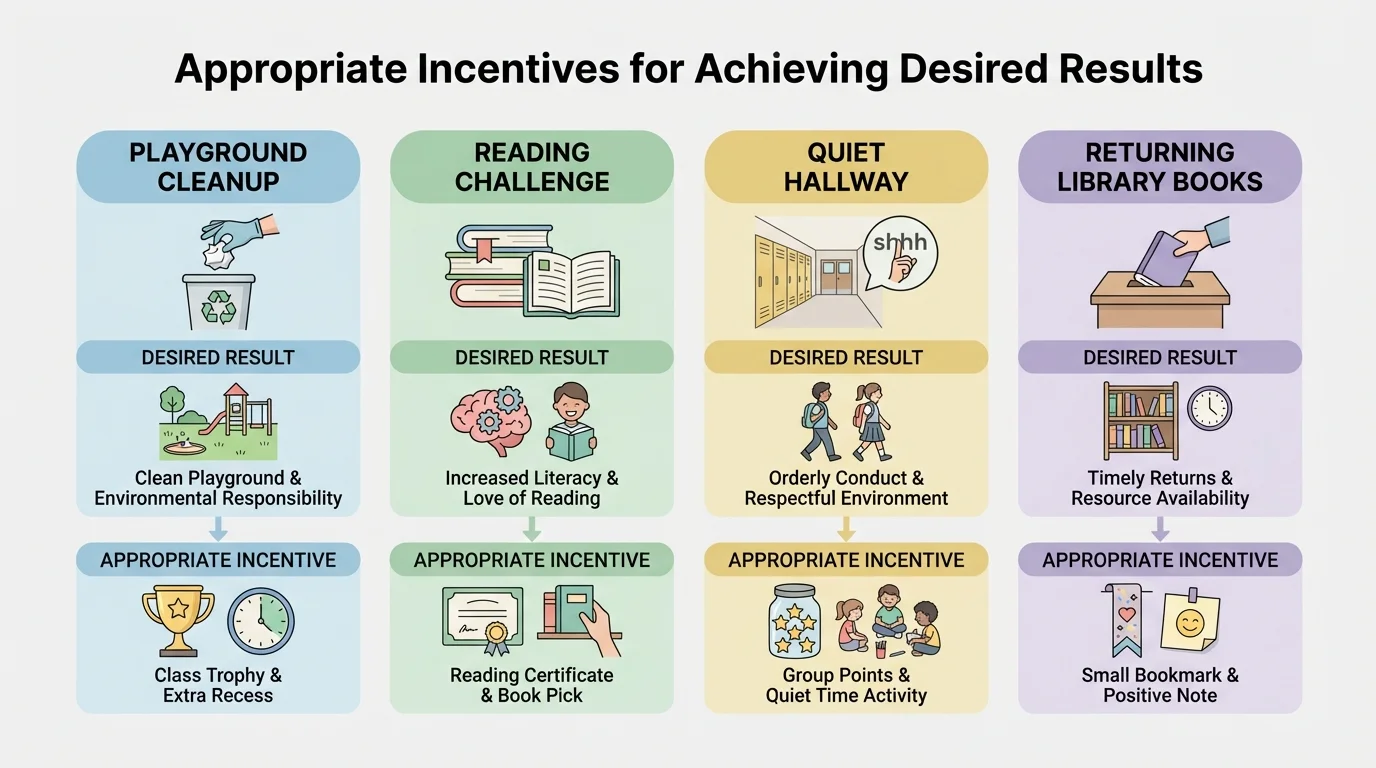
One reward does not fit every goal, as [Figure 2] illustrates. A plan that works for a reading challenge may not work for playground cleanup, because the behavior, time needed, and student interests are different.
Think about four questions: What is the goal? What behavior leads to it? How often does the behavior happen? What reward or consequence matches it? A one-time task may need a one-time prize. A daily habit may need a point system or weekly recognition.
| Situation | Desired result | Helpful behavior | Possible incentive |
|---|---|---|---|
| Playground cleanup | Less litter | Picking up trash safely | Prize for top helper; extra recess for cleanest class area |
| Reading challenge | More reading | Reading each night | Bookmarks, reading chart, class book celebration |
| Quiet hallway | Safer, calmer halls | Walking quietly in line | Points toward a class privilege |
| Library returns | Books returned on time | Returning books by due date | Certificate for on-time returns; temporary borrowing limit for late books |
Table 1. Examples of different situations, goals, behaviors, and matching incentives.
This comparison helps show that the same thinking process can be used in many places. The chart in [Figure 2] also makes it easier to see how each situation calls for a different match between goal and incentive.
If the goal involves teamwork, then a group incentive may work best. If the goal depends on personal effort, then an individual incentive may be fairer. For example, reading at home is often individual, while cleaning a shared classroom may be a group effort.
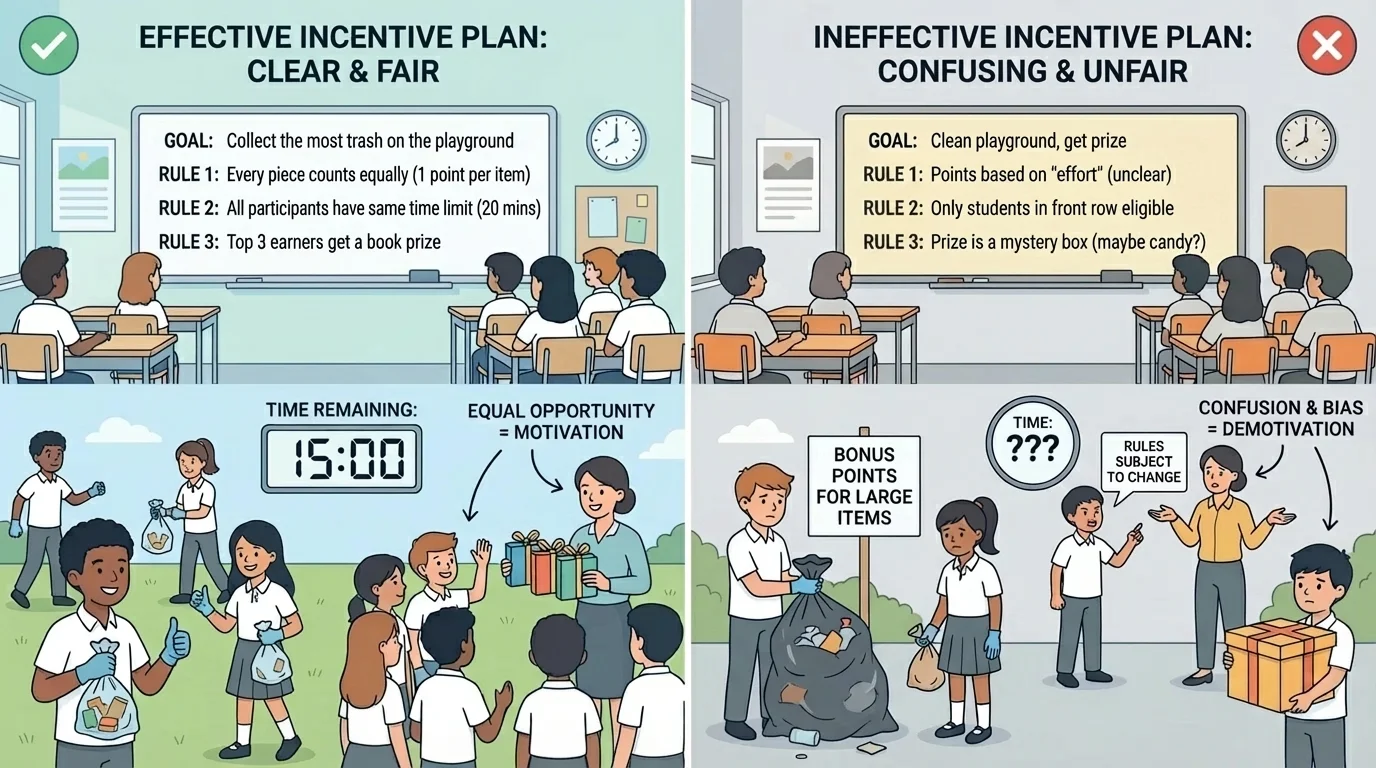
Fairness strongly affects how people respond, as [Figure 3] illustrates. If students believe a plan is unfair, they may stop trying, even if the reward is exciting. Fair plans give everyone a clear chance to succeed.
Rules should be simple and easy to understand. If one student gets extra points for a behavior that another student did not know about, the class may feel frustrated. Fairness means the rules are shared ahead of time and followed the same way for everyone.
Goals should also be realistic. Suppose a teacher says only the student who reads the most minutes in the whole grade will get a reward. Many students may give up because the target feels too hard. A better plan might let each student earn a reward after reaching a personal goal, such as reading for a set number of minutes each week.
Another fairness question is whether to reward speed, improvement, effort, or final results. Sometimes rewarding only the highest score leaves out students who are working hard and making progress. In many situations, improvement-based incentives are more encouraging.
Fair vs. unfair plan
A class wants students to bring homework on time.
Unfair version: Only one student each month wins a reward, but students do not know how the winner is chosen.
Fair version: Every student who turns in homework on time for one full week earns a homework star, and five stars can be traded for a class privilege.
The fair version works better because the rules are clear and many students can succeed.
When students talk about fairness later, they can think back to that contrast. A clear system builds trust, and trust makes incentives more powerful.
In homes, families may use incentives for chores, bedtime routines, or saving money. A child might earn screen time by finishing responsibilities first. In schools, teachers may use incentives for attendance, reading, kindness, or organization.
Communities use incentives too. Some neighborhoods hold recycling contests. Some cities give rewards for saving electricity or using less water. Stores offer coupons to encourage shoppers to come back. Sports teams use incentives such as extra playing time for good attendance at practice. These are all examples of people changing behavior because of expected rewards or consequences.
Economists study these choices because incentives help explain why people act the way they do. If a reward lowers the "cost" of effort or increases the "benefit" of a choice, people may respond strongly. Even without numbers, this idea is important: when choices change, behavior often changes too.
"People respond to incentives."
— A basic idea in economics
This short idea is powerful. It does not mean every person reacts the same way. It means incentives are one important reason behavior changes.
Some plans fail because the reward is too small, the rules are confusing, or the wrong behavior is rewarded. For example, if a cleanup contest rewards only the student who collects the most trash, a few students may rush while others do nothing. Adding a class reward for overall cleanliness may help more students participate.
Another problem happens when people focus only on the reward and not on the reason behind the task. If students clean the playground only for candy, they may stop caring about keeping the school clean when the candy disappears. That is why good plans often include both incentives and reminders about responsibility, safety, and community pride.
Plans should also avoid encouraging unsafe behavior. In a race to collect trash, students should not grab broken glass or run into dangerous areas. The rules must protect people first.
Why some incentive plans fail
An incentive plan is weak when it is unfair, unsafe, confusing, or aimed at the wrong behavior. Strong plans match the goal, reward the right action, and make success possible for the people involved.
Sometimes the best answer is to adjust the plan. You might change the reward, shorten the time, make the goal clearer, or switch from an individual competition to a team challenge.
When you create an incentive plan, you are thinking like an economist. You are asking how people make choices and what might change those choices. You are looking at behavior, rewards, consequences, and results.
An economist might say that people respond when the expected benefit is greater than the expected cost. For a fourth-grade student, this can be said simply: if a reward or avoided consequence feels important enough, a person is more likely to choose that action.
Suppose a class has two choices after lunch: spend three minutes cleaning the floor or lose five minutes of a favorite activity later. Many students may decide that cleaning now is the better choice. The negative incentive changes behavior. If the class can also earn extra game time for a week of neat cleanup, then both positive and negative incentives support the goal.
Learning to plan incentives is useful far beyond school. It helps you understand why people save, spend, recycle, study, arrive on time, and follow rules. A smart incentive plan does not try to force people. It gives them a reason to choose the behavior that leads to a better result.
