One school rule can make many people feel very different things. A student may think a rule is unfair, a teacher may think it helps learning, and a parent may worry about safety. In civics, learning about government and community decisions, it is important to understand why people disagree. Good citizens do not only say what they believe. They also learn how to explain the other side fairly.
A public policy is a rule, plan, or decision made by leaders to solve a problem in a school, city, state, or country. Some policies are made by school boards. Others are made by city councils, governors, or lawmakers. When people disagree about what the policy should be, they are part of a public policy debate.
In a debate, there can be more than one reasonable view. This does not mean every idea is equally strong, but it does mean people often have real reasons for their opinions. To investigate multiple perspectives, we ask questions such as: Who is affected? What problem is the policy trying to solve? What might improve if the policy changes? What problems might the change create?
Public policy is a rule or decision made by leaders to help a community. Perspective is the way a person sees an issue based on experiences, needs, and beliefs. Stakeholders are the people or groups affected by a decision.
One current public policy debate that many students understand is whether schools should place strong limits on student cell phone use during the school day. Some schools require phones to stay in backpacks or locked pouches. Other schools allow phones during lunch, passing time, or even class activities. This issue matters because phones can help, distract, protect, connect, and interrupt all at once.
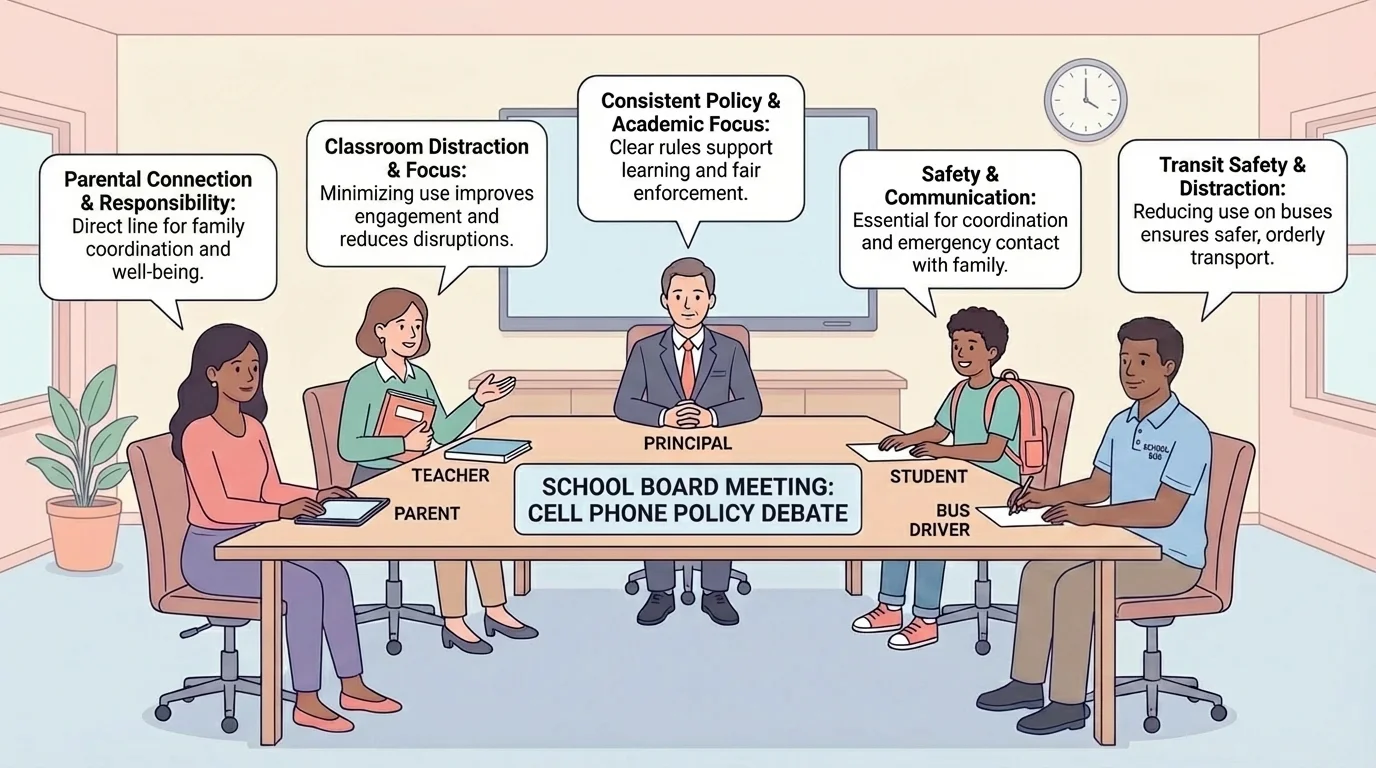
People can care about the same issue for different reasons, as [Figure 1] shows with several school community members discussing one rule. A teacher may focus on attention in class. A parent may focus on being able to reach a child quickly. A student may focus on freedom and responsibility. A principal may focus on keeping the school safe and organized.
These different views come from different jobs, experiences, and worries. A person who has seen cyberbullying may want tighter rules. A person whose family needs quick communication after school may want more phone access. In civics, we try to understand these reasons before judging them.
Sometimes people use different values when they think about policy. One person may care most about safety. Another may care most about fairness. Another may care most about learning time or privacy. Values are ideas about what matters most. They help explain why honest people can disagree.
That is why a strong civic thinker does two things at once: speak clearly and listen carefully. It is possible to support one side while still giving a fair explanation of the other side.
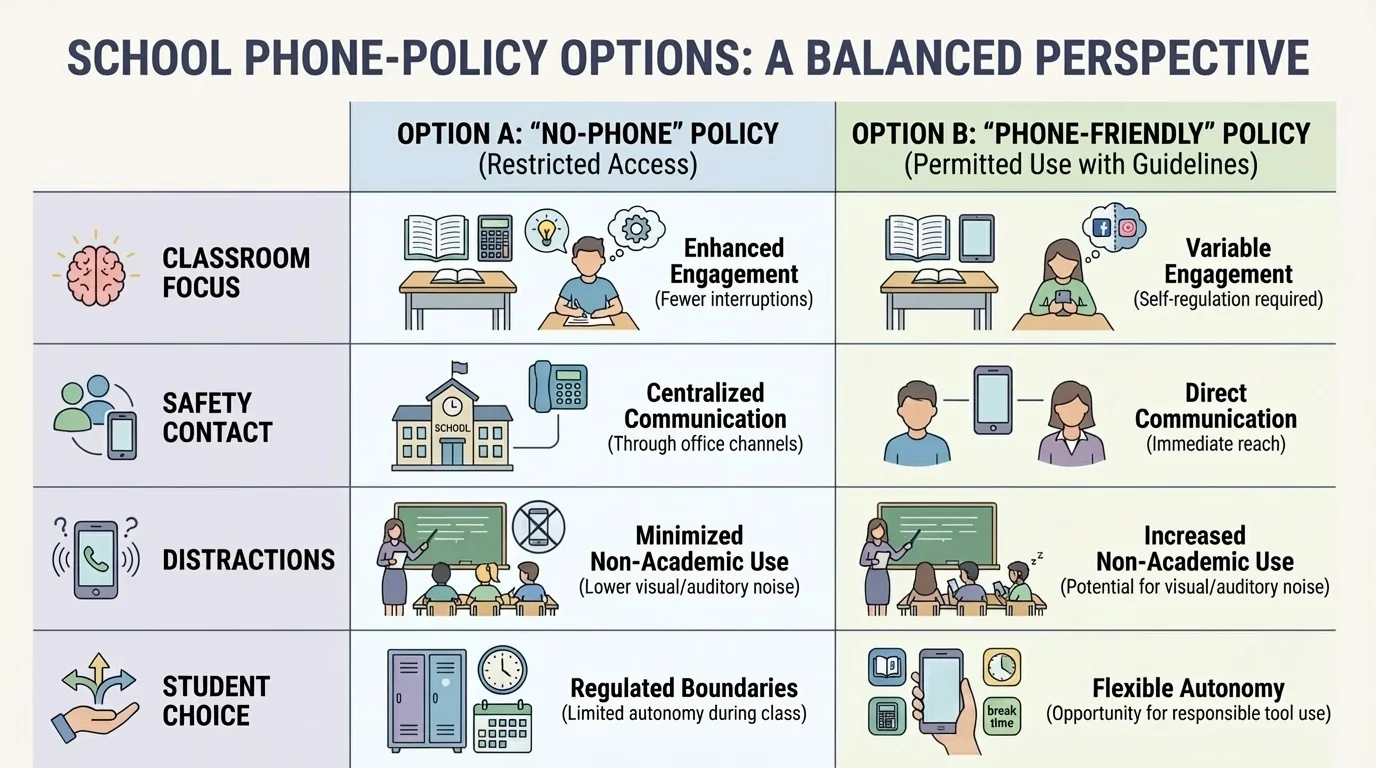
Many schools are asking a big question: should students be allowed to use phones freely during the school day, or should schools create strong limits? The two main policy choices, introduced in [Figure 2], are not exactly the same in every school, but they often look like this: one side supports strict limits, and the other side supports more student access and choice.
A policy about phones may say that phones must stay off during class. Another policy may say phones must be locked away from the first bell to the last bell. A different policy may allow phones at lunch or for learning activities. Even small rule changes can affect many people.
This debate is current because schools across the country are still deciding what works best. News stories, school board meetings, and family conversations often include this topic. It is a real civic issue with real stakeholders.
To understand the debate well, we need to build supportive arguments for both sides. A supportive argument is not just a complaint. It gives a clear reason, explains why that reason matters, and connects it to people affected by the policy.
What makes an argument supportive? A supportive argument uses a reason that fits the issue, connects to evidence or examples, and considers the needs of real people. For example, saying "phones are bad" is weak. Saying "phones can interrupt lessons because messages and games pull attention away from teaching" is much stronger because it explains the problem.
When students learn to make supportive arguments for both sides, they become better listeners, better writers, and better citizens. They learn that understanding is not the same as agreeing. It means being fair.
One strong argument for limiting phones is that phones can distract students during learning. Notifications, games, videos, and messages can pull attention away from reading, math, science, and discussion. Teachers may need to stop lessons to ask students to put phones away. This can take time from everyone in the room.
Another supportive argument is that strong limits may reduce cheating. If students can quickly search answers, send messages, or take pictures of tests, it can be harder to make sure schoolwork is honest. Schools want grades to show what students truly know.
Supporters of strict rules also say phones can increase bullying or hurt feelings during the school day. Mean messages, secret photos, and online arguments can spread quickly. If phones are put away, there may be fewer chances for this behavior during class time.
Some adults argue that strong limits help students build better face-to-face friendships. At lunch or recess, students may talk more, play more, and pay more attention to one another when they are not staring at screens. Schools are not only for academic learning. They are also places to practice community skills.
Another reason is fairness. If one student uses a phone for fun while another follows the rules, the classroom may feel unfair. A clear rule can be easier to understand and enforce. It may help everyone know what is expected.
Case study: A teacher supporting strong limits
Ms. Lopez teaches fourth grade and supports a strict phone policy.
Step 1: She identifies the problem.
Students sometimes look at phones during lessons, which breaks attention.
Step 2: She explains why it matters.
When attention breaks, students miss directions and need extra help later.
Step 3: She connects it to the whole class.
If the class stops many times, everyone loses learning time.
Her supportive argument is that stricter phone limits help students focus and protect class time.
Supporters may also say that schools already provide ways to contact families through the office if there is an emergency. From this view, students do not need constant phone access during every part of the day.
People on the other side also have real reasons. One supportive argument against strict limits is family communication. Some students need to message family members about rides, after-school plans, health needs, or changes in schedule. Parents may feel calmer if their child can reach them.
Another argument is that phones can be useful learning tools when used correctly. Students can take photos of assignments, use educational apps, record reminders, or look up information for research. Some classes use technology in creative ways, and a total ban may remove a helpful tool.
Supporters of more choice may also argue that students should practice responsibility. If children never get a chance to manage technology wisely, they may not learn how to make good decisions. This view says schools should teach proper use, not only forbid use.
Some families worry most about emergencies. They may believe that in a serious situation, direct contact matters. Even if schools have office phones, parents may still want immediate communication with their children.
Another supportive argument is that one strict rule may not fit every student. Some students use phones because of medical needs, translation needs, or family situations. A policy with flexibility may better serve students with different circumstances.
Case study: A parent supporting more access
Mr. Green does not want a full-day phone ban.
Step 1: He identifies the need.
His child's after-school pickup plan sometimes changes.
Step 2: He explains why it matters.
Quick messages help the family avoid confusion and make sure the child gets home safely.
Step 3: He connects the need to policy.
He supports rules during class but wants access at certain times, such as after school or lunch.
His supportive argument is that a flexible phone policy protects communication without allowing constant distraction.
Some students add that respectful use should matter. They may say a student who follows directions should not lose phone access because of other students' poor choices. This argument focuses on trust and individual responsibility.
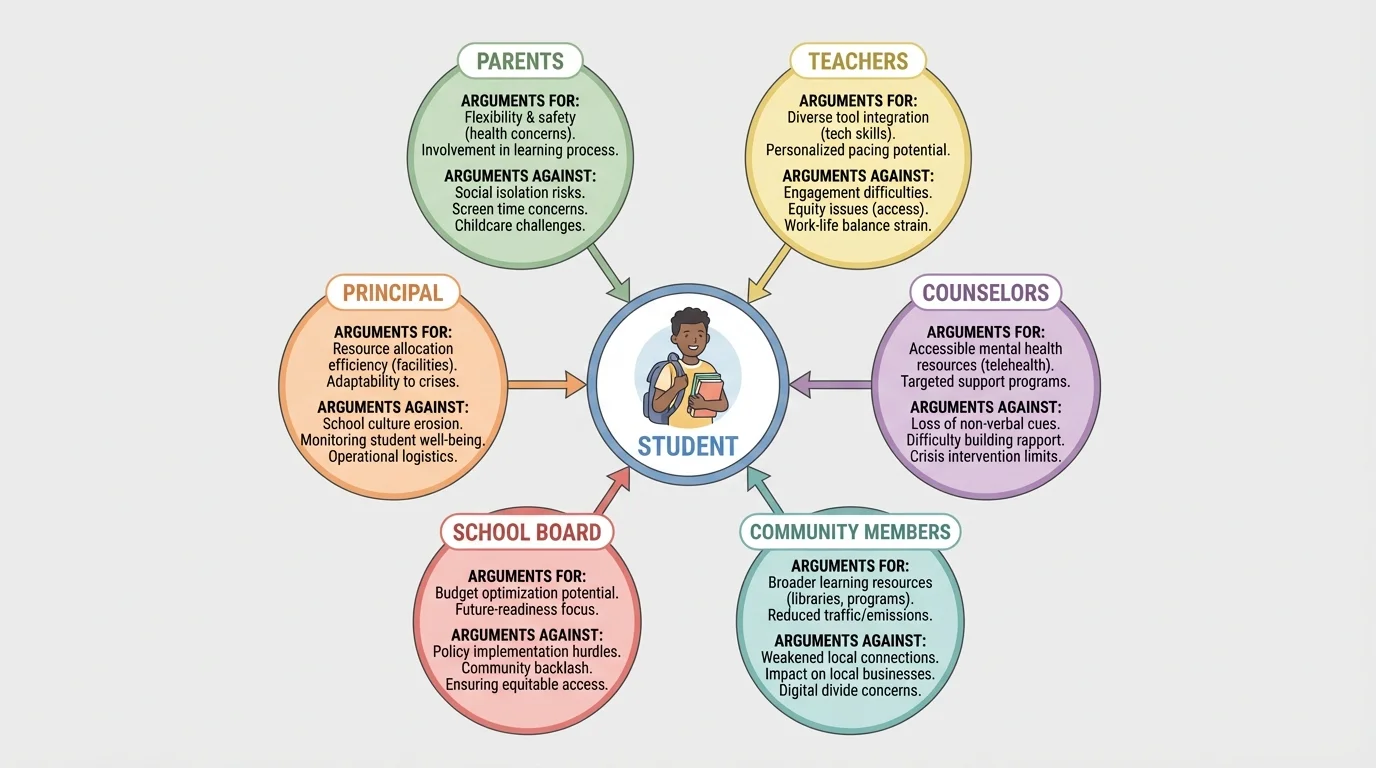
A stakeholder is any person or group affected by a policy, and [Figure 3] helps show how many groups connect to one school rule. In this debate, students are stakeholders because the rule affects their daily lives. Teachers are stakeholders because phones can affect teaching. Parents and caregivers are stakeholders because they care about communication and safety.
Principals and school board members are stakeholders too. They must think about school order, fairness, and what is best for the whole community. Counselors may think about mental health, friendship, and online conflict. Community members may think about how schools prepare children to use technology wisely.
One important civic skill is noticing that stakeholders may want some of the same things even when they disagree. For example, both sides may want students to be safe, learn well, and feel respected. The disagreement is often about how to reach those goals.
As we saw earlier in [Figure 1], different people bring different responsibilities to the same issue. A teacher is responsible for instruction. A parent is responsible for family care. A principal is responsible for the whole school. These roles shape their opinions.
| Stakeholder | What this group may care about most | Possible position |
|---|---|---|
| Students | Choice, communication, fairness | May want some access |
| Teachers | Focus, honest work, class management | May want stronger limits |
| Parents/Caregivers | Safety, communication, convenience | May differ based on family needs |
| Principals | Order, safety, clear rules | May want rules that are easy to enforce |
| School Board | Community concerns, fairness, policy success | May seek a balanced plan |
Table 1. Different stakeholders in a school phone debate and the concerns they may bring.
Supportive arguments become stronger when they use evidence. Evidence can include examples from school life, information from teachers or families, school survey results, or rules that have worked in other schools. Evidence helps move a debate from "I just feel this way" to "Here is why this might work."
Fair thinking also means avoiding tricks. We should not make the other side sound silly. We should not pretend there are only two extreme choices if there might be a middle option. For example, a school does not have to choose only "phones everywhere" or "phones never." It might allow phones at certain times and not others.
Many real public policy debates end with a compromise. A compromise is a solution in which each side gives up something to reach a plan that more people can accept.
A balanced thinker can say, "I support stronger limits because they help focus, but I understand that families may need communication." That kind of sentence shows respect for multiple perspectives. It does not hide disagreement. It explains it clearly and fairly.
The comparison in [Figure 2] reminds us that each policy choice has benefits and trade-offs. A trade-off means gaining one benefit while giving up something else. More phone freedom may increase communication, but it may also increase distraction. Stronger limits may improve focus, but they may reduce quick family contact.
Being good at civics does not mean choosing a side as fast as possible. It means understanding the issue carefully, naming the stakeholders, and giving supportive arguments for both sides. This helps students prepare for larger civic issues they will see as they grow older.
For the school phone debate, a balanced view might sound like this: strict limits can protect learning time, reduce distractions, and make rules clearer. At the same time, some students and families need communication, and phones can sometimes support learning or safety. Because both sides have real concerns, leaders must think carefully before choosing a rule.
Sometimes the best policy is not fully on one side. A school might ban phones during instruction but allow them before and after school. It might allow teacher-approved use for learning. It might make exceptions for health or family needs. These choices show how policy can try to respond to different stakeholders.
The stakeholder map in [Figure 3] stays useful here because it reminds us that one rule reaches many people at once. Good public policy tries to solve a problem while causing as little harm as possible.
"A strong citizen listens for understanding, not just for a turn to speak."
When you hear a civic debate, ask yourself: What is the problem? Who is affected? What are the strongest reasons on each side? What evidence supports those reasons? These questions help you think clearly and respectfully.
Understanding both sides does not weaken your opinion. It strengthens it. When you can explain your own side and the other side fairly, you are practicing one of the most important habits of citizenship.
