Two students can stand on the same playground and notice completely different problems. One might say, "We need more swings." Another might say, "The ground is too muddy when it rains." Both are looking at the same place, but each sees something important. That is how civic issues work too. A civic issue is a problem or question that affects a community, such as traffic near a school, keeping a park clean, or deciding where to build something new. To understand these issues well, we need good sources and we need to listen to more than one point of view.
When people investigate a community issue, they should not depend on just one voice. A principal, a student, a bus driver, a neighbor, and a mayor may all think differently about the same problem. Their ideas matter because civic decisions affect many people. Good citizens learn how to gather information carefully, check whether it is reliable, and think about different perspectives before making a choice.
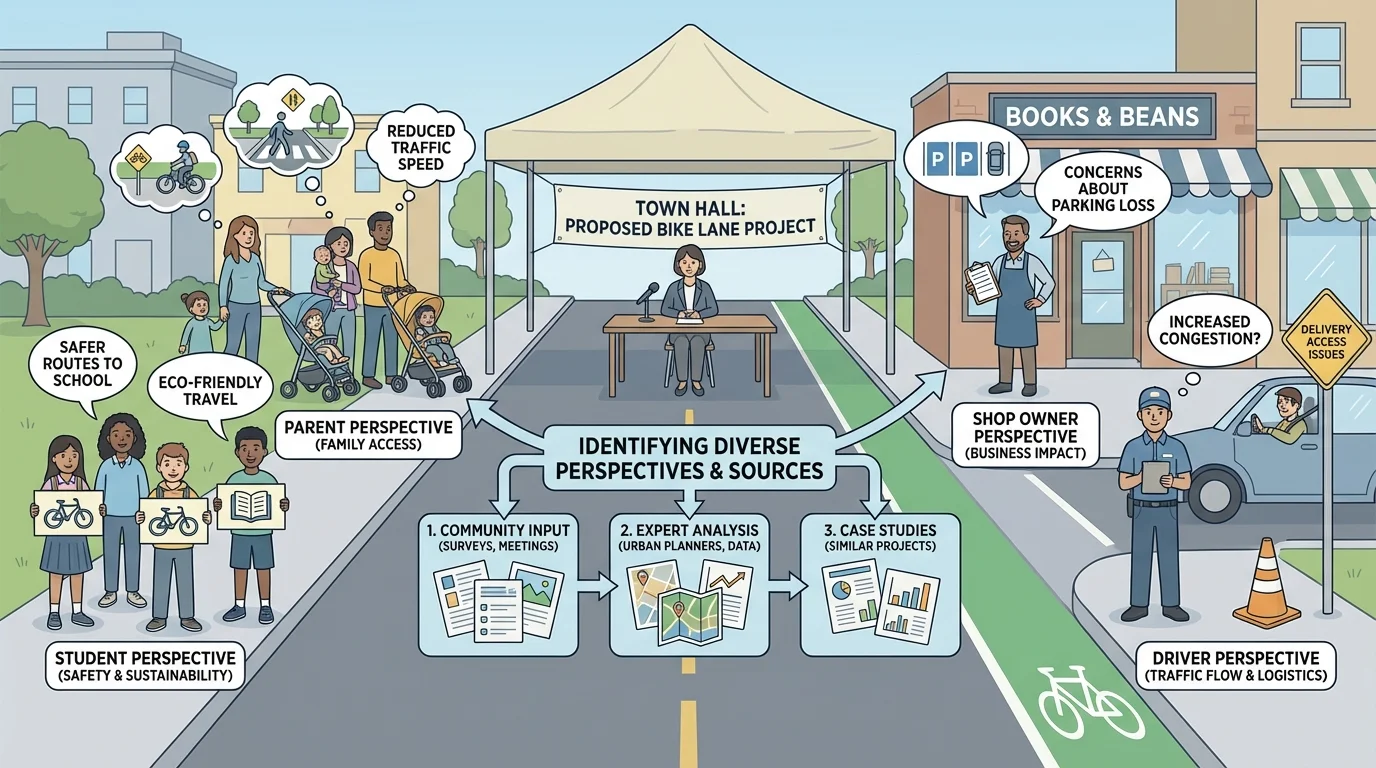
A perspective is the way a person sees and thinks about something. Perspectives can be shaped by age, job, needs, experiences, and responsibilities. For example, if a city is deciding whether to add a bike lane, a student who rides a bike may think it makes travel safer. A shop owner may wonder whether parking spaces will be lost. A parent may care most about children crossing streets safely. These are different perspectives on the same issue.
Civic issue means a problem, question, or decision that affects people in a community.
Perspective means the way someone views an issue based on their experiences, needs, and ideas.
Source means the place where information comes from.
Having different perspectives does not always mean someone is wrong. Sometimes people are focused on different parts of the problem. If we only listen to one group, we may miss important facts. Looking at multiple perspectives helps us be fair, thoughtful, and better prepared to solve problems that affect everyone.
In civics, fairness matters. If a town wants to change a park, it should think about children who play there, adults who use walking paths, neighbors who live nearby, and workers who care for the space. The more complete the picture, the smarter the decision can be.
Information can come from many places, and some kinds of sources help us in different ways. Sources can be sorted into types, as [Figure 1] shows, so that we know where the information started and how it reached us. A source might be a newspaper article, a photograph, an interview, a speech, a survey, a map, a government report, a video, or notes from a meeting.
One important kind of source is a primary source. A primary source gives information from a person or object that was directly involved. Examples include an interview with a crossing guard, a photograph of traffic outside school, meeting notes from the school board, or survey results collected from families. These sources can give direct evidence.
Another kind is a secondary source. A secondary source explains, retells, or summarizes information from other sources. Examples include a news article about the traffic problem, a textbook passage about local government, or a report written after someone studied survey results. Secondary sources can be useful because they organize information, but they are one step away from the original event or data.
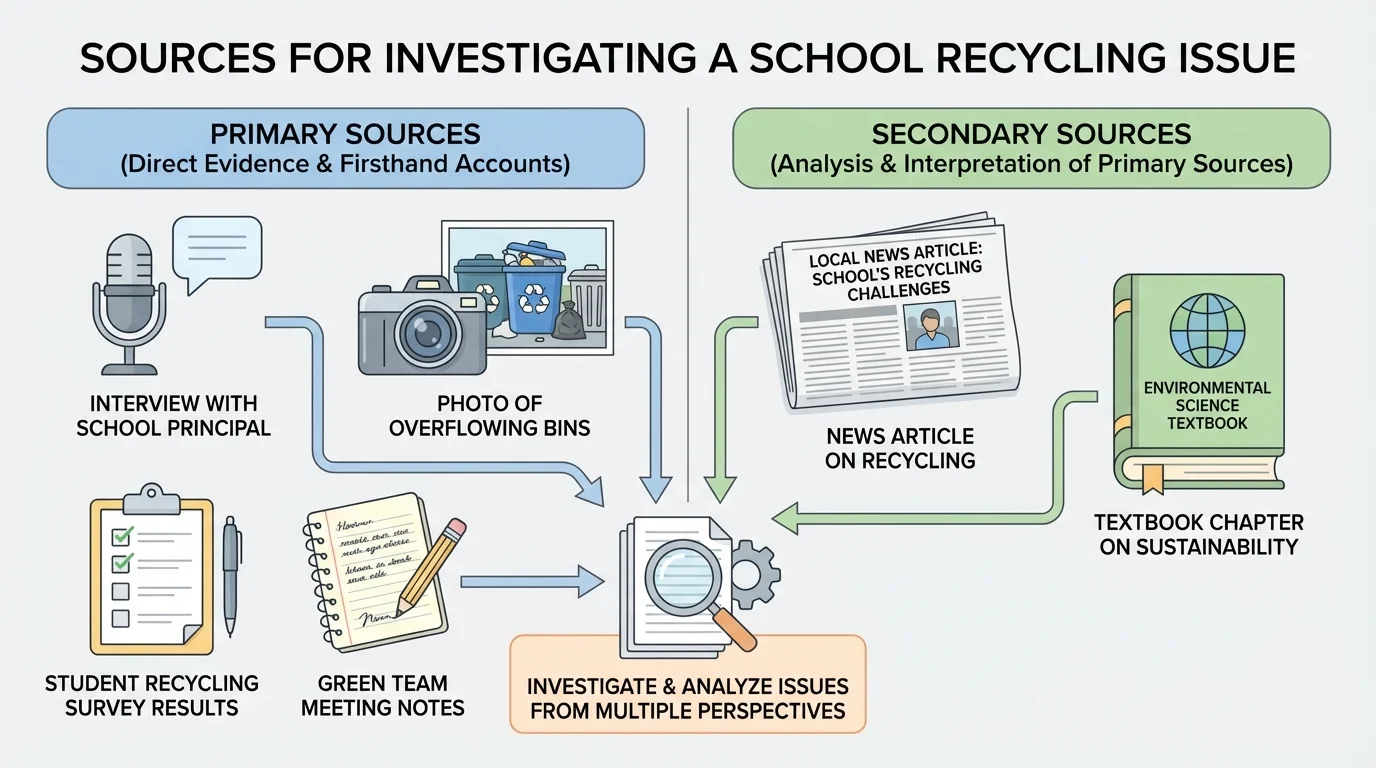
Suppose students want to know whether their school should start a recycling program. A photo of overflowing trash cans is a primary source. An interview with the custodian is a primary source. A newspaper story describing how another school improved recycling is a secondary source. A website article about recycling in general is also a secondary source. Using both kinds helps students learn more.
Not every source is written. People often think only books or articles count, but spoken interviews, audio recordings, charts, and even physical objects can also be sources. If students are studying whether a playground is safe, they might use inspection reports, student interviews, and photographs of broken equipment.
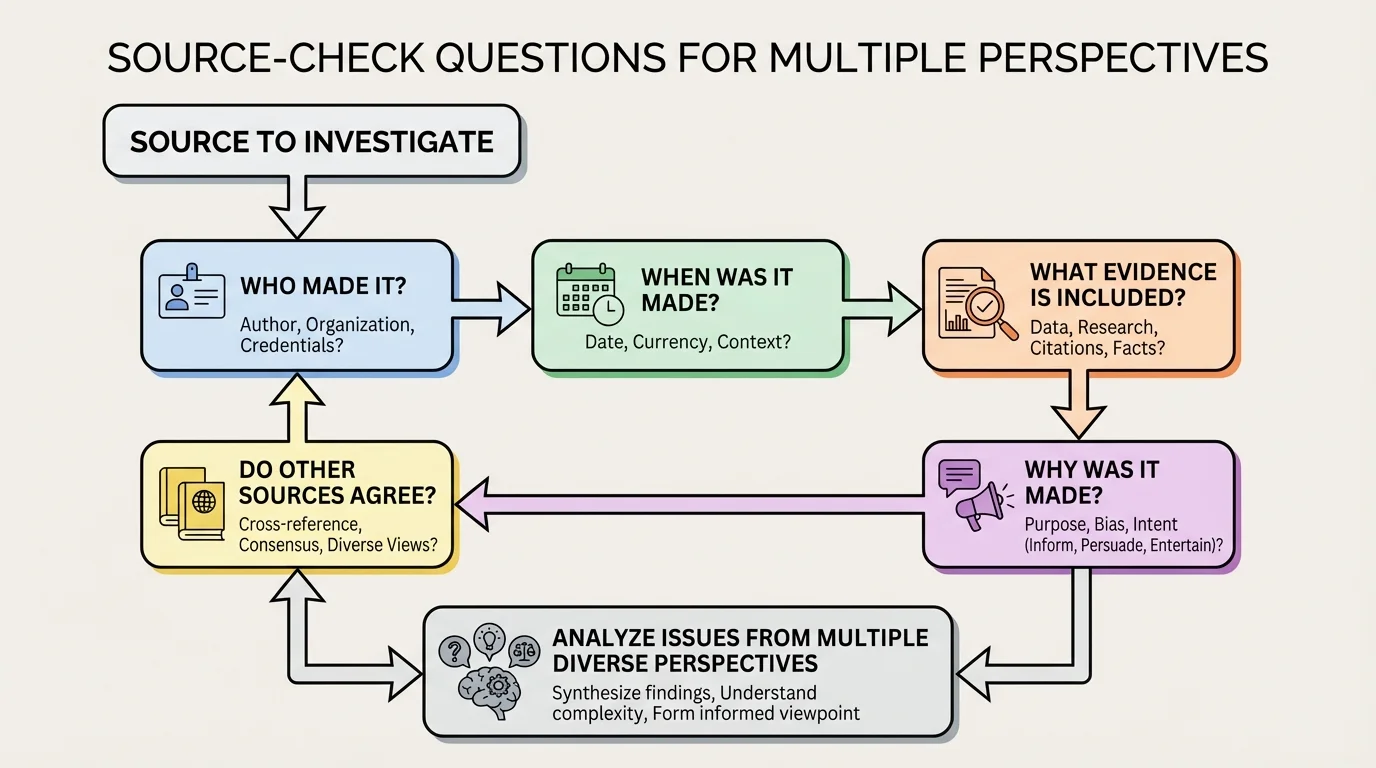
Some sources are much stronger than others. Good investigators do not believe every claim right away. They check a source step by step, as [Figure 2] explains, by asking careful questions. Who made it? When was it made? Why was it made? What evidence does it include? Can other sources support the same information?
A trustworthy source is one that is likely to be accurate and honest. If a city website posts a report about road repairs, that source may be useful because the city is responsible for the roads. If a person posts a rumor online with no proof, that source is weak. Good sources often include facts, dates, names, and evidence that can be checked.
It also helps to look at the evidence. Evidence is information that supports an idea or claim. If someone says, "The park is always crowded," ask, "How do you know?" A strong answer might include observations at different times, a count of visitors, or survey results. A weak answer might simply be, "I just think so."
Another important idea is bias. Bias means a source may lean strongly toward one side. Bias does not always mean the source is useless, but it does mean you should read carefully. For example, a person who owns a nearby business may strongly support more parking spaces. That view matters, but it may not include the needs of children who want a safer play area.
You should also check the date. Some information becomes old. A traffic study from many years ago may not match what is happening now if new homes or stores were built. Current information is often better for today's civic issues.
When several reliable sources agree, confidence grows. If interviews, photographs, and a city report all point to the same problem, that is stronger than depending on one source alone. This is why investigators compare sources instead of stopping after finding the first answer.
Courts, scientists, journalists, and historians all compare sources before making important claims. Civic investigation uses the same careful habit: look, check, compare, and question.
As the checklist in [Figure 2] makes clear, asking good questions about a source protects us from being fooled by rumors, guesses, or one-sided information.
One issue can affect many groups in different ways. A community is made up of people with different jobs, ages, and needs, so it is normal for them to have different ideas. The goal is not to collect only opinions we agree with. The goal is to understand the issue more fully.
[Figure 3] Think about a town deciding whether to add a bike lane near a school. Students who ride bikes may say it makes travel safer. Drivers may worry about narrower roads. Parents may think about safe crossings. Store owners may wonder whether delivery trucks will have enough room. City leaders may need to consider the cost. Each perspective adds a piece to the puzzle.
Respect matters when hearing multiple perspectives. Listening does not mean you must agree with every idea. It means you are willing to understand why someone thinks that way. In civic life, respectful listening helps people work together even when they disagree.
Sometimes important perspectives are missing. If adults make a decision about a playground without asking children who use it, they may miss key information. If a city studies bus routes without asking bus riders, it may overlook everyday problems. Good investigation includes voices that might otherwise be ignored.
Why multiple perspectives lead to better decisions
When people use many perspectives, they are less likely to make unfair choices. One source may show cost, another may show safety, and another may show how people feel. Bringing these together helps a community balance needs and make wiser decisions.
Later, when you compare opinions in [Figure 3], notice that different perspectives are often connected to different responsibilities. A bus driver thinks about schedules, a parent thinks about child safety, and a student thinks about daily experience.
Good investigations begin with strong questions. A weak question might be, "Is the new rule bad?" That question already sounds as if the answer should be yes. A stronger question is, "How does the new rule affect students, teachers, and families?" Strong questions are open, fair, and specific.
Helpful question starters include: Who is affected? What happened? When does it happen? Where does it happen? Why do people disagree? How can we learn more? These questions help students search for facts instead of guessing.
Suppose the issue is crowded car lines at school pickup. You might ask: Who waits the longest? What times are most crowded? How do walkers and bus riders feel? What does the principal say? What do families say? Are there safety concerns? These questions lead to interviews, observations, and records that give useful evidence.
Good questions also help students avoid choosing sides too quickly. When we slow down and ask better questions, we gather better information. That makes our conclusions stronger and fairer.
After collecting sources, the next step is to compare them. Ask what the sources agree on and what they disagree on. If a survey says most students want more shade on the playground, but an interview with the principal says money is needed for repairs first, both sources matter. One shows what students want. The other shows a budget concern.
It is also important to tell the difference between fact and opinion. A fact can be checked. For example, "The playground has two broken swings" can be checked by inspection. An opinion tells what someone thinks or feels, such as "The playground is boring." Opinions are still important in civic issues, especially when leaders want to know how people feel, but opinions should not be confused with facts.
Comparing sources can reveal missing details too. A newspaper article may explain a city plan, but it may not include what children think. A survey may show what students want, but it may not explain the cost. A complete investigation often needs both facts and viewpoints.
| Question to Ask | What It Helps You Find Out |
|---|---|
| Who made this source? | Whether the source may know the topic well |
| When was it made? | Whether the information is current |
| What evidence is included? | Whether the claim is supported |
| Whose perspective is shown? | Which voices are included |
| Whose perspective is missing? | Which voices still need to be heard |
Table 1. Questions students can use to compare and evaluate sources about a civic issue.
When two sources disagree, that does not always mean one must be false. They may be focused on different parts of the issue. A police officer might focus on traffic safety, while students focus on convenience. Looking carefully helps students understand why disagreements happen.
Now let's apply these ideas to a real community question: an empty lot near a school can become either a new playground or a small parking lot. This issue matters because many people may use the space in different ways.
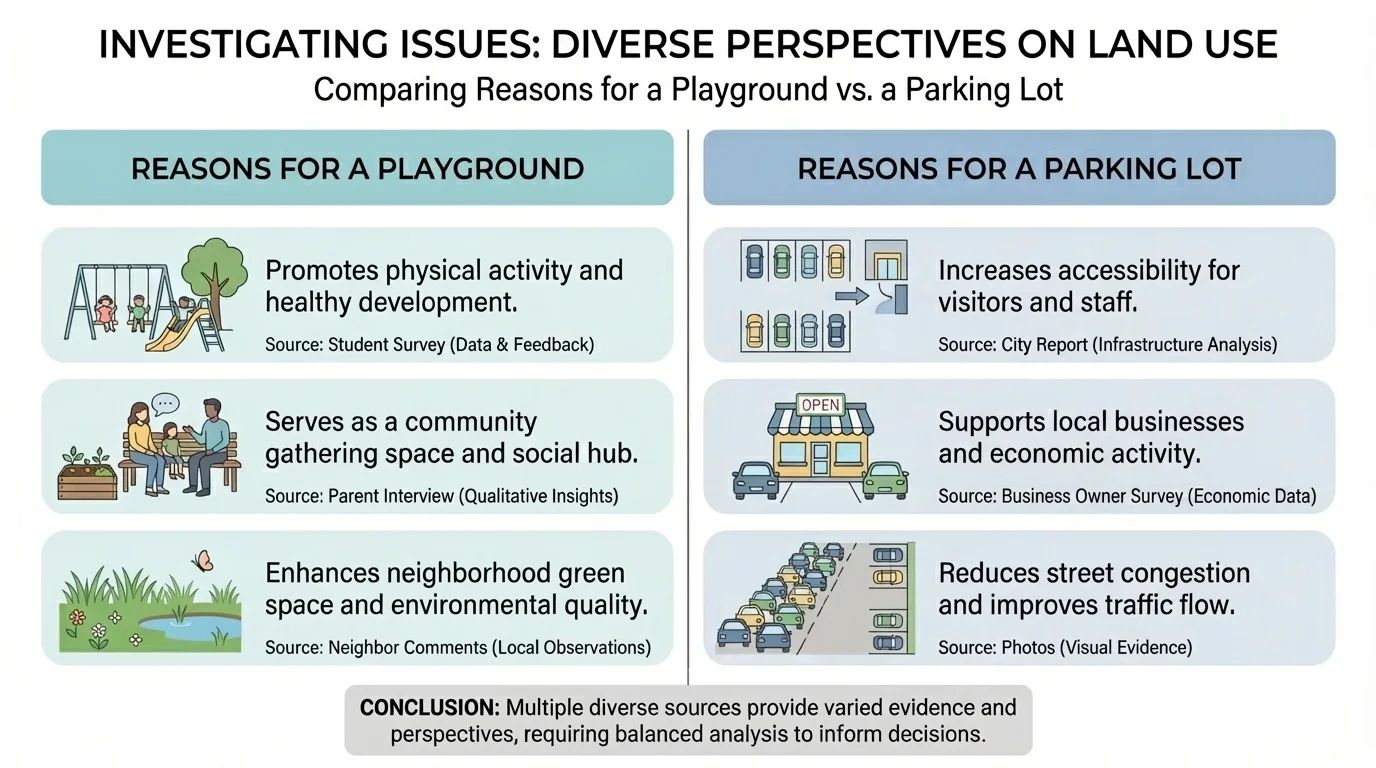
To investigate fairly, students gather several sources. They use a student survey, interviews with parents, comments from nearby neighbors, a city planning report, and photos of the lot. The information can be organized by claim and source, as [Figure 4] shows, so that students can compare reasons on both sides.
The student survey says most children want a playground because there is little space to play after school. Parent interviews show mixed opinions: some want a safe play area, while others want more parking for pickup time. Neighbors say they are worried about noise if a playground is built. The city planning report says the parking lot would cost less to maintain, but the report also notes that the neighborhood has limited green space.
Students now have multiple perspectives. Children focus on play and exercise. Some parents focus on convenience. Neighbors focus on quiet. The city focuses on cost and land use. None of these perspectives should be ignored.
Next, students check source quality. The city report may be strong for cost information. The student survey is strong for learning what students want, but it does not tell the whole story because only students answered it. Parent interviews are useful, but students should ask enough parents to hear more than one opinion. Photos help show the space, but photos alone cannot tell what people think.
Case study: making a fair conclusion
Students study the empty lot issue by using several sources and comparing perspectives.
Step 1: Gather different kinds of sources
Students collect surveys, interviews, photos, and a city report instead of using only one source.
Step 2: Identify perspectives
They note that students, parents, neighbors, and city leaders all care about different things.
Step 3: Check trustworthiness
They ask who made each source, when it was made, and what evidence it gives.
Step 4: Compare evidence
They look for agreements, disagreements, and missing voices before deciding what seems most fair.
A fair conclusion is based on evidence from many sources, not just the loudest opinion.
When students look back at the evidence chart in [Figure 4], they can see that a smart civic decision may require balancing needs, not just picking the first idea that sounds good.
Investigating a civic issue is not only about collecting facts. It is also about being responsible, fair, and thoughtful. Good citizens listen, ask questions, and check evidence before making up their minds. They understand that communities work best when people are informed.
This skill is useful in everyday life. Students may hear classmates argue about a new school rule, a lunch menu change, or whether a field should be improved. Instead of taking sides immediately, they can ask: What are the sources? Whose perspective is missing? What evidence supports this claim? That is how civic thinking grows stronger.
Being able to investigate issues from multiple perspectives also helps students become respectful decision-makers. They learn that disagreement is normal in a community. The important part is how people handle it: by listening, checking, comparing, and using evidence.
"Listen to understand, not just to answer."
When communities solve problems wisely, it is often because people took time to study strong sources and hear different voices. That habit helps everyone, whether the issue is a school sidewalk, a neighborhood park, a recycling plan, or a new safety rule.
