Colorado did not always have a governor, state lawmakers, and state judges. Long ago, Colorado was not even a state. It was a place where Native nations lived, explorers traveled, miners searched for gold, and settlers built towns. As Colorado changed and grew, the people living there needed rules for how to govern themselves. That is why the Colorado Constitution became so important. It helped turn Colorado from a territory into a state with its own government.
Before Colorado became a state, it was a territory. A territory is an area that belongs to the United States but is not yet a state. The federal government had more control over a territory than it would over a state. Colorado's path from territory to state was an important part of its history.
For thousands of years, Native peoples such as the Ute, Cheyenne, and Arapaho lived in the region that is now Colorado, as [Figure 1] helps show. Later, Spanish explorers, Mexican leaders, and then United States officials claimed parts of the land. After the Mexican-American War ended in 1848, the United States gained a large area in the West, including land that would become part of Colorado.
In 1858, gold was discovered near the Rocky Mountains. This brought many miners and settlers to the area during the Gold Rush. Towns grew quickly. As more people arrived, they wanted roads, courts, schools, and laws. They also wanted a government closer to home, not one run from far away.
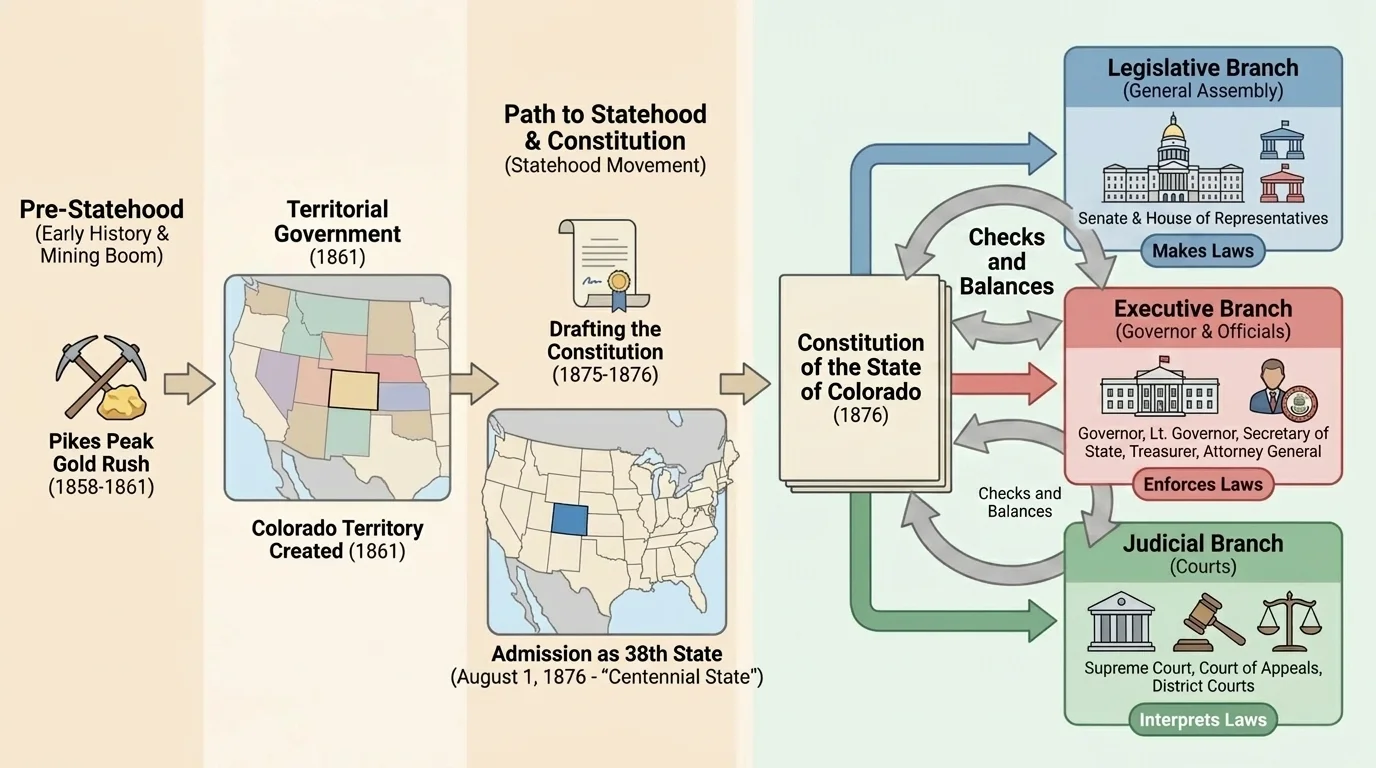
In 1861, the United States created the Colorado Territory. This gave the area an official territorial government. The president of the United States appointed the territorial governor and some other leaders. People in Colorado could elect some local officials, but they did not yet have all the rights that state citizens have.
Living in a territory could be frustrating. People paid taxes and followed laws, but they had less power over their own government than people in states did. Many Coloradans believed statehood would give them a stronger voice and more control over local decisions.
Constitution is a written plan for government. It explains how government is organized, what powers it has, and what rights people have.
Statehood means becoming an official state in the United States.
A constitution matters because it acts like the basic rulebook for government. Without it, leaders would not have a clear guide for who makes laws, who carries them out, and who decides what the laws mean. Colorado needed this kind of plan before it could become a state.
Colorado's constitution did not appear all at once. It came after many years of change. Population growth, new towns, and arguments about statehood all helped lead to the writing of the constitution.
One major event, shown on [Figure 2], was the 1858 gold rush. When miners and business owners rushed into the region, they built communities very quickly. Fast-growing communities need rules. People wanted courts to settle disagreements, sheriffs to keep order, and governments to build roads and support trade.
Another important event came in 1861, when Colorado Territory was organized. This gave the area a territorial government, but not full self-government. Over time, more residents believed Colorado was ready to become a state. They held discussions and tried more than once to move toward statehood.
There were earlier attempts to become a state before 1876, but they did not succeed. Some people worried that Colorado did not yet have enough people. Others in the federal government had political reasons for delaying statehood. Even when local leaders supported the idea, Congress did not always agree right away.
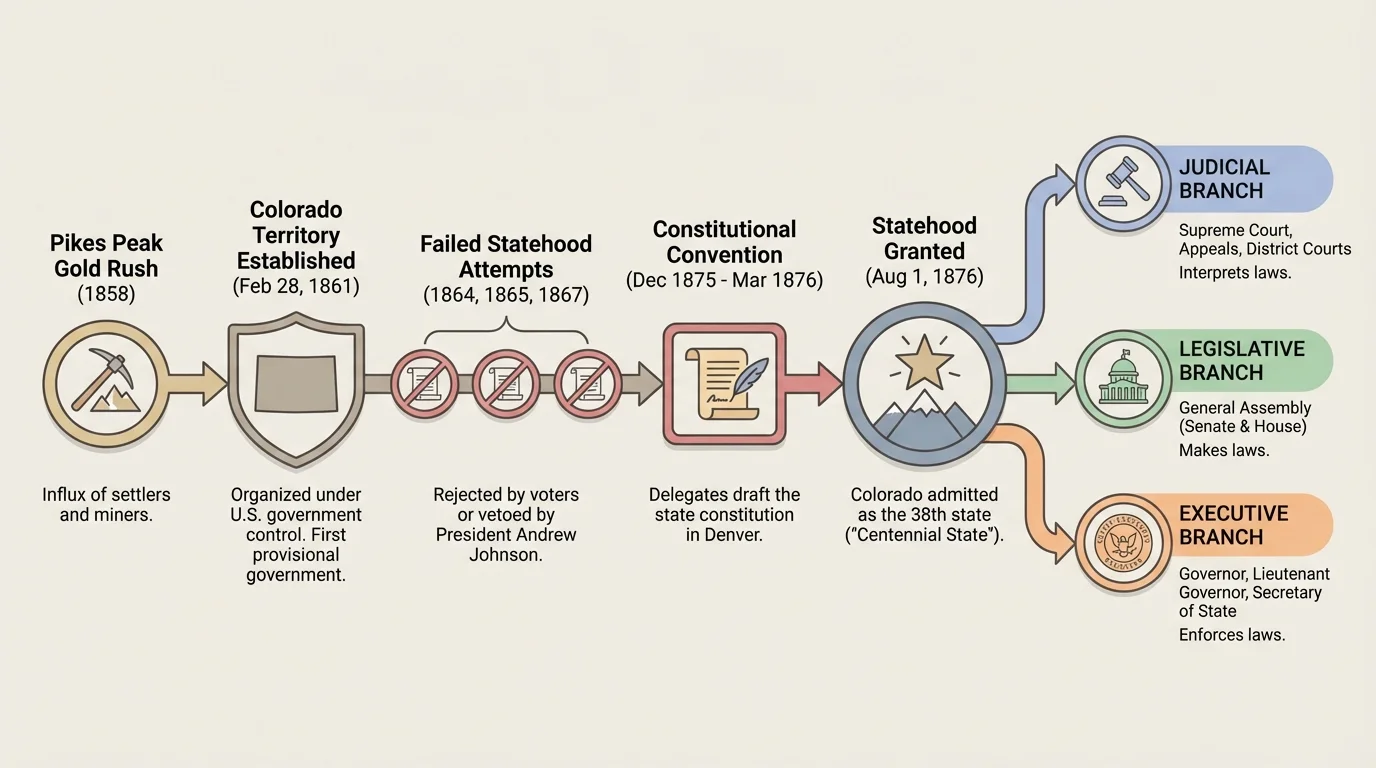
By the 1870s, Colorado had more people, more towns, and a stronger economy. Railroads helped connect Colorado to other places. Farming, ranching, and mining grew. These changes made many people feel that Colorado was ready for the responsibilities of statehood.
In 1875, the United States Congress passed a law allowing Colorado to prepare for statehood. That was a huge step. Colorado's leaders could now hold a meeting to write a state constitution.
Colorado is often called the "Centennial State" because it became a state in 1876, the year the United States celebrated its 100th birthday.
That timing made Colorado's statehood memorable. On August 1, 1876, Colorado officially became the 38th state. But before that could happen, the people had to create and approve a constitution.
The writing of the Colorado Constitution was a careful process. Leaders from around the territory met in 1875 and 1876 at a meeting called a constitutional convention. A convention is a gathering where people discuss important public questions and make decisions.
These delegates studied other state constitutions, especially those from western states. They did not want to start from nothing. They looked at what had worked elsewhere and tried to build a government that fit Colorado's needs.
The delegates wrote rules about elections, taxes, courts, schools, water, and the powers of state leaders. They also wrote a bill of rights for the people of Colorado. A bill of rights lists important freedoms and protections.
Why a written constitution matters
A written constitution helps people know the limits of government. It also explains who is in charge of different jobs. This is important because government has many duties. It must make laws, carry out laws, and settle disagreements fairly. A constitution gives a plan so one group does not take all the power.
After the constitution was written, it was not automatically accepted. The people of Colorado Territory had to vote on it. Voters approved the new constitution in 1876. This showed that many residents supported the plan for state government.
Congress then admitted Colorado to the Union. Colorado's constitution became the foundation of its state government. Even today, Colorado still uses that constitution, though it has been changed and added to over time through amendments.
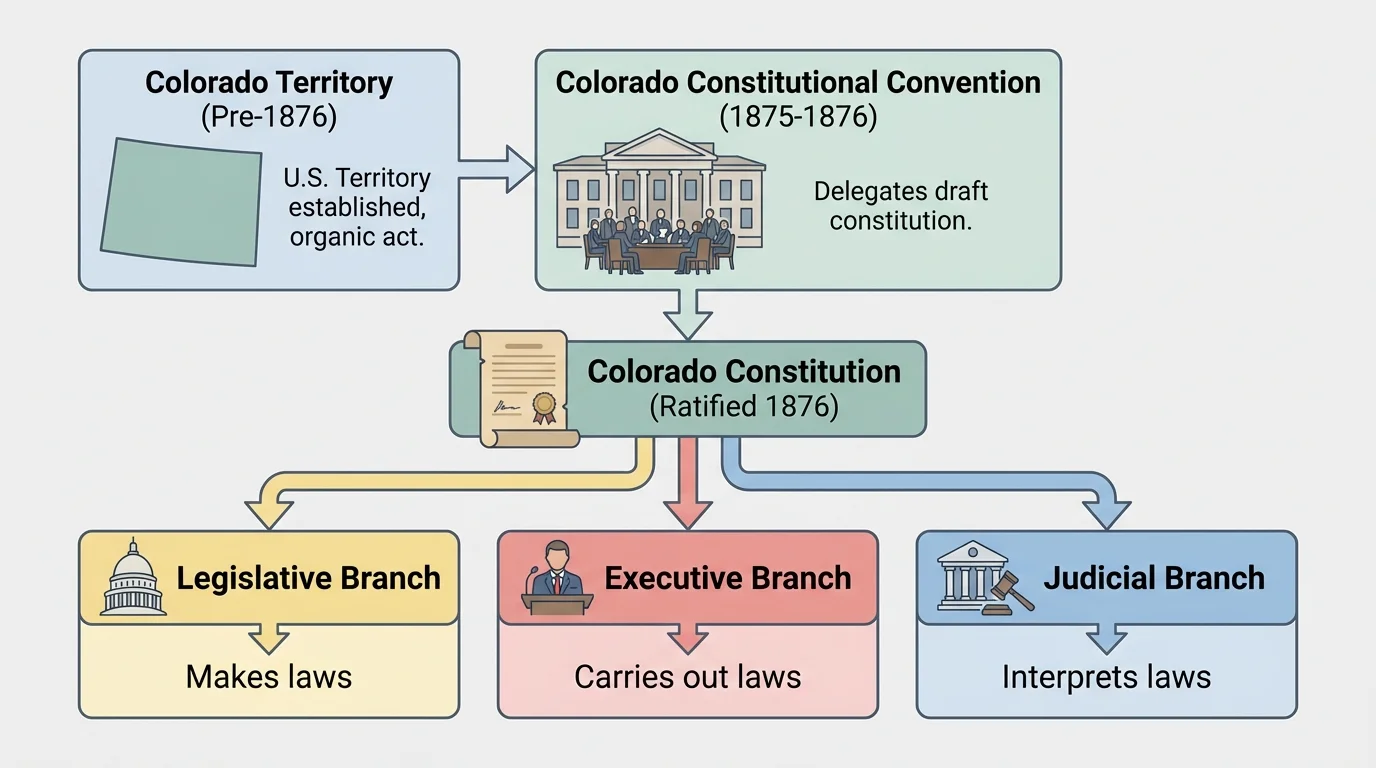
Colorado's government is divided into three parts. This system, shown in [Figure 3], was designed so that no single person or group would control everything. The three branches are the legislative branch, the executive branch, and the judicial branch.
The legislative branch makes laws. In Colorado, this branch is called the General Assembly. It has two parts: the Senate and the House of Representatives. Lawmakers in these groups discuss ideas, write bills, debate them, and vote on whether they should become laws.
The executive branch carries out the laws. The governor is the head of this branch. The governor works with other state officials and departments to make sure laws are put into action. For example, state workers help run parks, highways, and many public services.
The judicial branch interprets laws. That means judges and courts decide what laws mean and whether they match the constitution. If people disagree about a law or believe it is unfair or unconstitutional, the courts can hear the case.
This three-branch system is not unique to Colorado. It is similar to the structure of the United States government. Colorado's constitution followed this pattern because the idea of separating powers was already an important part of American government.
Example: A new safety law
Suppose Colorado wants a new law to improve bicycle safety.
Step 1: A lawmaker in the legislative branch writes a bill about helmet rules or safer roads.
Step 2: The General Assembly debates the bill and votes on it.
Step 3: If the bill passes, the governor in the executive branch signs it or vetoes it.
Step 4: If there is a disagreement later about what the law means, courts in the judicial branch can decide.
This example shows that each branch has a different job. The branches are connected, but they are not the same.
Colorado's constitution also created a system of shared power. Instead of one branch controlling everything, the branches can limit one another. This idea is often called checks and balances.
For example, as [Figure 4] shows, the legislative branch can pass a bill, but the governor can veto it. A veto means the governor rejects the bill. In some cases, lawmakers can still pass the bill by voting again with enough support.
The judicial branch can review laws and government actions. If a law goes against the constitution, a court can say that it is not valid. This is one way the courts help protect the constitution.
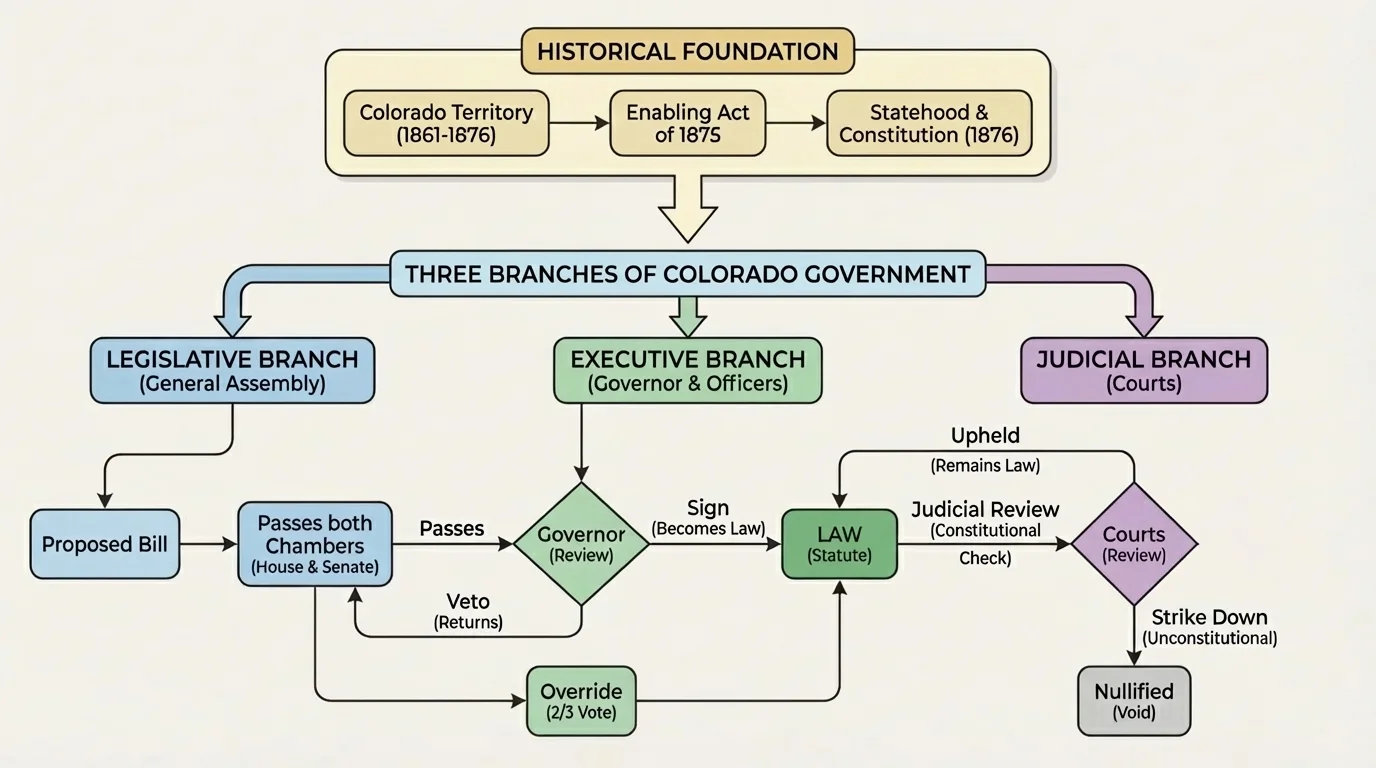
The executive branch also has limits. The governor cannot simply make any law he or she wants. Lawmakers must pass laws, and courts can review actions taken by the executive branch. This helps keep power balanced.
When you look back at [Figure 3], you can see why the branches are separated. Each branch has its own main job. When you study [Figure 4], you can also see why they must work together. Colorado's government needs both separation and cooperation.
The United States government also has three branches. Colorado's government follows a similar idea at the state level, but it focuses on state issues such as state laws, public schools, state parks, and Colorado roads.
This system helps protect freedom. If one branch had all the power, it could make unfair rules without being stopped. By sharing power, Colorado's constitution tries to make government more fair and more careful.
State government may sound far away, but it affects everyday life in many ways. Colorado's government helps support public schools, builds and repairs highways, protects state parks, and manages many public safety services. The constitution provides the structure that allows these jobs to happen in an organized way.
For example, if Colorado decides how to spend money on roads or classrooms, lawmakers in the legislative branch help write the budget. The governor and state agencies help carry out the plan. If there is a legal dispute about how a rule is used, the courts may become involved.
Water is another important issue in Colorado. Because Colorado is a dry state in many places, water laws matter a lot. The constitution and later laws help guide how water is managed. This shows that a constitution is not just a piece of old history. It still shapes important decisions today.
Real-world case: Schools and laws
Colorado's constitution supports public education. State leaders make laws about schools, set rules, and decide how state money is used for education.
Step 1: Lawmakers create or change school laws.
Step 2: The executive branch helps schools follow those laws.
Step 3: Courts can step in if people argue that a rule breaks the constitution.
So when students attend school, ride on state roads, or visit a state park, they are seeing the results of Colorado's government at work.
History is made by groups of people, but some individuals also played important roles. Territorial governors helped lead Colorado before statehood. Delegates at the constitutional convention did the hard work of writing the constitution. Voters then made the final decision by approving it.
One important national figure was President Ulysses S. Grant, who was president when Colorado became a state in 1876. At the state level, many convention delegates helped shape Colorado's government, even if their names are less well known today. Their work created a system that has lasted for many years.
| Year | Event | Why it mattered |
|---|---|---|
| 1848 | United States gained land from Mexico | Part of present-day Colorado came under U.S. control |
| 1858 | Gold discovered | Brought many settlers and rapid growth |
| 1861 | Colorado Territory created | Set up a territorial government |
| 1875 | Congress allowed Colorado to seek statehood | Opened the way for a constitution |
| 1875–1876 | Constitutional convention met | Delegates wrote the constitution |
| 1876 | Voters approved the constitution and Colorado became a state | Colorado entered the Union with its own government |
Table 1. Major events that led to the Colorado Constitution and Colorado statehood.
Looking again at [Figure 2], the order of these events matters. First came growth and settlement, then territorial government, then statehood efforts, and finally the constitution and admission to the Union. History often works this way: one event leads to another.
Colorado's constitution is more than an old document. It is the foundation for how the state government works today. The three branches it created still help make laws, carry out laws, and interpret laws for the people of Colorado.
