A new school rule, a repaired road, a wildfire emergency plan, or money for buses might seem like local community matters. But many of these decisions are connected to the state government. In Colorado, the state government helps shape what local governments can do, works together with the federal government, and interacts with sovereign Indigenous nations. That means one decision made in Denver can affect people in mountain towns, farming communities, big cities, and tribal communities too.
Government is not only something far away in a capital building. It affects daily life. If your town gets money to fix streets, if your school follows state learning rules, or if firefighters from different places work together during an emergency, government decisions are involved. Understanding these connections helps us see how communities are organized and how leaders solve problems.
Colorado has many levels of government. Each level has its own jobs, but they also depend on one another. Sometimes they cooperate smoothly. Sometimes they must debate, negotiate, or even go to court to settle a disagreement.
State government is the government of Colorado. It makes statewide laws and decisions.
Local government includes counties, cities, towns, school districts, and special districts that serve local communities.
Federal government is the national government of the United States.
Sovereign Indigenous nation is a Native nation that has the right to govern itself.
These words are important because the lesson is really about relationships: who makes decisions, who carries them out, and how different governments respect one another's powers.
Government in Colorado works like a team with different roles, as [Figure 1] shows. A local government takes care of nearby needs, the state government handles statewide needs, and the federal government deals with national matters.
Local governments may manage city parks, local streets, police or sheriff services, libraries, and neighborhood planning. The state government makes state laws, oversees public education rules, helps build and maintain state highways, and runs many statewide services. The federal government handles jobs such as national defense, immigration, and the nation's money system.
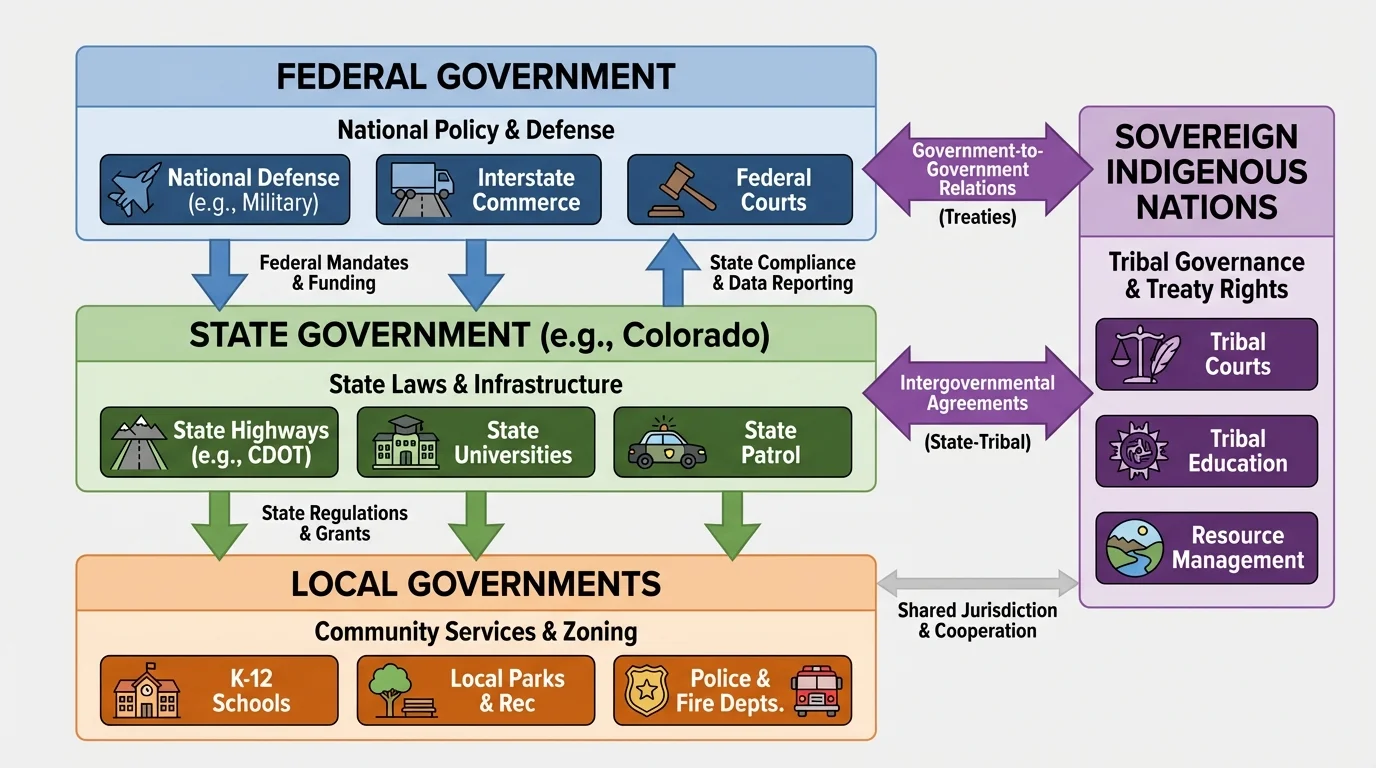
Even though each level has different responsibilities, they often overlap. For example, roads can involve a town, the state, and the federal government. A small road in a neighborhood may be local. A major highway crossing Colorado may be managed by the state. An interstate highway system connects many states and involves the federal government too.
This layering can make government seem complicated, but it also helps spread out the work. Problems that affect everyone in Colorado may need state action, while problems in one town may be best handled by local leaders who know the community well.
Colorado's state government has three branches. The legislative branch makes laws. In Colorado, this branch is the General Assembly, made up of the House of Representatives and the Senate. The executive branch, led by the governor, carries out laws. The judicial branch interprets laws and settles legal disputes through courts.
Because the state government makes statewide rules, its decisions can reach every city, county, and school district in Colorado. For example, the state can set rules for school funding, teacher requirements, safety standards, water use, and parts of transportation planning.
Why state decisions matter so much
The state government stands in the middle between local governments and the federal government. It can pass laws for the whole state, send money to local communities, and also follow national laws from the federal government. This middle position gives the state a powerful role in shaping everyday life.
The state government also collects some taxes and then decides how to spend that money. Some of it goes to statewide programs. Some of it is shared with local governments to help pay for schools, roads, health services, and other community needs.
State decisions reach local communities through rules and money, as [Figure 2] explains. A state law can require local governments to do something, limit what they may do, or provide funding for local services.
One important way the state affects local governments is through funding. Funding means money given to support a program or service. If Colorado gives money to school districts, that can help schools pay teachers, buy supplies, or run buses. If the state changes how much money is given, local schools may need to make changes.
The state also affects local governments through laws and standards. For example, the state may create safety rules for buildings, health rules for public services, or learning expectations for schools. Local governments must usually follow these state rules, even if they also create some of their own local rules.
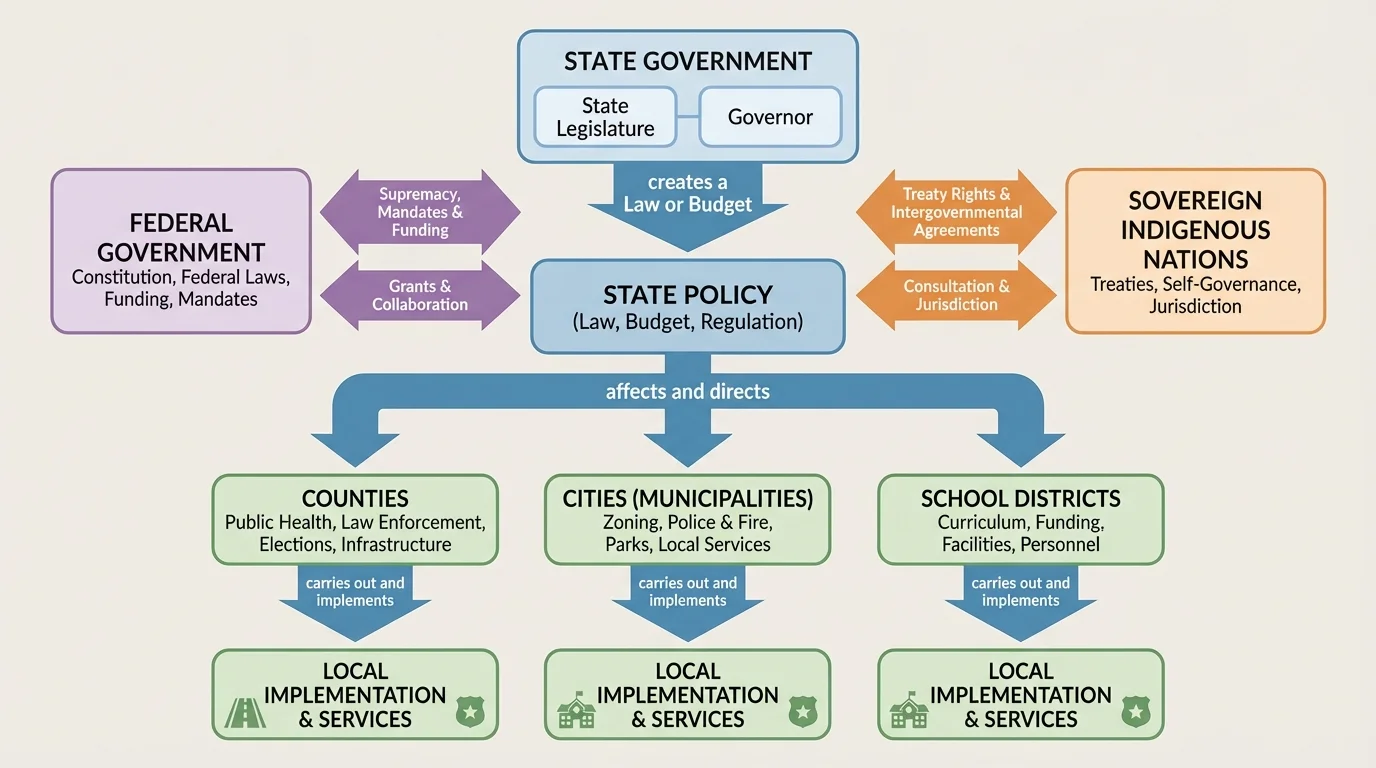
Counties and cities do not have exactly the same powers. Some places have more freedom in certain areas, especially if they have special local charters. But even then, local governments are still part of Colorado and must follow state law in many important ways.
Think about public health. If the state responds to a disease outbreak, it may give directions to county health departments. Or think about weather emergencies. During a major wildfire, state agencies may support local firefighters, send equipment, and help organize the response. Local governments still matter, but the state helps coordinate the larger effort.
We can also see this in schools. A local school district serves its own students and community, but the state sets many education rules. The state may decide learning goals, testing rules, graduation expectations, and some funding formulas. So even local schools are shaped by state choices.
Colorado has several kinds of local governments. Counties serve large areas and often manage courts, elections, roads in county areas, and sheriff departments. Cities and towns focus on services for people living inside their boundaries, such as police, water, trash collection, and local planning.
School districts are local governments too. They make decisions about local schools, but they must also follow state and federal education laws. Special districts are created for one main purpose, such as fire protection, water service, or parks and recreation.
| Type of government | Main jobs | How the state affects it |
|---|---|---|
| County | Elections, courts, roads, sheriff services | State laws set many rules for county duties |
| City or town | Police, utilities, local streets, planning | State law sets limits and powers |
| School district | Operate public schools | State sets many education standards and gives funding |
| Special district | Fire, water, parks, transportation, or other services | State law allows creation and sets rules |
Table 1. This table compares kinds of local governments in Colorado and shows how state government affects each one.
As the flow of decisions in [Figure 2] makes clear, local governments often do the day-to-day work, but state government often sets the larger rules that guide that work.
Colorado has both very large cities and tiny towns, but all of them operate within the larger state system. That means state laws can touch places that look very different from one another.
This is why one state law can have different effects in different places. A transportation decision may matter most in a mountain county with snowy roads, while a school funding decision may affect fast-growing suburban districts more strongly.
The state government does not act alone. It also works with the federal government. Sometimes the federal government makes a law or program for the whole country, and states help carry it out. In other cases, states ask the federal government for help, especially during disasters or large projects.
A major idea here is federalism. Federalism means power is shared between the state governments and the federal government. The United States Constitution gives some powers to the national government, keeps some powers for the states, and allows some powers to be shared.
Example: wildfire response
A large wildfire in Colorado may involve local firefighters, state agencies, and the federal government.
Step 1: Local crews respond first.
Fire departments and sheriffs in the area work to protect people and property.
Step 2: The state helps coordinate.
Colorado may send more firefighters, equipment, and emergency managers.
Step 3: The federal government may join.
If the fire spreads onto federal land or becomes very large, federal agencies may provide even more help.
This shows that different governments can have separate powers while still working together.
Federal money often reaches Colorado through grants. A grant is money given for a specific purpose. For example, the federal government may provide grants for highways, school programs, or food assistance. Colorado may then distribute or manage that money according to state and federal rules.
Sometimes federal law is stronger than state law. This is called supremacy. It means that if a state law directly conflicts with a valid federal law, the federal law wins. States still have important powers, but they cannot ignore the U.S. Constitution or federal laws that apply to them.
An example is civil rights. States and local governments must follow federal constitutional protections. If a state or local rule breaks those protections, courts may strike it down.
[Figure 3] Another important part of Colorado civics is understanding sovereignty. Sovereignty means the right of a people or government to rule itself. Indigenous nations are governments, but they are not the same as counties or cities.
A tribal nation has its own government, leadership, and laws for many of its internal matters. Tribal governments existed long before Colorado became a state. That history matters. Indigenous nations are not created by state governments in the same way towns or school districts are.
Because tribal nations are sovereign, the relationship between a state government and a tribal nation is not exactly like the relationship between a state and a city. A city is part of the state. A tribal nation has a government-to-government relationship with states and with the federal government.
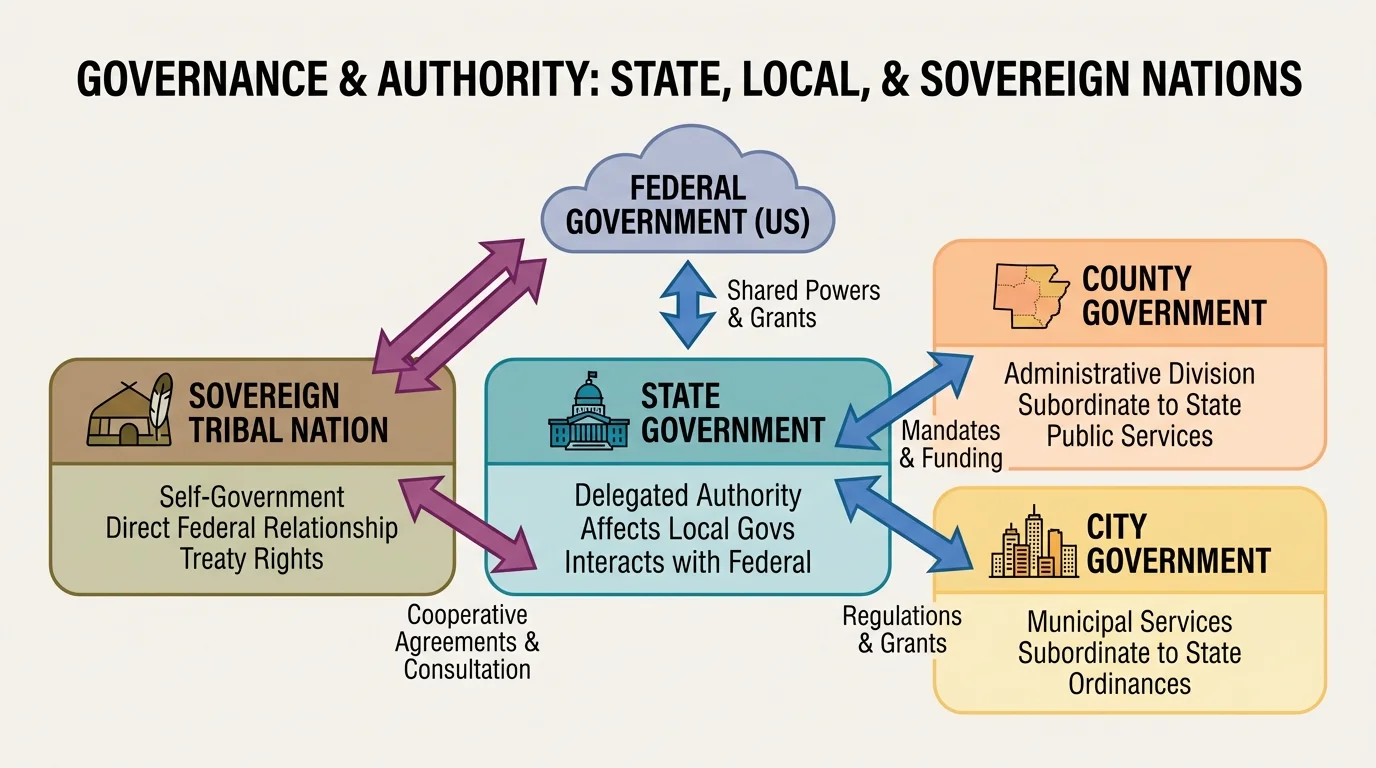
This can be a little tricky to understand at first. A county follows the state because it is a local government inside Colorado. A tribal nation has its own authority. At the same time, tribal nations, states, and the federal government may all interact on issues such as education, transportation, water, health care, cultural protection, and public safety.
Remember that not all governments fit into one simple ladder. Earlier, we learned about local, state, and federal levels. Tribal nations are governments too, but they are sovereign and have a special legal and historical relationship with the federal and state governments.
This is one reason the comparison matters so much: it helps us see that tribal nations should not be treated as if they were just another city department or county office.
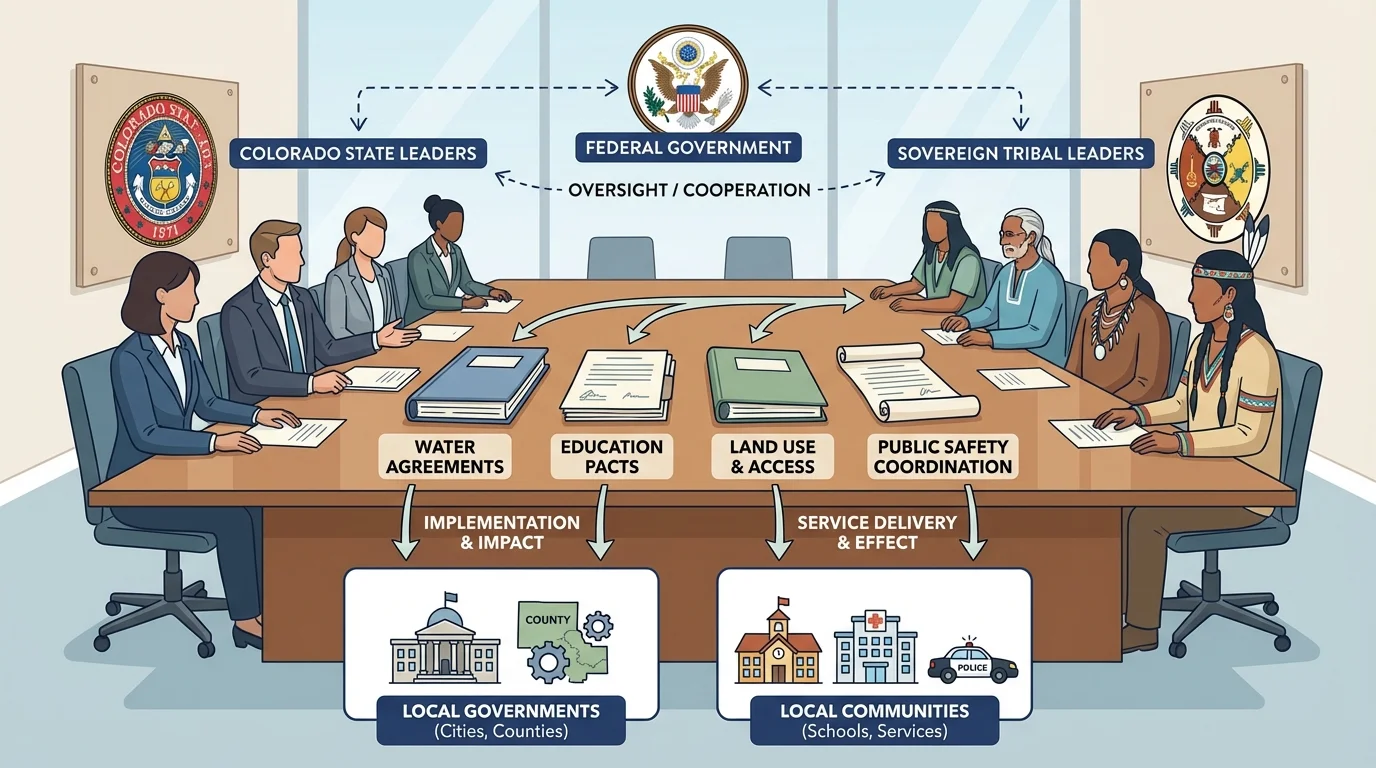
Colorado officials sometimes work directly with tribal governments, as [Figure 4] illustrates, because these are government-to-government relationships. State leaders may meet with tribal leaders to discuss water, education, transportation, health care, cultural resources, or public safety.
One important idea is consultation. Consultation means talking and listening before making certain decisions, especially when those decisions may affect tribal lands, sacred places, treaty rights, or important community resources. Good consultation is more than just giving notice. It means respecting tribal voices and taking them seriously.
Colorado may also work with tribal nations through agreements. These agreements can help governments share information, solve common problems, or coordinate services. For example, there may be agreements about child welfare, emergency help, or protecting important land and water areas.
These partnerships matter because many issues cross boundaries. Water does not stop at a county line. Smoke from a wildfire does not stop at a city border. Roads, schools, and public health concerns often affect many communities at once. Governments need ways to cooperate while respecting one another's authority.
Later, when students learn more about U.S. and Colorado history, they will see that these relationships are connected to treaties, removal, land changes, and the long history of Native peoples in the region. Understanding the present requires respecting that history.
Governments do not always agree. A city may want one rule while the state wants another. A state may disagree with a federal rule. A tribal nation may object to a decision that affects its people or lands. When that happens, leaders may negotiate, hold meetings, rewrite policies, or ask courts to decide what the law means.
For example, a local government may want to control a certain issue in its own way, but the state may decide that one statewide rule is necessary. In another case, Colorado may receive federal money for a program and must follow federal rules to keep that support. On tribal issues, state officials may need to change plans after hearing concerns from tribal leaders.
Disagreement is not always a sign that government is broken. In a democracy, debate is part of decision-making. The key is to use fair processes, listen carefully, and respect laws and rights.
"Government of the people, by the people, for the people."
— Abraham Lincoln
That famous idea reminds us that government should serve people. But serving people well often means balancing many voices and many responsibilities at once.
Consider a few Colorado examples. If the state changes school funding rules, local school districts may have to adjust class sizes, programs, or hiring. If the federal government provides highway money, Colorado may decide which projects are most important, and local communities may then see new bridges or road repairs.
If a drought affects water supplies, the state may create rules or plans for water use, while local governments manage community needs and tribal nations speak for their own interests and rights. As the meeting shown in [Figure 4] makes clear, cooperation becomes especially important when resources are shared.
During emergencies, the relationships become even easier to notice. A town may need help from the county. The county may need help from the state. The state may request federal disaster assistance. If tribal communities are affected, their governments are part of the response too.
Example: schools and state decisions
A local school may seem local because students, teachers, and families know one another. But state decisions can still affect it in important ways.
Step 1: The state sets some education rules.
These can include learning standards, testing requirements, and parts of school funding.
Step 2: The school district follows those rules.
District leaders decide how to organize schools while staying within state law.
Step 3: Students feel the results.
Changes may show up in class schedules, supplies, transportation, or available programs.
This is a clear example of how state decisions affect local governments and everyday life.
The layered structure from [Figure 1] helps explain why these examples happen so often: most public issues do not stay inside one single level of government.
Even fourth-grade students are part of civic life. Families can attend local meetings, contact state lawmakers, learn about community issues, and vote when eligible. People can also listen to tribal leaders, respect Native nations, and learn why sovereignty matters.
Older students and adults may testify at meetings, write letters, join community groups, or help others understand an issue. When people know how state, local, federal, and tribal governments connect, they are better prepared to solve problems fairly.
Good citizenship begins with paying attention. Who made the rule? Who carries it out? Who is affected? Those questions help us understand how government really works in Colorado.
