Have you ever had enough money for one thing, but wanted two? Maybe you could buy a frozen treat or a small toy, but not both. That moment may feel simple, but it teaches an important money idea. Every day, people make decisions about how to use their money, time, and energy. Those decisions are called choices, and each one has a cost beyond the price tag.
People make choices all day long. You choose what to eat for breakfast, what game to play at recess, how to spend your after-school time, and what to do with any money you have. Some choices are small. Some are big. But they all matter because you cannot always do or buy everything at once.
In personal financial literacy, we study how people use money wisely. A person might want to spend money, save money, or share money. Because money is limited, choosing one option often means not choosing another option. That is why learning about choice and opportunity cost helps people become thoughtful decision-makers.
Choice means selecting one option from two or more possibilities.
Opportunity cost is the value of the next best option that you do not choose.
These two ideas go together. First, a person makes a choice. Then, because that person did not choose something else, there is an opportunity cost. Opportunity cost is not always money. Sometimes it is time, fun, rest, or a different activity you had to give up.
A choice happens when you pick one thing from different options. For example, if your school store sells pencils, erasers, and notebooks, and you only have enough money for one item, you must choose. If you buy the notebook, that is your choice.
Choices happen because people have limited resources. A resource is something useful, such as money, time, or materials. You may have only $5. You may have only 30 minutes before dinner. You may have room in your backpack for only one library book. Since resources are limited, choices are necessary.
Not all choices are about buying things. You might choose whether to spend 20 minutes reading or 20 minutes playing outside. Both are good activities, but choosing one means giving up the chance to do the other during that time.
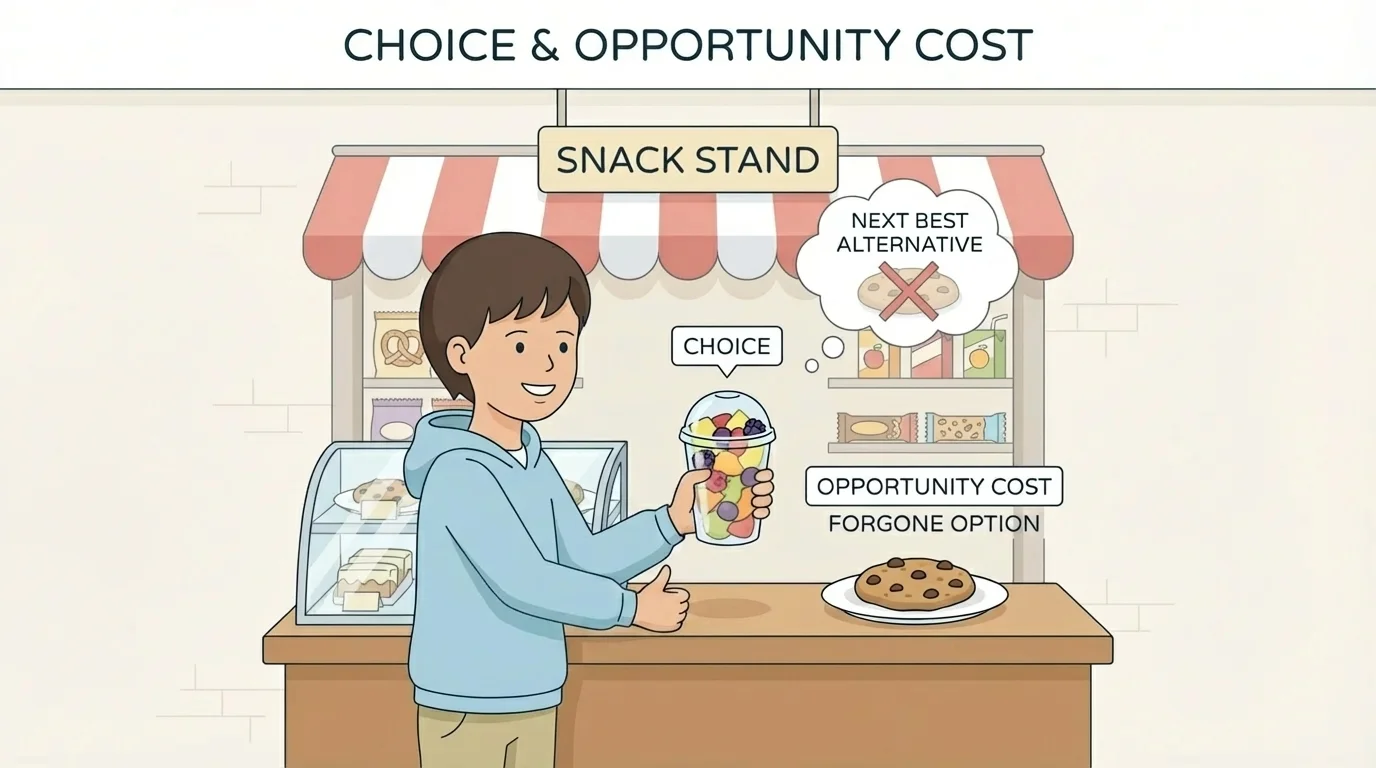
Opportunity cost is the next best thing you give up when you make a choice. As [Figure 1] shows, when one option is chosen, another valuable option is left behind. If you pick the fruit cup instead of the cookie, the opportunity cost is the cookie, if that was your next best choice.
This idea is very important: opportunity cost is not every single thing you did not choose. It is the best other option you gave up. If there were five things you could have bought, the opportunity cost is the one you wanted most after your final choice.
Suppose Maya has $3. She can buy a marker set for $3 or a puzzle book for $3. She chooses the marker set. Her opportunity cost is the puzzle book, because that was the other good option she gave up.
Now suppose Maya also could have bought a sticker for $1, but she did not really want it very much. The sticker is not the opportunity cost if the puzzle book was the next best option. This is why the words next best matter so much.
Adults use opportunity cost too. When a family spends money on a vacation, the opportunity cost might be new furniture, home repairs, or extra savings they decide not to choose.
Even when no money is involved, opportunity cost still exists. If you spend your Saturday morning at soccer practice, the opportunity cost might be sleeping later, playing a video game, or visiting a friend. Your time is a resource, just like money.
People often have more wants than they can satisfy at one time. A want is something you would like to have but do not need for survival. Toys, games, movie tickets, and fancy snacks are often wants. Because people have many wants and limited money, they must choose carefully.
That does not mean choices are bad. In fact, making smart choices helps people reach goals. If you want a bigger item later, you might skip a smaller item now. Then the smaller item becomes the opportunity cost of saving your money.
Sometimes the hardest part is that both choices seem good. You may want to go to a friend's party and also attend your basketball game. You cannot be in two places at once. Choosing the party means the game becomes the opportunity cost. Choosing the game means the party becomes the opportunity cost.
It is often easier to find the opportunity cost by following a simple process. As [Figure 2] illustrates, you can move from a list of options to your final choice and then identify the next best option that was left behind.
Ask yourself these questions:
The answer to the third question is the opportunity cost.
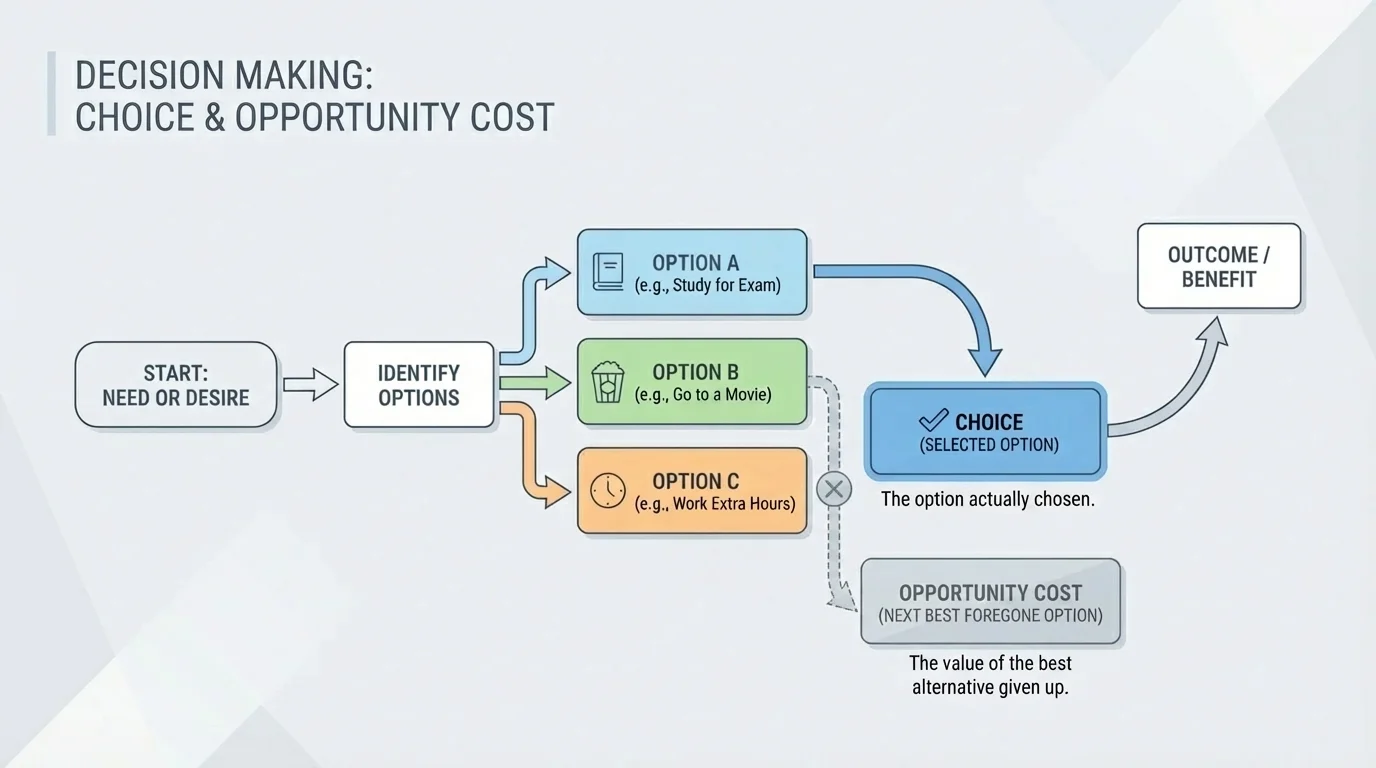
For example, suppose Eli has $10. He is thinking about buying a science kit, a baseball cap, or a comic book. He chooses the science kit. If the baseball cap was his second-favorite option, then the baseball cap is the opportunity cost. The comic book is not the opportunity cost because it was not the next best option.
Example 1: Choosing a snack
Lina has enough money for one snack. She can buy pretzels, yogurt, or a juice box. She chooses yogurt. Pretzels were her second-favorite choice.
Step 1: List the options.
The options are pretzels, yogurt, and a juice box.
Step 2: Find the choice.
Lina chooses yogurt.
Step 3: Identify the next best option not chosen.
Pretzels were her second-favorite option.
The opportunity cost is the pretzels.
This way of thinking helps students, families, and businesses. People can make stronger decisions when they know what they are giving up.
Let's look at more examples. These examples show that opportunity cost appears in money choices, time choices, and planning choices.
At lunch, Jordan can sit with one of two groups of friends. He chooses one table. The opportunity cost is sitting with the other group. No money is involved, but a choice still happened.
On a weekend afternoon, Ava can spend one hour biking or one hour baking cookies with her grandma. She chooses biking. The opportunity cost is baking cookies, if that was her next best choice.
Example 2: Saving or spending
Noah has $12. He can buy a small game now for $12, or he can save the money to put toward a $20 model kit he really wants.
Step 1: Identify the two main options.
Option 1: spend $12 now on the small game. Option 2: save the $12 for the larger goal.
Step 2: Choose one option.
Noah decides to save the $12.
Step 3: Name the next best option not chosen.
The next best option is buying the small game now.
The opportunity cost of saving is the small game he gave up for now.
Notice that sometimes the opportunity cost happens now, but the benefit comes later. This is one reason saving can feel difficult. You give up something today to reach a goal in the future.
Later, when people compare short-term and long-term results, they often discover that a smart choice is not always the easiest choice. This idea connects to money management and planning ahead because the best unchosen option is the real cost of the decision.
Personal financial literacy teaches people to think carefully before spending or saving. [Figure 3] Spending allowance money now can mean giving up the chance to buy something more important later. That future goal may be the opportunity cost of spending right away.
Suppose a student gets $5 each week for allowance. The student wants a snack for $5 today, but also wants a craft set for $15 later. If the student spends the $5 today, the opportunity cost may be getting to the craft set more slowly. If the student saves the $5, the opportunity cost may be the snack that was not bought today.
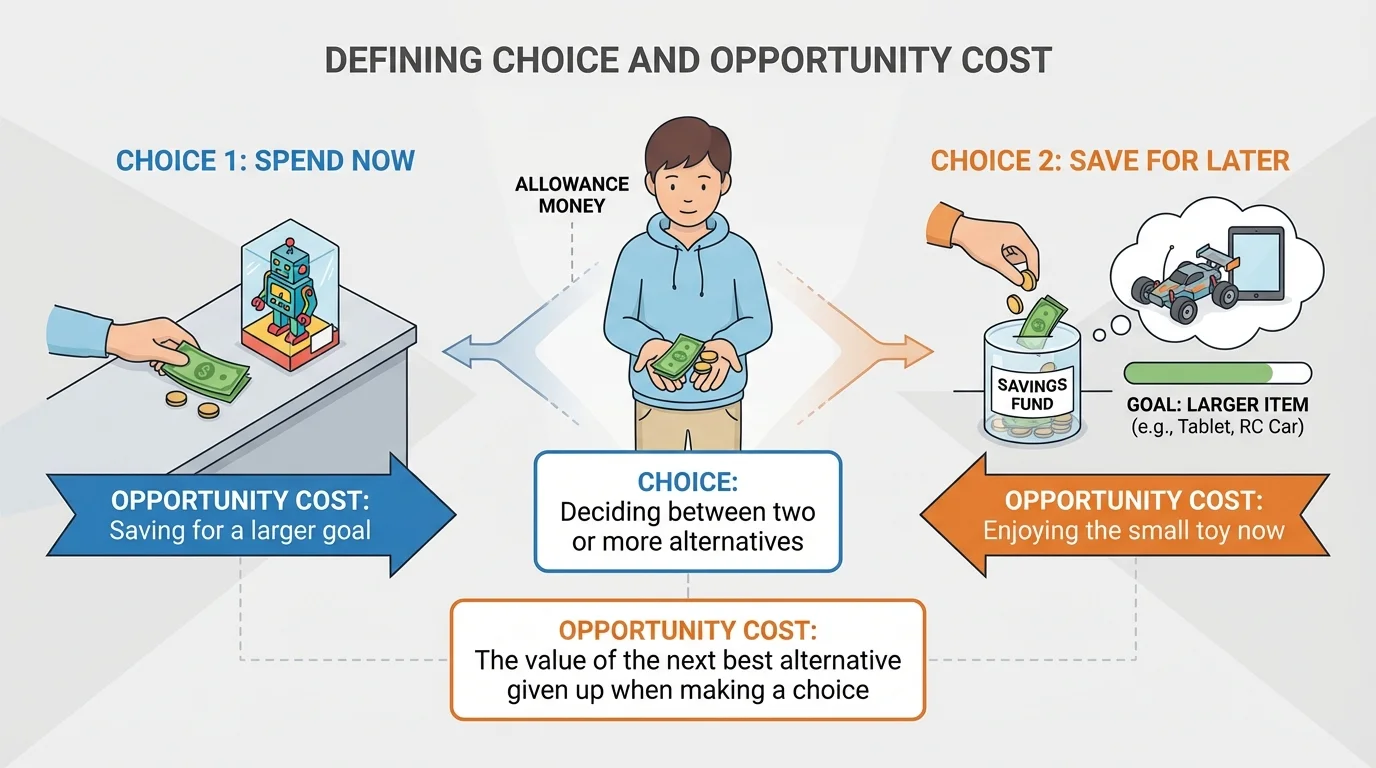
Neither choice is always right or always wrong. What matters is thinking about goals. If the student cares more about the craft set, saving makes sense. If the student needs the snack for a special event and values that more, spending might make sense. Opportunity cost helps explain what is given up in either case.
Families do this too. A family may decide whether to eat at a restaurant or cook at home. Eating out might cost more money, while cooking at home may take more time. The choice depends on what the family values most in that moment.
Short-term and long-term choices
Some choices bring a quick reward, while others help more in the future. Understanding opportunity cost helps people pause and ask, "What am I giving up now, and what might I gain later?" This kind of thinking is an important part of responsible money habits.
Smart decision-makers also think about priorities. A priority is something that is more important than other things. If saving for school supplies is a priority, then buying candy may not be the best choice. The opportunity cost of buying candy could be being less prepared later.
One common mistake is thinking that opportunity cost is just the money spent. If you buy a book for $8, the opportunity cost is not simply $8. The opportunity cost is the best other thing you could have chosen with that same money.
Another mistake is thinking the opportunity cost is every option you did not choose. That is not correct. If there were many options, only the next best one is the opportunity cost, as shown earlier in [Figure 1], where the child gives up one main alternative rather than every possible snack.
A third mistake is forgetting that time can have opportunity cost too. If you spend two hours watching television, you may give up homework time, practice time, or rest time. Time is valuable, so your decisions about time matter.
When people have limited resources, they cannot choose everything they want. This is why every choice includes something given up.
Understanding these mistakes helps you use the idea correctly. It also helps you explain your thinking clearly when you talk about decisions.
Before making a decision, it helps to stop and think. Ask: What do I want most? What am I giving up? Will this choice still seem smart tomorrow, next week, or next month?
Sometimes a choice that feels exciting in the moment is not the best choice later. For example, spending all your birthday money in one day may feel fun, but then you may not have money left for something important next week. In that case, the opportunity cost of spending quickly might be missing a bigger goal.
At other times, spending now makes perfect sense. If your shoes are worn out and you need new ones for school, buying shoes may be more important than saving for a toy. Good choices depend on needs, wants, goals, and priorities.
Example 3: Choosing how to use time
Sara has one hour after school. She can practice piano, ride her scooter, or watch a show. She chooses to practice piano because she has a recital soon. Riding her scooter is her second choice.
Step 1: Name the options.
The options are piano, scooter, and a show.
Step 2: State the choice.
Sara chooses piano practice.
Step 3: Find the next best option not chosen.
Riding her scooter is the next best option.
The opportunity cost is riding her scooter.
Thinking this way does not make every decision easy, but it makes decisions clearer. It helps you understand not only what you picked, but also what that choice meant.
When students learn to identify opportunity cost, they become stronger planners. They can use money more carefully, use time more wisely, and work toward goals with fewer surprises.
