Have you ever saved money for something big, but then felt tempted to spend it on something small right away? That is a real-life problem many people face, even adults. Every time we choose one thing, we give up another thing. Learning how that works helps us make better choices with money, time, and effort.
People cannot have everything they want at the same time. Money is limited. Time is limited. Energy is limited too. Because of that, we make choices every day. A student might choose to spend $5 on a snack, save $5 for a new soccer ball, or use $5 to buy school supplies. Each choice leads to a different result.
Some choices matter for only a short time. Other choices can shape what happens later. If you save a little money each week, you may reach a big goal after many weeks. If you spend all your money right away, that big goal may take longer to reach.
Long-term goal is something a person wants to achieve in the future, not right away. It may take weeks, months, or even years.
Opportunity cost is the next best thing you give up when you make a choice.
Budget is a plan for how to use money.
Trade-off means giving up one thing to get something else.
These ideas are important in personal finance because money choices are not only about what we buy today. They are also about what those choices make possible tomorrow.
A long-term goal is often different from a short-term want. A short-term want is something you want now, such as candy, a small toy, or a game app. A long-term goal might be saving for a bike, a special book set, sports equipment, or a class trip. As shown in [Figure 1], a future goal can change what you decide to do with money today.
Short-term wants can be fun and sometimes are perfectly fine. But if you always choose the small thing now, you may not have enough later for the bigger thing you truly want. That is why planning matters.
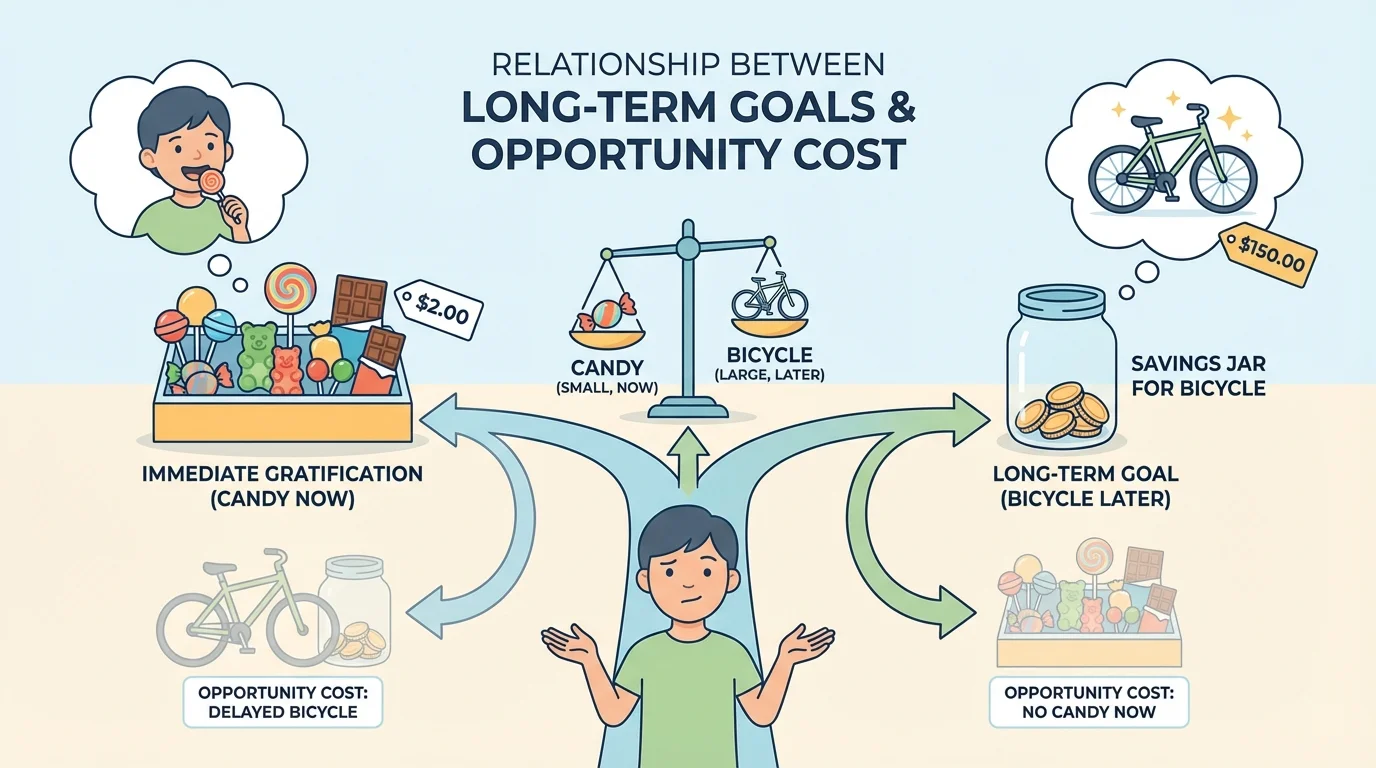
Suppose Maya has $20. She wants a craft kit that costs $20, but she also wants to buy stickers for $4 today. If she buys the stickers, she will have only $16 left. Then she cannot buy the craft kit yet. Her choice today affects her goal for later.
This does not mean small purchases are always bad. It means each purchase should be thought about carefully. The more important question is, How does this choice fit with my goal?
Some people keep savings in separate jars or envelopes for different goals. Seeing the money grow can make waiting easier and help people remember what they are working toward.
When students learn to connect present choices to future goals, they start building strong habits. Those habits can help with money, schoolwork, chores, and time management.
The opportunity cost of a choice is not just anything you miss. It is the next best thing you give up. As [Figure 2] illustrates, when one path is chosen, another important path is left behind.
For example, if Leo has $10 and chooses to buy a comic book for $10, he cannot also use that same $10 to save for a movie ticket. If the movie ticket was the next best choice, then the opportunity cost of buying the comic book is the movie ticket he gave up.
Opportunity cost helps us think more carefully. It reminds us that every choice has a cost, even when we do not hand over extra money. Sometimes the cost is another item. Sometimes the cost is lost time. Sometimes it is a delayed goal.
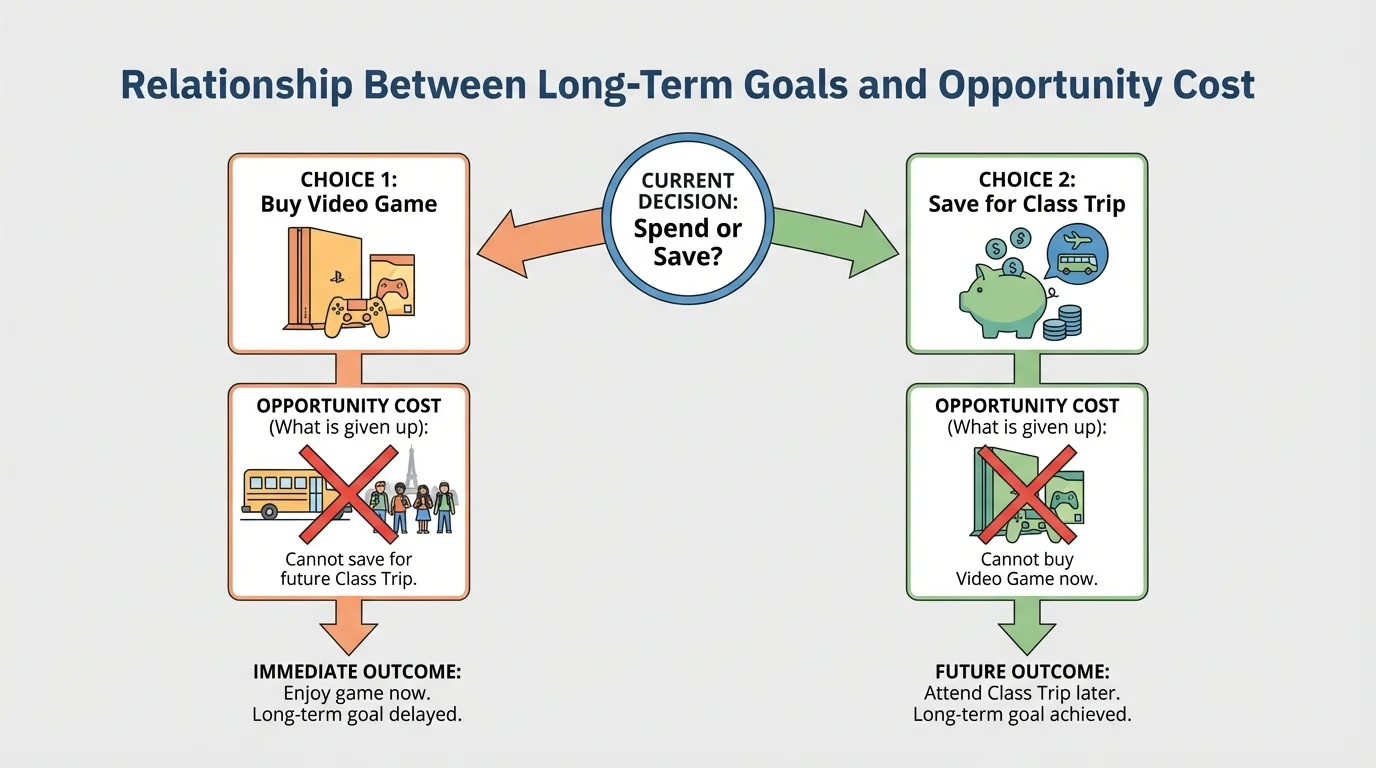
Here is another example. Ana has one free hour after school. She can either practice piano or watch videos. If she chooses videos, the opportunity cost may be the piano practice she gave up. If her long-term goal is to improve at piano, then that lost practice matters a lot.
Notice that opportunity cost does not tell us a choice is always wrong. It simply helps us understand what we are giving up. A choice might still be worth it. But it should be made on purpose, not by accident.
A goal acts like a guide. When you know what matters most in the future, it becomes easier to decide what to do now. If your goal is to save $30 for a backpack, then spending $3 here and $4 there may not seem so small anymore.
Think of it like a path. If your path leads to a treehouse, you do not want to keep walking in random directions. A long-term goal points you forward. Opportunity cost helps you notice when a choice pulls you away from that path.
This relationship is important: the stronger your long-term goal, the more carefully you think about opportunity cost. When a goal matters to you, you are more willing to wait, save, and make trade-offs.
How the relationship works
Long-term goals and opportunity cost are connected because every choice uses up resources such as money, time, or effort. If a choice helps your goal, it may be a wise trade-off. If it hurts your goal, the opportunity cost may be too high.
For example, if Ben wants to save $24 for a board game and already has $18, he needs only $6 more. Buying a $6 toy today may mean waiting much longer for the board game. In that case, the opportunity cost of the toy is very important because it delays his goal.
Money choices are easy to spot, so they are a great place to practice this idea. Let us look at a few situations carefully.
Example 1: Saving for headphones
Nia has $15. She wants headphones that cost $25. She is thinking about spending $5 on snacks.
Step 1: Find how much more she needs for her long-term goal.
Nia needs \(25 - 15 = 10\) more dollars.
Step 2: Think about what happens if she buys the snacks.
If she spends $5, she will have \(15 - 5 = 10\) dollars left.
Step 3: Find how much she would still need after buying the snacks.
Then she would need \(25 - 10 = 15\) more dollars.
The snacks may be tasty, but the opportunity cost is moving farther away from the headphones. Buying the snacks makes her goal harder to reach.
This example shows that even a small amount can matter when someone is saving for something important.
Example 2: Two good choices
Owen has $12. He can buy a puzzle for $12 or a sketchbook for $10. His long-term goal is to become better at drawing.
Step 1: Compare the choices to the goal.
The sketchbook connects directly to drawing practice. The puzzle may be fun, but it does not help the goal as much.
Step 2: Think about opportunity cost.
If he buys the puzzle, the opportunity cost is the sketchbook, which would help him practice drawing.
Because of his goal, the sketchbook may be the smarter choice, even though both items are good.
Sometimes the best choice is not the most exciting one in the moment. It is the one that supports what matters most later.
Example 3: Spending and saving together
Sara gets $8. She wants to save for a $20 jump rope set, but she also wants a $2 frozen treat.
Step 1: Consider saving all the money.
If she saves all $8, she still needs \(20 - 8 = 12\) more dollars.
Step 2: Consider spending $2 first.
If she buys the treat, she saves only \(8 - 2 = 6\) dollars.
Step 3: Compare what she gives up.
The opportunity cost of the treat is not only $2. It is also slower progress toward the jump rope set.
This choice may still be okay if she decides the treat is worth it. The key is understanding the trade-off.
These examples show that long-term goals do not force only one answer. Instead, they help people think more clearly about consequences.
Opportunity cost is not just about money. It also appears in how we use our time and effort. Time is a resource too.
If a student has \(30\) minutes before dinner, that student could read, finish homework, play outside, or practice a sport. Choosing one activity means not choosing another. If the student has a long-term goal of reading more books, then choosing to read may fit the goal better than other choices on that day.
Remember the earlier idea about practice. As we saw with piano and free time in [Figure 2], the opportunity cost of one activity can be the lost chance to build a skill. This matters because long-term goals often require repeated effort over time.
Effort matters too. Suppose Eli wants to improve in math. If he rushes through homework so he can start a game sooner, the opportunity cost may be the learning he gave up. That lost learning can affect his goal later.
When you save money, practice a skill, or finish work before playing, you are using self-control. Self-control helps you protect an important future goal from a tempting choice right now.
People who understand opportunity cost can use their time more wisely. They begin to ask, What am I giving up by choosing this?
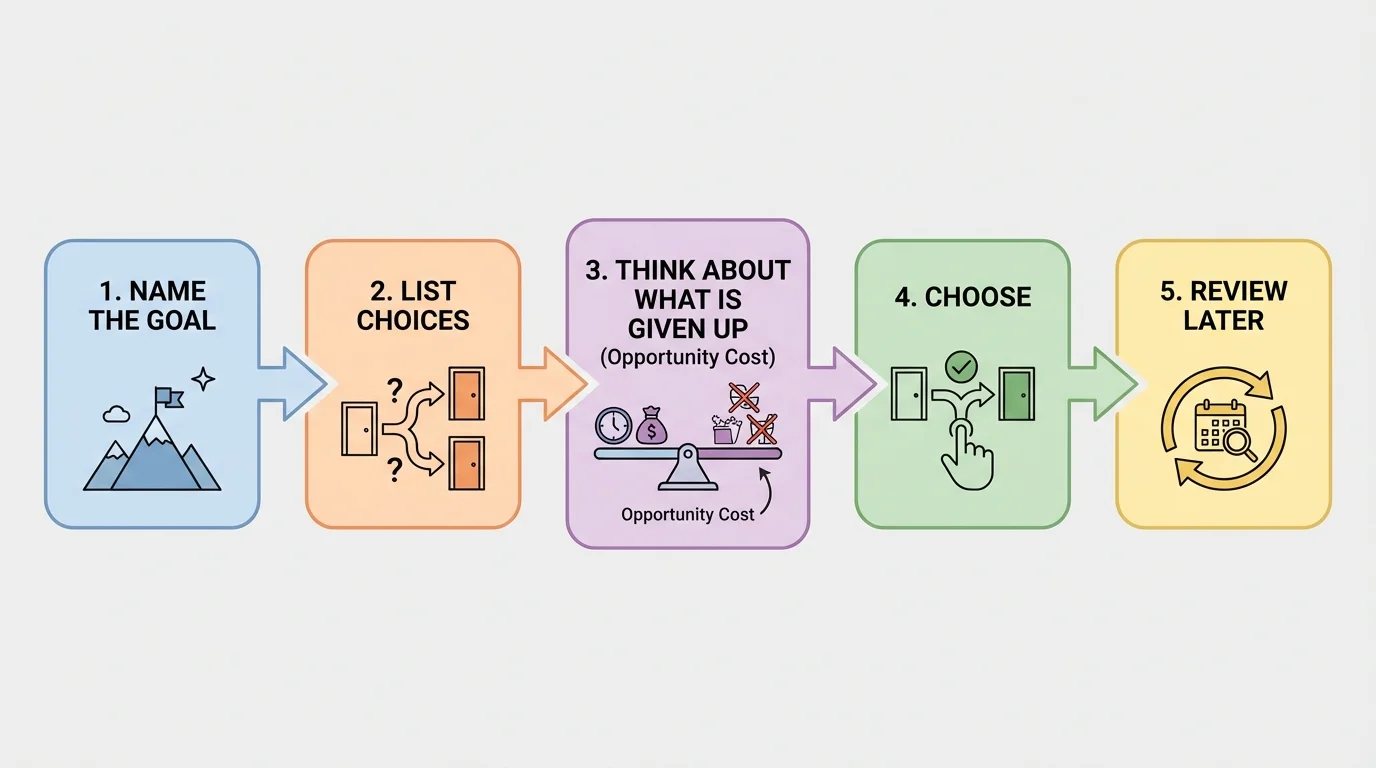
A simple decision process can help when choices feel tricky. The steps in [Figure 3] show how students can slow down and think before spending or using time.
First, name the goal clearly. Next, list the choices. Then think about the opportunity cost of each choice. After that, choose the option that best matches the goal. Finally, review the result later and ask whether the choice helped.
This process can be written as a simple plan:
| Question | Why it helps |
|---|---|
| What is my goal? | It keeps the future in mind. |
| What choices do I have? | It shows there may be more than one option. |
| What do I give up with each choice? | It identifies the opportunity cost. |
| Which choice helps my goal most? | It connects the decision to the future. |
| Was the choice worth it? | It helps improve future decisions. |
Table 1. Questions that help students connect opportunity cost to long-term goals.
For example, if Jada wants to save for a science kit, she can stop and ask these questions before buying a small toy. The answers may help her see that the toy gives quick fun, but saving gives progress toward a bigger goal.
Later, the same process still works. Looking back at [Figure 3], the final review step matters because people learn from past choices. If a choice slowed a goal too much, they can decide differently next time.
Sometimes both choices are good. Sometimes both choices have problems. Real life is often like that. A student may need to choose between spending money on a school project or saving for a personal goal. In that case, the school project may be the more important need.
This is why good decision-making is not only about wanting something. It is also about thinking about needs, priorities, and responsibility. A need is something important to have, such as required supplies. A want is something nice to have but not necessary right now.
When there is no perfect choice, opportunity cost still helps. It helps people be honest about what they are giving up. Then they can decide which choice is most worthwhile.
"Choosing one thing means saying no to something else."
That idea may sound simple, but it is very powerful. It reminds us that every choice has a result now and a result later.
Strong habits make smart choices easier. One useful habit is saving a little at a time. Another is making a simple budget before spending. A budget can be as simple as deciding, "I will save $3 and spend $2."
Another habit is checking progress. If a goal costs $40 and you already saved $28, you can see that you need \(40 - 28 = 12\) more dollars. Knowing that number can help you resist spending money on things that are less important.
Patience is also part of financial literacy. Waiting can be hard, but it often leads to a better result. A person who waits may be able to buy something more useful, more valuable, or more meaningful.
Long-term goals become more reachable when people notice their trade-offs. Spending, saving, using time, and using effort are all connected. The more clearly you understand opportunity cost, the more power you have to make choices that match your goals.
