When Europeans arrived in North America, they did not enter an empty land. They entered a continent inhabited by many Indigenous nations, each with its own language, government, beliefs, and trade system. Some meetings between groups led to exchange and cooperation. Many others led to war, forced labor, broken promises, and suffering. To understand early North American history, we need to look at how these groups lived together, clashed, and changed one another.
Long before Columbus crossed the Atlantic, Indigenous Peoples lived all across North America. They built towns, farmed, hunted, fished, traded, and governed themselves. Nations such as the Powhatan, Cherokee, Lakota, Pueblo, Wampanoag, and Haudenosaunee had different ways of life because they lived in different environments. A desert community solved different problems than a woodland community or a plains community.
These nations were not cut off from one another. They traded food, pottery, shells, furs, tools, and ideas across long distances. Some groups became allies. Others became rivals. This matters because when Europeans arrived, they entered a world that was already organized and connected.
Colonization is the process of one country taking control of another land and settling there. Cultural genocide means trying to destroy a group's culture, language, beliefs, and traditions. Chattel slavery is a system in which people are treated as property that can be bought and sold.
Beginning in the late 1400s and early 1500s, Spanish, French, Dutch, and English explorers and settlers came to North America. They wanted land, wealth, trade, power, and new routes for commerce. Some also wanted to spread Christianity. Their arrival brought horses, metal goods, guns, and new crops, but it also brought deadly diseases, warfare, and systems of control.
Not all people in North America had the same amount of power. European colonists often had support from kings or governments across the ocean. They built forts and colonies and claimed land already occupied by Native nations. Many Indigenous groups wanted to protect their homes, keep control of trade, and survive the changes brought by newcomers.
Another group in this story is often left out: enslaved people. Both Indigenous and African people were enslaved in parts of North America. They were forced to work, denied freedom, separated from family members, and punished if they resisted. Their labor helped build colonies, farms, roads, homes, and missions.
European colonists did not all behave in exactly the same way. Spanish colonists built missions and settlements in places such as Florida, the Southwest, and California. French colonists often focused more on trade, especially the fur trade, though they also competed for land and power. English colonists founded farming settlements that expanded steadily and pushed Native communities off their land. Even with these differences, colonization often harmed Indigenous communities.
[Figure 1] shows how trade linked many groups together through routes connecting Indigenous communities and European settlements. Long before Europeans arrived, Indigenous nations exchanged goods over great distances. After contact, these trade networks grew and changed. Europeans wanted furs, especially beaver pelts, while Indigenous traders might want metal knives, cloth, beads, kettles, or firearms.
Trade was not only about objects. People also exchanged knowledge. Indigenous guides taught Europeans about rivers, seasons, food crops, and local geography. Europeans brought new animals, plants, and tools. Corn, beans, and squash were already important Native crops in many places. Europeans sometimes depended on Native knowledge just to survive their first winters.
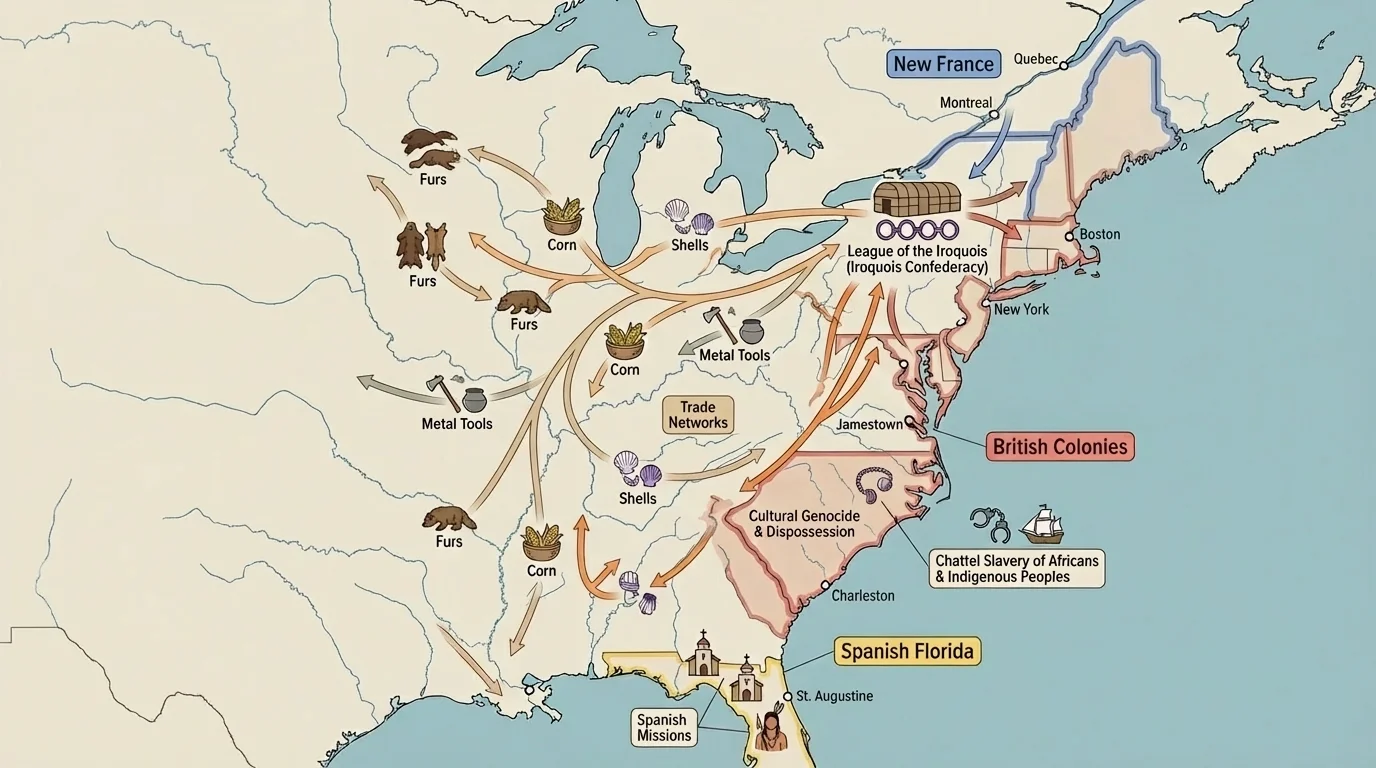
Trade could create friendships, but it could also create competition. If one Native nation got more guns through trade, nearby rivals might feel threatened. European powers sometimes used trade to build alliances. For example, French traders often worked closely with some Native nations in the Great Lakes region, while English colonists built ties with others. Trade relationships could quickly turn into military alliances during wars.
Trade also changed the environment. More hunting for fur-bearing animals reduced some animal populations. Dependence on European goods sometimes made Native groups more vulnerable if trade stopped. Looking back at [Figure 1], we can see that the movement of goods also meant the movement of power, influence, and conflict.
Wampum, which was made from shell beads, had cultural and diplomatic importance for some Native nations in the Northeast. It could record agreements and symbolize important relationships, not just serve as an item of exchange.
Some trade meetings were peaceful and careful. Leaders negotiated, exchanged gifts, and discussed terms. In other cases, colonists cheated Native traders or demanded unfair deals. The same network that carried goods could also carry tension.
One of the most tragic results of European contact was the spread of disease. Smallpox, measles, and influenza killed large numbers of Indigenous people because these diseases were new to the Americas. Entire communities suffered. When many adults died, children lost parents, traditions were harder to pass down, and villages became weaker.
At the same time, colonists wanted more land for settlements, farms, and plantations. This led to wars, forced removals, and broken treaties. Some colonists acted as if Native people had no right to the land, even though Native nations had lived there for centuries. This unfair taking of land was a central part of colonization.
Cultural genocide happened when colonizers tried to erase Native identity. They might ban Native languages, force children to change clothing and names, punish religious traditions, or pressure communities to abandon their own governments. Destroying culture was another way to try to control people.
Primary sources from this time include letters, treaty records, maps, church reports, and Native oral histories passed down through generations. Secondary sources, such as history books written later, help us study these events by comparing evidence from many places. Both kinds of sources help historians understand what happened, but they must be used carefully, because some colonial records ignored Native viewpoints.
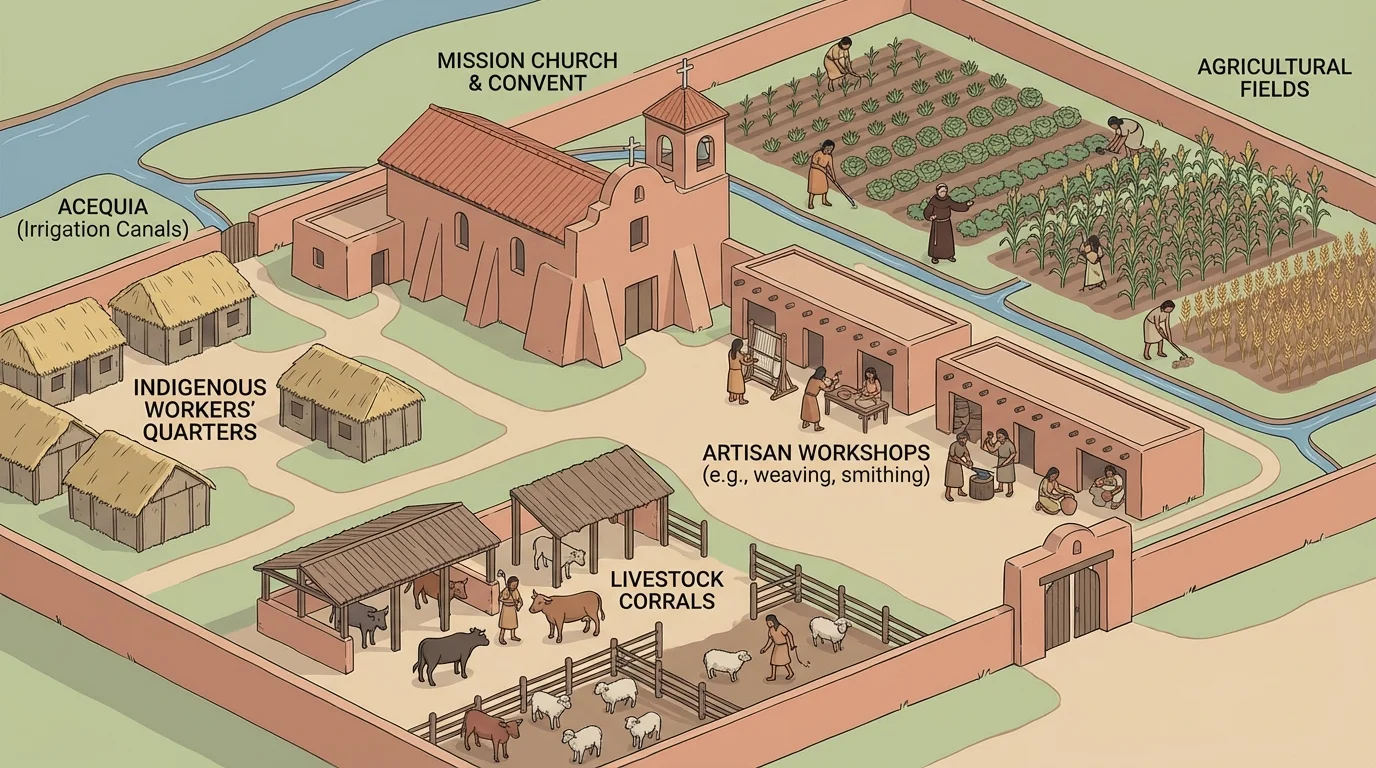
[Figure 2] illustrates how, in Spanish-controlled areas, Spanish missions were centers of religion, farming, and labor. Spanish priests hoped to convert Indigenous people to Christianity. But missions were not only churches. They were also tools of colonization where Indigenous people were often expected, or forced, to live, work, and follow Spanish rules.
At many missions, Indigenous people grew crops, raised animals, built structures, and learned tasks chosen by mission leaders. Some children were taught Spanish language and religion. Traditional ceremonies and beliefs were often discouraged or forbidden. For many Native families, missions meant losing freedom over daily life.
Spanish missions were built in places such as present-day Florida, Texas, New Mexico, Arizona, and California. In the Southwest, Spanish colonists also used systems of forced labor. Some Pueblo communities resisted Spanish rule. A major event was the Pueblo Revolt of 1680, when Pueblo people rose up against Spanish control and drove the Spanish out of the area for a time.
The mission system shows that religion and empire were often connected. Looking again at [Figure 2], we can see that missions combined worship, farming, housing, and work in one controlled space. For Native communities, that meant pressure to replace old ways with new ones chosen by colonizers.
Case study: The Pueblo Revolt
Step 1: Identify the causes
Spanish authorities demanded labor, punished Native religious practices, and tried to force Pueblo people to follow Spanish ways.
Step 2: Describe the event
In 1680, Pueblo leaders organized a revolt across a wide region of the Southwest.
Step 3: Explain the result
The revolt successfully pushed the Spanish out of New Mexico for about 12 years.
This event shows that Native communities did not simply accept colonization. They resisted in organized and powerful ways.
Not every Native person experienced missions in exactly the same way. Some tried to adapt, some cooperated under pressure, and some resisted openly or quietly. What remains true is that missions were part of a larger system that took away Native control.
One of the cruelest parts of colonial history was slavery. Chattel slavery of Africans treated human beings as property for life. Enslaved Africans and their children could be bought, sold, and forced to work. This system grew especially large in plantation colonies, where labor was needed to grow crops such as tobacco, rice, and later cotton.
Before African slavery became dominant in many British colonies, some colonists also enslaved Indigenous people. In Spanish areas and in parts of the Southeast and other regions, Native people were captured, traded, or forced into labor. Enslaving Native people was difficult for colonists in some places because Native communities knew the land well and could escape more easily, and because disease had already caused devastating population losses. Even so, Indigenous enslavement was real and harmful.
Africans brought to North America came from many cultures and regions of Africa. They carried languages, farming knowledge, music, crafts, and religious traditions. Colonists tried to strip away these identities, but enslaved Africans and African Americans preserved culture in families, songs, foodways, beliefs, and resistance. Their survival and creativity are important parts of history.
Enslaved people resisted in many ways. Some escaped. Some slowed down work. Some protected family traditions in secret. Some revolted. Resistance could be dangerous, but it showed courage and the human desire for freedom. Slavery shaped laws, wealth, and race relations in ways that lasted long after the colonial period.
| Group | What colonizers wanted | How people were treated | Examples of resistance or survival |
|---|---|---|---|
| Indigenous Peoples | Land, labor, trade alliances | Forced removal, mission control, warfare, attacks on culture | Revolts, diplomacy, moving communities, preserving traditions |
| Enslaved Indigenous people | Labor in homes, fields, settlements | Captivity, family separation, forced work | Escape, rebellion, support from Native communities |
| Enslaved Africans | Labor on plantations and in colonies | Chattel slavery, sale as property, harsh punishment | Revolt, escape, cultural preservation, community building |
Table 1. Comparison of how colonizers treated different groups and how those groups resisted or survived.
When we compare these experiences, we see both differences and similarities. Native people faced land theft and attacks on culture. Enslaved Africans faced a permanent system of racial slavery. Both groups suffered from violence and loss, yet both also fought to survive and keep identity alive.
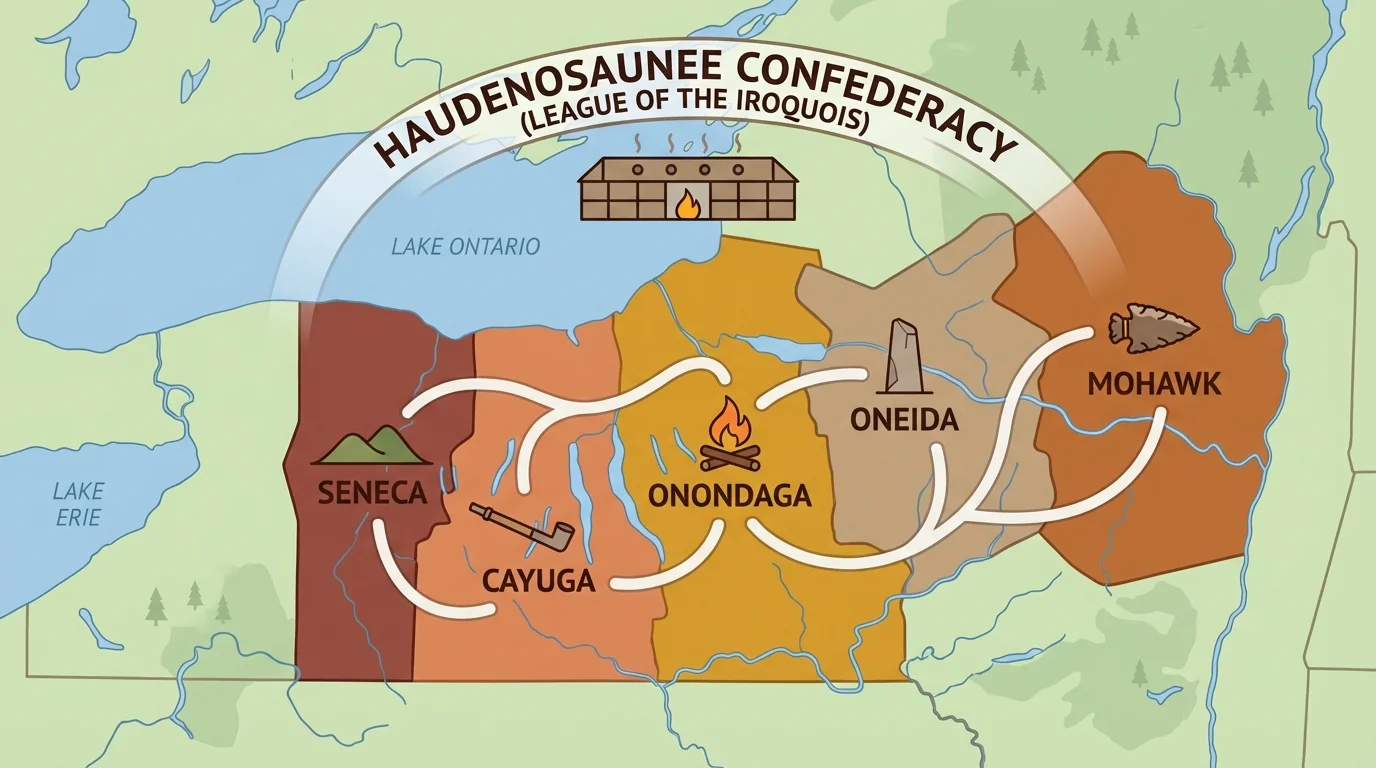
Not all history during this time is about European control. Indigenous nations also built strong political systems of their own. [Figure 3] shows how the League of the Iroquois, also called the Haudenosaunee Confederacy, joined several nations together. The original member nations were the Mohawk, Oneida, Onondaga, Cayuga, and Seneca. Later, the Tuscarora joined as well.
The League was created to bring peace among these nations and help them work together. It had rules for decision-making and diplomacy. Leaders discussed issues and aimed for agreement. This system helped the member nations become stronger together than they would have been alone.
The Haudenosaunee played an important role in relations with Europeans. Because they were organized and powerful, European empires often tried to win their friendship. The League used diplomacy to protect its interests, balance rival European powers, and preserve independence.
The confederacy is important because it reminds us that Indigenous governments were complex and effective. Indigenous political alliances covered large regions and shaped history in major ways. Indigenous nations were not just reacting to Europeans; they were also making strategic choices of their own.
Why alliances mattered
When groups made alliances, they shared military support, trade opportunities, and political strength. In colonial North America, alliances could protect communities, but they could also pull nations into wars started by European empires.
Some historians note that ideas about shared leadership and confederation in Indigenous governments, including the Haudenosaunee, are important to study when learning about the development of political thought in North America. Whether or not every later government copied these ideas directly, the League clearly showed that collective decision-making and shared rule existed in North America long before the United States was formed.
Even during very difficult times, people found ways to resist. Native communities moved villages, formed alliances, negotiated treaties, kept languages alive, and defended sacred traditions. Enslaved Africans built families and communities under terrible conditions and fought for freedom in large and small ways. Survival itself was an act of strength.
Important events on a simple timeline help show these changing interactions: European arrival after 1492 increased contact; Spanish missions spread in the 1500s and 1600s; the growth of African slavery expanded through the 1600s; the Pueblo Revolt took place in 1680; and Native confederacies such as the Haudenosaunee continued to shape diplomacy across the colonial era.
The effects of these interactions did not end when the colonial period ended. Loss of land, broken treaties, racism, and the lasting impact of slavery still matter today. At the same time, Indigenous nations still exist, African American communities continue to shape the nation, and the cultures colonizers tried to destroy are still alive. Understanding this history means recognizing both injustice and endurance.
"We are all connected to the choices people made in the past."
History is not only a list of names and dates. It is a story about real people making decisions, facing unfair systems, and trying to protect their families and cultures. When we study interactions among Indigenous Peoples, enslaved people, and European colonists, we learn how power worked in early North America and why those struggles still matter.
