One of the most surprising facts about the American Revolution is that it was not shaped by just a few famous men in wigs. North America was home to many peoples with different languages, cultures, and hopes. Some wanted independence from Britain. Some wanted to protect their homelands. Some were fighting for freedom from slavery. Some were trying simply to survive a dangerous time. To understand this period, we need to look at the many voices that shaped it.
Long before the United States existed, North America was home to millions of Indigenous people living in organized nations and communities. European explorers and colonists later arrived and built colonies on lands where Indigenous Peoples already lived. Over time, Africans were brought by force across the Atlantic and enslaved. By the 1700s, the land that would become the United States was a place of contact, trade, conflict, cooperation, and change.
When we study the road to the American Revolution, we should remember that different groups experienced history in different ways. A British colonist in Boston, an enslaved African in Virginia, a Haudenosaunee leader in New York, and a girl carrying messages in the countryside did not all see events the same way. Yet each group helped shape what happened.
American Revolution was the conflict in which the thirteen British colonies fought for independence from Great Britain.
Contribution means an action, idea, or effort that helps bring about a result.
Liberty means freedom, but during the Revolutionary era not everyone was given that freedom equally.
History becomes clearer when we ask two questions: Who had power? and Who was left out? Those questions help us see why this era was both inspiring and unfair at the same time.
Indigenous Peoples lived in every region of North America, and many nations had strong governments, trade networks, farming systems, and military alliances, as shown in [Figure 1]. They were not one single group. They included many nations such as the Haudenosaunee, Cherokee, Powhatan, Creek, and Shawnee, each with its own leaders and traditions.
Indigenous nations contributed to early American history by sharing agricultural knowledge, trade routes, and diplomatic practices. European colonists depended on Indigenous knowledge about local plants, geography, and survival. At the same time, colonists often took land, broke treaties, and brought diseases that harmed Indigenous communities.
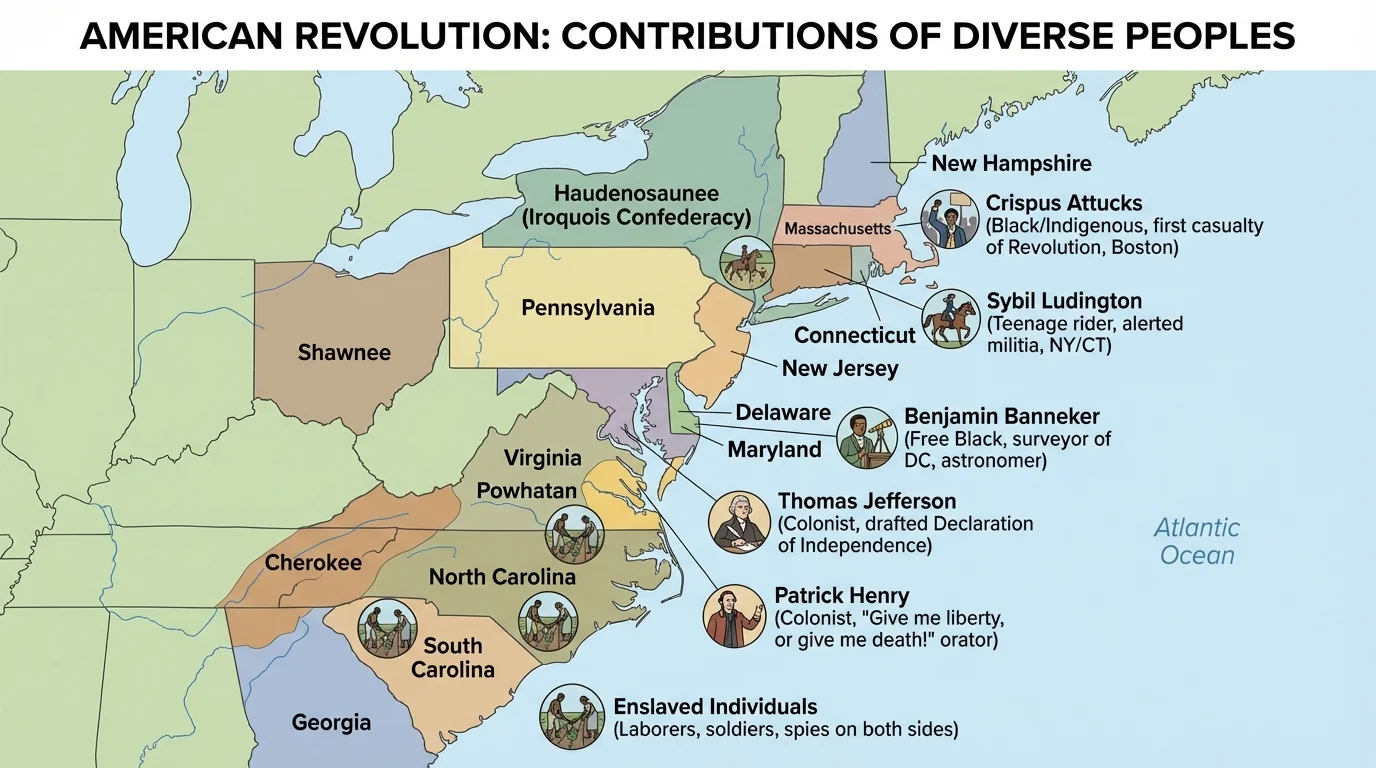
During the years leading to the Revolution, Indigenous nations had to make difficult choices. Some tried to stay neutral. Some sided with the British because they hoped Britain would slow colonial settlement on Indigenous lands. Others sided with the colonists for local reasons or because of existing relationships. There was no single Indigenous position.
The Haudenosaunee Confederacy, also known as the Iroquois Confederacy, is an important example. It was a powerful alliance of nations in the Northeast. The Revolution divided some of its member nations, showing how the war tore apart communities as well as empires. The map in [Figure 1] helps us see why location mattered: Indigenous nations often lived between expanding colonial settlements and important travel routes.
Indigenous leaders also contributed through diplomacy. Diplomacy means negotiating, making agreements, and trying to prevent war. Indigenous leaders met with European colonists and British officials, made speeches, and defended their peoples' rights. These actions were just as important as battles because they shaped alliances and survival.
The word confederacy means a group joined together for a common purpose. The Haudenosaunee Confederacy had long practiced forms of shared decision-making before the United States was created.
Even after the Revolution ended, many Indigenous nations faced the loss of more land. This reminds us that the new United States brought freedom to some people while bringing danger and displacement to others.
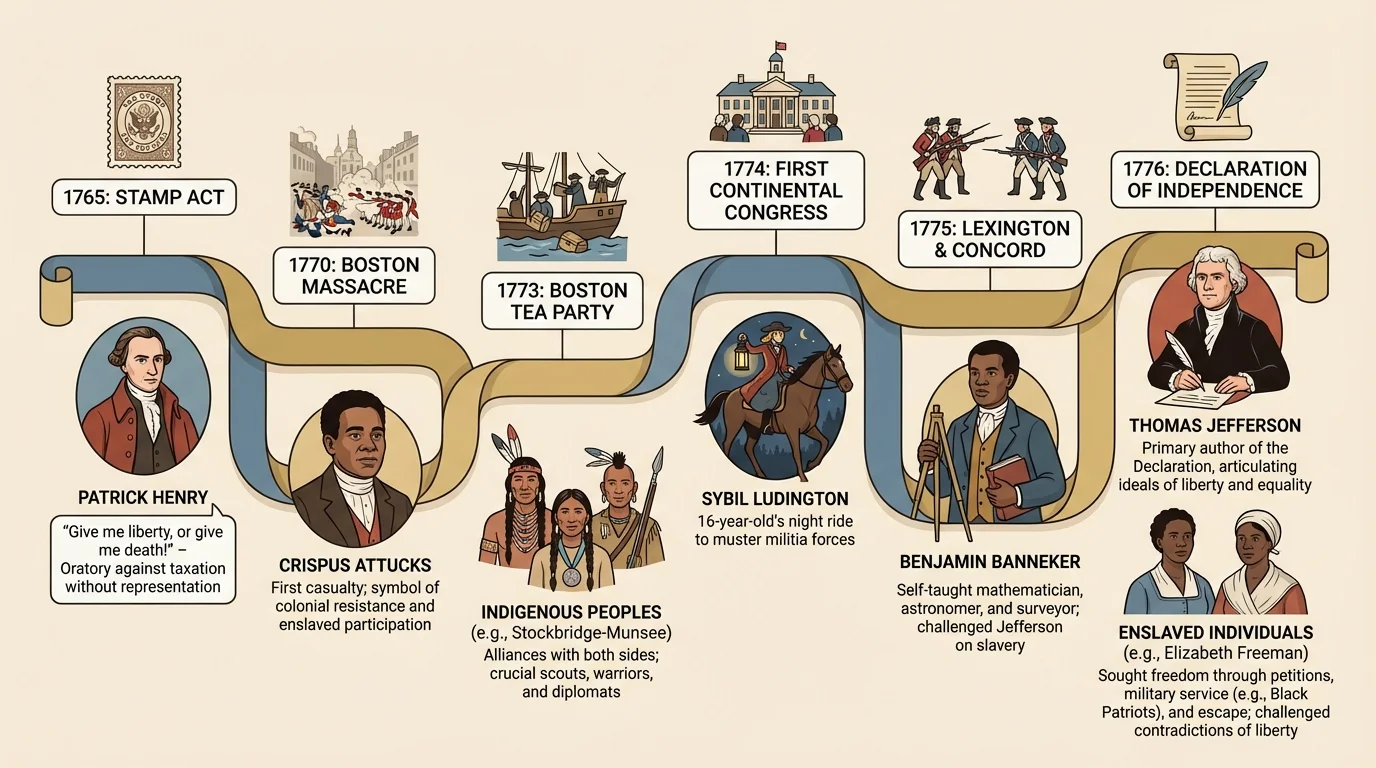
Colonists in the thirteen colonies argued more and more with Britain in the 1760s and 1770s. Tensions rose over taxes, laws, and the question of who should govern the colonies, and these events built on one another over time, as [Figure 2] shows through a sequence of major moments.
After the French and Indian War, Britain wanted the colonies to help pay war debts. Parliament passed taxes such as the Stamp Act. Many colonists protested because they believed it was unfair to be taxed by a government in which they had no direct representation. Protests grew into boycotts, public speeches, and eventually violent clashes.
The Boston Massacre, the Boston Tea Party, and the battles of Lexington and Concord pushed the colonies and Britain farther apart. Colonial leaders met in the Continental Congress to discuss what to do next.
One important colonial leader was Patrick Henry. He was a powerful speaker from Virginia. He believed Britain was taking away colonial rights. He is remembered for the line, "Give me liberty, or give me death!" His speeches encouraged resistance and helped inspire colonists to take action.
"Give me liberty, or give me death!"
— Patrick Henry
Another major figure was Thomas Jefferson. He wrote most of the Declaration of Independence in 1776. This document announced that the colonies were becoming independent states. Jefferson wrote that "all men are created equal" and have rights such as "life, liberty, and the pursuit of happiness." Those words became famous because they expressed big ideas about government and human rights.
But Jefferson's life also shows a major contradiction. He spoke about liberty while he enslaved people at his plantation. This is an important truth in history: some leaders used the language of freedom without giving freedom to everyone. The timeline in [Figure 2] helps place Jefferson and Henry within the fast-moving events that led to independence.
Ideas can change history. Speeches, pamphlets, and documents helped spread Revolutionary ideas. Leaders like Patrick Henry used spoken words to persuade people, while Thomas Jefferson used writing to explain why the colonies wanted independence.
European colonists contributed not only through famous leaders but also through everyday actions. Farmers, printers, shopkeepers, soldiers, and messengers all played a role. Some made uniforms, carried news, signed petitions, or fought in local militias. Revolution depended on many ordinary people as well as well-known names.
Slavery was a cruel system in which people were treated as property and forced to work without freedom. During the Revolutionary era, both enslaved and free Africans made important contributions, even though they lived under great injustice. The story of Crispus Attucks, introduced in [Figure 3], shows both courage and the unfairness of the time.
Crispus Attucks was a man of African and Native ancestry. He is often remembered as the first person killed in the Boston Massacre in 1770. His death became a symbol for colonists who opposed British rule. Because he died early in the conflict, many people later called him the first martyr of the American Revolution. A martyr is a person who dies for a cause or belief.
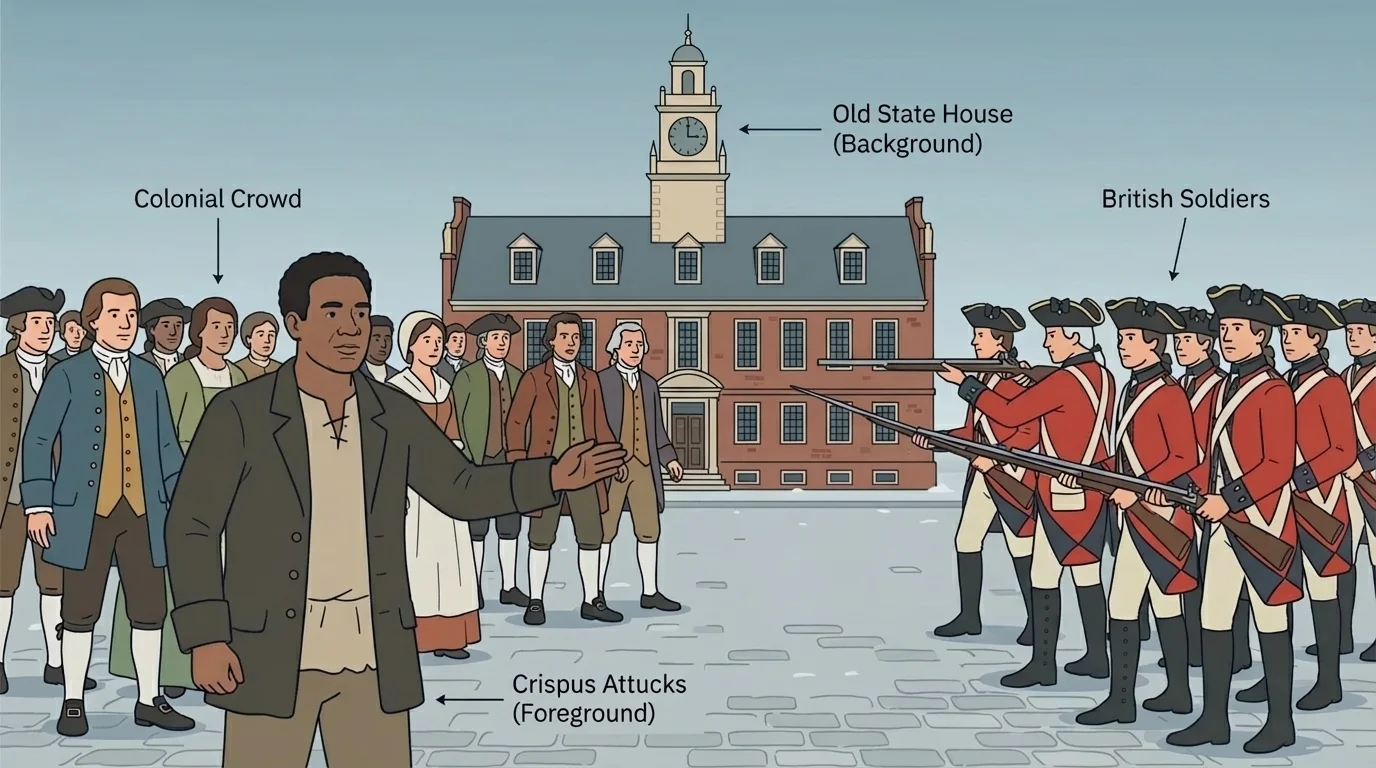
Attucks matters for more than one reason. He reminds us that people of African descent were present at the very center of Revolutionary events. He also reminds us that the fight for liberty included people who did not themselves enjoy full liberty.
Many enslaved people hoped the war would bring freedom. Some joined the British because British officials offered freedom to enslaved people who escaped rebel owners and supported the Crown. Others served with the colonists, hoping for freedom or a better future. Their choices were dangerous and difficult, and they often had to choose between unfair options.
Benjamin Banneker is another important figure. He was a free African American known for his skill in mathematics, astronomy, and surveying. He helped survey land for the new capital city, Washington, D.C. He also wrote a famous letter to Thomas Jefferson in 1791, challenging him to live up to the ideals of equality written during the Revolution.
Case study: Benjamin Banneker speaks up
Step 1: Banneker studied the stars, kept careful records, and became known for his scientific knowledge.
Step 2: He used writing, not weapons, to challenge unfairness by reminding Jefferson that African Americans were human beings deserving liberty.
Step 3: His example shows that contributions can be intellectual, moral, and political as well as military.
When we look back at Crispus Attucks in [Figure 3], we can see why Revolutionary language was powerful. Words like freedom and rights inspired people, but African Americans often had to fight to make those words apply to them too.
Women could not vote in the new nation, yet they made major contributions before and during the Revolution. Some organized homes and farms while men were away. Some made goods instead of buying British imports. Some carried information, wrote letters, raised money, or supported soldiers. Others took direct action, as [Figure 4] illustrates through the story of Sybil Luddington.
Sybil Luddington was a young woman from New York who is remembered for riding on horseback at night in 1777 to warn local militia forces that British troops were attacking Danbury, Connecticut. Her ride covered many miles through dark and difficult conditions. By spreading the alarm, she helped gather defenders quickly.
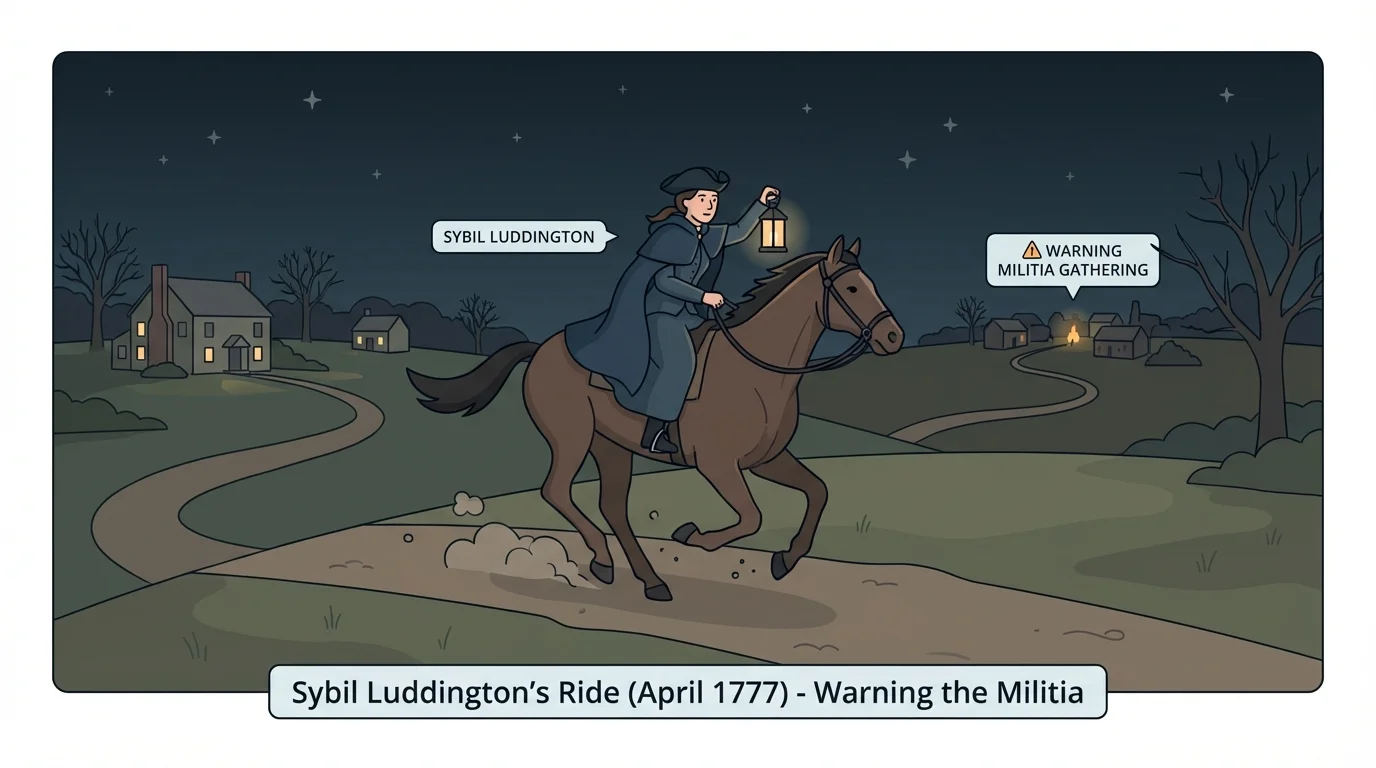
Sybil Luddington's contribution shows that young people and women could also influence events. She was not writing laws or leading a national army, but her action helped with communication, and communication was essential during wartime.
Women also participated in boycotts of British goods. If families stopped buying taxed items, Britain felt economic pressure. In this way, household choices became political actions. Some women followed armies and worked as cooks, nurses, and helpers. Their labor kept camps functioning.
Remember that a revolution is not only fought on battlefields. It also depends on communication, supplies, ideas, and everyday work done by many people.
Not all women experienced the era in the same way. Wealth, race, location, and whether a person was free or enslaved all affected daily life. An enslaved woman faced very different dangers than the wife of a wealthy planter or a girl carrying messages in a militia community.
The Revolution brought together many groups, but it did not give all of them the same rewards. Colonists won independence from Britain. Yet many African Americans remained enslaved. Women still had few political rights. Indigenous nations often lost land and power as the United States expanded.
This is why historians sometimes describe the Revolutionary era as both a time of great ideals and a time of deep contradictions. People spoke about equality while accepting inequality. They demanded self-government while denying many others a voice.
| Group | Important Contributions | Main Challenges |
|---|---|---|
| Indigenous Peoples | Diplomacy, alliances, defense of homelands, trade knowledge | Land loss, war, broken treaties |
| European colonists | Protests, speeches, writing, military service, political leadership | Conflict with Britain, division among colonists |
| Enslaved and free Africans | Military service, resistance, public protest, intellectual work | Slavery, racism, limited rights |
| Women | Communication, boycotts, nursing, managing homes and farms, warning rides | No voting rights, limited legal power |
Table 1. Comparison of contributions and challenges faced by major groups in the Revolutionary era.
Looking across the groups in Table 1 helps us understand that history is not only about famous leaders. It is also about communities making choices under pressure. The map in [Figure 1] and the night ride in [Figure 4] remind us that place and movement mattered, while the conflict events in [Figure 2] show how quickly political arguments can grow into war.
How do we know about these people and groups? Historians use primary sources and secondary sources. A primary source is something created during the time being studied, such as a letter, speech, map, diary, or newspaper. A secondary source is something made later by someone studying the past, such as a textbook or biography.
Patrick Henry's speeches, Thomas Jefferson's Declaration of Independence, and Benjamin Banneker's letter to Jefferson are examples of primary sources. Modern history books and museum exhibits are secondary sources. By comparing different kinds of evidence, historians can build a clearer picture of the past.
It is especially important to look for voices that were sometimes ignored in older histories. That includes Indigenous leaders, enslaved people, free African Americans, and women. When we include those voices, the story of the American Revolution becomes fuller and more accurate.
