More than 500 years ago, North America was not an empty place waiting to be discovered. It was already home to millions of people living in many different communities, speaking many languages, and following many traditions. Then European countries began building colonies here. Why would people cross an ocean to start over in a new place? The answers include power, religion, money, land, and trade. But those choices also brought terrible changes for Indigenous Peoples and for Africans who were captured and enslaved.
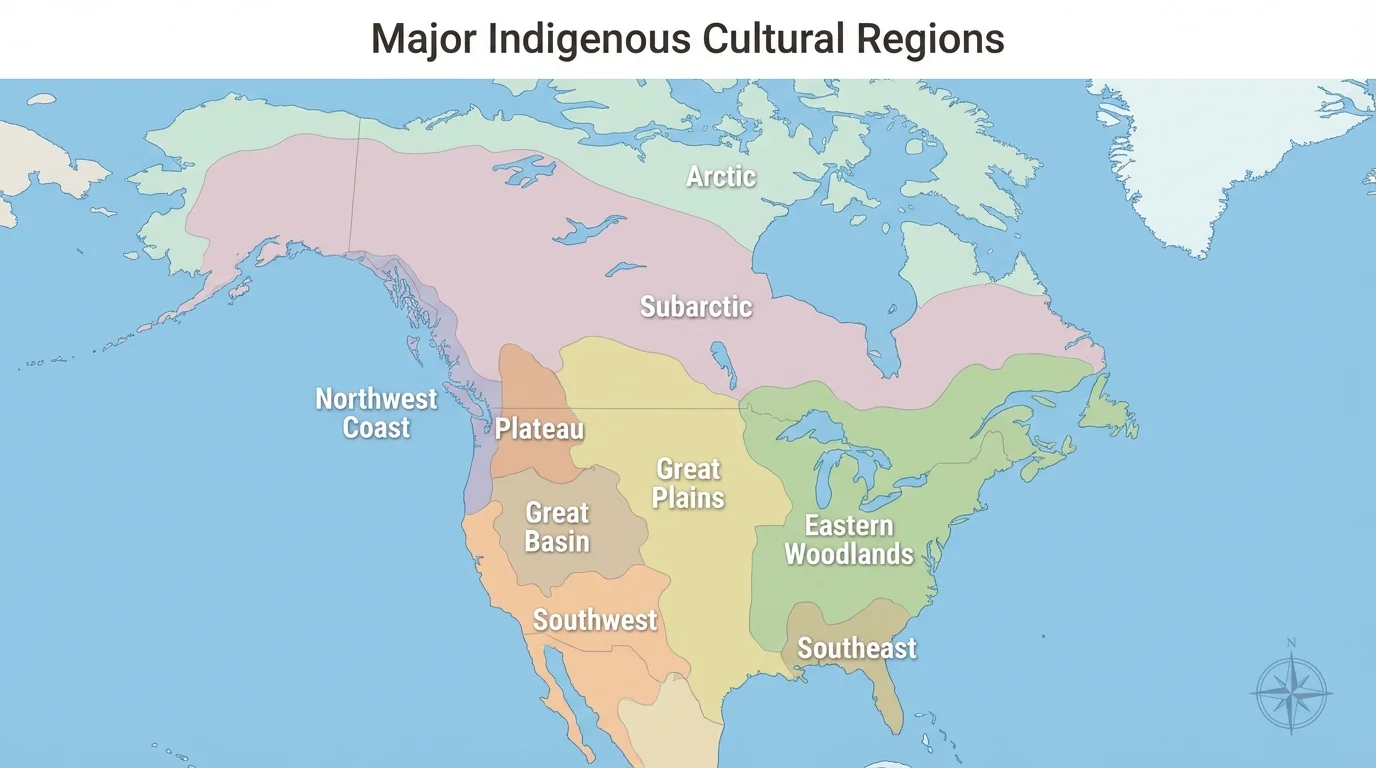
Before Europeans arrived, North America was home to many Indigenous Peoples, as [Figure 1] shows through different cultural regions across the continent. These were not all the same. The Haudenosaunee in the Northeast, the Cherokee in the Southeast, the Pueblo peoples in the Southwest, and the Inuit in the Arctic all had their own governments, homes, foods, and ways of life.
Some groups farmed corn, beans, and squash. Some hunted buffalo on the Great Plains. Some fished along the Northwest Coast. Many had strong trade networks and deep knowledge of the land. When European settlers arrived, they entered places that already had history, leaders, and communities.
Colony is a settlement controlled by another country.
Settlement is a place where people move and build homes and communities.
Colonization is the process of settling land and bringing it under the control of another power.
Understanding this starting point matters. If we only study the settlers, we miss the fact that colonization meant change forced onto people who were already there. That is why the story of colonies must include the experiences of Indigenous nations from the very beginning.
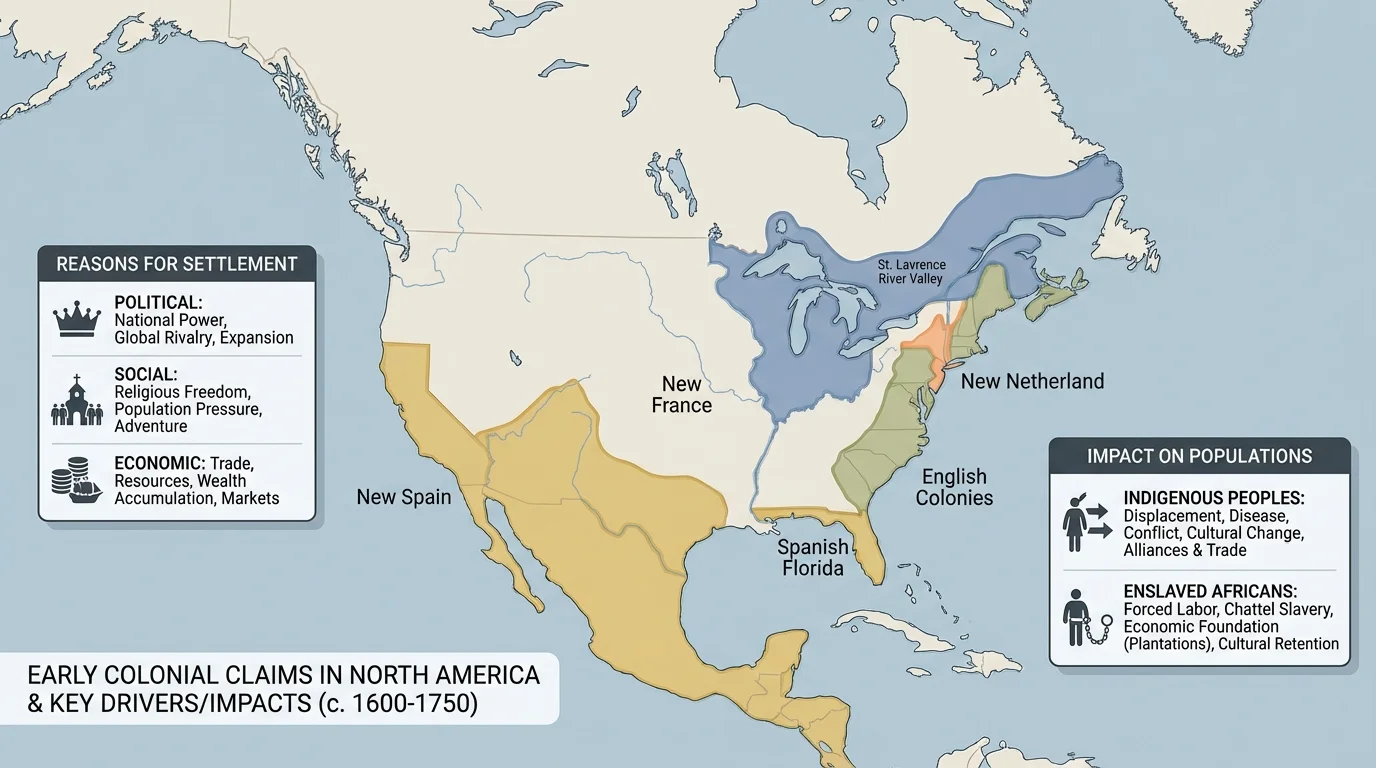
One major reason for colonization was empire. European countries such as Spain, France, England, and the Netherlands wanted more land and more power, as [Figure 2] illustrates with their competing claims in North America. If a country controlled more territory, it could become richer and stronger than its rivals.
These were political reasons for colonization. Kings and queens wanted to expand their rule. Governments wanted ports, forts, and trading centers. They also wanted to stop other countries from taking control first. In other words, colonies were often part of a contest for power.
Spain built settlements in places such as Florida and the Southwest. France focused on parts of Canada, the Great Lakes, and the Mississippi River valley. England created colonies along the Atlantic coast. The Dutch settled in areas such as New Netherland, near present-day New York. Each country hoped its colonies would strengthen the nation.
Political leaders also believed colonies could provide safety. A colony might offer a base for soldiers and ships. It could help protect trade routes. It could also give a country control over important rivers or coastlines. For rulers in Europe, colonies were not just faraway places. They were pieces in a struggle for influence.
St. Augustine, Florida, founded by the Spanish in 1565, is the oldest continuously occupied European-established settlement in what is now the United States.
Later, American colonists also pushed farther west for political reasons. As British colonies grew, settlers and colonial leaders wanted more land and more local control. After the United States became independent, expansion continued, often with harmful results for Native nations.
Not every colonist moved for the same reason. Some came because they hoped for a better life. Some wanted land. Some wanted to escape debt or poverty. Others came for religious freedom, meaning they wanted to worship in their own way.
For example, the Pilgrims came to Plymouth in 1620 partly because they wanted to practice their religion without interference. Puritans later settled in Massachusetts Bay for similar reasons, though they did not always allow religious freedom for everyone else. This reminds us that history can be complicated. A group may seek freedom for itself while denying freedom to others.
Some settlers were not fully free to choose. Indentured servants agreed to work for a set number of years in exchange for passage across the ocean. They hoped that after their service ended, they would own land or build a new life. Their lives were often harsh, but indentured servitude was different from slavery because it was not meant to last for life.
Social reasons for settlement include the hopes, fears, and beliefs that shape where people live. In the colonies, these reasons included religion, family plans, starting over after hardship, and joining communities from the same homeland.
Family connections mattered too. Once a settlement survived, letters and stories traveled back across the Atlantic. Relatives and neighbors sometimes followed. Over time, colonies grew not just because governments wanted them, but because ordinary people believed they could build homes there.
Another powerful cause of settlement was money. These were economic reasons. Governments, merchants, and settlers believed colonies could produce valuable goods such as tobacco, rice, indigo, timber, furs, and sugar. Colonies could also open new markets for trade.
Jamestown, founded by the English in 1607, began as a business project. Investors in the Virginia Company hoped to make a profit. At first the colony struggled badly. Many settlers died from hunger and disease. But tobacco farming eventually made Virginia profitable. That success encouraged more English settlement.
Land itself was seen as wealth. In Europe, many poor people could not easily own land. In North America, colonists believed they could gain farms and property. This hope attracted settlers, but it depended on taking land that Indigenous communities already used, lived on, or considered sacred.
Trade also shaped colonization. The French often built trading relationships, especially in the fur trade, with Native nations. Some alliances helped both sides in the short term, but they also drew Indigenous communities into European struggles and competition.
| Reason for settlement | What it means | Example |
|---|---|---|
| Political | Countries wanted power, land, and stronger empires | England and France competing for territory |
| Social | People wanted religious freedom or a fresh start | Pilgrims settling Plymouth |
| Economic | People wanted profit, resources, land, and trade | Jamestown growing tobacco for sale |
Table 1. Main political, social, and economic reasons for settlement with examples from colonial North America.
Economic goals often created a demand for labor. Large farms and plantations required many workers. This demand helped drive the terrible growth of slavery in the colonies.
Dates help us see how colonization grew over time, and [Figure 3] presents several important settlements and turning points in order. Colonization did not happen all at once. Different countries built settlements at different times and in different regions.
In 1492, Christopher Columbus reached lands in the Americas while sailing for Spain. Although he did not land in what is now the United States, his voyage helped begin lasting contact between Europe and the Americas. In 1565, the Spanish founded St. Augustine. In 1607, the English founded Jamestown. In 1620, the Pilgrims founded Plymouth.
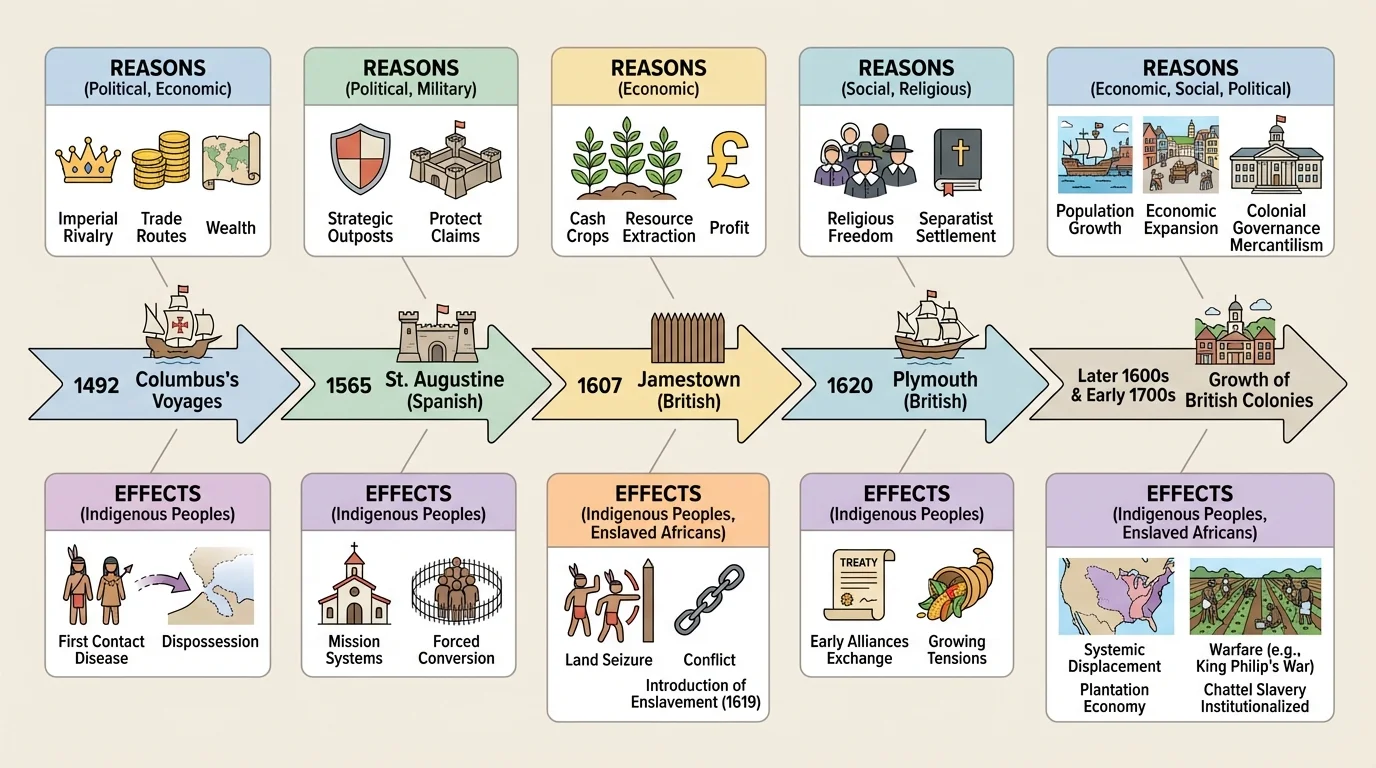
Spanish missions in the Southwest and California were built to spread Christianity and strengthen Spanish control. French settlements often grew near waterways important for travel and trade. British colonies along the Atlantic coast grew larger in population and developed local assemblies, farms, towns, and ports.
Key figures include John Smith, who helped Jamestown survive; Pocahontas, daughter of Powhatan, whose life became part of a famous and often misunderstood story; and leaders from many Native nations who negotiated, traded, resisted, or fought as colonization spread.
Case study: Jamestown and Plymouth
Step 1: Jamestown began mainly for economic reasons.
Investors hoped the colony would make money. Tobacco later made that possible.
Step 2: Plymouth began mainly for social and religious reasons.
The Pilgrims wanted a place to practice their faith.
Step 3: Both colonies depended on Native knowledge.
Settlers needed help learning about local crops, seasons, and survival.
This comparison shows that colonies could begin for different reasons, even when both were founded by English settlers.
Over time, the British colonies grew from a few fragile settlements into a chain of colonies along the Atlantic coast. As we see again in [Figure 3], the spread of settlements over many years led to more pressure on Native land and more labor demands in colonial economies.
The effects of colonization on Indigenous Peoples were deep and painful. One of the biggest changes was the loss of land. Colonists built towns, farms, roads, and forts on territory already occupied or used by Native nations.
Disease was another major cause of suffering. Europeans brought illnesses such as smallpox. Indigenous communities had not built immunity to these diseases, so many people died. In some places, disease spread even before large numbers of settlers arrived.
Conflict and war also increased. Sometimes Native nations formed alliances with European powers to protect themselves or gain advantage over rival groups. But these alliances could be risky. European wars often pulled Native communities into battles that were not originally their own.
Treaties and agreements were often broken. Colonists or governments might promise to respect boundaries and then ignore those promises when settlers wanted more land. This damaged trust and caused more violence.
Colonization changed daily life for Indigenous communities in many ways: people lost hunting grounds and farmland, families were forced to move, languages and beliefs came under pressure, and traditional governments faced outside control. Native nations did not simply disappear, however. They adapted, negotiated, resisted, and survived.
Resistance took many forms. Some communities fought in wars. Others used diplomacy, trade, or movement to new places. Indigenous Peoples remained active historical leaders, not just victims of events. Their choices shaped colonial history too.
Earlier, [Figure 1] shows how many different Indigenous regions existed before colonization. That map helps explain why the effects of colonization were not exactly the same everywhere. A Spanish mission system in the Southwest affected people differently from English farming settlements in New England or French trade networks near the Great Lakes.
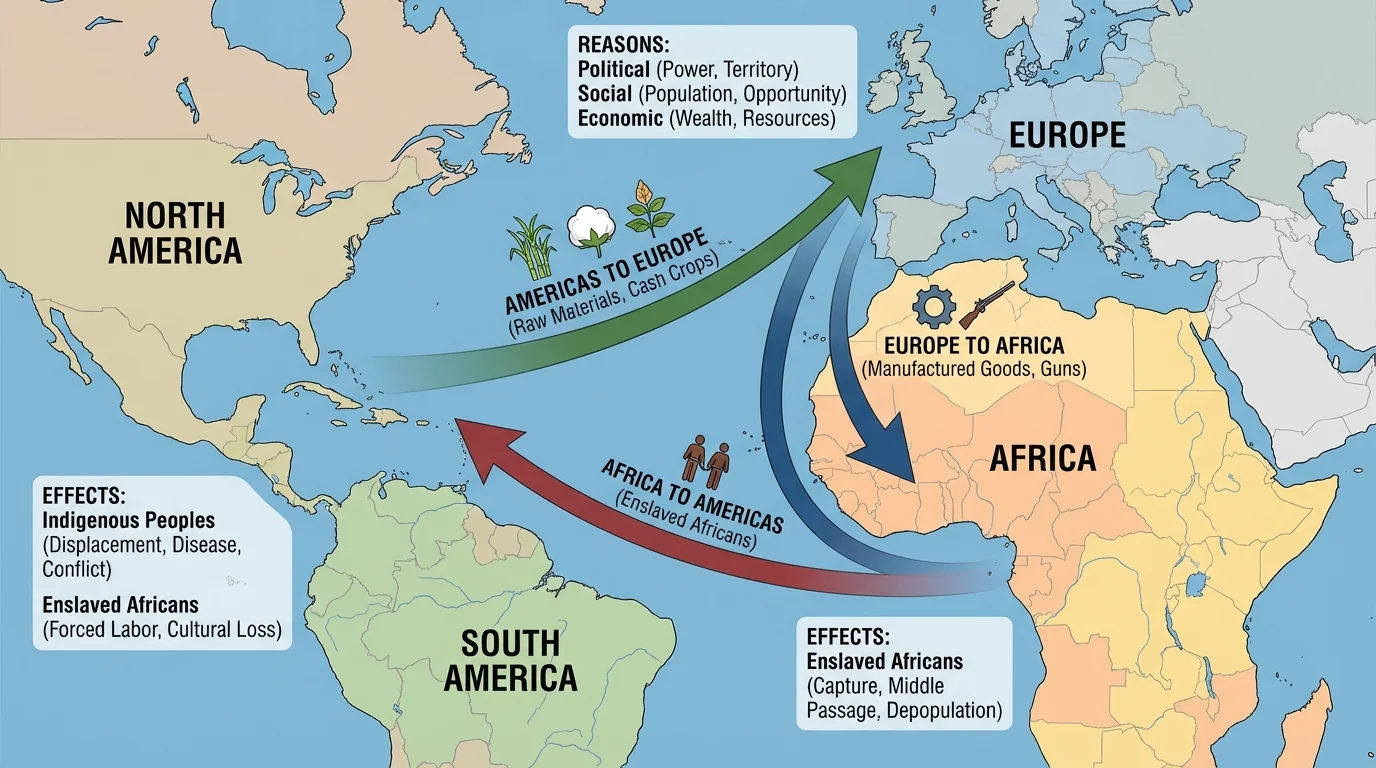
Colonial growth was also built on the suffering of enslaved Africans. Europeans and colonists forced millions of African people into slavery through the Atlantic slave trade, and [Figure 4] traces the ocean routes that connected Europe, Africa, and the Americas. Captured men, women, and children were taken from their homes, shipped across the ocean, and sold.
The middle part of this trade route, called the Middle Passage, was especially brutal. People were packed tightly into ships under terrible conditions. Many died before reaching the Americas. Those who survived were forced into labor on plantations, farms, docks, and in homes.
In the English colonies, enslaved labor became especially important in places growing tobacco, rice, and later cotton. Plantation owners made profits while enslaved people were denied freedom, safety, pay, and control over their own lives.
Families were often separated. People could be bought and sold as property. Laws were created to keep slavery in place and to make it hereditary, meaning children born to enslaved mothers were also enslaved. This made slavery a lasting system, not a temporary condition.
"No person was born to be property."
— A truth historians emphasize when studying slavery
Enslaved Africans resisted in many ways. Some preserved languages, music, stories, farming knowledge, and religious traditions. Some slowed work, escaped, or rebelled. Their courage reminds us that even under cruel systems, people struggled to keep their humanity and dignity.
The network of trade routes in [Figure 4] helps explain why slavery became tied to colonial economies. Goods, ships, and human beings were all treated as part of a trading system, but this system was morally wrong because it reduced human lives to profit.
The reasons for settlement can be grouped into three main kinds. Political reasons focused on power and control. Social reasons focused on belief, safety, and new beginnings. Economic reasons focused on wealth, land, resources, and trade.
These reasons often worked together. A king might want more territory, merchants might want profits, and families might want land. One colony could begin for one main reason and later grow for another. Jamestown is a good example: it began as a money-making project, but it later became a place where families settled too.
The consequences also connected to one another. When colonists wanted land for farming, Indigenous communities lost territory. When plantation farming expanded, the demand for enslaved labor grew. When empires competed, Native nations were caught in the middle of wars and alliances.
| Group | How colonization affected them |
|---|---|
| European settlers | Gained land, trade opportunities, and new communities, though many also faced hardship and danger |
| Indigenous Peoples | Lost land, suffered disease and war, faced pressure on culture, and resisted in many ways |
| Enslaved Africans | Were kidnapped, forced into labor, separated from families, and denied freedom while resisting oppression |
Table 2. Different groups experienced colonization in very different ways.
That is why historians ask not only, "Why were colonies settled?" but also, "Who benefited, and who was harmed?" Those questions help us study history more fairly.
Historians learn about colonial times from primary sources and secondary sources. A primary source is something made at the time, such as a letter, map, law, or diary. A secondary source is something created later by someone studying the past, such as a textbook or history article.
A colonial map might show where a country claimed land. A diary might reveal how a settler or traveler felt. An Indigenous oral history may preserve memories and teachings passed down through generations. Slave sale records can show how people were treated as property, while also helping historians trace lives and families.
When studying sources, ask who created the source, when it was made, and whose point of view is included or missing. A single source rarely tells the whole story.
Looking at many kinds of sources helps us understand that colonization was not one simple event. It was a long process involving hope, greed, fear, courage, violence, and survival. The story includes settlers, rulers, merchants, Native nations, and Africans who were forced into slavery.
