A banana from Central America, a T-shirt sewn in Asia, and a song with roots in Africa can all end up in the same town. That is a clue about something powerful: people, goods, and ideas are always moving. When groups interact, they change one another. Families may move to safer places, merchants may carry goods across oceans, and communities may borrow foods, words, music, and traditions from each other. Geography helps us understand these movements and the patterns they create.
Migration is the movement of people from one place to another, either within a country or between countries. People move for many reasons, and these reasons often connect to survival, opportunity, and hope. Some conditions push people away from a place, while other conditions pull them toward a new one.
[Figure 1] Push factors are problems that make people want or need to leave. These can include war, drought, flooding, lack of jobs, unsafe neighborhoods, or not enough land to farm. Pull factors are advantages that attract people to another place, such as better jobs, safer living conditions, good schools, freedom, or fertile land. A family might leave a dry farming area because crops have failed and move to a city where work is easier to find.
Geography matters a great deal. Mountains, rivers, deserts, climate, and natural resources can all affect movement. For example, a long drought can make farming difficult and force people to seek water and food elsewhere. A river valley with rich soil may attract settlers because it supports farming and transportation. Places are not equal in resources or safety, so movement often follows the geography of need and opportunity.
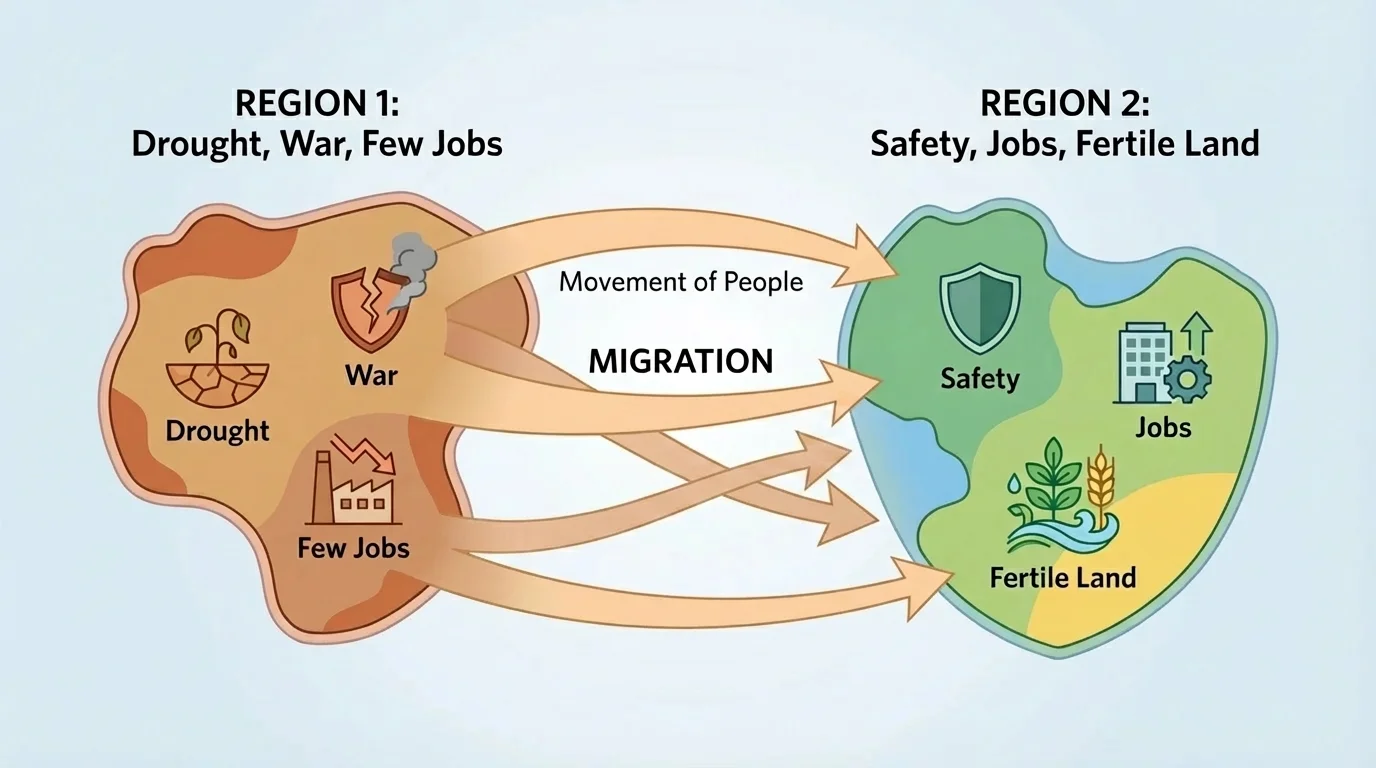
Push factors are conditions that drive people away from a place.
Pull factors are conditions that attract people to a new place.
People do not always move in the same way. Some migration is voluntary migration, which means people choose to move. They may want a new job, more land, or a different lifestyle. Other migration is forced migration, which means people must move because of danger, slavery, war, or disaster. Forced migration has happened many times in history, including the terrible removal and enslavement of millions of Africans across the Atlantic Ocean.
Migration can be short-distance or long-distance. A family may move from a farm to a nearby town, or from one state to another. Some people move from rural areas to cities because cities offer jobs, transportation, health care, and schools. This pattern is called urbanization, which means the growth of cities as more people move into them.
Movement can be temporary or permanent. Workers may move seasonally to harvest crops. Refugees may flee danger quickly and hope to return later. Other people settle in a new place and build homes, businesses, and communities there. Over time, migration changes both the place people leave and the place they join.
When many people leave an area, the population may shrink. Fewer workers may remain, and local traditions may change. But migrants often stay connected to their old homes by sending money, letters, or messages. When many people arrive in a new area, the population grows, neighborhoods expand, and schools, roads, and services may need to adjust. New languages, foods, and celebrations may become part of daily life.
Some of the biggest cities in the world grew quickly because they attracted migrants looking for work. Over time, those cities became places where many cultures met, mixed, and created new traditions.
Migration can also create challenges. If too many people arrive too quickly, there may not be enough housing, jobs, or clean water. Sometimes newcomers face unfair treatment or prejudice. At the same time, migrants bring skills, knowledge, and energy. They can start businesses, share farming techniques, and help cities and regions grow stronger.
Trade is the exchange of goods and services. Communities trade because no place has everything people need or want. One region may have fish, another may grow wheat, and another may produce cotton or metal. People trade so that each place can gain access to resources that are scarce nearby.
Trade often begins with specialization. That means a place focuses on producing what it can make well because of its climate, land, resources, or skills. A coastal community may catch fish. A fertile plain may grow corn. A forest region may provide timber. When different regions specialize, trade becomes useful because each region has something valuable to exchange.
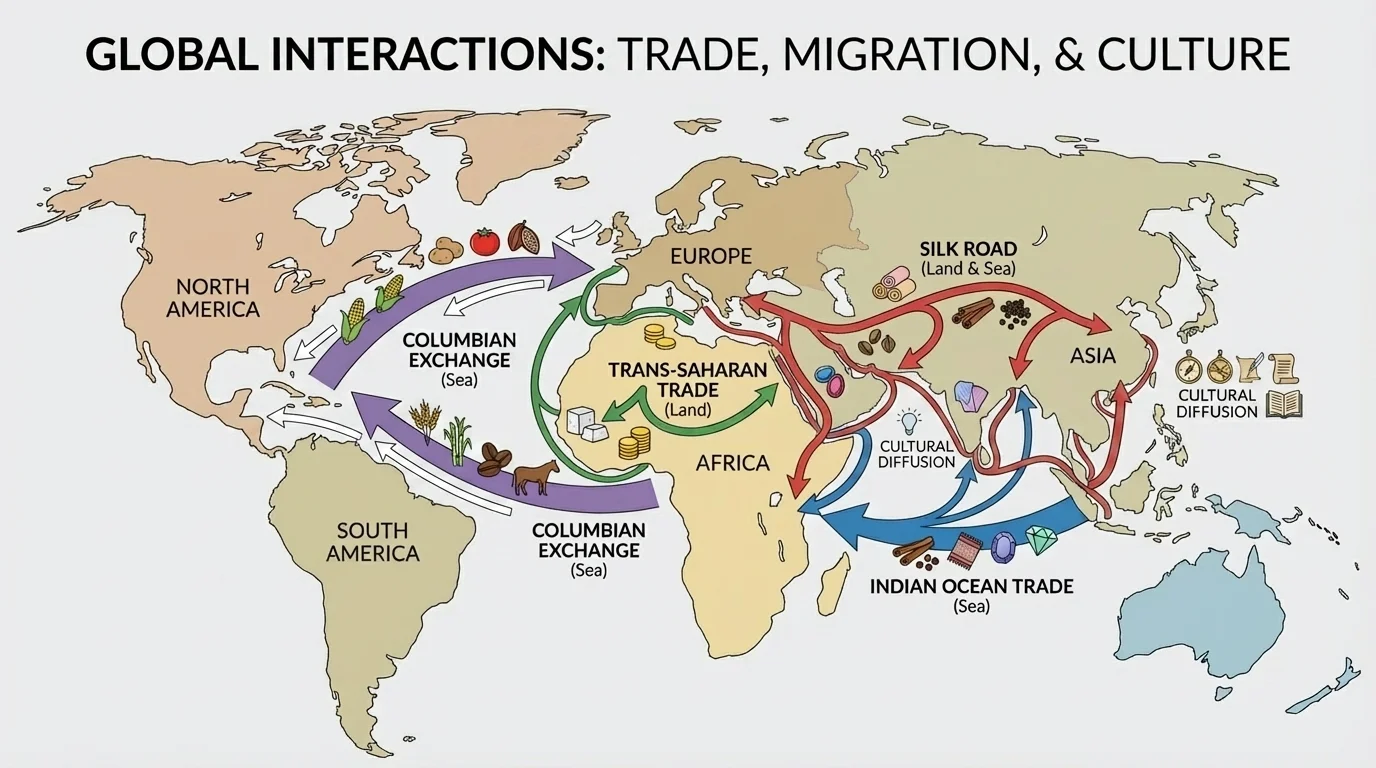
Trade routes form important geographic patterns, and [Figure 2] shows how land and sea routes connect distant regions. Rivers, roads, deserts, mountain passes, and oceans affect where trade happens. Long ago, traders used footpaths, camels, horses, and sailing ships. Today, goods move by trucks, trains, airplanes, and container ships. Transportation changes over time, but the basic idea stays the same: movement links places together.
Trade does more than move objects. It also spreads technology and ideas. If one group invents a better tool, that tool may spread through trade. Farming methods, writing systems, and ways to build ships or roads can travel with merchants. In this way, trade helps shape not only economies but also cultures.
| Region or Place | Resource or Product | Why It Was Traded |
|---|---|---|
| River valleys | Grain | Rich soil made farming productive |
| Coastal areas | Fish and shells | Easy access to oceans and seas |
| Forested regions | Timber and animal skins | Forests supplied wood and wildlife |
| Dry regions | Salt | Salt was important for preserving food |
Table 1. Examples of how geography influences what regions produce and trade.
Long before modern highways, Native peoples in North America built trade networks that stretched across large distances. Shells from the coast, copper from the Great Lakes area, and stones for tools moved from group to group. This shows that trade is not only an international story. It can happen among neighboring communities, across regions, and over many generations.
Culture includes the beliefs, customs, language, art, food, clothing, music, and traditions of a group of people. When people meet through migration or trade, they influence one another. This process is called cultural diffusion.
[Figure 3] Cultural diffusion can happen in many ways. A food from one place may become popular in another. Words from one language may enter another language. Clothing styles may spread. Music often shows cultural exchange clearly because instruments, rhythms, and singing styles can blend together. A city may celebrate festivals from many traditions because families from different backgrounds live there.
Not all cultural exchange is equal or peaceful. Sometimes powerful groups force their language or religion on others. Colonization often involved both exchange and unfair control. Indigenous peoples in many regions faced pressure to change their traditions, and some cultural knowledge was lost. At the same time, people often found ways to protect their identities and keep traditions alive.
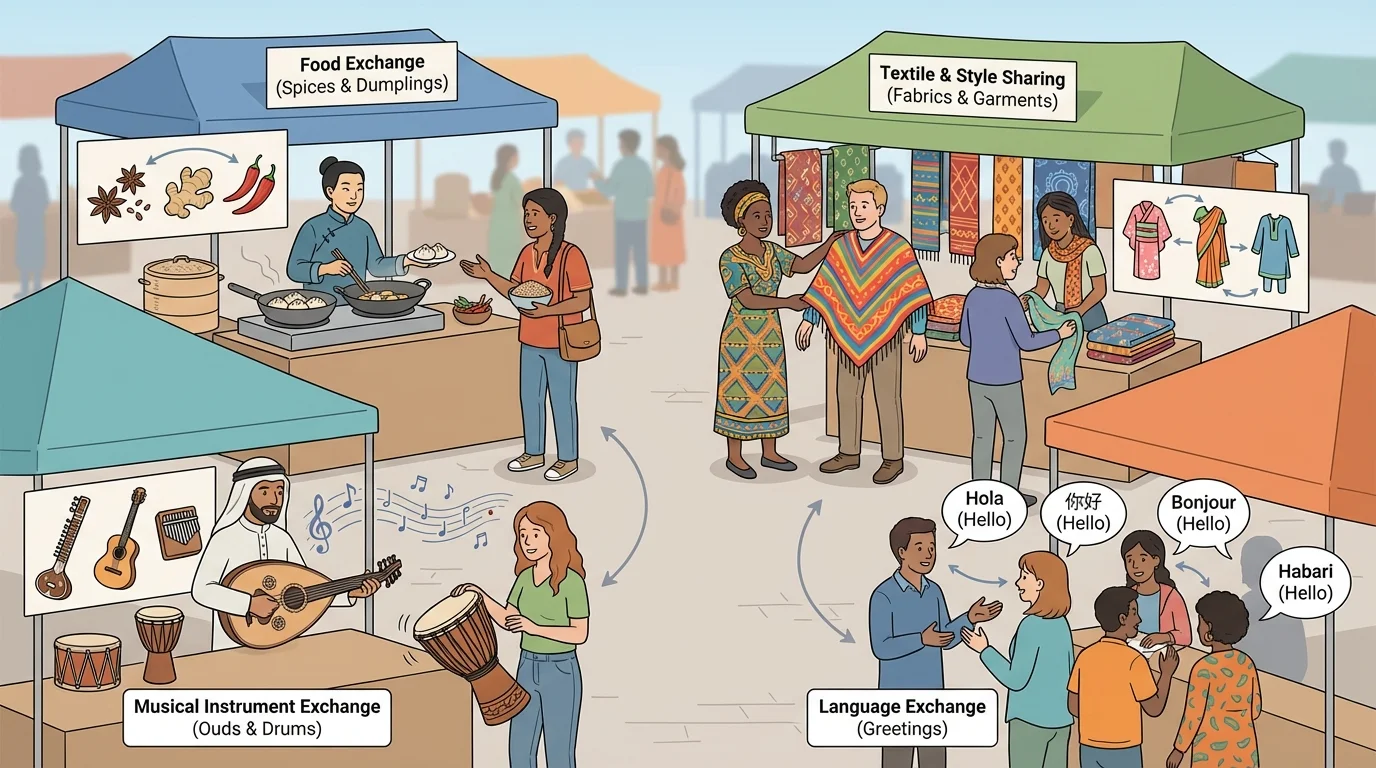
How interaction creates patterns
When movement happens again and again, it creates patterns that geographers can study. A route used by traders may become a road or port city. A place that attracts many migrants may become multilingual and culturally diverse. Repeated interactions shape settlements, markets, and traditions over time.
One interesting result of cultural contact is blending. New foods, holidays, music, and art forms can grow from mixed traditions. For example, foods in the Americas changed after crops like tomatoes, potatoes, and corn spread to other parts of the world, while horses, cattle, and wheat came to the Americas from Europe. This Columbian Exchange transformed diets, farming, and daily life across continents.
We can still see the effects today. As we saw earlier in [Figure 3], marketplaces, neighborhoods, and schools often become places where cultures meet. A student may eat food from one tradition, listen to music with roots in another, and use words borrowed from several languages without even noticing how connected the world has become.
The Silk Roads were a network of trade routes connecting Asia, Europe, and parts of Africa. Traders moved silk, spices, paper, and precious goods, but they also spread inventions and ideas. Religions such as Buddhism moved along these routes. This is a strong example of how trade and culture are linked.
Across the Sahara Desert in Africa, camel caravans carried salt, gold, and other goods between regions. Cities along these routes grew into important centers of trade and learning. Geography shaped these patterns because traders depended on oasis stops, desert knowledge, and animals that could handle harsh conditions.
In the Atlantic world, movement took very different forms. European settlers migrated to the Americas seeking land, wealth, and power. At the same time, millions of Africans were forced across the ocean in the slave trade. These movements changed populations, economies, and cultures across several continents. They also caused enormous suffering and injustice.
Case study: Moving to a city
A farming family lives in an area where rainfall has become unreliable.
Step 1: Identify the push factor
Drought makes crops fail, so farming becomes harder.
Step 2: Identify the pull factor
A nearby city offers factory jobs, schools, and medical care.
Step 3: Predict consequences
The village may lose population, while the city may grow and become more diverse.
This example shows how environment and opportunity work together to shape migration.
Modern migration continues these patterns. People move because of conflict, natural disasters, jobs, education, or family connections. Some settle in giant cities, while others move to smaller towns. Modern technology allows migrants to stay in contact with relatives far away, which keeps cultural ties strong even after moving.
Interactions among people and groups can lead to many consequences. Some are positive. Trade can increase access to food, tools, and clothing. Migration can help people find safety and opportunity. Cultural exchange can create new forms of art, language, and community life. Places with diverse populations often have rich cultural traditions and creative ideas.
Other consequences can be harmful. Competition for land or resources can lead to conflict. Diseases have spread along trade and migration routes. Powerful groups have sometimes controlled trade unfairly or forced people to move. Environmental damage can happen when forests are cut down, ports expand, or cities grow too quickly.
Geographers study both causes and consequences because movement is not just about where people go. It is also about what changes afterward. A trade route may help a town become wealthy. A migration wave may create new neighborhoods. A cultural exchange may enrich daily life while also raising questions about fairness, identity, and power.
Remember that geography is not only about landforms and maps. It also studies how people use space, move through places, and change regions over time.
Maps help geographers see patterns of movement and connection. Arrows may show where people move. Lines may show shipping routes, roads, or rivers used for trade. Colors can show where populations are growing or where cultural groups are concentrated.
[Figure 4] When reading a map, geographers ask questions such as: Where are the routes located? Why do they pass through certain places? What natural features help or block movement? How do cities, ports, rivers, and mountain gaps affect travel? Looking for these patterns helps explain why some places become important centers of trade or migration.
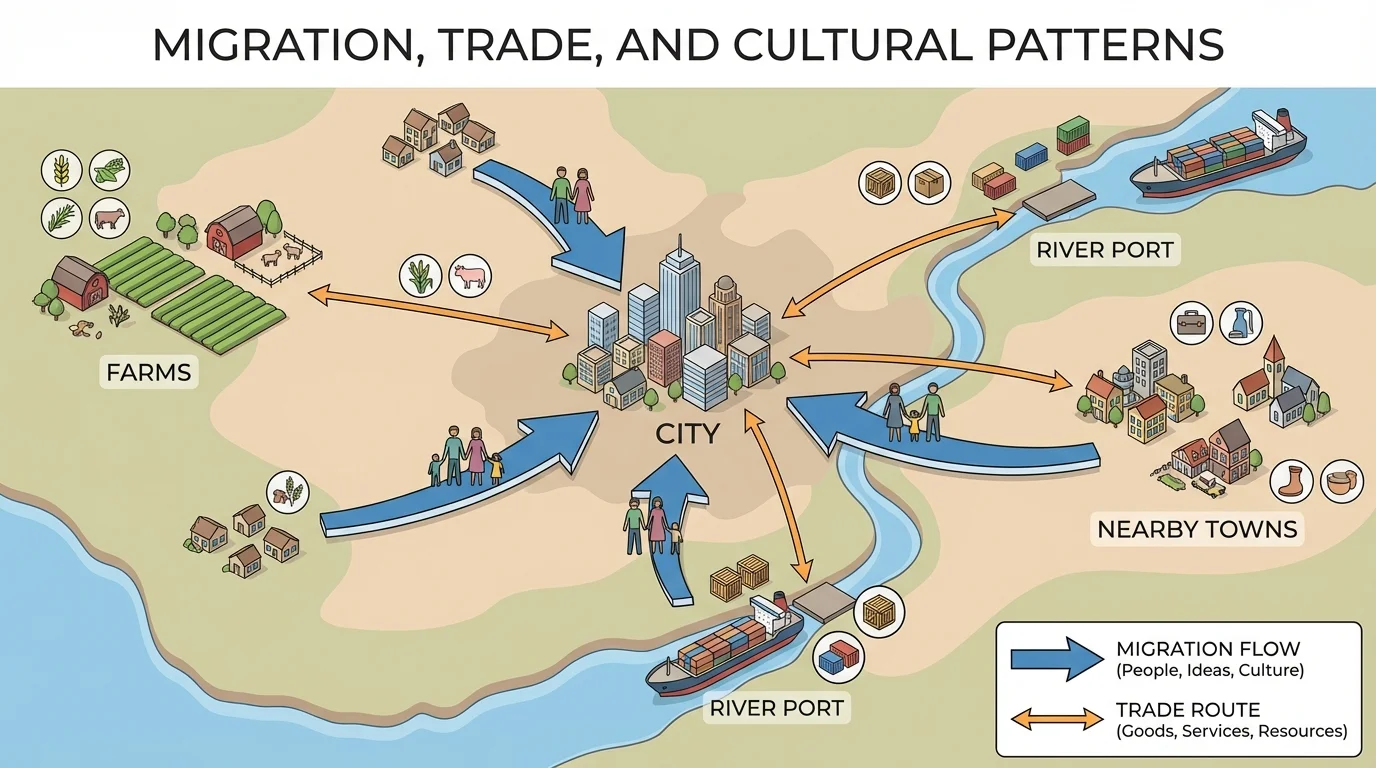
For example, a city near a river and a coastline may grow because it is easy to transport goods there. If jobs are available, migrants may also move to that city. Later, the city may develop neighborhoods with different languages, restaurants, and religious buildings. The map pattern helps explain the human story.
Earlier, [Figure 2] showed that trade routes often cross long distances, while [Figure 1] focused on why families or groups decide to move. Putting those ideas together helps us understand that movement is caused by needs and opportunities, but it also creates lasting patterns on the land.
"People, goods, and ideas move across Earth, and each movement leaves a mark on places and cultures."
Whether people are traveling for safety, merchants are exchanging goods, or communities are sharing traditions, interactions among groups help shape the world. The foods in stores, the languages heard in neighborhoods, the routes on maps, and the histories of cities all tell the story of movement. Geography helps us read that story by asking where movement happens, why it happens, and what changes because of it.
