The United States has always been a place where many different groups of people met, worked together, argued, traded, competed, and sometimes fought. That mix helped build the country, but it also created deep divisions. When people move into a new place, they bring languages, beliefs, skills, and traditions. Sometimes that leads to cooperation. Sometimes it leads to conflict over land, power, money, and rights. To understand the United States, we need to look at both.
Long before the United States existed, Native American nations lived across North America. They built communities, traded with one another, and used the land in different ways. Later, Europeans arrived, followed by Africans who were forcibly brought here through the transatlantic slave trade, and then people from many parts of the world came by choice or by need. This constant migration changed where people lived and how regions developed.
Geography matters in this story. Rivers, coastlines, plains, mountains, and rich farmland affected where people settled. Ports helped cities grow. Fertile soil made plantation farming profitable in the South. Open land drew settlers west. These geographic features influenced who moved, where they moved, and what kinds of cooperation and conflict followed.
Cooperation means people working together to reach a goal. Conflict means serious disagreement or struggle. A division is a split between groups. In history, divisions can be political about government and laws, economic about money, jobs, and resources, or social about how people live together and treat one another.
These divisions did not appear all at once. They grew as people moved, claimed land, built towns, started businesses, and made laws. Sometimes groups helped one another survive. At other times, one group tried to control another. Both cooperation and conflict shaped the nation.
When European settlers moved into lands already occupied by Native nations, relationships changed quickly, as [Figure 1] shows through patterns of settlement and movement. At first, there were many examples of cooperation. Native peoples taught colonists how to grow crops in local conditions, travel waterways, and survive harsh winters. Trade networks connected Native groups and Europeans, and alliances formed during wars between European empires.
But cooperation did not erase conflict. Colonists wanted more land for farms and towns. Native nations wanted to protect their homelands, governments, and ways of life. These different goals caused warfare, broken agreements, and forced movement. Disease brought by Europeans also caused terrible losses among Native populations, weakening many communities.
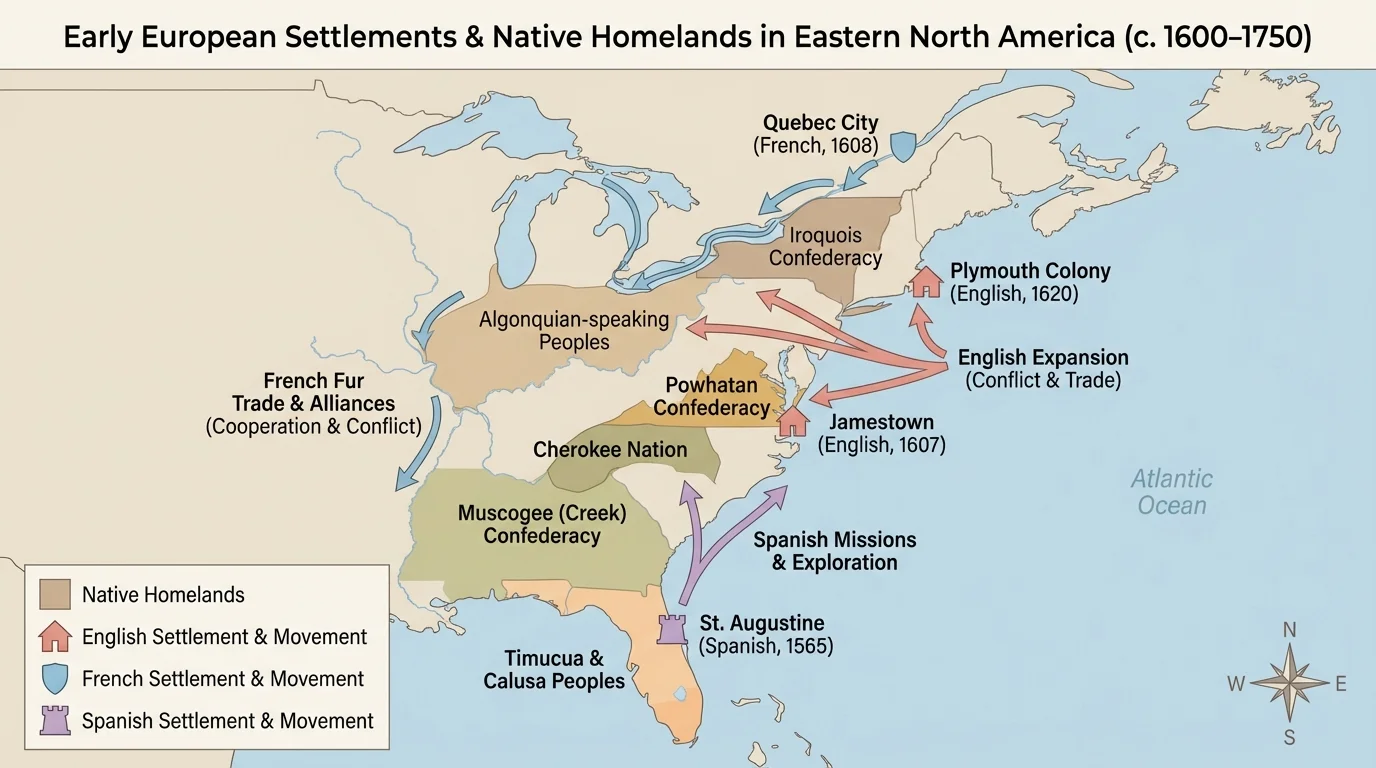
This created political divisions because leaders argued over who controlled land and whose laws counted. It created social divisions because people often saw one another as enemies instead of neighbors. It also created economic divisions because colonists gained access to land and trade while Native communities lost resources and security.
One important pattern in U.S. history begins here: movement into a region often benefits some groups while harming others. That pattern appears again and again, including later westward expansion. We can still see the same idea from [Figure 1] when we study how settlement spread beyond the coast.
Another major cause of division was the forced movement of Africans across the Atlantic Ocean. Enslaved Africans were kidnapped, sold, and made to work without freedom. This system was cruel and violent, but it became a huge part of the economy in many colonies and later in Southern states.
The South developed an economy based heavily on plantation agriculture, especially crops such as tobacco, rice, sugar, and cotton. Enslaved labor created wealth for plantation owners and supported trade with other regions and countries. Meanwhile, many people in the North worked in trade, shipping, small farms, and later factories. Because regions developed differently, they often wanted different laws and policies.
How labor systems create divisions
When one group controls another group's work, freedom, and pay, unfair economic systems grow. Those systems can make some people rich while forcing others into hardship. Over time, the unfairness spreads into politics and social life because laws, schools, voting rules, and daily behavior may be shaped to protect the system.
Slavery caused economic divisions because the Southern economy depended on it while many Northerners wanted different economic policies. It caused political divisions because people argued over whether slavery should expand into new territories. It caused social divisions because racist ideas were used to defend slavery and deny equal humanity to Black people.
At the same time, enslaved people resisted in many ways. They preserved family ties, music, religion, and cultural traditions. Some escaped, some rebelled, and many fought every day to protect their dignity. Their resistance reminds us that people facing injustice are not passive. They act, cooperate, and endure.
As the United States expanded west, routes, land claims, and new settlements spread both opportunity and conflict, as [Figure 2] illustrates. Some Americans saw western land as a chance for farms, mining, and new towns. Others already lived there, including Native nations, Mexican communities in the Southwest, and people with different ideas about the future of those territories.
Government policies encouraged settlers to move west. Roads, trails, and later railroads made travel easier. But expansion often meant that Native peoples were pushed off their land. One tragic example was Indian Removal, when the U.S. government forced Native nations in the Southeast to move west of the Mississippi River. The Cherokee and other nations suffered greatly on these removal routes.
Westward movement also raised a major question: would new territories allow slavery or not? This was not a small issue. It affected power in Congress, state laws, and the future shape of the country. As new lands entered the Union, debates became more intense.
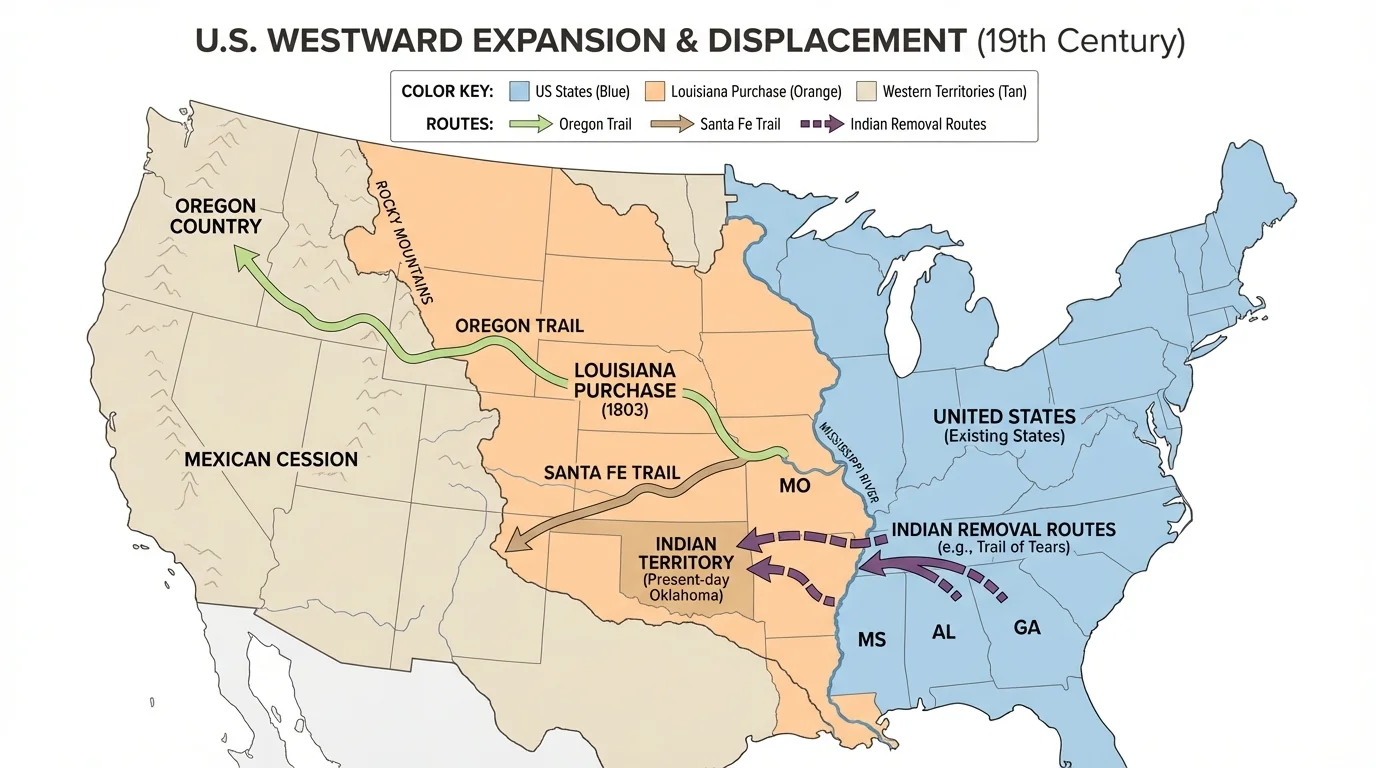
These arguments increased sectionalism, or strong loyalty to one region instead of the whole country. Northerners and Southerners often saw national problems in very different ways. Geography helped create these differences because each region had different land, resources, climate, and labor systems.
Movement is not only about people traveling. It is also about who gets displaced. The western story includes settlers moving in, Native nations being forced out, and fierce debates over law and power. That is why the patterns in [Figure 2] matter so much: migration routes can also become paths of conflict.
The Oregon Trail stretched about 2,000 miles. Families who traveled west often faced hunger, illness, and dangerous weather, showing that movement could bring hope but also great risk.
Not all conflict was between settlers and Native peoples. Some western lands had belonged to Mexico before the Mexican-American War. After the war, many Mexican residents suddenly found themselves living in the United States. This changed political control and often led to unfair treatment, land loss, and social tension.
In the 1800s and early 1900s, millions of immigrants arrived from Europe, Asia, and other parts of the world. Many settled in cities where jobs, transportation, and communities were growing, as [Figure 3] shows in a crowded urban neighborhood. They helped build railroads, work in factories, run stores, and strengthen neighborhoods by bringing languages, foods, religions, and traditions from around the world.
Immigrant groups often cooperated by forming churches, mutual aid societies, labor groups, and family businesses. These organizations helped newcomers find homes, jobs, and support. Cities became places of exchange, where many cultures met and influenced one another.
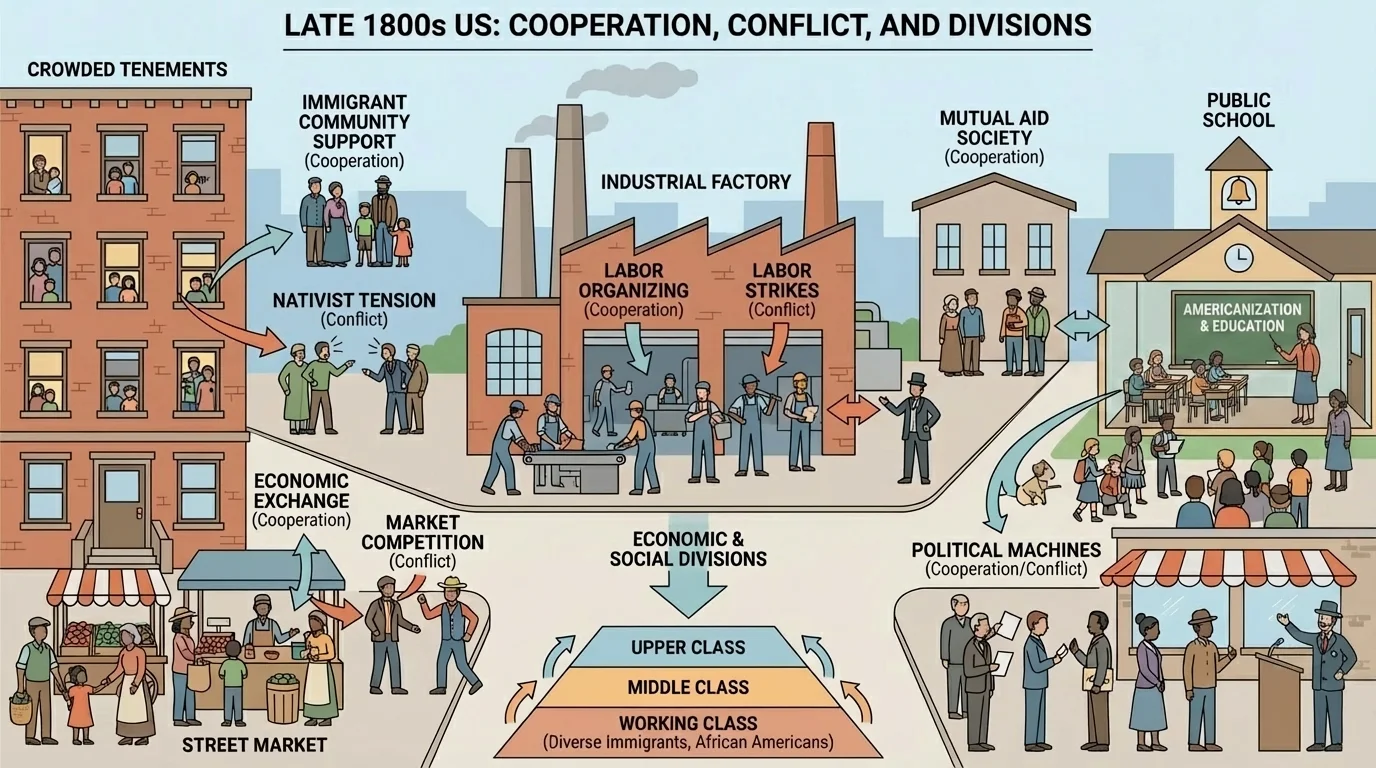
Yet immigration also led to conflict. Some Americans feared job competition or disliked people who seemed different. This led to prejudice, unfair stereotypes, and discriminatory laws. For example, the Chinese Exclusion Act limited immigration from China. Other groups, including Irish, Italian, Jewish, and Mexican immigrants, also faced hostility.
These tensions created social divisions in schools, neighborhoods, and workplaces. They also caused political divisions because leaders disagreed over who should be allowed into the country and what rights immigrants should have. Economic divisions grew when immigrants were paid low wages or forced to work in dangerous conditions.
Still, cooperation remained important. Workers from different backgrounds sometimes joined together to ask for safer workplaces and fairer pay. The busy city life seen in [Figure 3] reminds us that shared spaces can create both conflict and teamwork at the same time.
By the mid-1800s, repeated arguments over slavery, power, and state authority had built up over time, as [Figure 4] traces through key events. The North and South disagreed about the future of slavery, the balance of power in Congress, and whether states could ignore federal laws. These disagreements became so serious that they led to the Civil War.
The Civil War was the most extreme result of political, economic, and social division in U.S. history. It was not caused by one event alone. It grew from decades of conflict over slavery and regional power. Leaders tried compromises, but the divisions kept deepening.
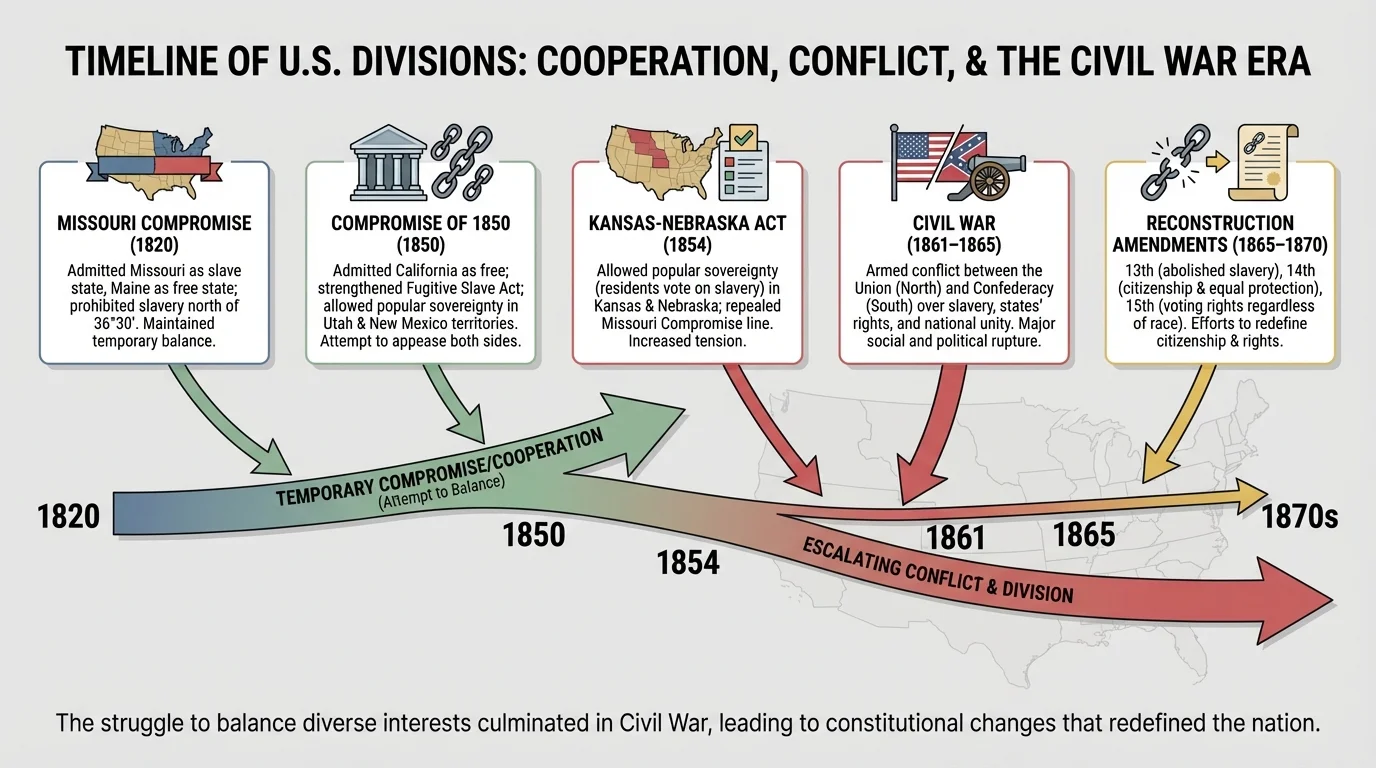
During the war, enslaved people sought freedom, and many Black soldiers fought for the Union. After the war, the period called Reconstruction attempted to rebuild the nation and create new rights for formerly enslaved people. Constitutional amendments ended slavery, defined citizenship, and protected voting rights for men.
But Reconstruction faced fierce resistance. White supremacist groups used violence and fear to keep power. New laws and practices limited Black freedom and voting. This shows that cooperation can make progress, but conflict and prejudice can try to stop it.
The timeline in [Figure 4] helps us see that great divisions often grow step by step. A single war may look sudden, but it usually comes after many smaller struggles, compromises, and failures.
"A house divided against itself cannot stand."
— Abraham Lincoln
Lincoln used these words before the Civil War to warn that the nation could not remain half free and half enslaved forever. His message shows how deeply connected politics, economics, and social life had become.
Conflict has divided the United States many times, but cooperation has also helped push the country toward greater fairness. Workers organized unions to demand safer conditions and shorter hours. Reformers fought for women's suffrage, child labor laws, and better schools. Civil rights leaders challenged segregation and discrimination.
These movements often brought together people from different backgrounds. Black and white activists sometimes worked side by side. Men and women supported one another in campaigns for voting rights. Religious groups, students, and community leaders joined protests and boycotts. Cooperation across groups became a powerful force for change.
Case study: The Civil Rights Movement
In the 1950s and 1960s, many Americans worked together to challenge segregation.
Step 1: Identify the problem
Segregation laws and customs kept Black Americans separated from white Americans in schools, transportation, housing, and public places.
Step 2: Notice cooperation
Students, ministers, parents, lawyers, and community organizers cooperated in marches, court cases, bus boycotts, and voter registration drives.
Step 3: See the conflict
Many people resisted change through unfair laws, arrests, threats, and violence.
Step 4: Understand the result
The movement helped win important civil rights laws, but it did not end all divisions.
This pattern appears again and again in U.S. history: when people work together, they can challenge unfair systems. But when groups refuse to share power or respect rights, conflict can deepen.
The category of geography helps us ask important questions: Why did people move? Where did they settle? Who already lived there? What were the consequences? These questions matter because movement changes places.
People move for many reasons: jobs, land, safety, freedom, war, family, or government orders. Some movement is voluntary, such as immigration for opportunity. Some movement is forced, such as slavery, Indian Removal, or refugee flight. The causes are different, and so are the consequences.
| Type of movement | Main cause | Possible cooperation | Possible conflict |
|---|---|---|---|
| European settlement | Land, trade, empire | Trade, shared knowledge | War, displacement of Native peoples |
| Forced migration of Africans | Slave trade | Cultural survival, resistance networks | Slavery, racism, unequal power |
| Westward expansion | Land, resources, farming | New communities, transportation links | Native removal, conflict over slavery |
| Immigration to cities | Jobs, safety, opportunity | Neighborhood support, labor organizing | Prejudice, unfair laws, wage competition |
| Great Migration | Escape racism, find jobs | Stronger urban communities | Housing discrimination, racial tension |
Table 1. Examples of movement in U.S. history, their causes, and how they led to both cooperation and conflict.
Geography also shapes power. A river can become a trade route. A port city can attract immigrants. Rich farmland can lead to competition. Mountains can separate communities. Because of geography, groups do not all meet under the same conditions. Some regions grow faster, some gain more wealth, and some face more pressure and struggle.
Earlier geography studies showed that people move because of push and pull factors. A push factor drives people away, such as war or hunger. A pull factor attracts people, such as jobs or safety. In U.S. history, both kinds of factors helped shape divisions.
The Great Migration is one important example. In the early and mid-1900s, many African Americans moved from the rural South to Northern and Midwestern cities. They hoped to escape racist violence and find industrial jobs. This movement changed music, politics, culture, and city life, but it also led to housing discrimination and tension in some neighborhoods.
The past continues to affect the present. Some communities today still show patterns created long ago by migration, segregation, and unequal laws. Neighborhoods may be separated by income or race. Job opportunities may be different from one place to another. Political disagreements can still reflect old regional and social divisions.
At the same time, the United States continues to be shaped by cooperation among diverse groups. Communities respond to disasters together, students learn in multicultural schools, workers join for fair treatment, and neighbors share traditions from many cultures. Diversity can create tension, but it can also create strength, creativity, and problem-solving.
Understanding history helps us avoid simple answers. Different groups did not always agree, and they did not all have equal power. Some groups gained land, wealth, and influence. Others lost freedom, safety, or rights. Looking honestly at both cooperation and conflict helps explain why the nation has both unity and division.
When we study movement, geography, and human relationships, we see that divisions are not just ideas. They are connected to where people live, how they move, what resources they control, and whether laws treat them fairly. That is why the history of diverse groups in the United States is also the history of its political, economic, and social divisions.
