Think about your breakfast this morning. Maybe you ate toast, fruit, or cereal. None of those things simply "appeared." A loaf of bread started as wheat grown in the soil, needed people to grow and bake it, and depended on tools and machines to move it from farm to table. Economists study these connections. They ask a simple but powerful question: What resources are needed to produce the things people want and need?
To answer that question, we learn about three major productive resources: land, labor, and capital. These resources help people produce goods, which are things you can touch, and services, which are jobs people do for others. Understanding these ideas also helps explain history. In Early America, different colonies had different resources, so they produced different goods and traded with one another. Trade patterns helped shape how regions grew and changed.
A productive resource is something used to make goods or services. Economists often group productive resources into three main categories: land, labor, and capital. These are sometimes called the "factors of production."
Goods are objects that people make or use, such as shoes, bread, books, or tables.
Services are actions that people do for others, such as teaching, cutting hair, transporting goods, or repairing a bicycle.
Production means making goods or providing services.
Whenever something is produced, these resources usually work together. A carpenter cannot build a chair without wood from nature, human effort, and tools. A teacher cannot provide a lesson without human skill, a classroom or computer, and materials such as books or paper. Even when the final result is different, the need for productive resources stays the same.
In economics, land does not mean only a field or a yard. It means all the natural resources that come from Earth. This includes soil, forests, rivers, oceans, minerals, and even sunlight and water. Land provides the raw materials people need before anything can be made.
For example, farmers use fertile soil and water to grow corn and wheat. Fishers depend on oceans, rivers, and lakes to catch fish. Builders need trees for lumber and stone or clay for construction materials. A factory making paper begins with trees. A bakery begins with crops that were grown in soil. Land is the starting point for many goods.
Land also matters for services. A tour guide at a national park depends on forests, mountains, or wildlife habitats. A ferry service depends on waterways. In this way, land is not only important for products in stores but also for jobs that help people travel, learn, or enjoy nature.
Some colonies in Early America had rocky soil, which made large farming difficult. Because of that, many people in New England turned to fishing, shipbuilding, and trade instead of relying on large-scale cash-crop farming.
Land resources are not the same everywhere. That difference matters. Colonists living near good harbors could trade more easily by ship. Colonists living where soil was rich could grow more crops. Because each area had different natural resources, each area often specialized in different jobs and products.
Labor is the human effort used to produce goods and services. Labor includes physical work, like digging, planting, building, and lifting. It also includes mental work, like planning, teaching, writing, measuring, and solving problems. Workers use their time, energy, and skills as part of production.
A farmer planting seeds, a blacksmith shaping metal, and a sailor guiding a ship all provide labor. So do a doctor caring for patients, a shopkeeper helping customers, and a teacher explaining a new idea. Labor is not just "working hard." It also includes knowledge and training. A person who learns a skill can often produce better work or work more efficiently.
In Early America, labor was especially important because many tasks had to be done by hand. Fields had to be cleared, crops planted and harvested, ships loaded, and buildings constructed. Families worked together, and many communities depended on skilled workers such as coopers, millers, printers, weavers, and carpenters.
Labor can change over time. If workers gain more skill, they may produce more or produce higher-quality goods. For example, an experienced shipbuilder can help make stronger ships. Better labor can improve trade because stronger ships can carry more goods over longer distances.
Capital means the tools, machines, buildings, and equipment used to produce goods and services. In economics, capital does not simply mean money. Money can be used to buy capital, but capital itself is the useful thing that helps people produce.
A hammer, fishing net, oven, tractor, road, mill, wagon, shop building, and printing press are all examples of capital. Capital helps workers do jobs faster, more safely, or with better results. A farmer using a plow can prepare soil more quickly than a farmer using only a stick. A mill can grind grain into flour much faster than a person grinding it by hand.
Capital is especially important because it increases what workers can do. If one baker has only a bowl and spoon, that baker can make some bread. If the baker also has mixers, ovens, shelves, and delivery carts, the bakery can make much more bread. Capital does not replace all labor, but it can make labor more productive.
How capital improves production
When people invest in better tools and equipment, they can often produce more goods or better services in less time. A water-powered mill in colonial times could process grain for many families. That saved time and allowed more flour to be traded.
Capital also supported trade in Early America. Harbors, docks, warehouses, roads, and ships were forms of capital. They made it possible to move products from one place to another. Without this equipment and infrastructure, trade would have been slower and more difficult.
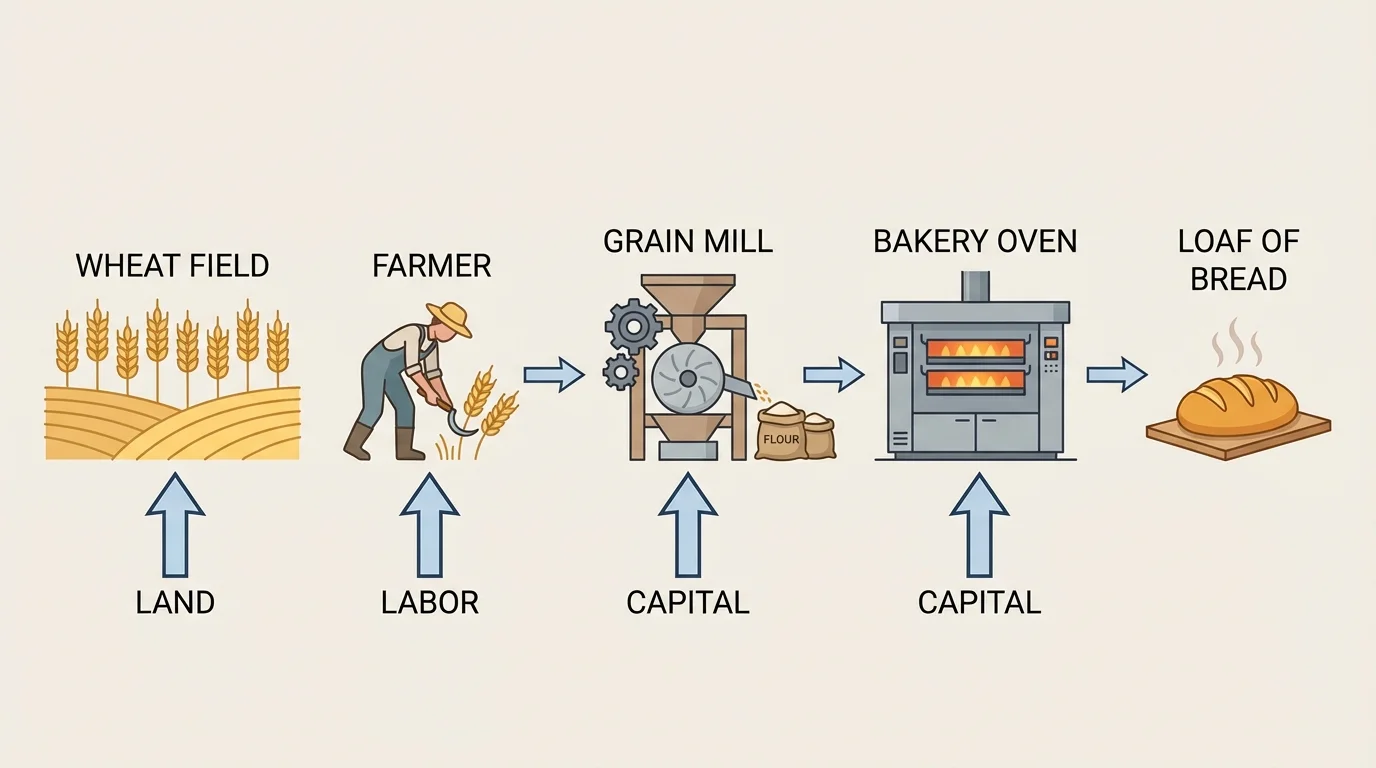
[Figure 1] shows that no product is made with only one resource. One loaf of bread depends on natural materials, human effort, and tools working together. Economists look at production by asking how land, labor, and capital combine to create a final good or service.
Take bread as an example. Land provides soil, water, and sunlight to grow wheat. Labor includes farmers planting and harvesting, mill workers grinding grain, bakers mixing dough, and drivers delivering the bread. Capital includes tractors, mills, ovens, mixing bowls, bakery buildings, and trucks. If even one part is missing, production becomes harder.
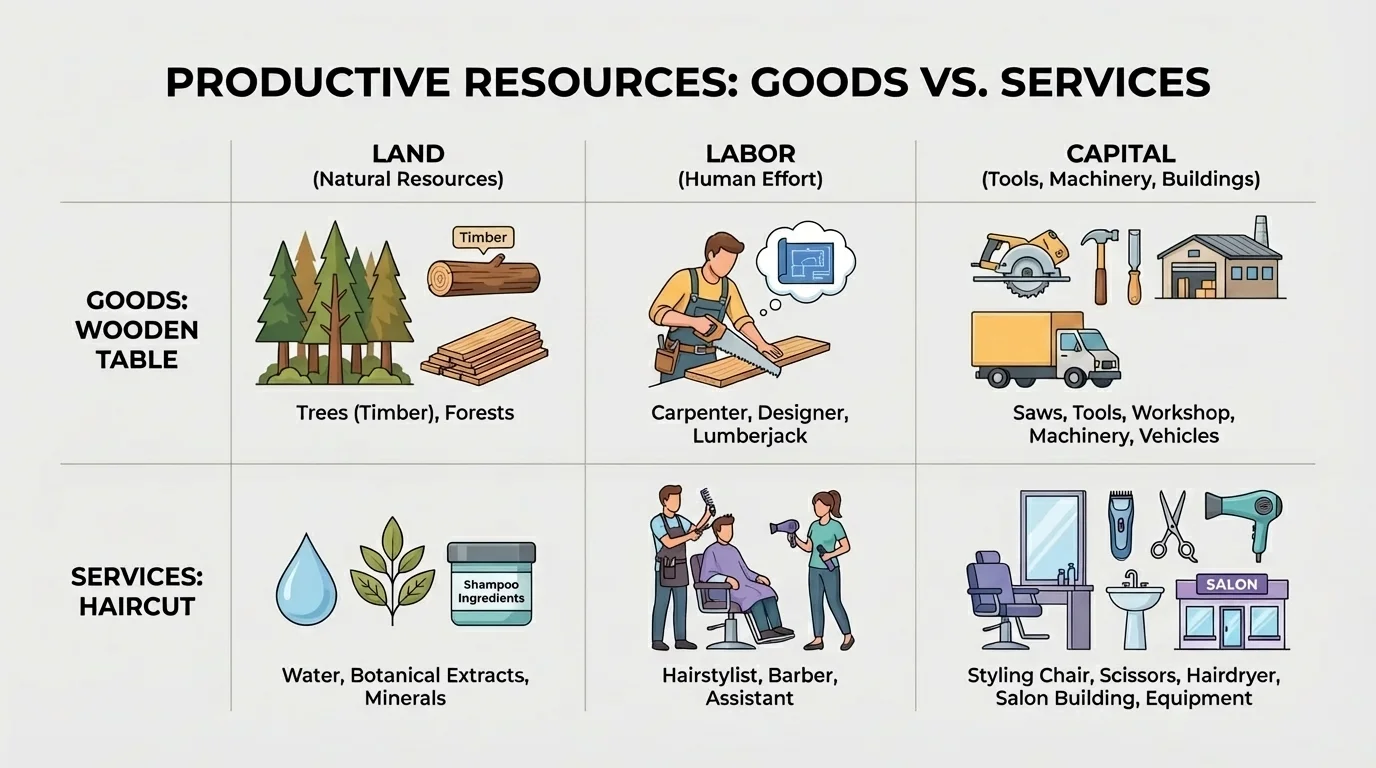
The same idea works for services. Consider a haircut. Land includes natural resources used to make the building materials, water, and electricity sources. Labor includes the barber's skill and time. Capital includes scissors, chairs, mirrors, sinks, and the shop itself. A service may not create a physical object, but it still depends on productive resources.
Example: Producing a wooden table
Step 1: Identify the land resources.
Trees from forests provide the wood. Water and minerals may also be used in processing and finishing the table.
Step 2: Identify the labor.
Workers cut the trees, transport the lumber, shape the wood, assemble the table, and sell it in a store.
Step 3: Identify the capital.
Saws, trucks, sanders, worktables, nails, and factory buildings help workers produce the table.
The table is a good because it is a physical object people can use.
When we study economics, we often sort examples this way because it helps us see how production really happens. It also helps explain why some places make certain goods more easily than others.
[Figure 2] shows that different parts of the American colonies developed different economies because they had different resources. Geography mattered. Climate mattered. Access to rivers and harbors mattered. These differences shaped what people produced and what they traded.
In New England, rocky soil and long winters made large-scale farming difficult. But the region had forests, fish, and good natural harbors. Because of this, many people worked in fishing, shipbuilding, whaling, and trade. Timber from forests was an important land resource. Shipbuilders and sailors provided labor. Shipyards, tools, ropes, docks, and ships were capital.
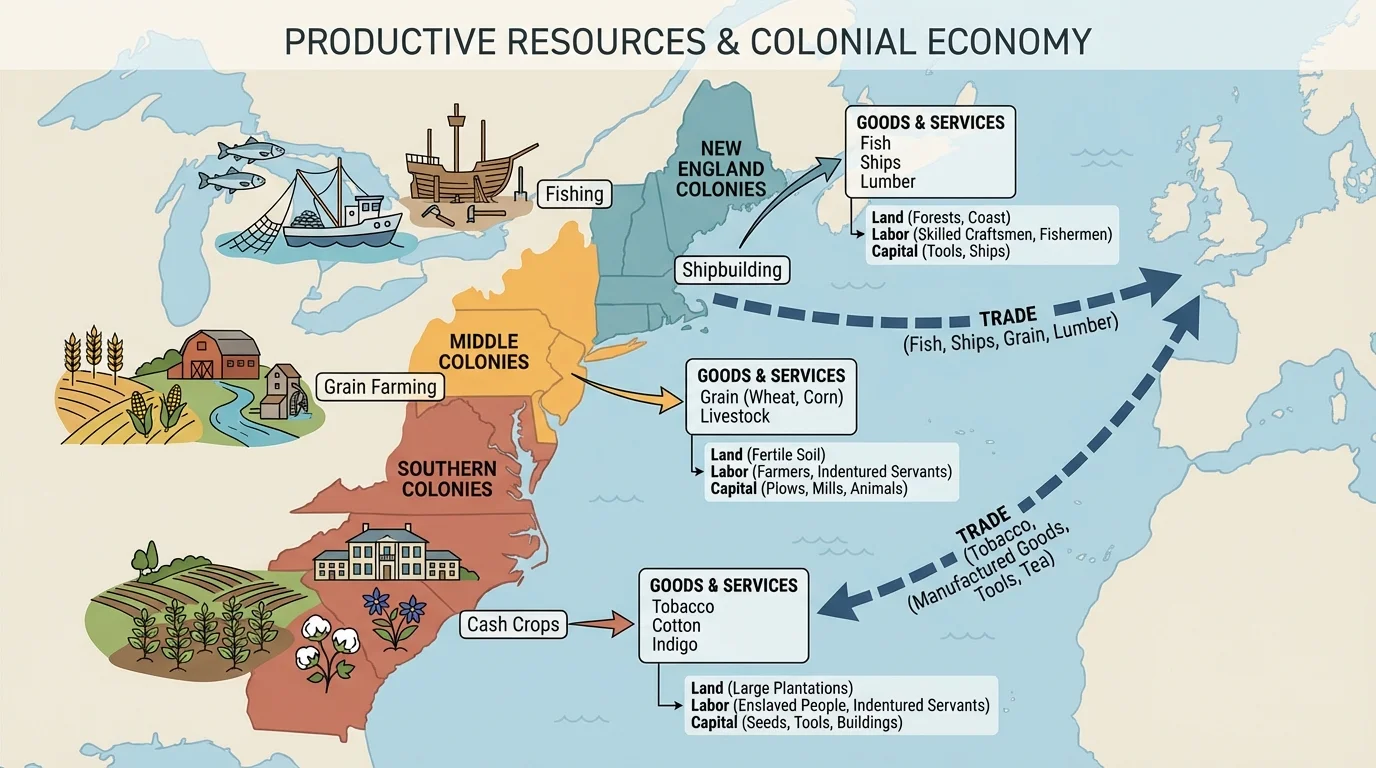
The Middle Colonies had more fertile soil and milder weather. Farmers there grew grains such as wheat, corn, and barley. Because they produced so much grain, the region became known as the "breadbasket." Mills, wagons, and storage buildings helped move and process crops. Grain could be sold within the colonies or shipped to other places.
The Southern Colonies had warm climates and long growing seasons. Farmers grew crops such as tobacco, rice, and indigo. Large plantations produced goods that could be exported. Rivers also helped move goods to ports. This made trade especially important to the southern economy.
As colonists traded fish, lumber, grain, and cash crops, regions became connected. New England might trade ships or fish. The Middle Colonies might trade flour and grain. The Southern Colonies might trade tobacco or rice. These patterns of trade helped settlements grow into busy economic regions with different specialties.
We can return to [Figure 2] to see that trade patterns were not random. They developed because each region had different land resources, different kinds of labor, and different capital. Geography and resources pushed people toward certain jobs and away from others.
[Figure 3] makes clear that both goods and services require productive resources by comparing two very different examples. Trade happens when people exchange goods and services. Regions often trade because no one area has everything it wants or needs. When one region can produce something well, it may specialize in that product and trade for other things.
Suppose one colony has many forests and skilled shipbuilders. It can build ships efficiently. Another colony has rich farmland and grows a lot of grain. It makes sense for these colonies to trade. One sends ships or lumber products. The other sends grain or flour. Both sides benefit because each uses its resources in a strong way.
This idea is connected to specialization. Specialization means focusing on producing a smaller number of goods or services well. When people specialize, they often become more skilled and efficient. A colony that specializes in shipbuilding may build better ships than a colony that only builds a few. A farming region that specializes in grain can produce more food for trade.
When places have different climates, landforms, and natural resources, they usually do not produce the same things. That is one reason trade networks develop.
Trade also depends on transportation. Roads, rivers, ports, and ships are part of capital. If transportation improves, trade becomes easier. That is why access to harbors and navigable rivers was so important in Early America. Better transportation allowed goods to move farther and faster.
Another important economic idea is scarcity. Scarcity means there are limited resources but many wants and needs. No place has unlimited land, unlimited labor, or unlimited capital. Because resources are limited, people must make choices.
If a town has only a few blacksmiths, people may have to wait longer for tools to be repaired. If farmland is limited, farmers must decide which crops to grow. If a colony spends resources building ships, it may have fewer resources left for other projects. Choices matter because using resources one way means not using them another way.
Why economic choices matter in daily life
Families, businesses, and governments all make choices about resources. A family chooses how to spend money. A business chooses which tools to buy. A government chooses whether to build roads, improve ports, or support schools. These decisions affect how easily goods and services can be produced and shared.
Even today, communities make decisions about resources. If a city builds better roads and bridges, businesses can transport goods more easily. If schools train workers well, labor becomes more skilled. If farmers protect soil and water, land resources stay healthier for the future. Economic ideas are not only about the past. They shape everyday life now.
Let's look at several clear examples of productive resources in action. Seeing different examples helps show that land, labor, and capital appear in many situations, not just farming or factories.
| Good or Service | Land | Labor | Capital |
|---|---|---|---|
| Apple | Soil, water, sunlight | Farmers pick and pack apples | Ladders, baskets, trucks, storage buildings |
| Fishing boat | Trees, metals, water access | Shipbuilders, designers, sailors | Tools, shipyard, saws, cranes |
| Haircut | Water, natural resources for building materials | Barber or stylist | Chair, scissors, mirrors, sinks |
| School lesson | Land for the school site, natural resources used in materials | Teacher | Desks, books, whiteboard, computers |
| Bread | Soil, water, wheat | Farmers, mill workers, bakers, drivers | Plows, mill, oven, bakery, truck |
Table 1. Examples of goods and services and the land, labor, and capital used to produce them.
Notice that some examples are goods and some are services. A school lesson and a haircut are services, but they still need all three productive resources. A loaf of bread and a fishing boat are goods, but they also depend on all three resources. This pattern repeats again and again in economics.
Case study: A colonial fishing business
Step 1: Land resources
The business needs access to the ocean, fish populations, wood for boats, and salt for preserving fish.
Step 2: Labor
Fishers catch the fish, workers clean and preserve them, and merchants sell them.
Step 3: Capital
Boats, nets, barrels, docks, and warehouses help the business operate.
This type of business fit New England well because the region had strong coastal resources and busy ports.
The same thinking can be used for a service. A wagon delivery service in colonial times depended on roads and animals, drivers and planners, and wagons and storage spaces. The final product was not a physical object made in a shop, but the service still required productive resources.
As we saw earlier in [Figure 1], production works best when all resources support one another. Land supplies materials, labor supplies effort and skill, and capital supplies tools and equipment. If one part is weak, the whole process slows down.
Looking again at [Figure 3], we can compare a good and a service side by side. That comparison helps us notice that economics is not only about factories and farms. It is also about the work people do for one another every day.
"Resources are limited, so people must make choices about what to produce and trade."
By understanding productive resources, we can better understand history, trade, and modern life. We can explain why one region grew grain, another built ships, and another raised export crops. We can also explain why your breakfast, your school, and your neighborhood all depend on land, labor, and capital.
