What if you had a basket of apples but needed shoes? You might try to trade your apples to a shoemaker. But what if the shoemaker did not want apples and wanted fish instead? That simple problem helps us understand a big idea in history and economics: people have always needed ways to exchange goods and services. In Early America, people and communities traded in different ways depending on what they had, what they needed, and what others would accept.
Exchange is important because no person or community can produce everything alone. A farming family might grow corn but need cloth, tools, or salt. A fishing village might have plenty of fish but need wood, grain, or metal. As communities grew, they became connected through trade. These patterns of trade helped shape roads, towns, ports, and even the economy of different regions.
Goods are things people make or grow that can be bought, sold, or traded, such as corn, tools, cloth, or fish.
Services are jobs people do for others, such as repairing a wagon, sewing clothing, or carrying goods by ship.
Trade is the exchange of goods or services between people or groups.
People do not trade only because they want more things. They also trade because different places have different resources. Forests provide timber. Rivers and oceans provide fish and transportation. Fertile soil grows crops. When one region has a lot of one resource and another region has something different, trade becomes useful. That was true in Native American communities long before Europeans arrived, and it remained true as colonies developed.
One of the oldest forms of exchange is barter, which means trading one good or service directly for another without using money. In barter, both sides must agree that what they receive is worth what they give. As [Figure 1] shows, barter is a direct trade: one person offers something, and the other person offers something back.
In Early America, barter happened often, especially in places where coins were scarce. A farmer might trade eggs for candles. A trapper might trade animal skins for metal tools. A carpenter might build a table in exchange for food, cloth, or help with another job. Native American groups traded items such as corn, pottery, shells, furs, and woven goods with neighboring groups. Colonists also bartered with one another and sometimes with Native American communities.
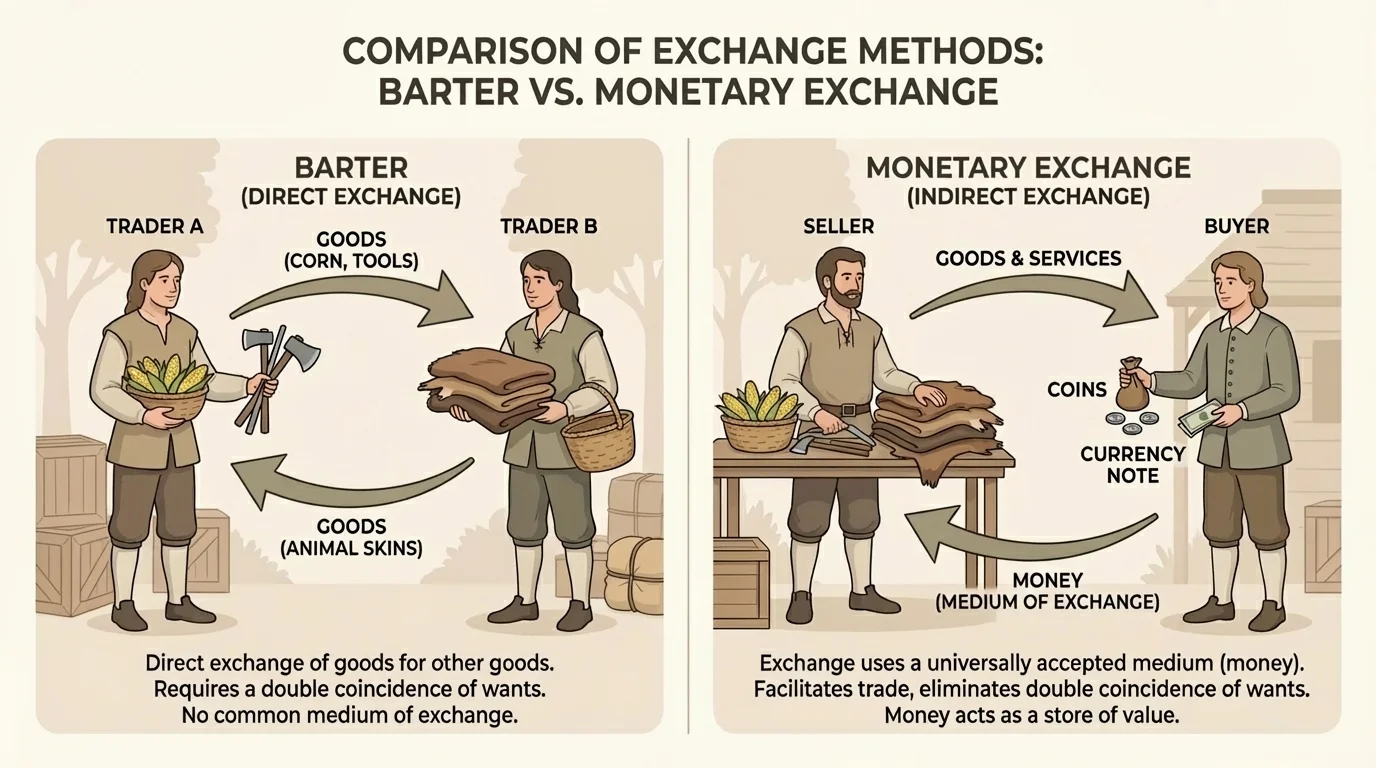
Barter could work well in a small community where people knew each other and understood what things were worth. If neighbors met often, they could make deals based on trust and need. In a village or small settlement, this system could feel simple and fair. People did not need coins in their pockets if they already had useful goods to trade.
Barter could also include services. For example, a blacksmith might fix a plow in exchange for wheat. A shipbuilder might repair a boat in exchange for lumber. A person with a skill could trade work instead of objects. This shows that exchange is not only about things; it is also about labor and knowledge.
Even though barter is useful, it has limits. One major problem is that both people must want what the other person has at the same time. Economists call this a double coincidence of wants. That phrase sounds complicated, but the idea is simple: a trade only works if each side wants exactly what the other side is offering.
Suppose a farmer has milk and wants shoes. The shoemaker may not want milk. The shoemaker may want firewood. Then the farmer must find someone with firewood who wants milk, and perhaps that person wants something else. A simple trade can turn into a long chain of searching and bargaining.
Another problem is value. How many baskets of corn equal one metal pot? How many fish equal one blanket? People might disagree. Goods can also spoil, break, or be hard to carry. A cow may be valuable, but it is not easy to divide into smaller parts for everyday trade. Barter also makes saving wealth difficult. Ten sacks of grain may be useful now, but they can rot over time.
Why barter is limited
Barter works best when communities are small, trade happens locally, and people exchange a few familiar goods. As trade grows larger and more complex, people need a more efficient system. They need something many people will accept, something easy to carry, and something that keeps its value better than food or bulky objects.
These limits help explain why many societies, including communities in Early America, also used different forms of money.
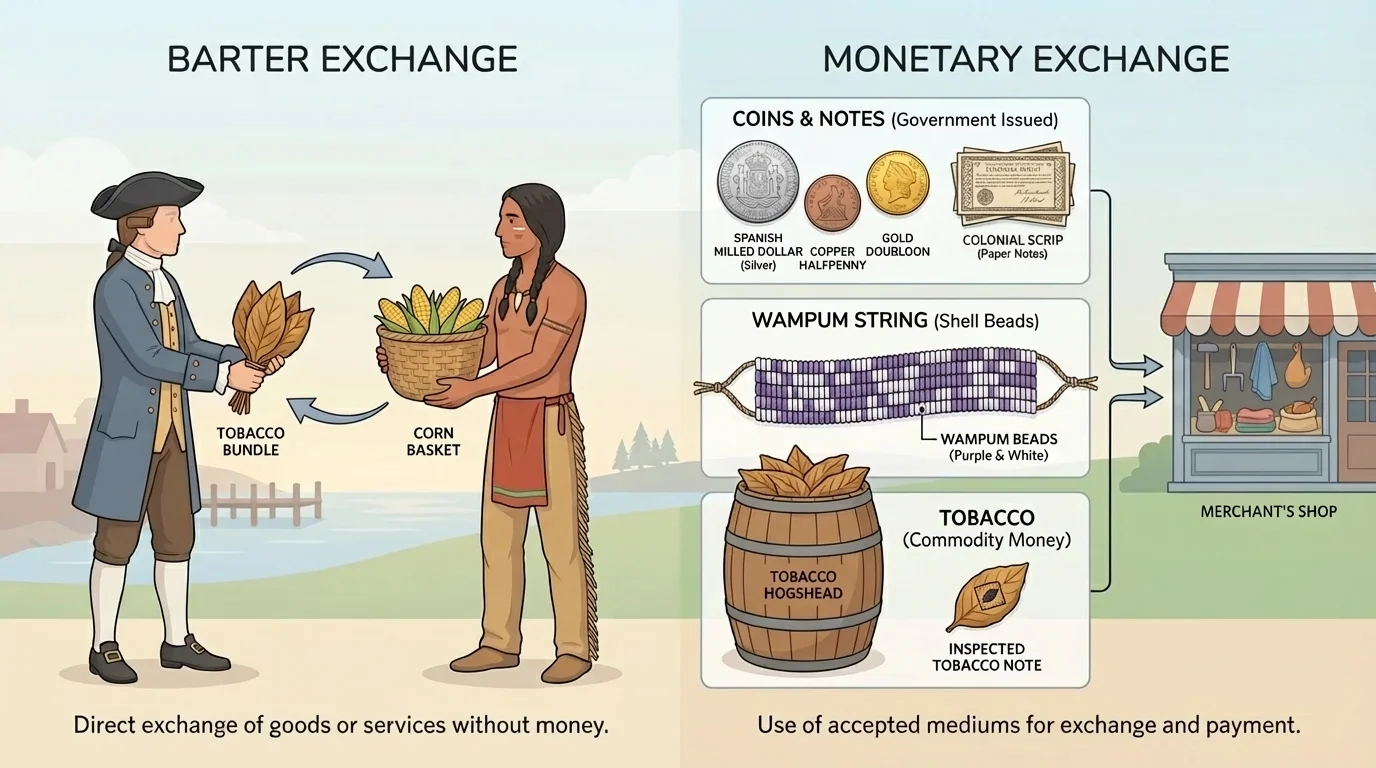
Monetary exchange means trading goods and services by using money instead of making a direct swap. Money is anything that people in a community agree can be used to pay for goods and services. As [Figure 2] illustrates, money in Early America did not always look like the paper bills and coins people use today.
In the American colonies, regular coin shortages were common. Because of that, people used different items as money in different places. Some used European coins. Some used paper notes. In certain areas, wampum was used in exchange. Wampum was made from shell beads and had cultural importance for some Native peoples; colonists sometimes used it as money in local trade. In Virginia, tobacco was sometimes accepted as payment because it was a valuable crop. This shows that money is based on agreement and trust as much as on the object itself.
Money made trade easier. If a shoemaker accepted coins, then a farmer could sell apples to one person, receive money, and later buy shoes from another person. The farmer no longer needed the shoemaker to want apples. Money acts like a bridge between buyers and sellers.
Monetary exchange also helps people compare prices more clearly. Instead of guessing whether one blanket is worth three fish or six fish, a community can agree on a price such as $2 for a blanket. Then buyers and sellers have a common way to measure value. This does not remove all disagreements, but it makes exchange faster and more organized.
For something to work well as money, it should have several qualities. It should be portable, meaning easy to carry. It should be durable, so it does not break or spoil quickly. It should be divisible, so people can use larger or smaller amounts. It should be widely accepted, meaning many people trust it and will take it in trade.
Coins are portable and durable. Paper money is light and easy to carry, though it can tear. Tobacco had value in some places, but it was not always easy to store and protect. Wampum could be carried more easily, but its use depended on whether a community accepted it. This helps explain why certain forms of money spread while others stayed local.
| Exchange System | How It Works | Strength | Weakness |
|---|---|---|---|
| Barter | Direct trade of goods or services | No money needed | Both sides must want each other's items |
| Coins | Metal money used to buy and sell | Durable and portable | Could be scarce in the colonies |
| Paper notes | Written promises or bills used as money | Easy to carry | Must be trusted to have value |
| Commodity money | Useful goods used as money, such as tobacco | Has value as a product | Can spoil or vary in quality |
Table 1. Comparison of barter and several forms of money used in exchange.
When trust in money is strong, trade can grow quickly. When trust is weak, people may refuse the money or demand something else. That is why rules, governments, and local customs matter in economics. A community must believe that money will be accepted tomorrow, not just today.
In some colonial places, people used more than one exchange system at the same time. A person might barter for one item, pay with coins for another, and settle a debt with a crop such as tobacco.
This mixed system was common in Early America because communities were still growing and did not all have the same access to coins, banks, or trade routes.
Trade patterns in Early America were shaped by geography, climate, and resources. People exchanged what their land and labor could produce. This led to specialization, which means focusing on making certain goods especially well.
In New England, rocky soil made large farming harder, but the coast offered fish, whales, and excellent harbors. People there traded fish, timber, and ships. In the Middle Colonies, fertile land supported grains such as wheat, so that region became known for farming. In the Southern Colonies, large plantations produced cash crops such as tobacco, rice, and indigo. These goods were shipped to other colonies and overseas markets.
As [Figure 3] shows, Native American trade networks existed long before colonists built towns and ports. Different groups exchanged food, tools, pottery, copper, shells, and furs across long distances. Colonists sometimes entered these networks, especially in the fur trade. Trade could build relationships, but it could also create conflict when groups competed for land, resources, or control of trade routes.
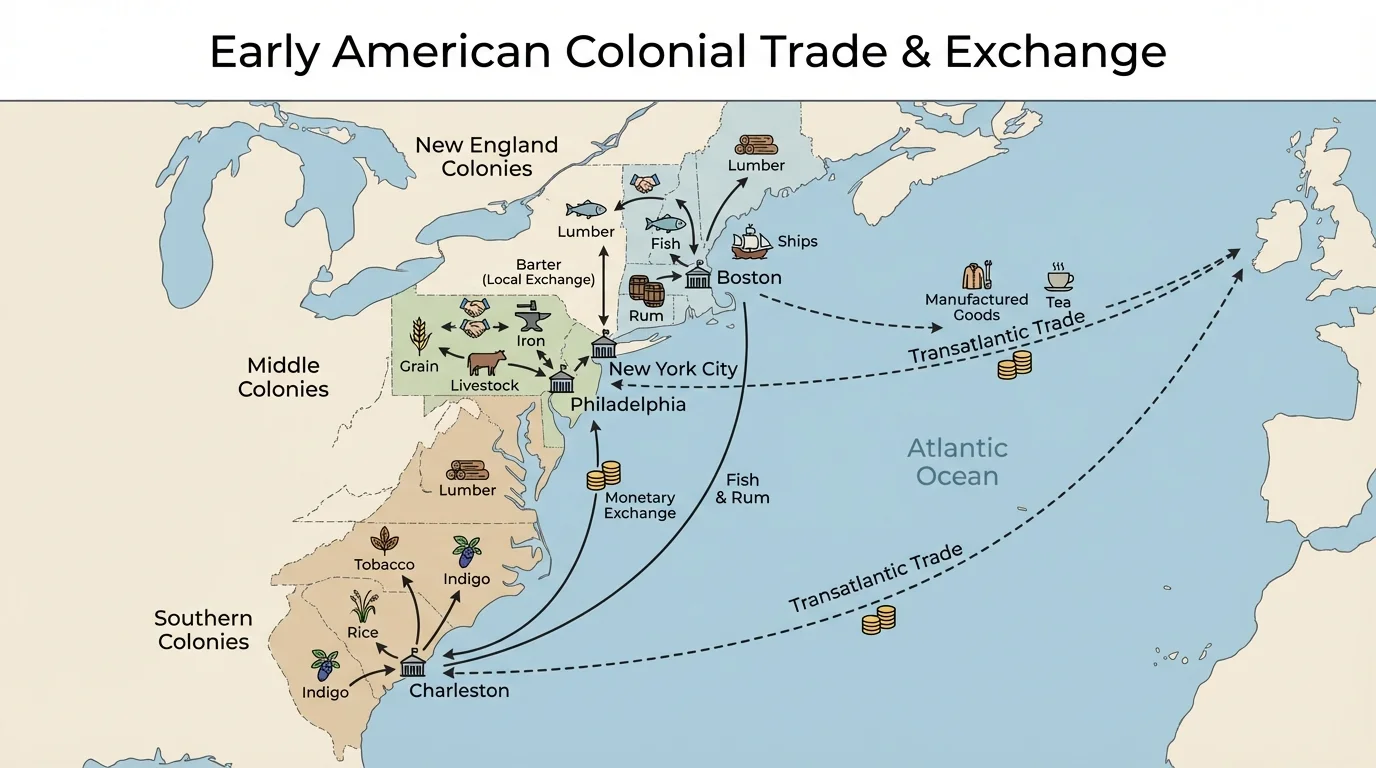
As trade increased, towns grew near rivers, harbors, and crossroads. Ports became busy centers where ships carried goods in and out. Roads improved because people needed ways to move products from farms and workshops to markets. In this way, trade did not just move things. It helped shape where people lived and how communities developed.
The exchange of goods was tied to the exchange of services too. Sailors transported cargo. Merchants arranged sales. Dockworkers loaded ships. Craftspeople repaired tools and made barrels, cloth, and furniture. A growing economy depends on many kinds of work, not only on the goods being sold.
Barter and monetary exchange both help people meet needs, but they do so in different ways. Barter is direct and can work well in small groups with trust and familiar goods. Monetary exchange is more flexible because it separates selling from buying. A person can sell one item now and buy something different later.
We can still see the importance of direct trade by thinking again about [Figure 1]. In a small settlement, a trade of corn for tools may be practical because both items are useful and both traders know each other. But in a busy port city with hundreds of buyers and sellers, direct swaps become much harder. Money saves time and allows more people to trade with strangers.
Money also supports larger markets. When prices are listed in the same form of money, people can compare choices. A family can decide whether cloth, salt, or a cooking pot is worth the price. Sellers can keep records more easily. Loans, taxes, and wages also become easier to manage when people use money instead of many different trade goods.
Case study: Getting a winter coat
A child in a colonial town needs a winter coat.
Step 1: If the family uses barter, they must find a tailor who wants exactly what they have to offer, such as grain or candles.
Step 2: If the tailor does not want those goods, the family must look for another trade partner or make several trades first.
Step 3: If the family can sell goods for money, they can pay the tailor directly, even if the tailor does not want grain or candles.
This example shows why monetary exchange often makes trade faster and easier.
Still, barter never completely disappeared. Even when money existed, people sometimes bartered during shortages or in remote areas. That is because exchange systems depend on what is available and what people trust.
As regions specialized and traded more, they became interdependent. Interdependence means people and places rely on one another. A port town depended on farmers for food. Farmers depended on blacksmiths for tools. Merchants depended on sailors and shipbuilders. Colonies depended on one another and on overseas trade for many needed goods.
This interdependence helped communities grow, but it also created inequalities. Some people gained wealth from trade, while others had little power. Enslaved Africans were forced to provide labor that supported parts of the colonial economy, especially in the South. This was unjust and cruel, yet it was part of how some trade systems operated. Studying economics in history means understanding both growth and unfairness.
Trade also spread ideas, news, and culture. When ships moved goods, they also carried people, languages, beliefs, and technologies. A new tool, crop, or craft skill could change life in a town. So trade shaped culture as well as the economy.
Communities grow when people meet needs together. Earlier lessons about geography and settlement connect directly to economics because rivers, harbors, climate, and natural resources all influence what people produce and trade.
As shown earlier in [Figure 3], regions with different resources developed different economies. That is why the map of trade is also a map of community growth.
Exchange works best when people trust one another and trust the system. If weights are dishonest, if money is not accepted, or if traders break promises, trade slows down. Communities often create rules about prices, quality, and payment to make exchange more dependable.
Governments can influence trade by making coins, allowing paper money, collecting taxes, or building roads and ports. These policy choices affect everyday life. Better roads can help farmers reach market. Stable money can help families plan spending. High taxes or shortages can make life harder.
Even today, people still use both barter and money. A neighbor might trade help fixing a fence for help mowing a lawn. But most stores, jobs, and large markets use money because it is more efficient. Looking back at Early America helps us see why communities moved toward monetary exchange as trade expanded.
Understanding barter and money also helps explain a larger idea: economies grow when people can exchange goods and services efficiently. The easier it is to trade, the easier it is for communities to specialize, connect, and develop.
