If you wanted chocolate, cloth, or metal tools in Early America, you usually could not just walk to a nearby store and buy them. People depended on trade. Farmers, fishers, craftspeople, merchants, sailors, and shopkeepers all helped move goods from one place to another. Trade was not a small part of life. It helped decide where towns grew, what jobs people had, and even why arguments with Britain became so serious.
Trade means the buying, selling, and exchanging of goods and services. In Early America, trade connected people across rivers, coastlines, forests, and oceans. Colonists traded for items they needed, such as salt, tools, cloth, sugar, and tea. They also traded goods they produced, such as tobacco, rice, fish, wood, and flour.
Trade patterns changed over time. At first, many people traded mostly with nearby neighbors. As colonies grew, trade expanded between regions. Later, ships carried goods across the Atlantic Ocean. Over time, trade became more organized, larger, and more connected to other parts of the world. This helped the colonies grow richer in some places, but it also created unfair systems and conflicts.
Exports are goods sent out to be sold in another place. Imports are goods brought in from another place. Goods are items people make, grow, or use, such as food, tools, or cloth.
When historians study trade, they look at more than objects. They also study routes, workers, ships, laws, money, and power. Trade shaped daily life because it affected what people ate, wore, built, and earned.
Long before English colonies were founded, Native peoples had wide trade networks across North America. These networks, shown across regions in [Figure 1], connected communities that exchanged food, shells, copper, stone, pottery, and animal skins. Rivers and trails acted like highways. Trade allowed groups to get things that were not available in their own environment.
When Europeans arrived, they entered trade systems that already existed. Native Americans often traded corn, furs, and local knowledge for metal tools, cloth, weapons, and other European goods. This changed older patterns of exchange. In some areas, trade partnerships grew. In other areas, competition and disease caused great harm.
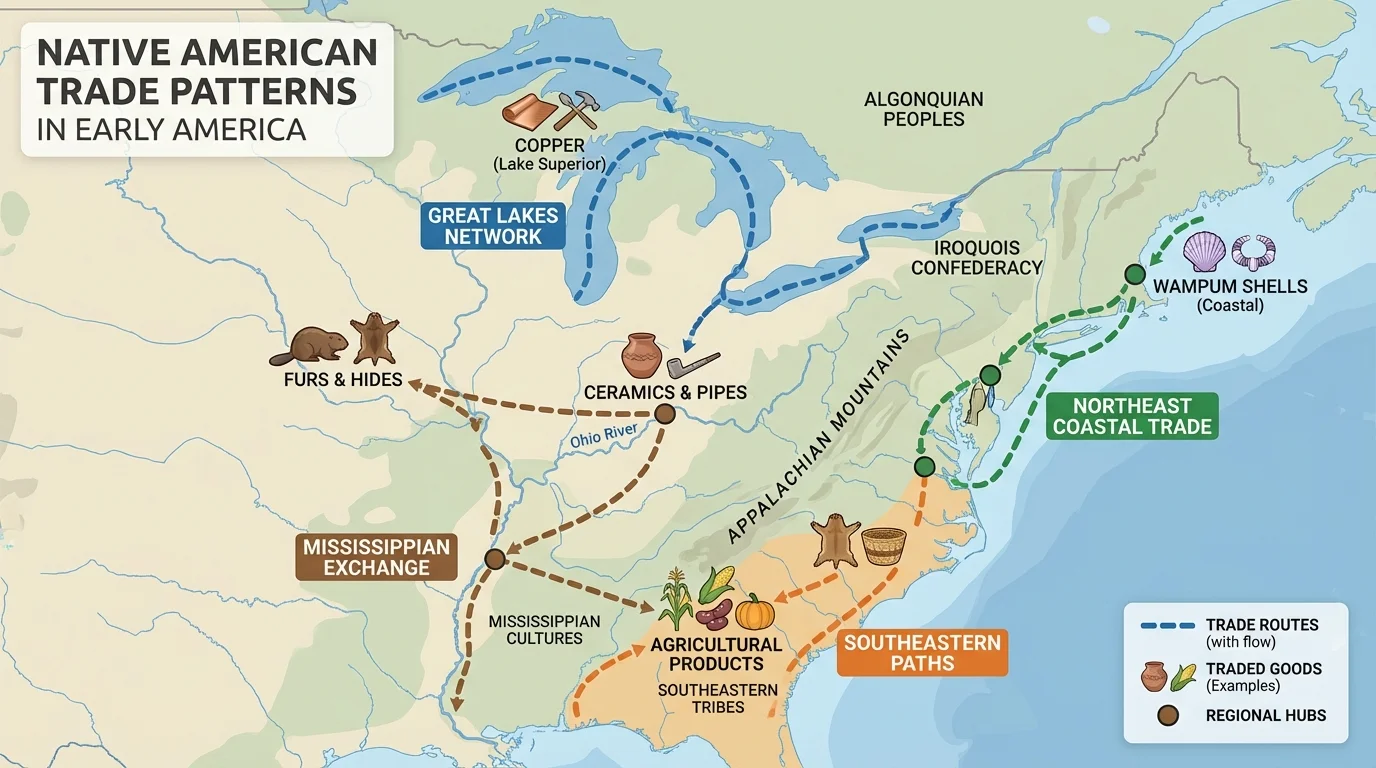
One very important trade item was fur. European settlers wanted beaver pelts to make hats and clothing. Native hunters and traders became part of the fur trade in many northern areas. This increased contact between Native peoples and Europeans, but it also changed the balance of power between groups and increased conflict over land and resources.
The exchange that followed European arrival is often called the Columbian Exchange. It included plants, animals, ideas, and diseases moving between the Americas, Europe, and Africa. Trade was a big part of that exchange. Goods moved farther and faster than before, but the effects were not equal or fair for everyone.
Some shells and beads were used in trade not only as decorations but also as a way to record agreements and exchange value. Trade could carry meaning, not just objects.
The map in [Figure 1] helps us see that trade in America did not begin with the colonies. Europeans joined and reshaped a much older trading world.
The colonies did not all make the same products. As [Figure 2] shows, geography, climate, and natural resources led each region to specialize in different goods. This is called specialization, which means focusing on making certain products especially well.
New England had rocky soil and a shorter growing season, so it was not ideal for large farms growing cash crops. Instead, many people in New England relied on fishing, shipbuilding, whaling, lumber, and trade. Their forests provided timber, and their coastal location gave them good harbors.
The Middle Colonies had richer soil and a good climate for farming. Farmers there grew wheat and other grains, so this region became known as the "breadbasket" colonies. They also traded flour, livestock, and iron products.
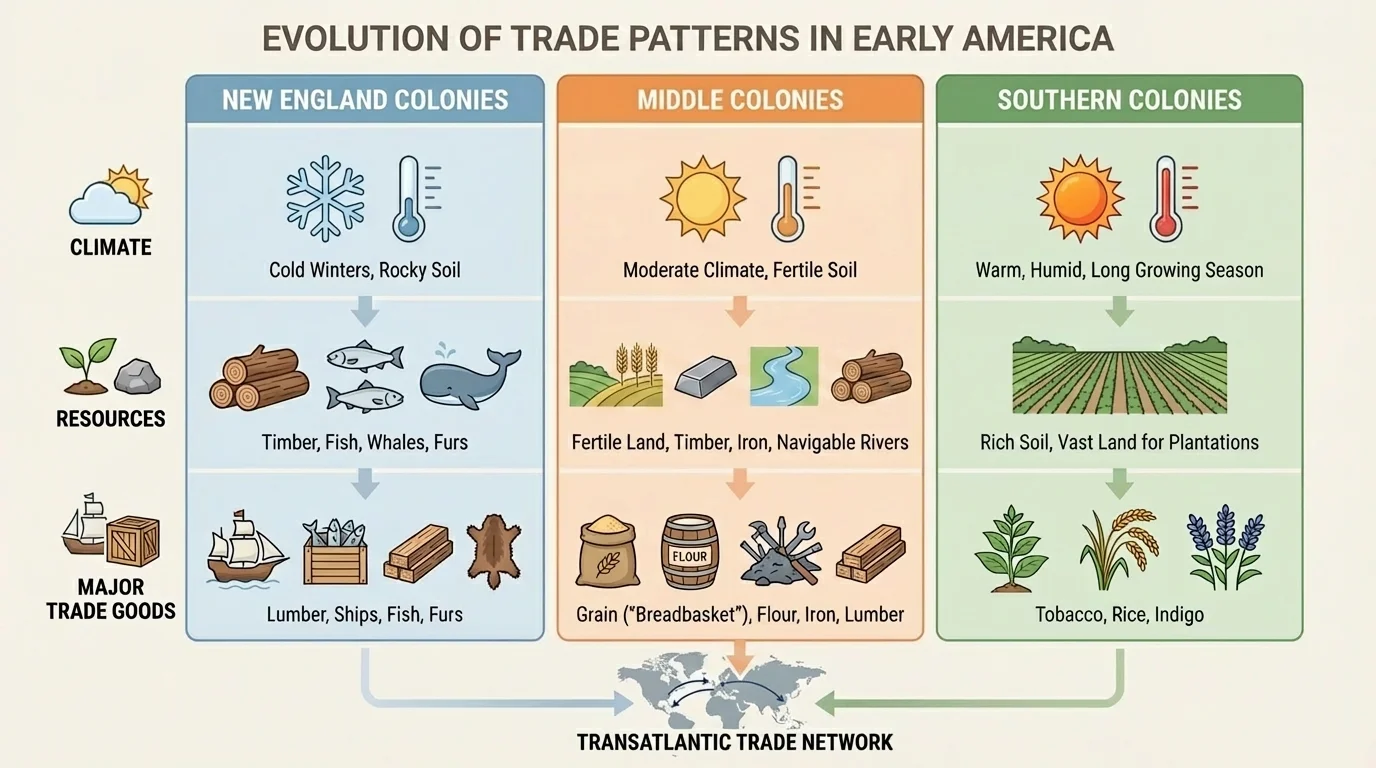
The Southern Colonies had warm weather and long growing seasons. Large farms and plantations produced tobacco, rice, and indigo. These were cash crops, meaning crops grown mainly to be sold for profit rather than just eaten at home.
Because each region had different resources, the colonies traded with one another. New England might send fish or ships. The Middle Colonies might send flour. The Southern Colonies might send tobacco or rice. This regional trade helped connect the colonies long before the colonies became the United States.
| Colonial Region | Main Resources | Important Trade Goods | Why These Goods Were Produced |
|---|---|---|---|
| New England | Forests, harbors, fish | Fish, lumber, ships, whale products | Rocky soil and access to the sea encouraged shipping and fishing |
| Middle Colonies | Rich soil, rivers | Wheat, flour, livestock, iron | Good farmland supported grain farming |
| Southern Colonies | Warm climate, fertile land | Tobacco, rice, indigo | Long growing seasons supported cash crops |
Table 1. Comparison of major colonial regions, their resources, and their important trade goods.
The chart in [Figure 2] makes clear that trade patterns were not random. Colonists usually traded what their environment allowed them to produce.
As the colonies grew, they became tied closely to the Atlantic world. Merchants sent exports from American ports to Britain, other parts of Europe, the Caribbean, and Africa. In return, the colonies imported goods they could not easily make themselves, such as fine cloth, metal items, tea, and some manufactured products.
A merchant was a person who bought and sold goods for profit. Merchants were important because they connected local producers to faraway buyers. A farmer might grow tobacco, but a merchant helped ship it overseas. In busy port cities, merchants became powerful leaders in the economy.
Mercantilism and colonial trade
Britain followed an economic idea called mercantilism. Under mercantilism, a country tried to become rich and powerful by controlling trade and collecting valuable raw materials from its colonies. Britain expected the American colonies to supply resources and buy British goods. This policy shaped who the colonies traded with and how much freedom they had to trade.
This system helped Britain gain wealth, but many colonists felt limited by it. They wanted more freedom to sell goods where they could get the best price and buy goods from whoever offered the best deal. These complaints would grow louder over time.
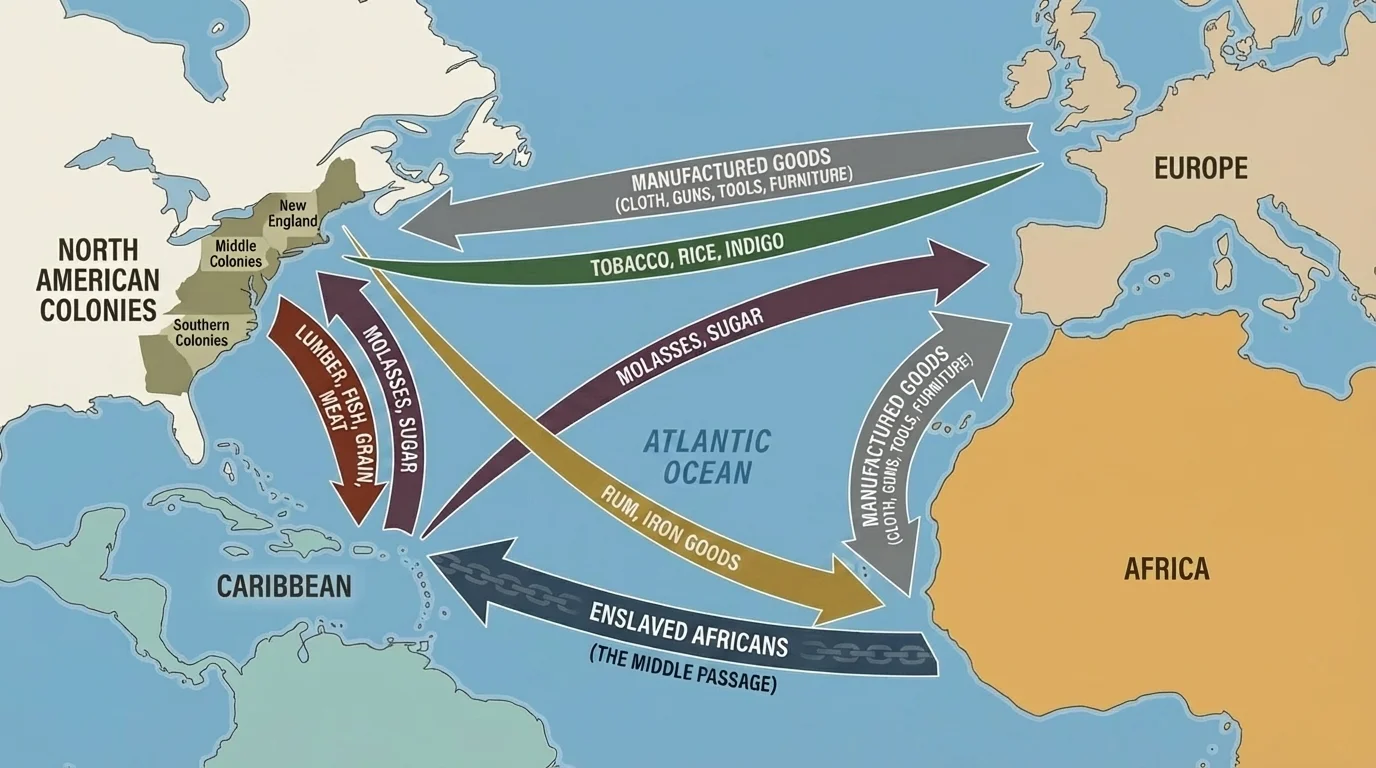
One famous trade pattern, displayed by route arrows in [Figure 3], is called Triangular Trade. This name describes trade routes linking the colonies, the Caribbean, Europe, and Africa. The routes did not always make a perfect triangle, but the name helps explain the pattern of exchange across the Atlantic.
For example, New England merchants could send rum to Africa. From Africa, enslaved Africans were forced across the Atlantic in the brutal journey known as the Middle Passage. In the Caribbean, ships picked up molasses, which was used to make more rum in New England. Other ships carried tobacco, rice, indigo, and lumber to Europe.
It is very important to understand that this trade system included slavery. Enslaved Africans were treated as property and forced to work, especially on plantations in the Southern Colonies and the Caribbean. Their labor produced many of the goods that made trade profitable for colonial merchants and plantation owners. This was cruel, unjust, and central to the growth of the colonial economy.
The Atlantic routes in [Figure 3] show that trade was not only about goods. It also involved human lives, power, and suffering. Early American trade helped create wealth for some people while causing terrible hardship for others.
Case study: A barrel of molasses and a much bigger story
Step 1: Molasses from the Caribbean arrives in a New England port.
Step 2: Workers use it to make rum.
Step 3: Rum is traded across the Atlantic.
Step 4: The profits help merchants buy more goods and send out more ships.
This example shows how one item could connect many places. It also reminds us that behind these profits were larger systems, including slavery and strict trade laws.
Because of these routes, colonial trade became more complex. Goods moved in long chains, and decisions made in one place affected people far away.
Trade needed places where goods could be loaded, unloaded, stored, and sold. That is why port cities such as Boston, New York, Philadelphia, and Charleston became so important. A port is a place where ships come and go with people and cargo.
Ports became busy centers of work. Sailors moved cargo. Dockworkers loaded ships. Shopkeepers sold imported goods. Shipbuilders made vessels from colonial timber. Printers, bankers, and craftspeople also found work in growing towns. Trade supported many jobs, not just farming.
As towns grew, roads and rivers became even more valuable. Farmers had to get their goods to market. Merchants needed warehouses. Governments collected taxes and checked cargoes. Trade helped turn scattered settlements into connected communities.
Remember that people settle where they can find food, water, safety, and ways to make a living. In Early America, good harbors and rivers gave towns a strong advantage because they made trade easier.
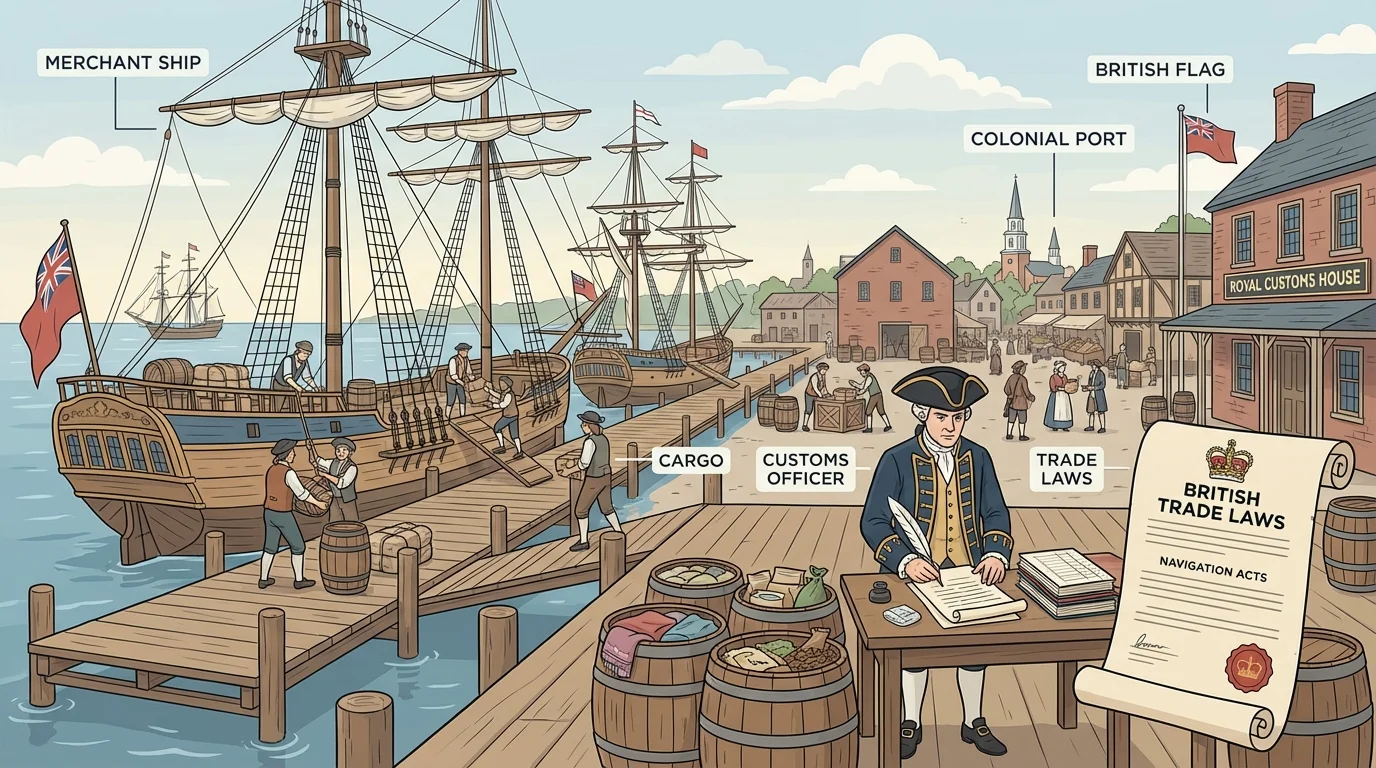
Port cities also became places where news spread quickly. As shown in [Figure 4], ideas about politics, rights, taxes, and protests traveled along the same routes as goods. Trade helped move information as well as objects.
Because trade brought wealth, Britain wanted tight control over it. As shown in [Figure 4], British officials watched ships, ports, and cargo to enforce trade laws. One major set of laws was the Navigation Acts. These laws required colonial goods to be carried mainly on British ships and often sold first through British ports.
Britain believed these laws would help the whole empire. Many colonists, however, thought the rules were unfair. They wanted to trade more freely with other countries and places. Some merchants turned to smuggling, which means secretly trading goods in order to avoid laws or taxes.
Taxes on imported goods made tensions worse. Colonists protested taxes on items like sugar and tea. Boycotts, or organized refusals to buy certain goods, became a way to fight back. When colonists stopped buying some British imports, they used trade itself as a form of protest.
The harbor scene in [Figure 4] helps explain why ports became places of conflict as well as commerce. Customs officers, merchants, sailors, and protesters all met in these busy spaces. Trade was no longer only an economic issue. It was becoming a political one.
"No taxation without representation."
— Colonial protest idea
Arguments over trade and taxes helped lead to the American Revolution. Colonists believed Britain was using trade laws to control them without giving them a fair voice in government.
When the Revolution began, old trade patterns were interrupted. War made ocean travel dangerous, and the colonies could not depend on British trade in the same way. Americans had to look for new trading partners and try to make more goods for themselves.
After independence, the new United States wanted greater control over its own economy. American merchants traded with more countries instead of being tied only to Britain. Even so, many earlier patterns stayed important. Ports still mattered. Regional specialization still mattered. Atlantic trade still mattered.
This shows that change in history is often a mix of old and new. The colonies broke from Britain politically, but the habits, routes, and jobs shaped by earlier trade did not disappear overnight.
Early American trade shaped where people lived, what work they did, and which places became wealthy. It connected farms to towns, colonies to one another, and America to the wider world. Trade encouraged shipbuilding, farming for sale, storekeeping, and international exchange.
Trade also had deep human costs. It supported slavery, increased competition for land, and brought unfair laws and unequal power. To understand Early America, we must remember both sides: trade created growth and opportunity for some people, but it also caused suffering and conflict.
Many features of the United States economy began in this period. Regional products, busy ports, overseas markets, and debates about taxes and trade rules all have roots in Early America. The choices people made about trade helped shape the country that would later emerge.
